Thank you for visiting SNEWPapers!
Sign up free
Springfield Weekly Republican
Springfield, Hampden County, Massachusetts
What is this article about?
Romantic secret marriage in 1854 between San Francisco lawyer Henry H. Byrne and actress Matilda Heron ends abruptly in separation after her conduct is revealed in New York; years later, she contests his will bequeathing estate to a friend, facing bigamy charges.
Clipping
OCR Quality
Full Text
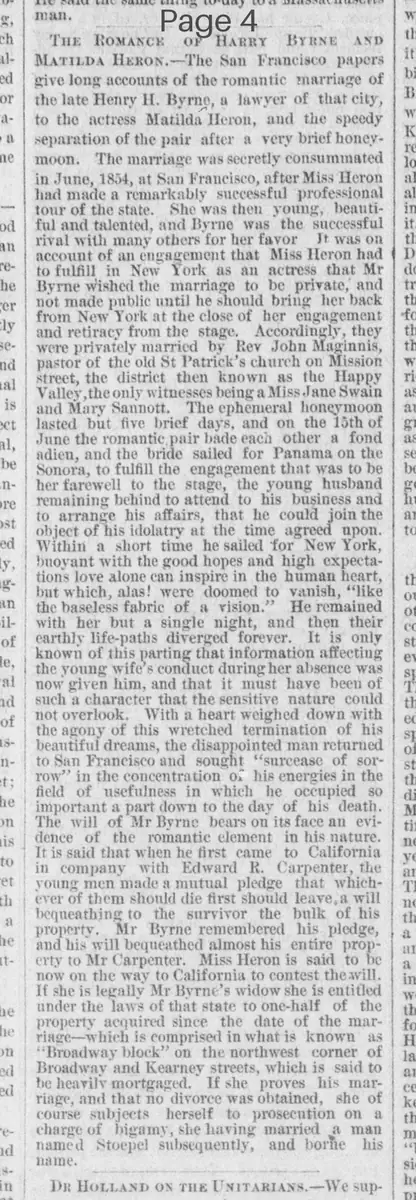
The San Francisco papers give long accounts of the romantic marriage of the late Henry H. Byrne, a lawyer of that city, to the actress Matilda Heron, and the speedy separation of the pair after a very brief honeymoon. The marriage was secretly consummated in June, 1854, at San Francisco, after Miss Heron had made a remarkably successful professional tour of the state. She was then young, beautiful and talented, and Byrne was the successful rival with many others for her favor. It was on account of an engagement that Miss Heron had to fulfill in New York as an actress that Mr. Byrne wished the marriage to be private, and not made public until he should bring her back from New York at the close of her engagement and retirement from the stage. Accordingly, they were privately married by Rev. John Maginnis, pastor of the old St. Patrick's church on Mission street, the district then known as the Happy Valley, the only witnesses being a Miss Jane Swain and Mary Sannott. The ephemeral honeymoon lasted but five brief days, and on the 15th of June the romantic pair bade each other a fond adieu, and the bride sailed for Panama on the Sonora, to fulfill the engagement that was to be her farewell to the stage, the young husband remaining behind to attend to his business and to arrange his affairs, that he could join the object of his idolatry at the time agreed upon.
Within a short time he sailed for New York, buoyant with the good hopes and high expectations love alone can inspire in the human heart, but which, alas! were doomed to vanish, like the baseless fabric of a vision. He remained with her but a single night, and then their earthly life-paths diverged forever. It is only known of this parting that information affecting the young wife's conduct during her absence was now given him, and that it must have been of such a character that the sensitive nature could not overlook. With a heart weighed down with the agony of this wretched termination of his beautiful dreams, the disappointed man returned to San Francisco and sought "surcease of sorrow" in the concentration of his energies in the field of usefulness in which he occupied so important a part down to the day of his death.
The will of Mr. Byrne bears on its face an evidence of the romantic element in his nature. It is said that when he first came to California in company with Edward R. Carpenter, the young men made a mutual pledge that whichever of them should die first should leave a will bequeathing to the survivor the bulk of his property. Mr. Byrne remembered his pledge, and his will bequeathed almost his entire property to Mr. Carpenter. Miss Heron is said to be now on the way to California to contest the will. If she is legally Mr. Byrne's widow she is entitled under the laws of that state to one-half of the property acquired since the date of the marriage—which is comprised in what is known as "Broadway block" on the northwest corner of Broadway and Kearney streets, which is said to be heavily mortgaged. If she proves his marriage, and that no divorce was obtained, she of course subjects herself to prosecution on a charge of bigamy, she having married a man named Stoepel subsequently, and borne his name.
What sub-type of article is it?
What themes does it cover?
What keywords are associated?
What entities or persons were involved?
Where did it happen?
Story Details
Key Persons
Location
San Francisco
Event Date
June 1854
Story Details
Secret marriage of lawyer Henry H. Byrne and actress Matilda Heron in San Francisco in June 1854, brief five-day honeymoon, separation in New York due to information about her conduct, Byrne's return and focus on career, his will bequeathing property to friend Edward R. Carpenter per old pledge, Heron's intent to contest will risking bigamy charge from later marriage to Stoepel.