Thank you for visiting SNEWPapers!
Sign up free
Watertown Republican
Watertown, Jefferson County, Dodge County, Wisconsin
What is this article about?
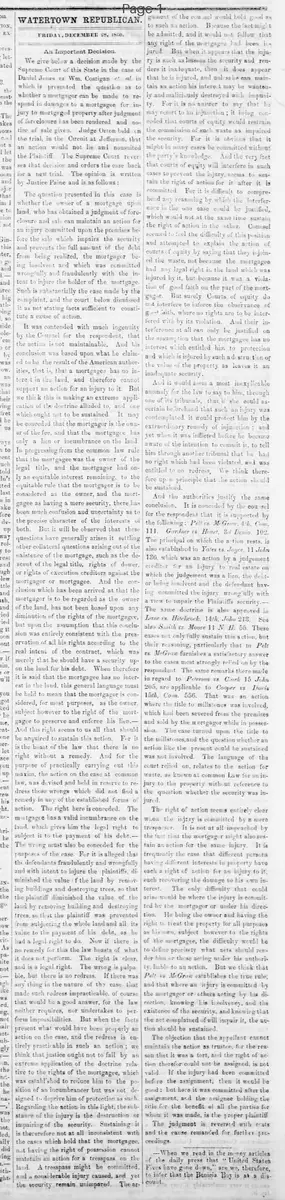
The Supreme Court of New York reverses a lower court ruling in Daniel Jones v. Wm. Costigan, allowing a mortgagee to sue an insolvent mortgagor for fraudulent damage to mortgaged property after foreclosure judgment but before sale, to protect the security interest. Case remanded for new trial.
Clipping
OCR Quality
Full Text
FRIDAY, DECEMBER 28, 1860.
An Important Decision.
We give below a decision made by the
Supreme Court of this State in the case of
Daniel Jones vs. Wm. Costigan et. al. in
which is presented the question as to
whether a mortgagor can be made to respond in damages to a mortgagee for injury to mortgaged property after judgment
of foreclosure has been rendered and notice of sale given. Judge Orton held in
the trial, in the Circuit at Jefferson, that
an action would not lie and nonsuited
the Plaintiff. The Supreme Court reverses that decision and orders the case back
for a new trial. The opinion is written
by Justice Paine and is as follows:
The question presented in this case is
whether the owner of a mortgage upon
land, who has obtained a judgment of foreclosure and sale can maintain an action for
an injury committed upon the premises before the sale which impairs the security
and prevents the full amount of the debt
from being realized, the mortgagor being insolvent and which was committed
wrongfully and fraudulently with the intent to injure the holder of the mortgage.
Such is substantially the case made by the
complaint, and the court below dismissed
it as not stating facts sufficient to constitute a cause of action.
It was contended with much ingenuity
by the Counsel for the respondent, that the action is not maintainable. And his
conclusion was based upon what he claimed to be the result of the American authorities, that is, that a mortgagee has no interest in the land, and therefore cannot
support an action for an injury to it. But
we think this is making an extreme application of the doctrine alluded to, and one
which ought not to be sustained. It may
be conceded that the mortgagor is the owner of the fee, and that the mortgagee has
only a lien or incumbrance on the land.
In progressing from the common law rule
that the mortgagee was the owner of the
legal title, and the mortgagor had only an equitable interest remaining, to the
equitable rule that the mortgagor is to be
considered as the owner, and the mortgagee as having a mere security, there has
been much confusion and uncertainty as to the precise character of the interests of
both. But it will be observed that these
questions have generally arisen in settling
other collateral questions arising out of the
existence of the mortgage, such as the descent of the legal title, rights of dower,
or rights of execution creditors against the
mortgagor or mortgagee. And the conclusion which has been arrived at that the
mortgagor is to be regarded as the owner
of the land, has not been based upon any
diminution of the rights of the mortgagee,
but upon the assumption that this conclusion was entirely consistent with the preservation of all his rights according to the
real intent of the contract, which was
merely that he should have a security upon the land for his debt. When therefore
it is said that the mortgagee has no interest in the land, this general language must
be held to mean that the mortgagor is considered, for most purposes, as the owner,
subject however to the right of the mortgagee to preserve and enforce his lien,—
And this right seems to us all that should
be acquired to sustain this action. For it
is the boast of the law that there is no
right without a remedy. And for the
purpose of practically carrying out this
maxim, the action on the case at common
law, was devised and held in reserve to redress those wrongs which did not find a
remedy in any of the established forms of
action. The right here is conceded. The
mortgagee has a valid incumbrance on the
land, which gives him the legal right to
subject it to the payment of his debt.—
The wrong must also be conceded for the
purposes of the case. For it is alleged that
the defendants fraudulently and wrongfully
and with intent to injure the plaintiff, diminished the value of the land by removing buildings and destroying trees, so that
the plaintiff was prevented from subjecting the whole land and all its
value to the payment of his debt, as he
had a legal right to do. Now if there is
no remedy for this the law boasts of what
it does not perform. The right is clear.
and is a legal right. The wrong is palpable, but there is no redress. If there was
any thing in the nature of the case that
made such redress impracticable, of course
that would be a good answer, for the law
neither requires, nor undertakes to perform impossibilities. But when the facts
present what would have been properly an
action on the case, and the redress is entirely practicable in such an action: we
think that justice ought not to fail by an
extreme application of the doctrine relative to the rights of the mortgagee, which
was established to reduce him to the position of an incumbrancer but was not designed to deprive him of protection as such.
Regarding the action in this light, the substance of the injury is the destruction or
impairing of the security. Sustaining it
is therefore not at all inconsistent with
the cases which hold that the mortgagee,
not having the right of possession cannot
maintain an action for a trespass on the
land. A trespass might be committed.
and a considerable injury caused, and yet
the security remain unimpaired. The argument of the counsel would hold good as
to such an action. Because the fact must
be admitted, and it would not follow that
any right of the mortgagee had been injured. But when it appears that the injury is such as lessens the security and renders it inadequate, then it does appear
that he is injured, and unless he can maintain an action his interest may be wantonly and maliciously destroyed with impunity. For it is no answer to say that he
may resort to an injunction; it being conceded that courts of equity would restrain
the commission of such waste as impaired
the security. For it is obvious that it
might in many cases be committed without
the party's knowledge. And the very fact
that courts of equity will interfere in such
cases to prevent the injury, seems to sustain the right of action for it after it is
committed. For it is difficult to comprehend any reasoning by which the interference in the one case could be justified.
which would not at the same time sustain
the right of action in the other. Counsel
seemed to feel the difficulty of this position and attempted to explain the action of
courts of equity by saying that they enjoined the waste, not because the mortgagee
had any legal right in the land which was
injured by it, but because it was a violation of good faith on the part of the mortgagor. But surely Courts of equity do
not interfere to enforce the observance of
good faith, where no rights are to be interfered with by its violation. And their interference at all can only be justified on
the assumption that the mortgagee has an
interest which entitled him to protection
and which is injured by such a destruction of the value of the property as leaves it an
inadequate security.
And it would seem a most inexplicable
anomaly for the law to say to him, through
one of its tribunals, that if she could ascertain beforehand that such an injury was
contemplated it would protect him by the
extraordinary remedy of injunction: and
yet when it was inflicted before he became
aware of the intention to commit it, to tell
him through another tribunal that he had
no right which had been violated, and was
entitled to no redress. We think therefore upon principle that the action should
be sustained.
And the authorities justify the same
conclusion. It is conceded by the counsel
for the respondent that it is supported by
the following: Pell vs MeGrane, 4th Com.
111. Gardner vs. Heart. 3d Denio. 102.
The principle on which the action rests, is
also established in Yates vs. Joyce, 11 John
136. which was an action by a judgement
creditor for an injury to real estate on
which the judgement was a lien, the debtor being insolvent and the defendant having committed the injury wrongfully with
a view to impair the Plaintiffs security.—
The same doctrine is also approved in
Lane vs. Hitchcock. 14th, John 213. See
also Smith vs. Moore 11 N. H. 55. These
cases not only fully sustain this action, but
their reasoning, particularly that in Pelt
vs MeGraw furnishes a satisfactory answer
to the cases most strongly relied on by the
respondent. The same remarks there made
in regard to Peterson vs. Clark 15 John
205. are applicable to Cooper vs Davis
15th. Com. 556. That was an action
where the title to millstones was involved,
which had been severed from the premises
and sold by the mortgagor while in possession. The case turned upon the title to
the millstones, and the question whether an
action like the present could be sustained
was not involved. The language of the
court relied on, relates to the action for
waste, as known at common Law for an injury to the property without reference to
the question whether the security was injured.
The right of action seems entirely clear
when the injury is committed by a mere
trespasser. It is not at all impeached by
the fact that the mortgagor might also sustain an action for the same injury. It is
frequently the case that different persons
having different interests in property have
each a right of action for an injury to it.
each recovering the damage to his own interest. The only difficulty that could
arise would be where the injury is committed by the mortgagor or under his direction. He being the owner and having the
right to treat the property for all purposes
as his own, subject however to the rights
of the mortgagee, the difficulty would be
to define precisely what acts should render him or those acting under his authority, liable to an action. But we think that
Pelt vs MeGrane establishes the true rule.
and that where an injury is committed by
the mortgagor or others acting by his direction, knowing his insolvency, and the
existence of the security, and knowing that
the act complained of will impair it, the action should be sustained.
The objection that the appellant cannot
maintain the action as trustee, for the reason that it was a tort, and the right of action therefor could not be assigned, is not
valid. If the injury had been committed
before the assignment, then it would be
good: but here it was committed after the
assignment, and the assignee holding the
title for the benefit of all the parties for
whom it was made, is the proper plaintiff.
The judgment is reversed with costs
and the cause remanded for further proceedings.
What sub-type of article is it?
What keywords are associated?
What entities or persons were involved?
Where did it happen?
Domestic News Details
Primary Location
Jefferson
Event Date
December 28, 1860
Key Persons
Outcome
the supreme court reverses the lower court's nonsuit and remands the case for a new trial, allowing the mortgagee to maintain an action for damages to the mortgaged property.
Event Details
In the case of Daniel Jones vs. Wm. Costigan et al., the Supreme Court addresses whether a mortgagee can sue a mortgagor for fraudulent injury to mortgaged land after foreclosure judgment but before sale, when the mortgagor is insolvent. The court holds that such an action is maintainable to protect the mortgagee's security interest.