Thank you for visiting SNEWPapers!
Sign up free
Alexandria Daily Advertiser
Alexandria, Virginia
What is this article about?
Inhabitants of Burlington, Vermont, petition Congress to modify the Embargo Act of March 12, 1808, to restore trade with Lower Canada via Lake Champlain, citing severe economic distress from halted exports of lumber, ashes, and produce, and imports of salt and specie.
Merged-components note: Continuation of the Vermont memorial/petition regarding the embargo act across pages 2 and 3; the second component was mislabeled as 'notice' but fits as domestic_news overall.
Clippings
1 of 2
OCR Quality
Full Text
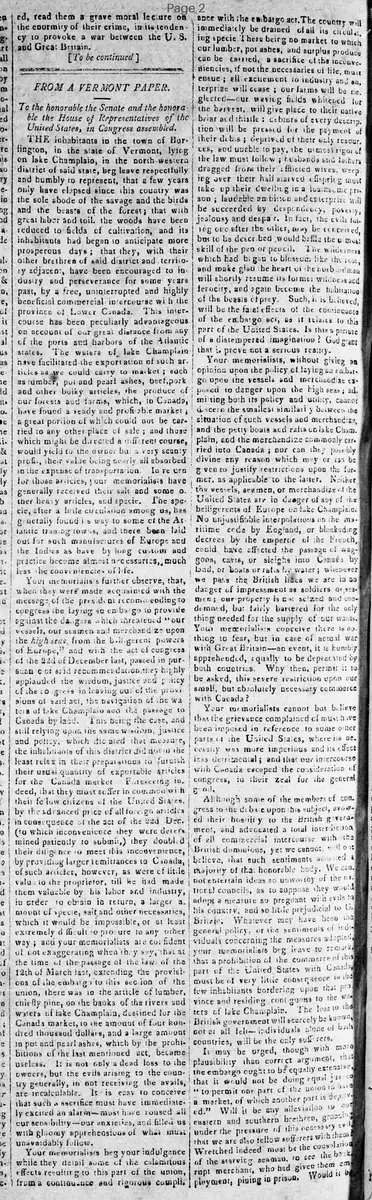
To the honorable the Senate and the honorable the House of Representatives of the United States, in Congress assembled.
THE inhabitants in the town of Burlington, in the state of Vermont, lying on lake Champlain, in the north western district of said state, beg leave respectfully and humbly to represent, that a few years only have elapsed since this country was the sole abode of the savage and the birds and the beasts of the forest; that with great labor and toil the woods have been reduced to fields of cultivation, and its inhabitants had begun to anticipate more prosperous days; that they, with their other brethren of said district and territory adjacent, have been encouraged to industry and perseverance for some years past, by a free, uninterrupted and highly beneficial commercial intercourse with the province of Lower Canada. This intercourse has been peculiarly advantageous on account of our great distance from any of the ports and harbors of the Atlantic states. The waters of lake Champlain have facilitated the exportation of such articles as we could carry to market; such as timber, pot and pearl ashes, beef, pork and other bulky articles, the produce of our forests and farms, which, to Canada, have found a ready and profitable market: a great portion of which could not be carried to any other place of sale; and those which might be directed a different course, would yield to the owner but a very scanty profit, their value being nearly all absorbed in the expense of transportation. In return for those articles, your memorialists have generally received their salt and some other heavy articles, and specie. The specie, after a little circulation among us, has generally found its way to some of the Atlantic trading towns, and there been laid out for such manufactures of Europe and the Indies as have by long custom and practice become almost necessaries, much less the conveniences of life.
Your memorialists further observe, that, when they were made acquainted with the message of the president recommending to congress the laying an embargo to provide against the dangers which threatened "our vessels, our seamen and merchandise upon the high seas, from the belligerent powers of Europe," and with the act of congress of the 22d of December last, passed in pursuance of said recommendation, they highly applauded the wisdom, justice and policy of the congress in leaving out of the provisions of said act, the navigation of the waters of lake Champlain and the passage to Canada by land. This being the case, and still relying upon the same wisdom, justice and policy which dictated that measure, the inhabitants of this district did not in the least relax in their preparations to furnish their usual quantity of exportable articles for the Canada market. Foreseeing to be sure, that they must suffer in common with their fellow citizens of the United States, by the advanced price of all foreign articles in consequence of the act of the 22d Dec. (to which inconvenience they were determined patiently to submit,) they doubled their diligence to meet this inconvenience, by providing larger remittances to Canada, of such articles, however, as were of little value to the proprietor, till he had made them valuable by his labor and industry, in order to obtain in return, a larger amount of specie, salt and other necessaries, which it would be impossible, or at least extremely difficult to procure in any other way; and your memorialists are confident of not exaggerating when they say, that at the time of the passage of the law of the 12th of March last, extending the provisions of the embargo to this section of the union, there was in the article of lumber, chiefly pine, on the banks of the rivers and waters of lake Champlain, destined for the Canada market, to the amount of four hundred thousand dollars, and a large amount in pot and pearl ashes, which by the prohibitions of the last mentioned act, became useless. It is not only a dead loss to the owners, but the evils arising to the country generally, in not receiving the avails, are incalculable. It is easy to conceive that such a sacrifice must have immediately excited an alarm--must have roused all our sensibility--our anxieties, and filled us with gloomy apprehensions of what must unavoidably follow.
Your memorialists beg your indulgence while they detail some of the calamitous effects resulting to this part of the union, from a continuance and rigorous compliance with the embargo act. The country will immediately be drained of all its circulating specie. There being no market to which our lumber, pot ashes, and surplus produce can be carried, a sacrifice of the inconveniences, if not the necessaries of life, must ensue; all excitement to industry and enterprise will cease; our farms will be neglected--our waving fields whitened for the harvest, will give place to their native briar and thistle: debtors of every description will be pressed for the payment of their debts; deprived of their only resources, and unable to pay, the utmost rigor of the law must follow; husbands and fathers dragged from their afflicted wives, weeping over their half starved offspring must take up their dwelling in a loathsome prison; laudable ambition and enterprise will be succeeded by despondency, poverty, jealousy and despair. In fact, the evils following one after the other, may be conceived, but to be described; would baffle the utmost skill of the pen or pencil. The wilderness which had begun to blossom like the rose, and make glad the heart of the husbandman will shortly resume its former wildness and ferocity, and again become the habitation of the beasts of prey. Such, it is believed, will be the fatal effects of the continuance of the embargo act, as it relates to this part of the United States. Is this a picture of a distempered imagination? God grant that it prove not a serious reality.
Your memorialists, without giving an opinion upon the policy of laying an embargo upon the vessels and merchandise exposed to danger upon the high seas; admitting both its policy and utility, cannot discern the smallest similarity between the situation of such vessels and merchandise and the petty boats and rafts on lake Champlain, and the merchandise commonly carried into Canada: nor can they possibly divine any reason which may or can be given to justify restrictions upon the former, as applicable to the latter. Neither the vessels, seamen, or merchandise of the United States are in danger of any of the belligerents of Europe on lake Champlain. No unjustifiable interpolations on the maritime code by England, or blockading decrees by the emperor of the French could have affected the passage of wagons, carts, or sleighs into Canada by land, or boats or rafts in water; whenever we pass the British lines we are in no danger of impressment as soldiers or seamen; our property is not seized and condemned, but fairly bartered for the only thing needed for the supply of our wants.
Your memorialists conceive there is nothing to fear, but in case of actual war with Great Britain--an event, it is humbly apprehended, equally to be deprecated by both countries. Why then, permit it to be asked, this severe restriction upon one small, but absolutely necessary commerce with Canada?
Your memorialists cannot but believe that the grievance complained of must have been imposed in reference to some other part of the United States, where its necessity was more imperious and its effect less detrimental; and that our intercourse with Canada escaped the consideration of congress, in their zeal for the general good.
Although some of the members of congress in the debate upon this subject, avowed their hostility to the British government, and advocated a total interdiction of all commercial intercourse with the British dominions, yet we cannot, will not believe, that such sentiments actuated a majority of that honorable body. We cannot entertain ideas so unworthy of the national councils, as to suppose they would adopt a measure so pregnant with evils to this country, and so little prejudicial to G. Britain: Whatever may have been the general policy, or the sentiments of individuals concerning the measures adopted.
your memorialists beg leave to remark, that a prohibition of the commerce of this part of the United States with Canada, must be of very little consequence to the few inhabitants bordering upon that province and residing contiguously to the waters of lake Champlain. The loss to the British government will scarcely be known, not at all felt--individuals alone of both countries, will be the only sufferers.
It may be urged, though with more plausibility than correct argument, that it would not be doing equal justice to permit one part of the union to have a market, of which another part is deprived. Will it be any alleviation to our eastern and southern brethren, groaning under the pressure of this necessary evil that we are also fellow sufferers with them! Wretched indeed must be the consolation of the starving seaman, to see the bankrupt merchant, who had given them employment, pining in prison. Would it be of the globe, laboring under the calamity of a severe famine, that another was desolated with a sweeping pestilence? Would it administer comfort to one, that another of his fellow mortals was expiring in the agonies of a violent death, wasting his life by a lingering consumption of the vitals? We had supposed that when the exigency of our government required a embargo, which if necessity must produce partial evil, as many would be exempt from its calamitous effects, as the nature of the case would admit. Why should the whole body perish, when by a skilful amputation of a single member, it might be injured? We wish not to heighten the picture, but to exhibit it in its true colors.
Your memorialists are not mere spectators of the perilous situation of the country; and they flatter themselves that they feel in common with their brethren throughout the union, a patriotic, a virtuous indignation at the shameless aggression of our nation; and pledge themselves that they will not be the last to repel her injuries or vindicate her rights.
But your Memorialists are yet to learn, that the partial distresses of this small part of the union, necessarily connected with the fate of the embargo, can add a mile to the general good, on the contrary they are deeply, seriously impressed with the idea that they will only increase the general calamity.
Your memorialists, after mature, candid, and deliberate reflection, cannot repress their feelings, cannot remain silent; duty to their country, to themselves and families, it is hoped, will be an apology, if any apology be necessary, for their plainly and unreservedly making known their complaints and their sufferings; relying as well upon the humanity, as the wisdom and justice of congress, to grant them a patient hearing. They look up to congress as the guardian of their interests and industry, as well as their independence; and do most earnestly entreat, even as a matter of right, that their grievances may be duly considered, and if consistent with the honour, dignity, safety and independence of our common country, they humbly and respectfully solicit, that there may be such a modification of the act of the 12th of March last, as to restore to the inhabitants contiguous to the province of Lower Canada, and bordering upon Lake Champlain, the full enjoyment of their former commercial intercourse with the said province; and as in duty bound will ever pray.
Resolved, That the select men of the town of Burlington, sign the above memorial in behalf of said town, and transmit the same to congress as soon as may be.
Resolved, That Samuel Hitchcock, Ozias Buell, and Moses Fay, esqrs. be a committee to correspond with the other towns and places lying contiguous to the province of Lower Canada and bounding upon Lake Champlain upon the subject of this meeting:
A true Copy,
Attest,
GEORGE ROBINSON.
Town Clerk.
What sub-type of article is it?
What keywords are associated?
What entities or persons were involved?
Where did it happen?
Domestic News Details
Primary Location
Burlington, Vermont
Event Date
Following The Act Of The 12th Of March Last
Key Persons
Outcome
economic distress including loss of $400,000 in lumber and ashes, potential farm neglect, debt enforcement, imprisonment, and cessation of industry; request for modification of embargo to restore trade.
Event Details
Inhabitants of Burlington petition Congress against the extension of the Embargo Act to Lake Champlain trade with Canada, detailing benefits of prior commerce in timber, ashes, beef, pork for salt and specie, and predicting calamitous effects like specie drain, neglected farms, and poverty if continued.