Thank you for visiting SNEWPapers!
Sign up free
Foreign News
November 9, 1804
The National Intelligencer And Washington Advertiser
Washington, District Of Columbia
What is this article about?
Excerpt from John Philpot Curran's speech analyzing Napoleon Bonaparte's motives and rule in France, arguing that his power relies on force rather than shared interests, making alliances with him unappealing for Ireland or Britain. Discusses implications for religion, liberty, and subjugated nations.
Clipping
OCR Quality
95%
Excellent
Full Text
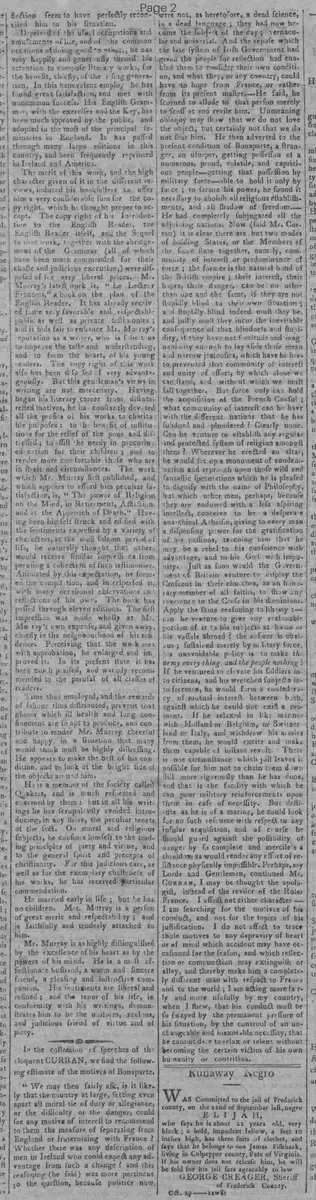
In the collection of speeches of the eloquent CURRAN, we find the following estimate of the motives of Bonaparte.
"We may then fairly ask, is it likely that the country at large, setting even apart all moral ties of duty or allegiance, or the difficulty or the danger, could see any motive of interest to recommend to them the measure of separating from England or fraternizing with France? Whether there was any description of men in Ireland who could expect any advantage from such a change? and this reasoning (he said) was more pertinent to the question, because politics now were not, as heretofore, a dead science, in a dead language; they had now become the subject of the day; vernacular and universal. And the repose which the late system of Irish Government had given the people for reflection had enabled them to consider their own condition, and what they, or any country, could have to hope from France, or rather from its present master. He said, he scorned to allude to that person merely to scoff at and revile him. Unmeaning obloquy may show that we do not love the object, but certainly not that we do not fear him. He then adverted to the present condition of Bonaparte, a stranger, an usurper, getting possession of a numerous, proud, volatile, and capricious people-getting that possession by military force—able to hold it only by force; to secure his power, he found it necessary to abolish all religious establishments, and all shadow of freedom. He had completely subjugated all the adjoining nations. Now (said Mr. Curran) it is clear there are but two modes of holding States, or the Members of the slave state together, namely, community of interest or predominance of force; the former is the natural bond of the British empire: their interests, their hopes, their danger, can be no other than one and the same, if they are not stupidly blind to their own situation; and stupidly blind indeed must they be, and justly must they incur the inevitable consequence of that blindness and stupidity, if they have not fortitude and magnanimity enough to lay aside those mean and narrow jealousies, which have hitherto prevented that community of interest and unity of effort, by which alone we can stand, and without which we must fall together. But force only can hold the acquisition of the French Consul; what community of interest can he have with the different nations that he has subdued and plundered? Clearly none. Can he venture to establish any regular and protected system of religion amongst them? Wherever he erected an altar, he would set up a monument of condemnation and reproach upon those wild and fantastic speculations which he is pleased to dignify with the name of Philosophy, but which other men, perhaps, because they are endowed with a less aspiring intellect, conceive to be a desperate anarchical Atheism, giving to every man a dispensing power for the gratification of his passions, teaching him that he may be a rebel to his conscience with advantage, and to his God with impunity. Just as soon would the Government of Britain venture to display the Crescent in their churches, as an honorary member of all faiths, to show any reverence to the Cross in his dominions.
Apply the same reasoning to liberty:--can he venture to give any reasonable portion of it to his subjects at home or his vassals abroad? the answer is obvious; sustained merely by military force, his unavoidable policy is to make the army every thing, and the people nothing! If he ventured to elevate his soldiers into citizens, and his wretched subjects into freemen, he would form a confederacy of mutual interest between both against which he could not exist a moment. If he relaxed in like manner with Holland or Belgium, or Switzerland or Italy, and withdrew his armies from them, he would excite and make them capable of instant revolt. There is one circumstance which just leaves it possible for him not to chain them down still more rigorously than he has done, and that is the facility with which he can pour military reinforcements upon them in case of necessity. But destitute as he is of a marine, he could look for no such resource with respect to any insular acquisition, and of course he should guard against the possibility of danger: by so complete and merciless a thraldom as would render any effort of resistance physically impossible. Perhaps, my Lords and Gentlemen, continued Mr. Curran, I may be thought the apologist, instead of the reviler of the Ruler of France. I affect not either character--I am searching for the motives of his conduct, and not for the topics of his justification. I do not affect to trace those motives to any depravity of heart or of mind which accident may have occasioned for the season, and which reflection or compunction may extinguish or allay, and thereby make him a completely different man with respect to France and to the world; I am acting more fairly and more usefully by my country, when I show, that his conduct must be so wayed by the permanent pressure of his situation, by the controul of an unchangeable and inexorable necessity, that he cannot dare to relax or relent without becoming the certain victim of his own humanity or contrition."
"We may then fairly ask, is it likely that the country at large, setting even apart all moral ties of duty or allegiance, or the difficulty or the danger, could see any motive of interest to recommend to them the measure of separating from England or fraternizing with France? Whether there was any description of men in Ireland who could expect any advantage from such a change? and this reasoning (he said) was more pertinent to the question, because politics now were not, as heretofore, a dead science, in a dead language; they had now become the subject of the day; vernacular and universal. And the repose which the late system of Irish Government had given the people for reflection had enabled them to consider their own condition, and what they, or any country, could have to hope from France, or rather from its present master. He said, he scorned to allude to that person merely to scoff at and revile him. Unmeaning obloquy may show that we do not love the object, but certainly not that we do not fear him. He then adverted to the present condition of Bonaparte, a stranger, an usurper, getting possession of a numerous, proud, volatile, and capricious people-getting that possession by military force—able to hold it only by force; to secure his power, he found it necessary to abolish all religious establishments, and all shadow of freedom. He had completely subjugated all the adjoining nations. Now (said Mr. Curran) it is clear there are but two modes of holding States, or the Members of the slave state together, namely, community of interest or predominance of force; the former is the natural bond of the British empire: their interests, their hopes, their danger, can be no other than one and the same, if they are not stupidly blind to their own situation; and stupidly blind indeed must they be, and justly must they incur the inevitable consequence of that blindness and stupidity, if they have not fortitude and magnanimity enough to lay aside those mean and narrow jealousies, which have hitherto prevented that community of interest and unity of effort, by which alone we can stand, and without which we must fall together. But force only can hold the acquisition of the French Consul; what community of interest can he have with the different nations that he has subdued and plundered? Clearly none. Can he venture to establish any regular and protected system of religion amongst them? Wherever he erected an altar, he would set up a monument of condemnation and reproach upon those wild and fantastic speculations which he is pleased to dignify with the name of Philosophy, but which other men, perhaps, because they are endowed with a less aspiring intellect, conceive to be a desperate anarchical Atheism, giving to every man a dispensing power for the gratification of his passions, teaching him that he may be a rebel to his conscience with advantage, and to his God with impunity. Just as soon would the Government of Britain venture to display the Crescent in their churches, as an honorary member of all faiths, to show any reverence to the Cross in his dominions.
Apply the same reasoning to liberty:--can he venture to give any reasonable portion of it to his subjects at home or his vassals abroad? the answer is obvious; sustained merely by military force, his unavoidable policy is to make the army every thing, and the people nothing! If he ventured to elevate his soldiers into citizens, and his wretched subjects into freemen, he would form a confederacy of mutual interest between both against which he could not exist a moment. If he relaxed in like manner with Holland or Belgium, or Switzerland or Italy, and withdrew his armies from them, he would excite and make them capable of instant revolt. There is one circumstance which just leaves it possible for him not to chain them down still more rigorously than he has done, and that is the facility with which he can pour military reinforcements upon them in case of necessity. But destitute as he is of a marine, he could look for no such resource with respect to any insular acquisition, and of course he should guard against the possibility of danger: by so complete and merciless a thraldom as would render any effort of resistance physically impossible. Perhaps, my Lords and Gentlemen, continued Mr. Curran, I may be thought the apologist, instead of the reviler of the Ruler of France. I affect not either character--I am searching for the motives of his conduct, and not for the topics of his justification. I do not affect to trace those motives to any depravity of heart or of mind which accident may have occasioned for the season, and which reflection or compunction may extinguish or allay, and thereby make him a completely different man with respect to France and to the world; I am acting more fairly and more usefully by my country, when I show, that his conduct must be so wayed by the permanent pressure of his situation, by the controul of an unchangeable and inexorable necessity, that he cannot dare to relax or relent without becoming the certain victim of his own humanity or contrition."
What sub-type of article is it?
Political
What keywords are associated?
Bonaparte Motives
French Rule
Military Force
Subjugation
Political Analysis
Curran Speech
What entities or persons were involved?
Curran
Bonaparte
Where did it happen?
France
Foreign News Details
Primary Location
France
Key Persons
Curran
Bonaparte
Event Details
John Philpot Curran delivers a speech estimating the motives of Bonaparte, portraying him as a usurper who maintains power through military force alone, subjugating France and neighboring nations without shared interests, religion, or liberty, making alliance with him unbeneficial for Ireland or Britain.