Thank you for visiting SNEWPapers!
Sign up free
Letter to Editor
February 14, 1795
Gazette Of The United States And Daily Evening Advertiser
Philadelphia, Philadelphia County, Pennsylvania
What is this article about?
An essay critiquing Democratic Societies in early America as dangerous to republicanism, arguing they create divisions, act like aristocracies, and undermine government. Warns of foreign interference and historical precedents. Signed Wm. Wilcocks, New-York, February 7, 1795.
Clipping
OCR Quality
95%
Excellent
Full Text
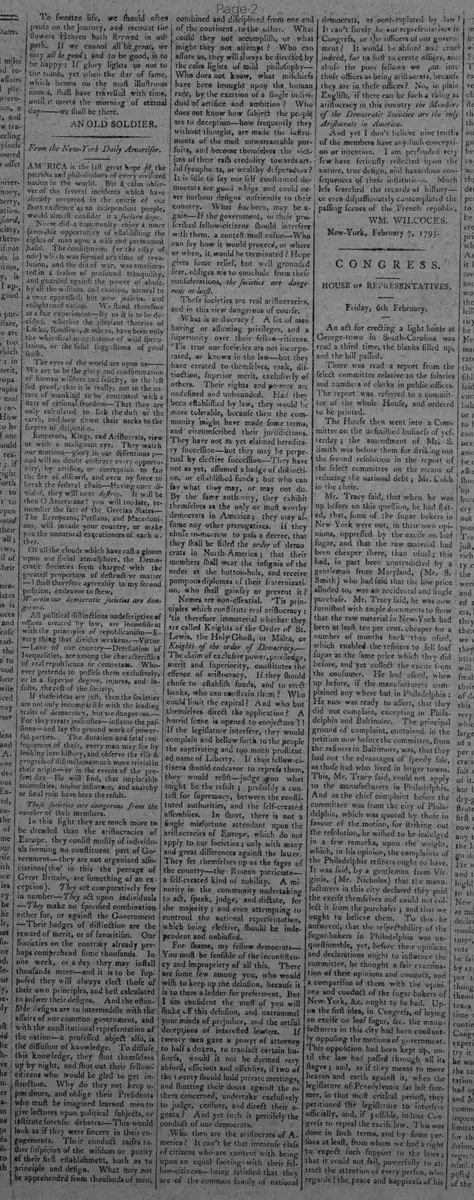
AN OLD SOLDIER.
From the New-York Daily Advertiser.
AMERICA is the last great hope of the patriots and philosophers of every civilized nation in the world. But a calm observer of the several incidents which have already occurred in the course of our short existence as an independent people, would almost consider it a forlorn hope.
Never did a community enjoy a more favorable opportunity of establishing the rights of man upon a wise and permanent basis. The constitution (or the essay of one) which was formed at a time of revolution, and the din of war, was ameliorated in a season of profound tranquility, and guarded against the power of abuse, by all the wisdom and caution, natural to a once oppressed, but now jealous and enlightened nation. We stand therefore as a fair experiment—By us it is to be decided, whether the pleasant theories of Locke, Rousseau, & others, have been only the whimsical imaginations of wild speculation, or the solid suggestions of good sense.
The eyes of the world are upon us— We are to be the glory and consummation of human wisdom and felicity, or the last sad proof, that it is really, not in the nature of mankind to be contented with a state of rational freedom—That they are only calculated to lick the dust of the earth, and bow down their necks to the sceptre of despotism.
Emperors, Kings, and Aristocrats, view us with a malignant eye. They watch our motions—glory in our dissensions;— and will no doubt embrace every opportunity, by artifice, or corruption to fan the fire of discord, and even by force to break the federal chain—Having once divided, they will next destroy. It will be then O Americans! you will too late, remember the fate of the Grecian States— The Europeans, Persians, and Macedonians, will invade your country, or make you the unnatural executioners of each other.
Of all the clouds which have cast a gloom upon our social atmosphere, the Democratic Societies seem charged with the greatest proportion of destructive matter—I shall therefore agreeably to my second position, endeavor to show,
Wherein our democratic societies are dangerous.
All political distinctions un descriptive of offices created by law, are inconsistent with the principles of republicanism—Every thing that divides weakens.—Virtue—Love of our country—Detestation of Inequalities, are among the characteristics of real republicans or democrats. Whoever pretends to possess them exclusively, or in a superior degree, injures, and insults, the rest of the society.
If these ideas are just, then the societies are not only incompatible with the leading traits of democracy, but are dangerous.— For they create jealousies—inflame the passions—and lay the ground work of powerful parties. The duration and fatal consequences of these, every man may see by looking into history, and observe the rise & progress of distinctions much more trivial in their origin—or in the events of the present day—He will find, that implacable animosities, undue influence, and anarchy or final ruin have been the result.
These societies are dangerous from the number of their members.
In this light they are much more to be dreaded than the aristocracies of Europe. they consist mostly of individuals forming no constituent part of Government—they are not organized associations (tho' in this the peerage of Great Britain, are something of an exception). They are comparatively few in number—They act upon individuals They make no specified combination either for, or against the Government —Their badges of distinction are the reward of merit, or of favoritism. Our Societies on the contrary already perhaps comprehend some thousands In one week, or a day they may install thousands more—and it is to be supposed they will always elect those of their own principles, and best calculated to answer their designs. And the ostensible designs are to intermeddle with the affairs of our common government, and with the constitutional representation of the nation—a professed object also, is the diffusion of knowledge. To diffuse this knowledge, they shut themselves up by night, and shut out their fellow-citizens who would be glad to get instruction. Why do they not keep open doors, and oblige their Presidents who must be imagined learned men to give lectures upon political subjects, or institute forensic debates.—This would look as if they were sincere in their engagements. Their conduct raises rather suspicion of the wisdom or purity of their first establishment, both as to principle and design. What may not be apprehended from thousands of men,
combined and disciplined from one end of the continent to the other. What could they not accomplish, or what might they not attempt? Who can assure us, they will always be directed by the calm lights of mild philosophy— Who does not know, what mischiefs have been brought upon the human race, by the exertion of a single individual of artifice and ambition? Who does not know how subject the people are to deception—how frequently they without thought, are made the instruments of the most unwarrantable pursuits, and become themselves the victims of their rash credulity towards artful yeophants, or wealthy desperadoes?
It is idle to say our self constituted democrats are good whigs and could never harbour designs unfriendly to their country. What has been, may be again—If the government, or their proscribed fellow-citizens should interfere with them. a contest must ensue—Who can say how it would proceed, or where or when, it would be terminated? Hope gives some relief, but well grounded fear, obliges me to conclude from these considerations, the societies are dangerous at least.
These societies are real aristocracies, and in this view dangerous of course.
What is aristocracy? A set of men having or assuming privileges, and superiority over their fellow-citizens 'Tis true our societies are not incorporated, or known in the law—but they have created to themselves, rank, distinction, superior merit, exclusively of others. Their rights and powers are undefined and unbounded. Had they been established by law, they would be more tolerable, because then the community might have made some terms, and circumscribed their jurisdictions. They have not as yet claimed hereditary succession—but they may be perpetual by elective succession—They have not as yet, assumed a badge of distinction, or established funds; but who can say what they may, or may not do. By the same authority, they exhibit themselves as the only or most worthy democrats in America; they may assume any other prerogatives. If they choose to-morrow to pass a decree, that they shall be styled the order of democrats in North-America; that their members shall wear the insignia of the order at the button-hole, and receive pompous diplomas of their fraternization, who shall gainsay or prevent it? Names are non-essential. 'Tis principles which constitute real aristocracy: 'tis therefore immaterial whether they are called Knights of the Order of St. Lewis, the Holy Ghost, o Malta, or Knights of the order of Democracy.— The claim of exclusive power, privilege, merit and superiority, constitutes the essence of aristocracy. If they should choose to establish funds, and to erect banks, who can constrain them? Who could limit the capital? And who but themselves direct the application? A horrid scene is opened to conjecture!! If the legislature interfere, they would complain and bellow forth to the people the captivating and too much prostituted name of Liberty. If their fellow-citizens should endeavor to repress them, they would resist—judge you what might be the result; probably a contest for supremacy, between the constituted authorities, and the self-created assemblies. In short, there is not a single misfortune attendant upon the aristocracies of Europe, which do not apply to our societies; only with many and great differences against the latter. They set themselves up as the sages of the country—the Roman patriciate— a self-created kind of nobility. A minority in the community undertaking to act, speak, judge, and dictate, for the majority; and even attempting to controul the national representation, which being elective, should be independent and unbiased.
For shame, my fellow democrats— You must be sensible of the inconsistency and impropriety of all this. There are some few among you, who would wish to keep up the delusion, because it is to them a ladder for preferment. But I am confident the most of you will shake off this delusion, and untrammel your minds of prejudice, and the artful deceptions of interested leaders.
If twenty men gave a power of attorney to half a dozen, to transact certain business, would it not be deemed very absurd, officious and offensive, if two of the twenty should hold private meetings, and shutting their doors against the others concerned, undertake exclusively to judge, censure, and direct their agents? And yet such is precisely the conduct of our democrats.
Who then are the aristocrats of America? It can't be that immense class of citizens who are content with being upon an equal footing with their fellow-citizens—being satisfied that they are of the common family of national democrats, as contemplated by law? It can't surely be our representatives in Congress, or the officers of our government? It would be absurd and cruel indeed, for us first to create offices, and abuse the poor fellows we put into those offices as being aristocrats, because they are in these offices?. No, in plain English, if there can be such a thing as aristocracy in this country the Members of the Democratic Societies are the only Aristocrats in America.
And yet I don't believe nine tenths of the members have any such conceptions or intention. I am persuaded very few have seriously reflected upon the nature, true design, and hazardous consequences of these institutions. Much less searched the records of history— or even dispassionately contemplated the passing scenes of the French republic.
WM. WILCOCKS.
New-York, February 7, 1795.
From the New-York Daily Advertiser.
AMERICA is the last great hope of the patriots and philosophers of every civilized nation in the world. But a calm observer of the several incidents which have already occurred in the course of our short existence as an independent people, would almost consider it a forlorn hope.
Never did a community enjoy a more favorable opportunity of establishing the rights of man upon a wise and permanent basis. The constitution (or the essay of one) which was formed at a time of revolution, and the din of war, was ameliorated in a season of profound tranquility, and guarded against the power of abuse, by all the wisdom and caution, natural to a once oppressed, but now jealous and enlightened nation. We stand therefore as a fair experiment—By us it is to be decided, whether the pleasant theories of Locke, Rousseau, & others, have been only the whimsical imaginations of wild speculation, or the solid suggestions of good sense.
The eyes of the world are upon us— We are to be the glory and consummation of human wisdom and felicity, or the last sad proof, that it is really, not in the nature of mankind to be contented with a state of rational freedom—That they are only calculated to lick the dust of the earth, and bow down their necks to the sceptre of despotism.
Emperors, Kings, and Aristocrats, view us with a malignant eye. They watch our motions—glory in our dissensions;— and will no doubt embrace every opportunity, by artifice, or corruption to fan the fire of discord, and even by force to break the federal chain—Having once divided, they will next destroy. It will be then O Americans! you will too late, remember the fate of the Grecian States— The Europeans, Persians, and Macedonians, will invade your country, or make you the unnatural executioners of each other.
Of all the clouds which have cast a gloom upon our social atmosphere, the Democratic Societies seem charged with the greatest proportion of destructive matter—I shall therefore agreeably to my second position, endeavor to show,
Wherein our democratic societies are dangerous.
All political distinctions un descriptive of offices created by law, are inconsistent with the principles of republicanism—Every thing that divides weakens.—Virtue—Love of our country—Detestation of Inequalities, are among the characteristics of real republicans or democrats. Whoever pretends to possess them exclusively, or in a superior degree, injures, and insults, the rest of the society.
If these ideas are just, then the societies are not only incompatible with the leading traits of democracy, but are dangerous.— For they create jealousies—inflame the passions—and lay the ground work of powerful parties. The duration and fatal consequences of these, every man may see by looking into history, and observe the rise & progress of distinctions much more trivial in their origin—or in the events of the present day—He will find, that implacable animosities, undue influence, and anarchy or final ruin have been the result.
These societies are dangerous from the number of their members.
In this light they are much more to be dreaded than the aristocracies of Europe. they consist mostly of individuals forming no constituent part of Government—they are not organized associations (tho' in this the peerage of Great Britain, are something of an exception). They are comparatively few in number—They act upon individuals They make no specified combination either for, or against the Government —Their badges of distinction are the reward of merit, or of favoritism. Our Societies on the contrary already perhaps comprehend some thousands In one week, or a day they may install thousands more—and it is to be supposed they will always elect those of their own principles, and best calculated to answer their designs. And the ostensible designs are to intermeddle with the affairs of our common government, and with the constitutional representation of the nation—a professed object also, is the diffusion of knowledge. To diffuse this knowledge, they shut themselves up by night, and shut out their fellow-citizens who would be glad to get instruction. Why do they not keep open doors, and oblige their Presidents who must be imagined learned men to give lectures upon political subjects, or institute forensic debates.—This would look as if they were sincere in their engagements. Their conduct raises rather suspicion of the wisdom or purity of their first establishment, both as to principle and design. What may not be apprehended from thousands of men,
combined and disciplined from one end of the continent to the other. What could they not accomplish, or what might they not attempt? Who can assure us, they will always be directed by the calm lights of mild philosophy— Who does not know, what mischiefs have been brought upon the human race, by the exertion of a single individual of artifice and ambition? Who does not know how subject the people are to deception—how frequently they without thought, are made the instruments of the most unwarrantable pursuits, and become themselves the victims of their rash credulity towards artful yeophants, or wealthy desperadoes?
It is idle to say our self constituted democrats are good whigs and could never harbour designs unfriendly to their country. What has been, may be again—If the government, or their proscribed fellow-citizens should interfere with them. a contest must ensue—Who can say how it would proceed, or where or when, it would be terminated? Hope gives some relief, but well grounded fear, obliges me to conclude from these considerations, the societies are dangerous at least.
These societies are real aristocracies, and in this view dangerous of course.
What is aristocracy? A set of men having or assuming privileges, and superiority over their fellow-citizens 'Tis true our societies are not incorporated, or known in the law—but they have created to themselves, rank, distinction, superior merit, exclusively of others. Their rights and powers are undefined and unbounded. Had they been established by law, they would be more tolerable, because then the community might have made some terms, and circumscribed their jurisdictions. They have not as yet claimed hereditary succession—but they may be perpetual by elective succession—They have not as yet, assumed a badge of distinction, or established funds; but who can say what they may, or may not do. By the same authority, they exhibit themselves as the only or most worthy democrats in America; they may assume any other prerogatives. If they choose to-morrow to pass a decree, that they shall be styled the order of democrats in North-America; that their members shall wear the insignia of the order at the button-hole, and receive pompous diplomas of their fraternization, who shall gainsay or prevent it? Names are non-essential. 'Tis principles which constitute real aristocracy: 'tis therefore immaterial whether they are called Knights of the Order of St. Lewis, the Holy Ghost, o Malta, or Knights of the order of Democracy.— The claim of exclusive power, privilege, merit and superiority, constitutes the essence of aristocracy. If they should choose to establish funds, and to erect banks, who can constrain them? Who could limit the capital? And who but themselves direct the application? A horrid scene is opened to conjecture!! If the legislature interfere, they would complain and bellow forth to the people the captivating and too much prostituted name of Liberty. If their fellow-citizens should endeavor to repress them, they would resist—judge you what might be the result; probably a contest for supremacy, between the constituted authorities, and the self-created assemblies. In short, there is not a single misfortune attendant upon the aristocracies of Europe, which do not apply to our societies; only with many and great differences against the latter. They set themselves up as the sages of the country—the Roman patriciate— a self-created kind of nobility. A minority in the community undertaking to act, speak, judge, and dictate, for the majority; and even attempting to controul the national representation, which being elective, should be independent and unbiased.
For shame, my fellow democrats— You must be sensible of the inconsistency and impropriety of all this. There are some few among you, who would wish to keep up the delusion, because it is to them a ladder for preferment. But I am confident the most of you will shake off this delusion, and untrammel your minds of prejudice, and the artful deceptions of interested leaders.
If twenty men gave a power of attorney to half a dozen, to transact certain business, would it not be deemed very absurd, officious and offensive, if two of the twenty should hold private meetings, and shutting their doors against the others concerned, undertake exclusively to judge, censure, and direct their agents? And yet such is precisely the conduct of our democrats.
Who then are the aristocrats of America? It can't be that immense class of citizens who are content with being upon an equal footing with their fellow-citizens—being satisfied that they are of the common family of national democrats, as contemplated by law? It can't surely be our representatives in Congress, or the officers of our government? It would be absurd and cruel indeed, for us first to create offices, and abuse the poor fellows we put into those offices as being aristocrats, because they are in these offices?. No, in plain English, if there can be such a thing as aristocracy in this country the Members of the Democratic Societies are the only Aristocrats in America.
And yet I don't believe nine tenths of the members have any such conceptions or intention. I am persuaded very few have seriously reflected upon the nature, true design, and hazardous consequences of these institutions. Much less searched the records of history— or even dispassionately contemplated the passing scenes of the French republic.
WM. WILCOCKS.
New-York, February 7, 1795.
What sub-type of article is it?
Persuasive
Political
Reflective
What themes does it cover?
Politics
Constitutional Rights
Social Issues
What keywords are associated?
Democratic Societies
Aristocracy
Republicanism
Political Divisions
American Experiment
Federal Government
Locke Rousseau
What entities or persons were involved?
Wm. Wilcocks
Letter to Editor Details
Author
Wm. Wilcocks
Main Argument
democratic societies are dangerous to the american republic because they create political divisions, act as self-constituted aristocracies with undefined powers, and threaten constitutional government by intermeddling in national affairs.
Notable Details
References Theories Of Locke And Rousseau
Cites Fate Of Grecian States
Compares To European Aristocracies And French Republic
Warns Of Foreign Monarchs Exploiting Divisions