Thank you for visiting SNEWPapers!
Sign up free
Story
December 5, 1908
The San Mateo Item
San Mateo, Putnam County, Florida
What is this article about?
A Scranton mining journal highlights lower tuberculosis mortality in coal mining areas compared to others, a phenomenon also noted in Britain by B. T. Thwaite, who attributes it to carbon monoxide from lung carbon dust inhibiting the resilient tubercle bacillus, similar to workers at blast furnaces.
Clipping
OCR Quality
98%
Excellent
Full Text
Miners and Tuberculosis.
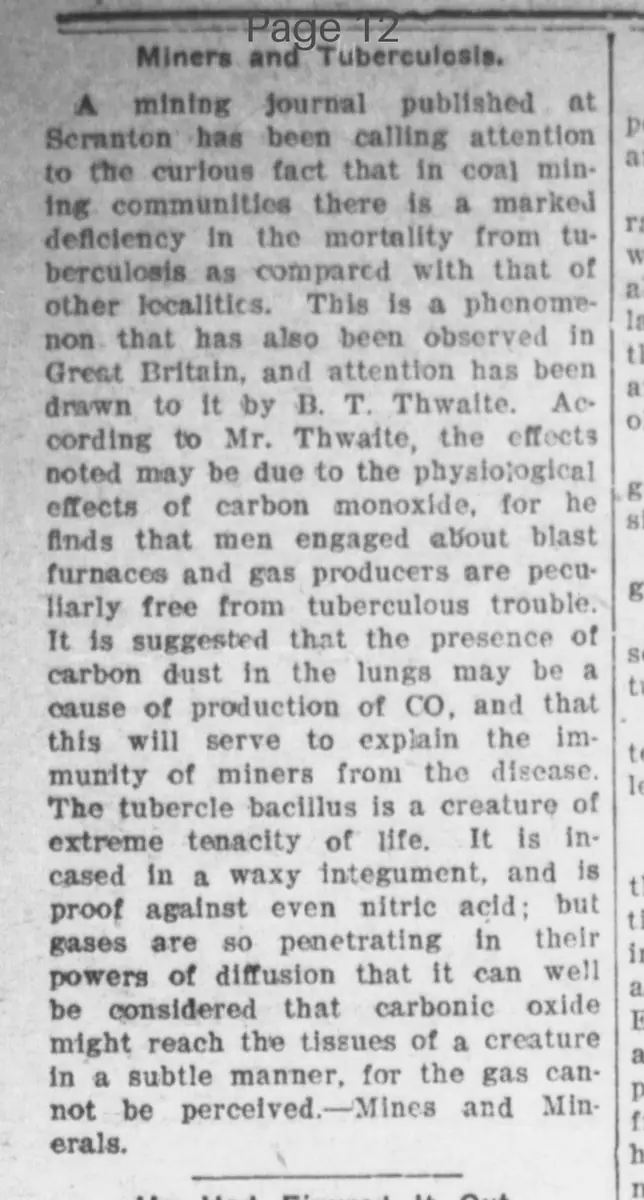
A mining journal published at Scranton has been calling attention to the curious fact that in coal mining communities there is a marked deficiency in the mortality from tuberculosis as compared with that of other localities. This is a phenomenon that has also been observed in Great Britain, and attention has been drawn to it by B. T. Thwaite. According to Mr. Thwaite, the effects noted may be due to the physiological effects of carbon monoxide, for he finds that men engaged about blast furnaces and gas producers are peculiarly free from tuberculous trouble. It is suggested that the presence of carbon dust in the lungs may be a cause of production of CO, and that this will serve to explain the immunity of miners from the disease. The tubercle bacillus is a creature of extreme tenacity of life. It is incased in a waxy integument, and is proof against even nitric acid; but gases are so penetrating in their powers of diffusion that it can well be considered that carbon monoxide might reach the tissues of a creature in a subtle manner, for the gas cannot be perceived.—Mines and Minerals.
A mining journal published at Scranton has been calling attention to the curious fact that in coal mining communities there is a marked deficiency in the mortality from tuberculosis as compared with that of other localities. This is a phenomenon that has also been observed in Great Britain, and attention has been drawn to it by B. T. Thwaite. According to Mr. Thwaite, the effects noted may be due to the physiological effects of carbon monoxide, for he finds that men engaged about blast furnaces and gas producers are peculiarly free from tuberculous trouble. It is suggested that the presence of carbon dust in the lungs may be a cause of production of CO, and that this will serve to explain the immunity of miners from the disease. The tubercle bacillus is a creature of extreme tenacity of life. It is incased in a waxy integument, and is proof against even nitric acid; but gases are so penetrating in their powers of diffusion that it can well be considered that carbon monoxide might reach the tissues of a creature in a subtle manner, for the gas cannot be perceived.—Mines and Minerals.
What sub-type of article is it?
Medical Curiosity
Curiosity
What themes does it cover?
Survival
Nature
What keywords are associated?
Tuberculosis
Miners
Carbon Monoxide
Immunity
Coal Mining
Blast Furnaces
Tubercle Bacillus
What entities or persons were involved?
B. T. Thwaite
Where did it happen?
Coal Mining Communities, Scranton, Great Britain
Story Details
Key Persons
B. T. Thwaite
Location
Coal Mining Communities, Scranton, Great Britain
Story Details
Lower tuberculosis mortality in coal miners explained by carbon monoxide from lung dust inhibiting the bacillus, as observed in Britain and among furnace workers.