Thank you for visiting SNEWPapers!
Sign up free
Editorial
April 15, 1960
Minneapolis Spokesman
Minneapolis, Hennepin County, Minnesota
What is this article about?
The editorial supports a Senate-passed voting rights bill enforcing the Fifteenth Amendment through court-appointed referees to protect qualified Negro voters in the South, addressing subtle discrimination amid Southern opposition and Reconstruction fears, urging its practical effectiveness.
Clipping
OCR Quality
98%
Excellent
Full Text
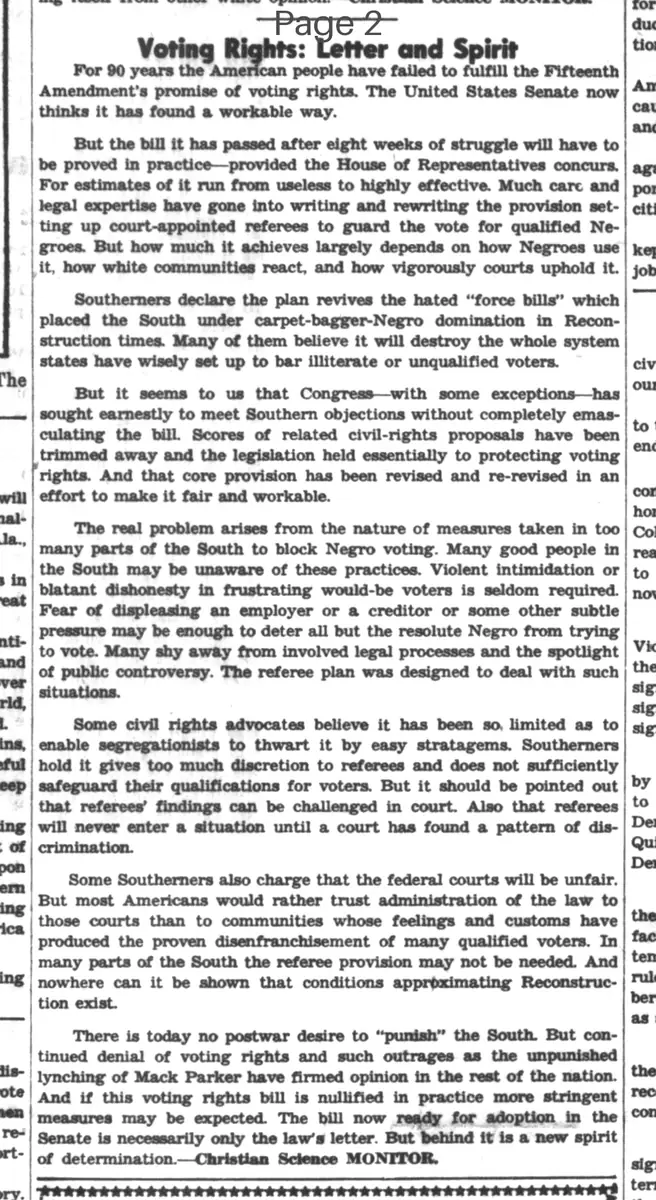
Voting Rights: Letter and Spirit
For 90 years the American people have failed to fulfill the Fifteenth Amendment's promise of voting rights. The United States Senate now thinks it has found a workable way.
But the bill it has passed after eight weeks of struggle will have to be proved in practice provided the House of Representatives concurs.
For estimates of it run from useless to highly effective. Much care and legal expertise have gone into writing and rewriting the provision setting up court-appointed referees to guard the vote for qualified Negroes. But how much it achieves largely depends on how Negroes use it, how white communities react, and how vigorously courts uphold it.
Southerners declare the plan revives the hated "force bills" which placed the South under carpet-bagger-Negro domination in Reconstruction times. Many of them believe it will destroy the whole system states have wisely set up to bar illiterate or unqualified voters.
But it seems to us that Congress with some exceptions—has sought earnestly to meet Southern objections without completely emasculating the bill. Scores of related civil-rights proposals have been trimmed away and the legislation held essentially to protecting voting rights. And that core provision has been revised and re-revised in an effort to make it fair and workable.
The real problem arises from the nature of measures taken in too many parts of the South to block Negro voting. Many good people in the South may be unaware of these practices. Violent intimidation or blatant dishonesty in frustrating would-be voters is seldom required.
Fear of displeasing an employer or a creditor or some other subtle pressure may be enough to deter all but the resolute Negro from trying to vote. Many shy away from involved legal processes and the spotlight of public controversy. The referee plan was designed to deal with such situations.
Some civil rights advocates believe it has been so limited as to enable segregationists to thwart it by easy stratagems. Southerners hold it gives too much discretion to referees and does not sufficiently safeguard their qualifications for voters. But it should be pointed out that referees' findings can be challenged in court. Also that referees will never enter a situation until a court has found a pattern of discrimination.
Some Southerners also charge that the federal courts will be unfair. But most Americans would rather trust administration of the law to those courts than to communities whose feelings and customs have produced the proven disenfranchisement of many qualified voters. In many parts of the South the referee provision may not be needed. And nowhere can it be shown that conditions approximating Reconstruction exist.
There is today no postwar desire to "punish" the South. But continued denial of voting rights and such outrages as the unpunished lynching of Mack Parker have firmed opinion in the rest of the nation. And if this voting rights bill is nullified in practice more stringent measures may be expected. The bill now ready for adoption in the Senate is necessarily only the law's letter. But behind it is a new spirit of determination.
—Christian Science Monitor.
For 90 years the American people have failed to fulfill the Fifteenth Amendment's promise of voting rights. The United States Senate now thinks it has found a workable way.
But the bill it has passed after eight weeks of struggle will have to be proved in practice provided the House of Representatives concurs.
For estimates of it run from useless to highly effective. Much care and legal expertise have gone into writing and rewriting the provision setting up court-appointed referees to guard the vote for qualified Negroes. But how much it achieves largely depends on how Negroes use it, how white communities react, and how vigorously courts uphold it.
Southerners declare the plan revives the hated "force bills" which placed the South under carpet-bagger-Negro domination in Reconstruction times. Many of them believe it will destroy the whole system states have wisely set up to bar illiterate or unqualified voters.
But it seems to us that Congress with some exceptions—has sought earnestly to meet Southern objections without completely emasculating the bill. Scores of related civil-rights proposals have been trimmed away and the legislation held essentially to protecting voting rights. And that core provision has been revised and re-revised in an effort to make it fair and workable.
The real problem arises from the nature of measures taken in too many parts of the South to block Negro voting. Many good people in the South may be unaware of these practices. Violent intimidation or blatant dishonesty in frustrating would-be voters is seldom required.
Fear of displeasing an employer or a creditor or some other subtle pressure may be enough to deter all but the resolute Negro from trying to vote. Many shy away from involved legal processes and the spotlight of public controversy. The referee plan was designed to deal with such situations.
Some civil rights advocates believe it has been so limited as to enable segregationists to thwart it by easy stratagems. Southerners hold it gives too much discretion to referees and does not sufficiently safeguard their qualifications for voters. But it should be pointed out that referees' findings can be challenged in court. Also that referees will never enter a situation until a court has found a pattern of discrimination.
Some Southerners also charge that the federal courts will be unfair. But most Americans would rather trust administration of the law to those courts than to communities whose feelings and customs have produced the proven disenfranchisement of many qualified voters. In many parts of the South the referee provision may not be needed. And nowhere can it be shown that conditions approximating Reconstruction exist.
There is today no postwar desire to "punish" the South. But continued denial of voting rights and such outrages as the unpunished lynching of Mack Parker have firmed opinion in the rest of the nation. And if this voting rights bill is nullified in practice more stringent measures may be expected. The bill now ready for adoption in the Senate is necessarily only the law's letter. But behind it is a new spirit of determination.
—Christian Science Monitor.
What sub-type of article is it?
Suffrage
Social Reform
What keywords are associated?
Voting Rights
Fifteenth Amendment
Negro Enfranchisement
Southern Discrimination
Referee Plan
Civil Rights Bill
Reconstruction Force Bills
Mack Parker Lynching
What entities or persons were involved?
United States Senate
House Of Representatives
Southerners
Negroes
Congress
Federal Courts
Mack Parker
Editorial Details
Primary Topic
Senate Voting Rights Bill Enforcing Fifteenth Amendment
Stance / Tone
Supportive With Cautious Optimism
Key Figures
United States Senate
House Of Representatives
Southerners
Negroes
Congress
Federal Courts
Mack Parker
Key Arguments
American People Have Failed To Fulfill Fifteenth Amendment For 90 Years
Senate Bill Sets Up Court Appointed Referees To Guard Negro Voting
Effectiveness Depends On Negro Usage, White Reactions, And Court Upholding
Southerners Claim It Revives Reconstruction Era Force Bills
Congress Trimmed Bill To Focus On Voting Rights While Addressing Objections
Subtle Pressures Deter Negro Voting More Than Violence
Referee Plan Designed For Subtle Discrimination Situations
Referees' Findings Challengeable In Court After Pattern Of Discrimination Found
Federal Courts Preferred Over Biased Communities
Continued Denial And Outrages Like Mack Parker's Lynching Firm National Opinion
Bill Represents New Spirit Of Determination