Thank you for visiting SNEWPapers!
Sign up free
Martinsburg Gazette And Public Advertiser
Martinsburg, Berkeley County, West Virginia
What is this article about?
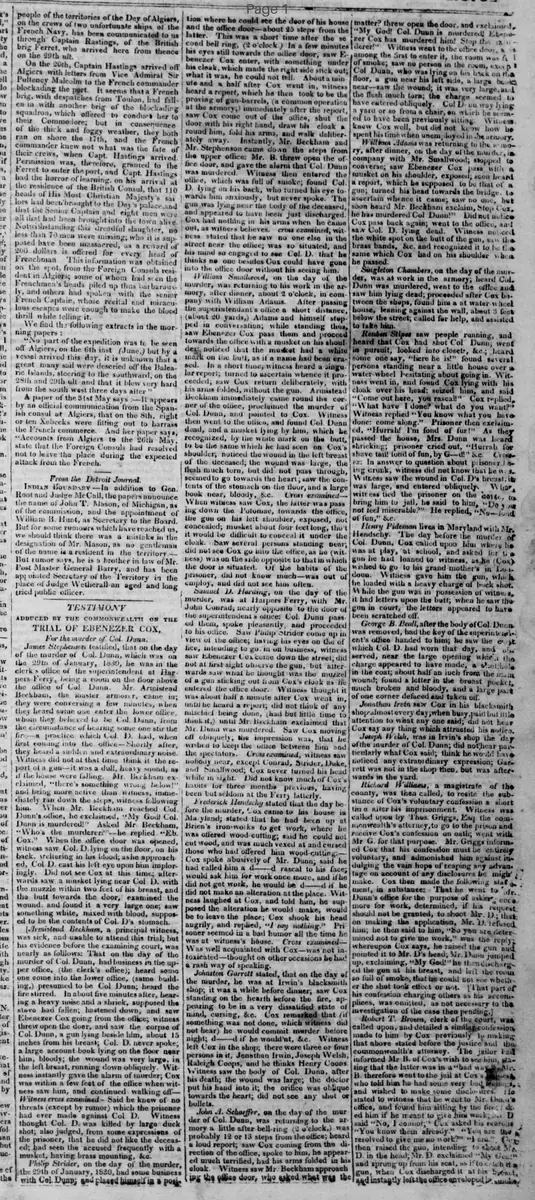
Testimony from witnesses and Cox's confession in the trial of Ebenezer Cox for murdering Col. Dunn by shooting him in the office at Harper's Ferry on January 29, 1830. Eyewitnesses saw Cox enter with a musket, heard the shot, and observed him leaving; Dunn died from a large wound to the left breast.
Clipping
OCR Quality
Full Text
For the murder of Col. Dunn.
James Stephenson testified, that on the day of the murder of Col. Dunn, which was on the 29th of January, 1830, he was in the clerk's office of the superintendent at Harper's Ferry, being a room on the floor above the office of Col. Dunn. Mr. Armistead Beckham, the master armorer, came in; they were conversing a few minutes, when they heard some one enter the lower office, whom they believed to be Col. Dunn, from the circumstance of hearing some one stir the fire—a practice which Col. D. had, when first coming into the office—Shortly after, they heard a sudden and extraordinary noise. Witness did not at that time think it the report of a gun—it was a dull, heavy sound, as if the house were falling. Mr. Beckham exclaimed, "there's something wrong below!" and being more active than witness, immediately ran down the steps, witness following him. When Mr. Beckham reached Col. Dunn's office, he exclaimed, "My God! Col. Dunn is murdered!" Asked Mr. Beckham, "Who's the murderer?"—he replied "Eb. Cox." When the office door was opened, witness saw Col. D. lying on the floor, on his back, weltering in his blood; as he approached, Col. D. cast his left eye upon him imploringly. Did not see Cox at this time; afterwards saw a musket lying near Col. D. with the muzzle within two feet of his breast, and the butt towards the door, examined the wound, and found it a very large one; saw something white, mixed with blood, supposed to be the contents of Col. D's stomach.
[Armistead Beckham, a principal witness, was sick, and unable to attend this trial; but his evidence before the examining court, was nearly as follows: That on the day of the murder of Col. Dunn, had business in the upper office, (the clerk's office); heard some one come into the lower office, (same building,) presumed to be Col. Dunn; heard the fire stirred. In about five minutes after, hearing a heavy noise and a shriek, supposed the stove had fallen; hastened down, and saw Ebenezer Cox going from the office; witness threw open the door, and saw the corpse of Col. Dunn, a gun lying beside him, about 15 inches from his breast; Col. D. never spoke; a large account book lying on the floor near him, bloody; the wound was very large, in the left breast, running down obliquely. Witness instantly gave the alarm of murder; Cox was within a few feet of the office when witness saw him, and continued walking off— Witness cross examined—Said he knew of no threats (except by rumor) which the prisoner had ever made against Col. D. Witness thought Col. D. was killed by large duck shot; also judged, from some expressions of the prisoner, that he did not like the deceased; had seen the accused frequently with a musket, having brass mounting, &c.]
Philip Strider, on the day of the murder, the 29th of January, 1830, had some business with Col. Dunn; and placed himself in a position where he could see the door of his house and the office door—about 25 steps from the latter. This was a short time after the second bell ring. (2 o'clock.) In a few minutes his eyes still towards the office door, saw Ebenezer Cox enter, with something under his cloak, which made the right side stick out; what it was, he could not tell. About a minute and a half after Cox went in, witness heard a report, which he then took to be the proving of gun-barrels, (a common operation at the armory;) immediately after the report, saw Cox come out of the office, shut the door with his right hand, draw his cloak round him, fold his arms, and walk deliberately away. Instantly, Mr. Beckham and Mr. Stephenson came down the steps from the upper office: Mr. B. threw open the office door, and gave the alarm that Col. Dunn was murdered. Witness then entered the office, which was full of smoke; found Col. D. lying on his back, who turned his eye towards him anxiously, but never spoke. The gun was lying near the body of the deceased, and appeared to have been just discharged. Cox had nothing in his arms when he came out, as witness believes. Cross examined, witness stated that he saw no one else in the street near the office; was so situated, and his mind so engaged to see Col. D. that he thinks no one besides Cox could have gone into the office door without his seeing him.
William Smallwood, on the day of the murder, was returning to his work in the armory, after dinner, about 2 o'clock, in company with William Adams. After passing the superintendent's office a short distance, (about 20 yards, Adams and himself stopped in conversation; while standing thus, saw Ebenezer Cox pass them and proceed towards the office with a musket on his shoulder; noticed that the musket had a white mark on the butt, as if a name had been erased. In a short time, witness heard a singular report; turned to ascertain whence it proceeded; saw Cox return deliberately, with his arms folded, without the gun. Armistead Beckham immediately came round the corner of the office, proclaimed the murder of Col. Dunn, and pointed to Cox. Witness then went to the office, and found Col. Dunn dead, and a musket lying by him, which he recognized, by the white mark on the butt, to be the same which he had seen on Cox's shoulder; noticed the wound in the left breast of the deceased; the wound was large, the flesh much torn, but did not pass through, seemed to go towards the heart; saw the contents of the stomach on the floor, and a large book near, bloody, &c. Cross examined— When witness saw Cox, the latter was passing down the Potomac, towards the office, the gun on his left shoulder, exposed, not concealed; musket about four feet long, tho't it would be difficult to conceal it under the cloak. Saw several persons standing near; did not see Cox go into the office, as he (wit. ness) was on the side opposite to that in which the door is situated. Of the habits of the prisoner, did not know much—was out of employ, and did not see him often.
Samuel D. Harding, on the day of the murder, was at Harpers Ferry, with Mr. John Conrad, nearly opposite to the door of the superintendent office: Col. Dunn passed them, spoke pleasantly, and proceeded to his office. Saw Philip Strider come up in view of the office; having his eyes on the office, intending to go in on business, witness saw Ebenezer Cox come down the street; did not at first sight observe the gun, but afterwards saw what he thought was the muzzle of a gun sticking out from Cox's cloak as he entered the office door. Witness thought it was about half a minute after Cox went in, until he heard a report; did not think of any mischief being done, (had but little time to think it,) until Mr. Beckham exclaimed that Mr. Dunn was murdered. Saw Cox moving off obliquely; the impression was, that he wished to keep the office between him and the spectators. Cross examined, witness saw nobody near, except Conrad, Strider, Duke and Smallwood; Cox never turned his head while in sight. Did not know much of Cox's habits for three months previous, having been but seldom at the Ferry latterly.
Frederick Hendschy stated that the day before the murder, Cox came to his house in Maryland; stated that he had been up at Brien's iron-works to get work, where he was offered wood-cutting: said he could not cut wood, and was much vexed at and cursed those who had offered him wood-cutting:— Cox spoke abusively of Mr. Dunn; said he had called him a d—d rascal to his face; would ask him for work once more, and if he did not get work, he would be d—d if he did not make an alteration at the place. Witness laughed at Cox, and told him, he supposed the alteration he would make, would be to leave the place; Cox shook his head angrily, and replied, "I say nothing." Prisoner seemed in a bad humor all the time he was at witness's house. Cross examined— Was well acquainted with Cox—was not intoxicated—thought on other occasions he had a rash way of speaking.
Johnston Garrett stated, that on the day of the murder, he was at Irwin's blacksmith shop; it was a while before dinner; saw Cox standing on the hearth before the fire, appearing to be in a very dissatisfied state of mind, cursing, &c. Cox remarked that (if something was not done, which witness did not hear) he would commit murder before night; d—d if he wouldn't, &c. Witness left Cox in the shop; there were three or four persons in it, Jonathan Irwin, Joseph Welsh, Raleigh Coops, and he thinks Henry Coobs. Witness saw the body of Col. Dunn, after his death; the wound was large; the doctor put his hand into it; the orifice was oblique towards the heart; did not see any shot or bullets.
John A. Schaeffer, on the day of the murder of Col. Dunn, was returning to the armory a little after bell-ring (2 o'clock,) was probably 12 or 13 steps from the office; heard a loud report; saw Cox coming from the direction of the office, spoke to him, he appeared much terrified, had his arms folded in his cloak. Witness saw Mr. Beckham approaching the office door, who asked what way the matter? threw open the door, and exclaimed, "My God! Col. Dunn is murdered! Ebenezer Cox has murdered him! Stop the murderer!" Witness went to the office door, as among the first to enter it, the room was full of smoke; saw no person in the room, except Col. Dunn, who was lying on his back on the floor, a gun near his left side, a large book near—saw the wound; it was very large, and the flesh much torn; the charge seemed to have entered obliquely. Col. Dunn was lying a yard or so from a chair, on which he seemed to have been previously sitting. Witness knew Cox well, but did not know how he spent his time when unemployed in the armory.
William Adams was returning to the armory, after dinner, on the day of the murder, in company with Mr. Smallwood; stopped to converse; saw Ebenezer Cox pass with a musket on his shoulder, exposed; soon heard a report, which he supposed to be that of a gun; turned his head towards the bridge, to ascertain whence it came; saw no one, but soon heard Mr. Beckham exclaim, Stop Cox, he has murdered Col. Dunn!" Did not notice Cox pass back again; went to the office, and saw Col. D. lying dead. Witness noticed the white spot on the butt of the gun, saw the brass bands, &c. and recognized it to be the same which Cox had on his shoulder when he passed.
Singleton Chambers, on the day of the murder, was at work in the armory; heard Col. Dunn was murdered, went to the office and saw him lying dead; proceeded after Cox between the shops, found him at water-wheel house, leaning against the wall, about 8 feet below the street; called for help, and assisted to take him.
Reuben Slipes saw people running, and heard that Cox had shot Col. Dunn; went in pursuit, looked into closets, &c.; heard some one say, "here he is!" found several persons standing near a little house over water-wheel hesitating about going in. Witness went in, and found Cox lying with his cloak over his head: seized him, and said "Come out here, you rascal!" Cox replied, "What have I done? what do you want?" Witness replied "You know what you have done: come along." Prisoner then exclaimed, "Hurrah! I'm fond of fun!" As they passed the house, Mrs. Dunn was heard shrieking; prisoner cried out, "Hurrah or shave tail! fond of fun, by G—d!" &c. Cross ex: In answer to question about prisoner being drunk, witness did not know that he was. Witness saw the wound in Col. D's breast. it was large, and entered obliquely. When, witness tied the prisoner on the horse, to bring him to jail, he said to him, "Do you not feel miserable?" He replied, "No—fond of fun," &c.
Henry Pideman lives in Maryland with Mr. Hendschy. The day before the murder of Col. Dunn, Cox called upon him where he was at play, at school, and asked for the gun he had loaned to witness, as he (Cox) wished to go to his grand-mother's in Loudoun. Witness gave him the gun, which he loaded with a heavy charge of buck shot. While the gun was in possession of witness, it had letters upon the butt; when he saw the gun in court, the letters appeared to have been scratched off.
George B. Beall, after the body of Col. Dunn was removed, had the key of the superintendent's office handed to him; he saw the coat which Col. D. had worn that day, and often observed, near the large opening where the charge appeared to have made, a slothole in the coat; about half an inch from the main wound; found a letter in the breast pocket, much broken and bloody, and a large part of one corner defaced and taken off.
Jonathan Irwin saw Cox in his blacksmith shop almost every day; when busy, paid but little attention to what any one said; did not hear Cox say anything which attracted his notice.
Joseph Welsh, was in Irwin's shop the day of the murder of Col. Dunn; did not hear particularly what Cox said; think he would have noticed any extraordinary expression; Garrett was not in the shop then, but was afterwards in the yard.
Richard Williams, a magistrate of the county, was then called, to recite the substance of Cox's voluntary confession a short time after his imprisonment. Witness was called upon by Thos. Griggs, Esq. the commonwealth's attorney, to go to the prison and receive Cox's confession on oath; went with Mr. G. for that purpose. Mr. Griggs informed Cox that his confession must be entirely voluntary, and admonished him against indulging the vain hope of reaping any advantage on account of any disclosures he might make. Cox then made the following statement, in substance: That he went to Mr. Dunn's office for the purpose of asking once more for work, determined, if his request should not be granted, to shoot Mr. D.; that on making the application, Mr. D. refused him; he then said to him, "So you are determined not to give me work," was the reply; whereupon Cox says, he raised the gun and pointed it to Mr. D's head; Mr. Dunn jumped up, exclaiming, "My God!" he then discharged the gun at his breast, and left the room so full of smoke, that he could not see whether the shot took effect or not. [That part of his confession charging others as his accomplices, was omitted, as not necessary to the investigation of the case then pending.]
Robert T. Brown, clerk of the court, was called upon, and detailed a similar confession made to him by Cox previously to making that above stated before the justice and the commonwealth's attorney. The jailor had informed Mr. B. of Cox's wish to see him, stating that the latter was in a "bad way." Mr. B. therefore went to the jail at Cox's request, who told him he had some very bad things, and wished to make some disclosures. He stated to witness that he went to Mr. Dunn's office, and found him sitting by the fire; asked him if he meant to give him work; Mr. D. said "No, I cannot;" Cox asked his reason "You know them already." "You are then resolved to give me no work?" "I am." Cox then raised the gun, intending to shoot Mr. D. in the head; Mr. D. exclaimed "My God" and sprung up from his seat, as if to catch the gun, when Cox discharged it at his breast, and instantly left the office enveloped in smoke.
What sub-type of article is it?
What keywords are associated?
What entities or persons were involved?
Where did it happen?
Domestic News Details
Primary Location
Harper's Ferry
Event Date
29th Of January, 1830
Key Persons
Outcome
col. dunn shot in the left breast with buckshot from a musket, died from the wound; ebenezer cox arrested, confessed to the murder motivated by refusal of employment.
Event Details
Ebenezer Cox entered Col. Dunn's office at the armory in Harper's Ferry armed with a musket loaded with buckshot, asked for work, and upon refusal shot Dunn in the breast at close range around 2 o'clock; witnesses observed Cox entering and leaving, heard the shot, found Dunn dying with the gun nearby; Cox fled but was captured nearby and later confessed voluntarily to the act.