Thank you for visiting SNEWPapers!
Sign up free
Miami Labor Citizen
Miami, Dade County, Florida
What is this article about?
The Commercial Telegraphers' Union strike against Western Union continues unbroken, 98% effective, with the company handling only 5% of business using supervisors and mail. Supervisory staff discontent grows over unfair wage increases, especially after President Walter Marshall's raise. Strike began April 3 after failed negotiations for better hours, wages, and pensions amid company mechanization reducing workforce.
Merged-components note: Merged continuation from page 1 to page 4; changed label from domestic_news to story for consistency
Clippings
1 of 2
OCR Quality
Full Text
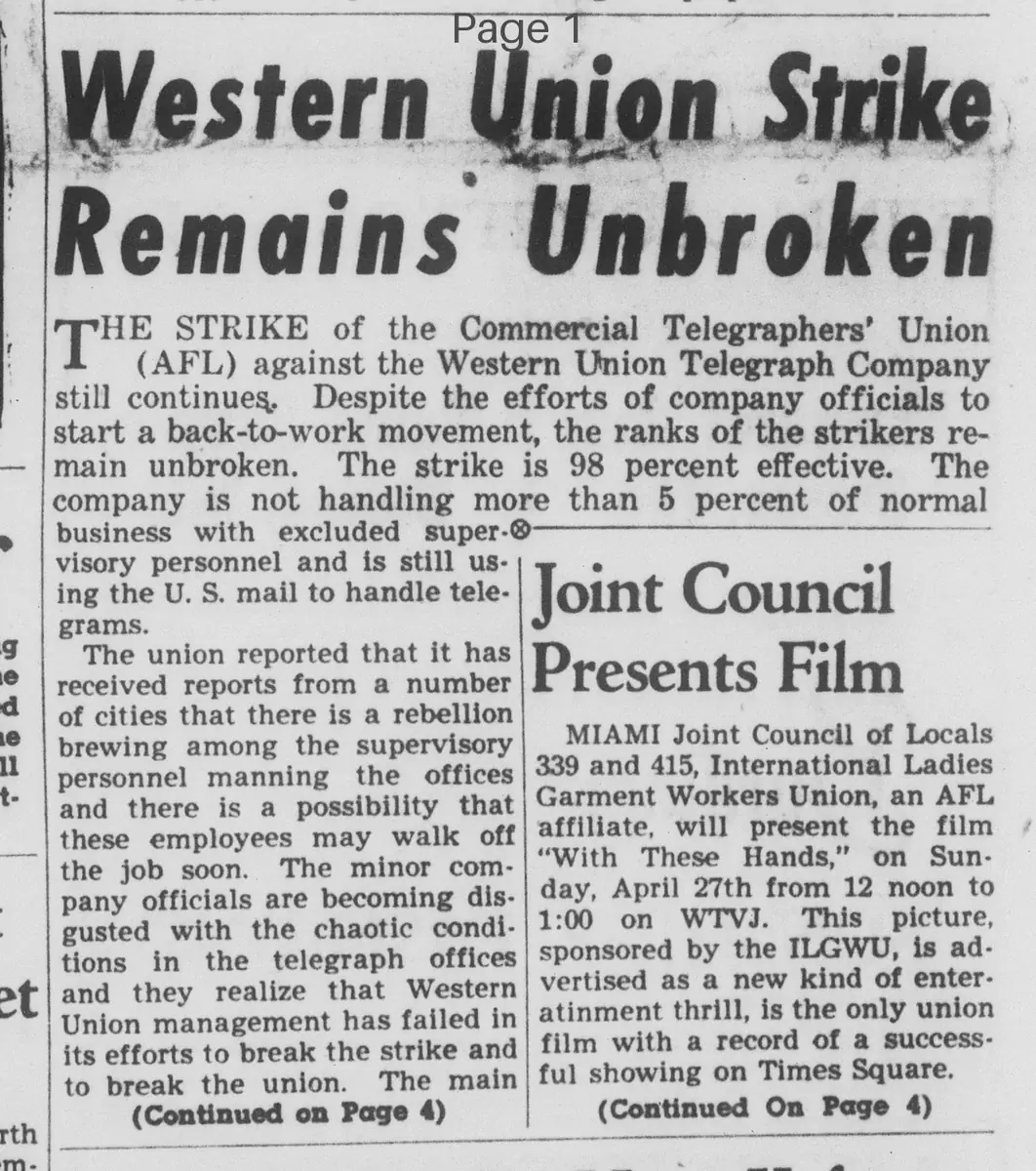
THE STRIKE of the Commercial Telegraphers' Union (AFL) against the Western Union Telegraph Company still continues.
Despite the efforts of company officials to start a back-to-work movement, the ranks of the strikers remain unbroken.
The strike is 98 percent effective.
The company is not handling more than 5 percent of normal business with excluded supervisory personnel and is still using the U. S. mail to handle telegrams.
The union reported that it has received reports from a number of cities that there is a rebellion brewing among the supervisory personnel manning the offices and there is a possibility that these employees may walk off the job soon. The minor company officials are becoming disgusted with the chaotic conditions in the telegraph offices and they realize that Western Union management has failed in its efforts to break the strike and to break the union.
The main
(Continued on Page 4)
Western Union
(Continued From Page 1)
gripe of these minor officials, however, is that the company has not treated them fairly in the distribution of wage increases. The company promised these officials more than a year ago that there would be a "review" of salaries and "meritorious" increases would be granted. These wage increases have been very slow in coming or have not been granted at all.
The minor officials were patient but their dissatisfaction zoomed to a boiling point recently when they learned that Walter Marshall, president of Western Union, had received a salary increase of $11,810 last year, bringing his salary to $93,025 a year, with provision for a pension of $41,000 a year when Mr. Marshall retires.
The strike against Western Union started at 12:01 a.m., April 3rd, after negotiations between the CTU and the company were broken off when the company refused to offer "one penny" towards giving the employees a 40-hour, 5-day week, a wage increase and other improvements in the contract.
The union charges that the company has adopted a "medieval" anti-labor policy. The union points to the fact that the company has spent more than $100,000,000 for new telegraph machines in the past five years, and through mechanization has been able to reduce the telegraph force from 66,000 to 40,000 in less than 10 years, but the company refuses to give its employees any of the benefits of this mechanization by agreeing to a 40-hour, 5-day week, a wage increase to correct inequities in job classification and an improved pension plan.
What sub-type of article is it?
What themes does it cover?
What keywords are associated?
What entities or persons were involved?
Where did it happen?
Story Details
Key Persons
Location
A Number Of Cities
Event Date
Started At 12:01 A.M., April 3rd
Story Details
Ongoing strike by CTU against Western Union remains 98% effective; supervisors discontented over wages amid executive raises; began after failed talks for 40-hour week, wage increases, better pensions despite mechanization reducing staff.