Thank you for visiting SNEWPapers!
Sign up free
The Virginia Gazette
Richmond, Williamsburg, Richmond County, Virginia
What is this article about?
Excerpt from Dr. Robertson's history detailing the origins and tenets of the Anabaptists during the Reformation, their fanaticism, the uprising in Munster led by Matthias and Beccold, establishment of a polygamous theocracy, and its violent suppression in 1535.
Merged-components note: Continuation of the history of the Anabaptists across pages 1 and 2.
Clippings
1 of 2
OCR Quality
Full Text
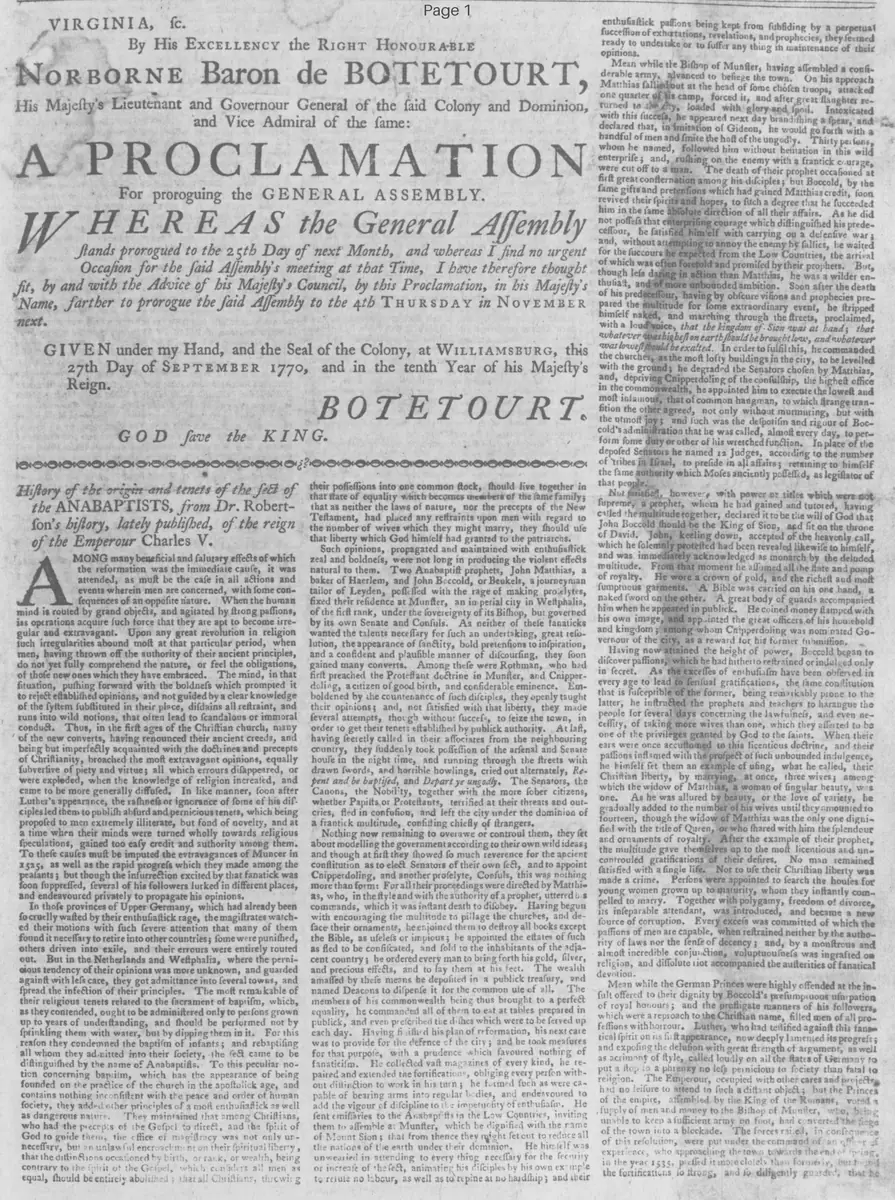
AMONG many beneficial and salutary effects of which the reformation was the immediate cause, it was attended, as must be the case in all actions and events wherein men are concerned, with some consequences of an opposite nature. When the human mind is roused by grand objects, and agitated by strong passions, its operations acquire such force that they are apt to become irregular and extravagant. Upon any great revolution in religion such irregularities abound most at that particular period, when men, having thrown off the authority of their ancient principles, do not yet fully comprehend the nature, or feel the obligations, of those new ones which they have embraced. The mind, in that situation, pushing forward with the boldness which prompted it to reject established opinions, and not guided by a clear knowledge of the system substituted in their place, disdains all restraint, and runs into wild notions, that often lead to scandalous or immoral conduct. Thus, in the first ages of the Christian church, many of the new converts, having renounced their ancient creeds, and being but imperfectly acquainted with the doctrines and precepts of Christianity, broached the most extravagant opinions, equally subversive of piety and virtue; all which errors disappeared, or were exploded, when the knowledge of religion increased, and came to be more generally diffused. In like manner, soon after Luther's appearance, the rashness or ignorance of some of his disciples led them to publish absurd and pernicious tenets, which being proposed to men extremely illiterate, but fond of novelty, and at a time when their minds were turned wholly towards religious speculations, gained too easy credit and authority among them. To these causes must be imputed the extravagances of Munzer in 1525, as well as the rapid progress which they made among the peasants; but though the insurrection excited by that fanatic was soon suppressed, several of his followers lurked in different places, and endeavoured privately to propagate his opinions. In those provinces of Upper Germany, which had already been so cruelly wasted by their enthusiastick rage, the magistrates watched their motions with such severe attention that many of them found it necessary to retire into other countries; some were punished, others driven into exile, and their errors were entirely rooted out. But in the Netherlands and Westphalia, where the pernicious tendency of their opinions was more unknown, and guarded against with less care, they got admittance into several towns, and spread the infection of their principles. The most remarkable of their religious tenets related to the sacrament of baptism, which, as they contended, ought to be administered only to persons grown up to years of understanding, and should be performed not by sprinkling them with water, but by dipping them in it. For this reason they condemned the baptism of infants; and rebaptizing all whom they admitted into their society, the sect came to be distinguished by the name of Anabaptists. To this peculiar notion concerning baptism, which has the appearance of being founded on the practice of the church in the apostolick age, and contains nothing inconsistent with the peace and order of human society, they added other principles of a most enthusiastick as well as dangerous nature. They maintained that among Christians, who had the precepts of the Gospel to direct, and the spirit of God to guide them, the office of magistracy was not only unnecessary, but an unlawful encroachment on their spiritual liberty, that the distinctions occasioned by birth, or rank, or wealth, being contrary to the spirit of the Gospel, which considers all men as equal, should be entirely abolished; that all Christians, throwing their possessions into one common stock, should live together in that state of equality which becomes members of the same family; that as neither the laws of nature, nor the precepts of the New Testament, had placed any restraints upon men with regard to the number of wives which they might marry, they should use that liberty which God himself had granted to the patriarchs. Such opinions, propagated and maintained with enthusiastick zeal and boldness, were not long in producing the violent effects natural to them. Two Anabaptist prophets, John Matthias, a baker of Haerlem, and John Beccold, or Beukels, a journeyman tailor of Leyden, possessed with the rage of making proselytes, fixed their residence at Munster, an imperial city in Westphalia, of the first rank, under the sovereignty of its Bishop, but governed by its own Senate and Consuls. As neither of these fanaticks wanted the talents necessary for such an undertaking, great resolution, the appearance of sanctity, bold pretensions to inspiration, and a confident and plausible manner of discoursing, they soon gained many converts. Among these were Rothman, who had first preached the Protestant doctrine in Munster, and Knipperdolling, a citizen of good birth, and considerable eminence. Emboldened by the countenance of such disciples, they openly taught their opinions; and, not satisfied with that liberty, they made several attempts, though without success, to seize the town, in order to get their tenets established by publick authority. At last, having secretly called in their associates from the neighbouring country, they suddenly took possession of the arsenal and Senate house in the night time, and running through the streets with drawn swords, and horrible howlings, cried out alternately, Repent and be baptised, and Depart ye ungodly. The Senators, the Canons, the Nobility, together with the more sober citizens, whether Papists or Protestants, terrified at their threats and outcries, fled in confusion, and left the city under the dominion of a frantick multitude, consisting chiefly of strangers. Nothing now remaining to overawe or controul them, they set about modelling the government according to their own wild ideas; and though at first they showed so much reverence for the ancient constitution as to elect Senators of their own sect, and to appoint Knipperdolling, and another proselyte, Consuls, this was nothing more than form: For all their proceedings were directed by Matthias, who, in the style and with the authority of a prophet, uttered his commands, which it was instant death to disobey. Having begun with encouraging the multitude to pillage the churches, and deface their ornaments, he enjoined them to destroy all books except the Bible, as useless or impious; he appointed the estates of such as fled to be confiscated, and sold to the inhabitants of the adjacent country; he ordered every man to bring forth his gold, silver, and precious effects, and to lay them at his feet. The wealth amassed by these means he deposited in a publick treasury, and named Deacons to dispense it for the common use of all. The members of his commonwealth being thus brought to a perfect equality, he commanded all of them to eat at tables prepared in publick, and even prescribed the dishes which were to be served up each day. Having finished his plan of reformation, his next care was to provide for the defence of the city; and he took measures for that purpose, with a prudence which savoured nothing of fanaticism. He collected vast magazines of every kind, he repaired and extended the fortifications, obliging every person without distinction to work in his turn; he formed such as were capable of bearing arms into regular bodies, and endeavoured to add the vigour of discipline to the impetuosity of enthusiasm. He sent emissaries to the Anabaptists in the Low Countries, inviting them to assemble at Munster, which he dignified with the name of Mount Sion; that from thence they might set out to reduce all the nations of the earth under their dominion. He himself was unwearied in attending to every thing necessary for the security or increase of the sect, animating his disciples by his own example to refuse no labour, as well as to repine at no hardship; and their enthusiastick passions being kept from subsiding by a perpetual succession of exhortations, revelations, and prophecies, they seemed ready to undertake or to suffer any thing in maintenance of their opinions.
Meanwhile the Bishop of Munster, having assembled a considerable army, advanced to besiege the town. On his approach Matthias sallied out at the head of some chosen troops, attacked one quarter of his camp, forced it, and after great slaughter returned to the city, loaded with glory and spoil. Intoxicated with this success, he appeared next day brandishing a spear, and declared that, in imitation of Gideon, he would go forth with a handful of men and smite the host of the ungodly. Thirty persons, whom he named, followed him without hesitation in this wild enterprize; and, rushing on the enemy with a frantick courage, were cut off to a man. The death of their prophet occasioned at first great consternation among his disciples; but Beccold, by the same gifts and pretensions which had gained Matthias credit, soon revived their spirits and hopes, to such a degree that he succeeded him in the same absolute direction of all their affairs. As he did not possess that enterprising courage which distinguished his predecessor, he satisfied himself with carrying on a defensive war; and, without attempting to annoy the enemy by sallies, he waited for the succours he expected from the Low Countries, the arrival of which was often foretold and promised by their prophets. But, though less daring in action than Matthias, he was a wilder enthusiast, and of more unbounded ambition. Soon after the death of his predecessor, having by obscure visions and prophecies prepared the multitude for some extraordinary event, he stripped himself naked, and marching through the streets, proclaimed, with a loud voice, that the kingdom of Sion was at hand; that whatsoever was high on earth should be brought low, and whatsoever was lowest should be exalted. In order to fulfil this, he commanded the churches, as the most lofty buildings in the city, to be levelled with the ground; he degraded the Senators chosen by Matthias, and, depriving Knipperdolling of the consulship, the highest office in the commonwealth, he appointed him to execute the lowest and most infamous, that of common hangman, to which strange transition the other agreed, not only without murmuring, but with the utmost joy; and such was the despotism and rigour of Beccold's administration that he was called, almost every day, to perform some duty or other of his wretched function. In place of the deposed Senators he named 12 Judges, according to the number of tribes in Israel, to preside in all affairs; retaining to himself the same authority which Moses anciently possessed, as legislator of that people.
Not satisfied, however, with power or titles which were not supreme, a prophet, whom he had gained and tutored, having called the multitude together, declared it to be the will of God that John Beccold should be the King of Sion, and sit on the throne of David. John, kneeling down, accepted of the heavenly call, which he solemnly protested had been revealed likewise to himself, and was immediately acknowledged as monarch by the deluded multitude. From that moment he assumed all the state and pomp of royalty. He wore a crown of gold, and the richest and most sumptuous garments. A Bible was carried on his one hand, a naked sword on the other. A great body of guards accompanied him when he appeared in publick. He coined money stamped with his own image, and appointed the great officers of his household and kingdom; among whom Knipperdolling was nominated Governor of the city, as a reward for his former submission. Having now attained the height of power, Beccold began to discover passions, which he had hitherto restrained or indulged only in secret. As the excess of enthusiasm have been observed in every age to lead to sensual gratifications, the same constitution that is susceptible of the former, being remarkably prone to the latter, he instructed the prophets and teachers to harangue the people for several days concerning the lawfulness, and even necessity, of taking more wives than one, which they asserted to be one of the privileges granted by God to the saints. When their ears were once accustomed to this licentious doctrine, and their passions inflamed with the prospect of such unbounded indulgence, he himself set them an example of using, what he called, their Christian liberty, by marrying, at once, three wives; among which the widow of Matthias, a woman of singular beauty, was one. As he was allured by beauty, or the love of variety, he gradually added to the number of his wives until they amounted to fourteen, though the widow of Matthias was the only one dignified with the title of Queen, or who shared with him the splendour and ornaments of royalty. After the example of their prophet, the multitude gave themselves up to the most licentious and uncontroll'd gratifications of their desires. No man remained satisfied with a single wife. Not to use their Christian liberty was made a crime. Persons were appointed to search the houses for young women grown up to maturity, whom they instantly compelled to marry. Together with polygamy, freedom of divorce, its inseparable attendant, was introduced, and became a new source of corruption. Every excess was committed of which the passions of men are capable, when restrained neither by the authority of laws nor the sense of decency; and, by a monstrous and almost incredible conjunction, voluptuousness was ingrafted on religion, and dissolute riot accompanied the austerities of fanatical devotion.
Meanwhile the German Princes were highly offended at the insult offered to their dignity by Beccold's presumptuous usurpation of royal honours; and the profligate manners of his followers, which were a reproach to the Christian name, filled men of all professions with horror. Luther, who had testified against this fanatical spirit on its first appearance, now deeply lamented its progress; and exposing the delusion with great strength of argument, as well as acrimony of style, called loudly on all the states of Germany to put a stop to a phrenzy no less pernicious to society than fatal to religion. The Emperour, occupied with other cares and projects had no leisure to attend to such a distant object; but the Princes of the empire, assembled by the King of the Romans, voted a supply of men and money to the Bishop of Munster, who, being unable to keep a sufficient army on foot, had converted the siege of the town into a blockade. The forces raised, in consequence of this resolution, were put under the command of an officer of experience, who approaching the town towards the end of spring in the year 1535, pressed it in close then sought relief, but found the fortifications so strong, and so diligently guarded, that he did not attempt an assault. It was now above 15 months since the Anabaptists had established their dominion in Munster; they had, during that time, undergone prodigious fatigue in working on the fortifications, and performing military duty. Notwithstanding the prudent attention of their King to provide for their subsistence, and his frugal and regular economy in their public meals, they began to feel the approach of famine. Several small bodies of their brethren, who were advancing to their assistance from the Low Countries, had been intercepted, and cut to pieces; and, while all Germany was ready to combine against them, they had no prospect of succour. But such was the ascendant which Bockold had acquired over the multitude, and so powerful the fascination of enthusiasm, that their hopes were as sanguine as ever, and they hearkened with implicit credulity to the visions and predictions of their prophets, which assured them that the Almighty would speedily interpose, in order to deliver the city. The faith, however, of some few, shaken by the violence and length of their sufferings, began to fail; but, being suspected of an inclination to surrender to the enemy, they were punished with immediate death, as guilty of impiety in distrusting the power of God. One of the King's wives, having uttered certain words that implied some doubt concerning his divine mission, he instantly called the whole number together, and commanding the blasphemer, as he called her, to kneel down, cut off her head with his own hands; and so far were the rest from expressing any horror at this cruel deed, that they joined him in dancing with a frantic joy around the bleeding body of their companion. By this time the besieged endured the utmost rigour of famine; but they chose rather to suffer hardships, the recital of which is shocking to humanity, than to listen to the terms of capitulation offered them by the Bishop. At last a deserter, whom they had taken into their service, being either less intoxicated with the fumes of enthusiasm, or unable any longer to bear such distress, made his escape to the enemy. He informed their General of a weak part in the fortifications, which he had observed, and assuring him that the besieged, exhausted with hunger and fatigue, kept watch there with little care, he offered to lead a party thither in the night. The proposal was accepted, and a chosen body of troops appointed for the service; who, scaling the walls unperceived, seized one of the gates, and admitted the rest of the army. The Anabaptists, though surprised, defended themselves in the market place with valour, heightened by despair; but being overpowered by numbers, and surrounded on every hand, most of them were slain, and the remainder taken prisoners. Among the last were the King, and Knipperdolling. The King, loaded with chains, was carried from city to city, as a spectacle to gratify the curiosity of the people, and was exposed to all their insults. His spirit, however, was not broken or humbled by this adverse reverse of his condition; and he adhered with unshaken firmness to the distinguishing tenets of his sect. After this he was brought back to Munster, the scene of his royalty and crimes, and put to death with the most exquisite and lingering tortures, all which he bore with astonishing fortitude. This extraordinary man, who had been able to acquire such amazing dominion over the minds of his followers, and to excite commotions so dangerous to society, was only 26 years of age. Together with its monarch, the kingdom of the Anabaptists came to an end. Their principles having taken deep root in the Low Countries, the party still subsists there, under the name of Mennonites; but, by a very singular revolution, this sect, so mutinous and sanguinary at its first origin, hath become altogether innocent and pacifick. Holding it unlawful to wage war, or to accept of civil offices, they devote themselves entirely to the duties of private citizens, and by their industry and charity endeavour to make reparation to human society for the violence committed by their founders. A small number of this sect, which is entitled in England, retains its peculiar tenets concerning baptism, but without any dangerous mixture of enthusiasm.
What sub-type of article is it?
What themes does it cover?
What keywords are associated?
What entities or persons were involved?
Literary Details
Title
History Of The Origin And Tenets Of The Sect Of The Anabaptists, From Dr. Robertson's History, Lately Published, Of The Reign Of The Emperour Charles V.
Author
Dr. Robertson
Subject
Origin And Tenets Of The Anabaptists During The Reformation
Form / Style
Historical Narrative In Prose
Key Lines