Thank you for visiting SNEWPapers!
Sign up free
Lynchburg Virginian
Lynchburg, Virginia
What is this article about?
The Baltimore Patriot refutes the Washington Union's accusations that the Whig party supports abolitionism, citing the rejection of extreme abolition resolutions at the Massachusetts Whig State Convention and noting President Polk's associations with abolitionists.
Clipping
OCR Quality
Full Text
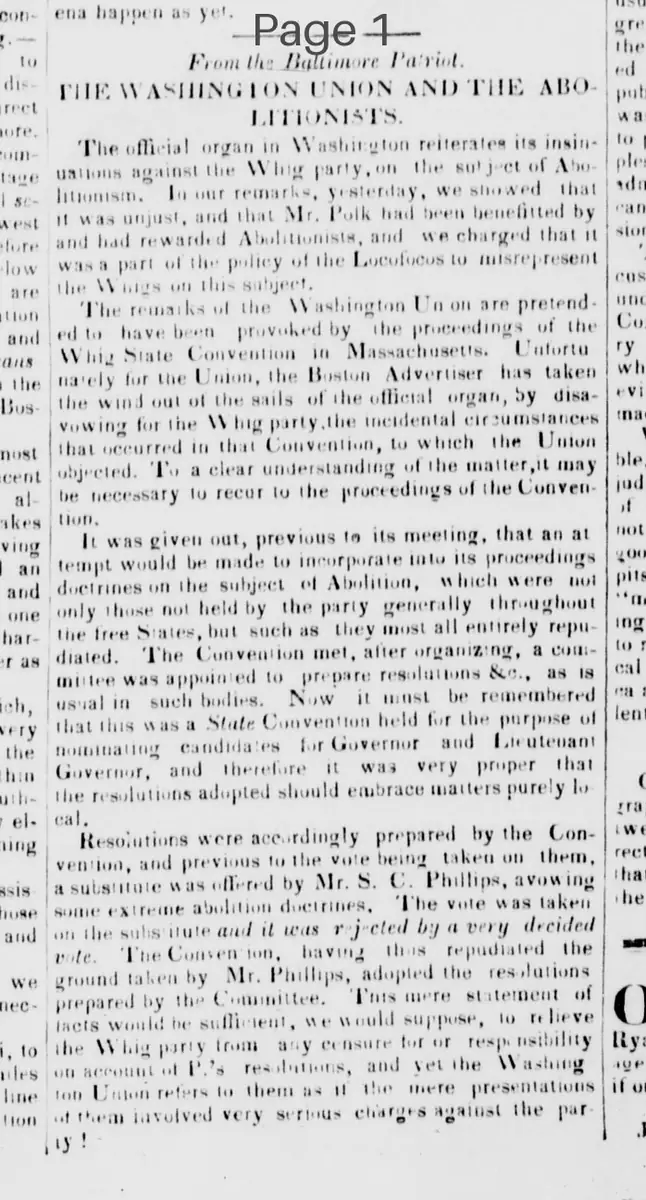
THE WASHINGTON UNION AND THE ABOLITIONISTS.
The official organ in Washington reiterates its insinuations against the Whig party, on the subject of Abolitionism. In our remarks, yesterday, we showed that it was unjust, and that Mr. Polk had been benefitted by and had rewarded Abolitionists, and we charged that it was a part of the policy of the Locofocos to misrepresent the Whigs on this subject.
The remarks of the Washington Union are pretended to have been provoked by the proceedings of the Whig State Convention in Massachusetts. Unfortunately for the Union, the Boston Advertiser has taken the wind out of the sails of the official organ, by disavowing for the Whig party, the incidental circumstances that occurred in that Convention, to which the Union objected. To a clear understanding of the matter, it may be necessary to recur to the proceedings of the Convention.
It was given out, previous to its meeting, that an attempt would be made to incorporate into its proceedings doctrines on the subject of Abolition, which were not only those not held by the party generally throughout the free States, but such as they most all entirely repudiated. The Convention met, after organizing, a committee was appointed to prepare resolutions &c., as is usual in such bodies. Now it must be remembered that this was a State Convention held for the purpose of nominating candidates for Governor and Lieutenant Governor, and therefore it was very proper that the resolutions adopted should embrace matters purely local.
Resolutions were accordingly prepared by the Convention, and previous to the vote being taken on them, a substitute was offered by Mr. S. C. Phillips, avowing some extreme abolition doctrines. The vote was taken on the substitute and it was rejected by a very decided vote. The Convention, having thus repudiated the ground taken by Mr. Phillips, adopted the resolutions prepared by the Committee. This mere statement of facts would be sufficient, we would suppose, to relieve the Whig party from any censure for or responsibility on account of P.'s resolutions, and yet the Washington Union refers to them as if the mere presentations at them involved very serious charges against the party!
The Boston Advertiser, as if anticipating this very course of the Washington Union, has by an examination of the subject, so completely answered every ground taken by the Washington Union, that it leaves nothing to be said by others. And as the Convention itself rejected the resolutions, and they have thus fallen to the ground, it is quite useless to say any thing more on the subject, or to disclaim for the Whigs of Maryland what the Whigs of Massachusetts condemned as soon as proposed.
What sub-type of article is it?
What keywords are associated?
What entities or persons were involved?
Where did it happen?
Domestic News Details
Primary Location
Massachusetts
Key Persons
Outcome
extreme abolition resolutions proposed by mr. s. c. phillips were rejected by a decisive vote; the convention adopted the committee's local resolutions.
Event Details
The Whig State Convention in Massachusetts nominated candidates for Governor and Lieutenant Governor. A substitute resolution with extreme abolition doctrines was offered by Mr. S. C. Phillips but rejected. The Washington Union accused the Whig party of abolitionism based on this, but the Boston Advertiser and the Patriot defended the party, noting the rejection and Polk's ties to abolitionists.