Thank you for visiting SNEWPapers!
Sign up free
Richmond Enquirer
Richmond, Richmond County, Virginia
What is this article about?
On January 15, 1821, New York Governor De Witt Clinton delivered a message to the state legislature detailing evidence of improper interference by U.S. federal officers in the 1820 state elections, including from navy yard, customs, post office, and judicial officials, to influence outcomes against the state administration.
Clipping
OCR Quality
Full Text
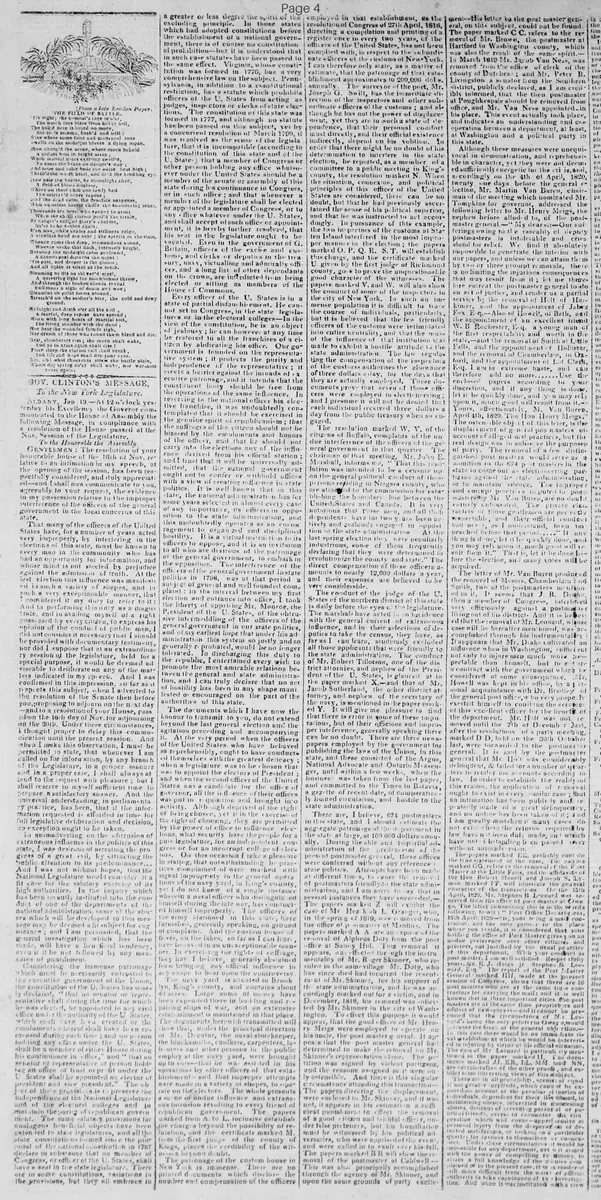
To the New York Legislature.
ALBANY, Jan. 19.—At 12 o'clock yesterday his Excellency the Governor communicated to the House of Assembly the following Message, in compliance with a resolution of the House passed at the Nov. Session of the Legislature.
To the Honorable the Assembly.
Gentlemen: The resolution of your honorable house of the 16th of Nov. relative to an intimation in my speech, at the opening of the session, has been respectfully considered, and duly appreciated—and I shall now communicate to you, agreeably to your request, the evidence in my possession relative to the improper interference of the officers of the general government in the local concerns of this state.
That many of the officers of the United States have, for a number of years acted very improperly, by interfering in the elections of this state, must be known to every man in the community who has had an opportunity for information, and whose mind is not steeled by prejudice against the admission of truth. At the last election this influence was manifested in such a variety of shapes, and in such a very exceptionable manner, that I considered it my duty to refer to it:
And in performing this duty as a magistrate, and in availing myself of a right possessed by every citizen, to express his opinion of the conduct of public men, I did not consider it necessary that I should be provided with documentary testimony, nor did I suppose that at an extraordinary session of the legislature, held for a special purpose, it would be deemed advisable to deliberate on any of the matters indicated in my speech. And I was confirmed in this impression, so far as it respects this subject, when I adverted to the resolution of the Senate then before you, proposing to adjourn on the next day—and to a resolution of your House, passed on the 15th day of Nov. for adjourning on the 20th. Under these circumstances, I thought proper to delay this communication until the present session. And when I make this observation, I must be permitted to state, that whenever I am called on for information, by any branch of the Legislature, in a proper manner and in a proper case, I shall always attend to the request with pleasure: but I shall reserve to myself sufficient time to prepare a satisfactory answer. And the universal understanding, in parliamentary practice, has been, that if the information requested is afforded in time for full legislative deliberation and decision, no exception ought to be taken.
In animadverting on the diffusion of extraneous influence in the politics of this state, I was desirous of arresting the progress of a great evil, by exciting the public attention to its predominance... And I was not without hopes, that the National Legislature would consider it a fit case for the salutary exercise of its high authorities. In the inquiry which has been recently instituted into the conduct of one of the departments of the National administration, some of the abuses which will be developed in this message may be deemed a fit subject for cognizance: and I am persuaded, that the general investigation which has been made, will have a beneficial tendency, even if it be not followed by any measures of punishment.
Considering the immense patronage which must be necessarily entrusted to the executive government of the Union, the constitution of the U. States has wisely declared, "that no senator or representative shall during the time for which he was elected, be appointed to any civil office under the authority of the U States, which shall have been created, or the emoluments whereof shall have been increased during such time; and no person holding any office under the U. States, shall be a member of either House during his continuance in the same," and "that no senator or representative or person holding any office of trust or profit under the U. States shall be appointed an elector of president and vice president." The object of these provisions is to preserve the independence of the National Legislature and of the electoral colleges and to sustain the purity of republican government. The same salutary provisions for analogous beneficial objects have been extended to state legislatures, and all the state constitutions formed since the proposal of the national constitution in 1787 declare in substance that no member of Congress, or officer of the U. States, shall have a seat in the state legislature. There are in some constitutions, variations in the provisions, but they all embrace in a greater or less degree the spirit of the excluding principle. In those states which had adopted constitutions before the establishment of a national government, there is of course no constitutional prohibition—but it is understood that in such case statutes have been passed to the same effect. Virginia, whose constitution was formed in 1776, has a very comprehensive law on the subject. Pennsylvania, in addition to a constitutional restriction, has a statute which prohibits officers of the U. States from acting as judges, inspectors or clerks of state elections. The constitution of this state was formed in 1777, and although no statute has been passed on this subject, yet by a concurrent resolution of March 1790, it was resolved as the sense of the legislature, that it is incompatible (according to the constitution of this state and of the U. States) that a member of Congress or other person holding any office whatsoever under the United States should be a member of the senate or assembly of this state during his continuance in Congress, or in such office: and that whenever a member of the legislature shall be elected or appointed a member of Congress, or to any office whatsoever under the U. States, and shall accept of such office or appointment, it is hereby further resolved, that his seat in the legislature ought to be vacated. Even in the government of G. Britain, officers of the excise and customs, and clerks or deputies in the treasury, navy, victualling and admiralty offices, and a long list of other dependants on the crown, are interdicted from being elected or sitting as members of the House of Commons.
Every officer of the U. States is in a state of partial disfranchisement. He cannot sit in Congress, in the state legislatures or in the electoral colleges—In the view of the constitution, he is an object of jealousy; he can however at any time be restored to all the franchises of a citizen by abdicating his office. Our government is founded on the representative system: it protects the purity and independence of the representative: it erects a barrier against the inroads of executive patronage, and it intends that the constituent body should be free from the operations of the same influence. In reserving to the national officer his elective franchise, it was undoubtedly contemplated that it should be exercised in the genuine spirit of republicanism: that the suffrages of the citizen should not be biassed by the emoluments and honors of the officer, and that he should not carry into the elections any of the influence derived from his official station: and I trust that it will be universally admitted, that the national government ought not to confer or withhold offices with a view of creating influence in state politics. It is well known that in this state, the national administration has for some years selected in almost every case of any importance, as officers in opposition to the state administration, and this undoubtedly operates as an encouragement to organized and disciplined hostility. It is a virtual instruction to its officers to oppose, and it is an invitation to all who are desirous of the patronage of the general government, to embark in the opposition. The interference of the officers of the general government in state politics in 1798, was at that period a subject of general and well founded complaint: in the interval between my first election and entrance into office, I took the liberty of apprizing Mr. Monroe, the President of the U. States, of the obtrusive intermeddling of the officers of the general government in our state politics, and of my earnest hope that under his administration this system so justly and so generally reprobated, would be no longer tolerated. In discharging this duty to the republic, I entertained every wish to promote the most amicable relations between the general and state administration, and I can truly declare that no act of hostility has been in any shape manifested or encouraged on the part of the authorities of this state.
The documents which I have now the honour to transmit to you, do not extend beyond the last general election and the agitation preceding and accompanying it. At the very period when the officers of the United States, who have behaved so reprehensibly, ought to have conducted themselves with the greatest delicacy: when a legislature was to be chosen that was to appoint the electors of President: and when the second officer of the United States was a candidate for the office of governor, all the influence of their offices was put in requisition and brought into activity. Although deprived of the right of being chosen, yet in the exercise of the right of choosing, they are permitted by the power of office to influence elections, what security have the people for a pure legislature, for an independent congress or for an incorrupt college of electors. On this occasion I take a pleasure in stating, that notwithstanding the practices complained of were marked with signal impropriety in the general operations of the navy yard, in King's county, yet I do not know of a single instance wherein a naval officer who distinguished himself during the late war, has conducted himself improperly. The officers of the army stationed in this state, have furnished, generally speaking, no ground of complaint. And the custom house officers, on the lakes, so far as I can learn, have behaved in an unexceptionable manner. In exercising the rights of suffrage, they have I believe, generally abstained from bringing any official influence in any shape to bear upon the controversy.
The navy yard is situated in Brooklyn, King's county, and contains about 40 acres. Large sums of money have been expended there in building and repairing ships of war, and an extensive establishment is maintained in that place. The documents herewith transmitted will show that, under the principal direction of Mr. Decatur, the naval storekeeper, the blacksmiths, caulkers, carpenters, laborers and other persons in the public employ at the navy yard, were brought up to vote—that he was assisted in his operations by other officers of that establishment—and that improper attempts were made in a variety of shapes, to operate on the electors. The whole presents a scene of undue influence and extraneous intrusion revolting to every friend of republican government. The papers marked from A. to L. inclusive establish direct charges beyond the possibility of retaliation, and the certificate marked M. from the first judge of the county of Kings, places the credibility of the witnesses beyond doubt.
The patronage of the custom house in New York is immense. There are no printed documents which disclose the number and compensation of the officers employed in that establishment, as the resolution of Congress of 27th April, 1816, directing a compilation and printing of a register once in every two years, of the officers of the United States, has not been complied with, in respect to the subordinate officers of the customs of New York. I can therefore only state, as a matter of estimate, that the patronage of that establishment approximates to 200,000 dols. annually. The surveyor of the port, Mr. Joseph G. Swift, has the immediate direction of the inspectors and other subordinate officers of the customs: and although he has not the power of displacement, yet they are in such a state of dependence, that their personal comfort must directly, and their official existence indirectly, depend on his volition. In order that there might be no doubt of his determination to interfere in the state election, he reported, as a member of a committee to a public meeting in King's county, the resolution marked N. When the situation, connection, and political principles of this officer of the United States are considered, there can be no doubt, but that he had previously ascertained the sense of his political superior, and that he was instructed to act accordingly. In pursuance of this example, the two inspectors of the customs at Staten Island interfered in the most improper manner in the election: the papers marked O. P. Q. R. S. T. will establish this charge, and the certificate marked U. given by the first judge of Richmond county, goes to prove the unquestionable good character of the witnesses. The papers marked V. and W. will also show the conduct of some of the inspectors in the city of New York. In such an immense population it is difficult to trace the course of individuals, particularly, but it is believed that the few friends of officers of the customs were intimidated into entire neutrality, and that the mass of the influence of that institution was made to exhibit a hostile attitude to the state administration. The law regulating the compensation of the inspectors of the customs authorises the allowance of three dollars a day, for the days that they are actually employed. These documents prove that seven of those officers were employed in electioneering; and I presume it will not be denied that each individual received three dollars a day from the public treasury when so engaged.
The resolution marked W. V. of the citizens of Buffalo, complains of the undue interference of the officers of the general government in that quarter. The chairman of that meeting, Mr. John E. Marshall, informs me, "That this resolution was intended to be a censure upon the general political conduct of those persons residing in Niagara county, who are attached to the commission for establishing the boundary line between the United States and Canada. It is very notorious that those men, and all their dependents have for two years been actively and zealously engaged in opposition to the state administration. At the last spring election they were peculiarly industrious, some of them frequently declaring that they were determined to revolutionize the county and state." The direct compensation of these officers amounts to nearly 12,000 dollars a year, and their expenses are believed to be very considerable.
The conduct of the judge of the U. States of the northern district of this state is daily before the eyes of the legislature. The marshals have acted in coincidence with the general current of extraneous influence, and in their selections of deputies to take the census, they have, as far as I can learn, studiously excluded all those applicants that were friendly to the state administration. The conduct of Mr. Robert Tillotson, one of the district attorneys, and nephew of the President of the U. States, is glanced at in the paper marked X.—and that of Mr. Jacob Sutherland, the other district attorney, and nephew of the secretary of the navy, is mentioned in the paper marked Y. It will give me pleasure to find that there is error in some of these imputations, but of their officious and improper interference, generally speaking there can be no doubt. There are three newspapers employed by the government for publishing the laws of the Union, in this state, and these consisted of the Argus, National Advocate and Ontario Messenger, until within a few weeks, when the business was taken from the last paper, and committed to the Times in Batavia, a gazette of recent date, of comparatively limited circulation, and hostile to the state administration.
There are, I believe, 674 postmasters in this state, and I should estimate the aggregate patronage of the department in the state at large, at 100,000 dollars annually. During the able and impartial administration of the predecessor of the present postmaster general, these offices were conferred without any reference to state politics. Attempts have been made at different times, to cause the removal of postmasters friendly to the state administration, and I am sorry to say that in several instances they have succeeded.— The papers marked Z will exhibit the case of Mr. Hezekiah L. Granger, who, in the spring of 1819, was removed from the office of postmaster at Manlius. The papers marked A A are an expose of the removal of Alpheus Doty from the post office at Sandy Hill. His removal it appears, was effected through the instrumentality of Mr. Roger Skinner, who resides in the same village Mr. Doty, who has since died had incurred the resentment of Mr. Skinner, for his support of the state administration, and he was accordingly marked out for a victim, and in December, 1818, his removal was solicited by Mr. Skinner in the city of Washington. To effect this purpose it would appear, that the good offices of Mr. Henry Meigs were employed to operate on his uncle, the post master general. It appears that the post master general had determined to make the removal on Mr. Skinner's representation alone. The petition was signed by violent partisans, and the reasons assigned in it were only ostensible. And there is this singular circumstance attending this transaction— The papers directing the displacement, were enclosed to Mr. Skinner, and it was not, it appears in his estimation a sufficient punishment to effect the removal of a good citizen and faithful officer, under false pretences, but his humiliation must be witnessed by his political adversaries, who were apprised of the event and were called in to exult over his fall. The papers marked B B will shew the removal of the postmaster at Caldwell— This was also principally accomplished through the agency of Mr. Skinner, and upon the same grounds of party excitement—his letter to the post master general, on this subject, could not be found. The paper marked C C. refers to the removal of Mr. Brown, the postmaster at Hartford in Washington county, which was also the result of the same spirit.— In March 1819 Mr. Jacob Van Ness, was removed from the office of clerk of the county of Dutchess: and Mr. Peter R. Livingston a senator from the Southern district, publicly declared, as I am credibly informed, that the then postmaster at Poughkeepsie should be removed from office, and Mr. Van Ness appointed in his place. This event actually took place, and indicates an understanding and close operation between a department, at least, at Washington and a political party in this state.
Although these measures were unequivocal in demonstration, and reprehensible in character, yet they were not deemed sufficiently energetic for the crisis, and, accordingly on the 4th of April, 1820, twenty one days before the general election, Mr. Martin Van Buren, chairman of the meeting which nominated Mr. Tompkins for governor, addressed the following letter to Mr. Henry Meigs, the nephew before alluded to, of the postmaster general.—"My dear sir—Our sufferings owing to the rascality of deputy postmasters is intolerable and cries aloud for relief. We find it absolutely impossible to penetrate the interior with our papers, and unless we can attain them by two or three prompt removals, there is no limiting the injurious consequences that may result from it: Let me therefore entreat the postmaster general to do an act of justice, and render us a partial service by the removal of Hitt of Herkimer, and the appointment of Jabez Fox Esq.—Also of Howell, of Bath, and the appointment of an excellent friend W. B. Rochester, Esq. a young man of the first respectability and worth in the state,—and the removal of Smith at Little Falls, and the appointment of Hollister and the removal of Chamberlain, in Oxford, and the appointment of Lt Clark, Esq. I am in extreme haste, and can therefore add no more.......Use the enclosed papers according to your discretion, and if any thing is done, let it be quickly done, and you may rely upon it, much good will result from it.— Yours, affectionately, M. Van Buren. April 4th, 1820. The Hon Henry Meigs." The ostensible object of this letter, is the displacement of general postmasters on account of alleged mal practices.but the real design was to subserve the purposes of party. The removal of a few distinguished post masters would serve as a monition to the 674 post masters in the state to come out as electioneering partisans against the state administration. or to maintain silence. The improper and contempt practices imputed to postmasters by Mr. Van Buren,are no doubt: entirely unfounded. The private characters of those gentlemen are perfectly respectable, and their official conduct had never, as I understand, been impeached before that period....." If anything is done, let it be quickly done, and you may rely upon it, much good will result from it." That is, let it be done before the election, and many votes will be acquired.
The letter of Mr. Van Buren produced the removal of Messrs. Chamberlain and Smith. two of the postmasters mentioned in it. It seems that J. R. Drake. then a member of Congress, interfered very officiously against a postmaster living out of his district. And it is believed that the removal of Mr. Leonard, whose case will be hereafter mentioned, was accomplished through his instrumentality: It appears that Mr. Drake cultivated an influence when in Washington, sufficient not only to injure men much more respectable than himself. but to secure a contract with the government which he considered of some consequence. Mr. Howell was kept in his office, by a personal acquaintance with Dr. Bradley of the general post office, who very properly exerted himself to continue the service of this excellent officer for the benefit of the department. Mr. Holt was not removed until the 15th of December last, after the resolutions of a party meeting, marked D D. held on the 30th October last, were forwarded to the postmaster general. It is said by the postmaster general that Mr Holt was considerably delinquent, & failed for a number of quarters to render his accounts according to law. In order to establish the reality of this reason, the application of removal ought to exist in every similar case: but an intimation has been publicly and repeatedly made of a great delinquency. and no notice has been taken of it: and I am greatly mistaken if many cases do not exist here the returns required by law have not been duly made. and which have not notwithstanding been passed over without any remedy. The papers marked EE, probably contain the true statement of the case. The papers marked GG, relate to the removal of the Post Master at the Little Falls, and the affidavits of the Hon Robert Monell and Joseph S. Lyman marked FF, will illustrate the general character of the transactions On the 15th April, 1820, Mr. Stephen B Leonard was removed from the office of post master at Owego. The letter announcing this is in the words following, to wit: "Post Office Department, 15th April, 1820—Sir, your being a mail contractor, and the only printer in the place where you reside, it is considered that your holding the office of Post Master gives you an undue preference over other citizens. and printers, not justified by the usual practice of this department. With your conduct as post master, I am well satisfied Respectfully yours, &c K.J. Meigs jr Stephen B Leonard, Esq" The report of the Post Master General marked HH, made at the present session of Congress, shews that there are 58 post masters who are at the same time the contractors for carrying the mail: and it is well known that in three important cities the post masters are at the same time proprietors and editors of newspapers—and it cannot be presumed that the circumstance of Mr Leonard's being the only printer in Owego, would increase the force of the general objection.— In this case there would be no immediate rival establishment which he would be interested in injuring by virtue of his official station. The case of Mr Leonard is particularly mentioned in the paper marked II, The documents marked JJ. KK. LL. MM. and NN, are corroborative of the other proof, and exhibit some interesting views of the subject.
There are in all probability, scenes of equal if not greater amplitude, which cannot be exposed on account of the peculiar situation of individuals, dependent for their livelihood, in maintaining silence interested in concealing abuses, desirous of screening personal or political friends, averse to encounter the vituperation which will ensue—apprehensive of personal injury from the desperation of detected malefactors, or looking to a particular quarter for favors to themselves or connections. Under these circumstances it would be impossible for any department, even if armed with the power of compelling testimony, to attain a full knowledge of the abuses complained of in the present case. it was rendered still more difficult from the want of official authority to take cognizance of an investigation. And when it was instituted with a view to the obtainment of documentary testimony, the offenders were forewarned, and had ample time to take measures for the suppression of the truth.
It is, I conceive, impossible to resist the unavoidable conclusions which must be drawn from the body of testimony now submitted to you, making full allowances for exaggeration or error, for the influence of prejudice and the operation of improper motives. And admitting that a considerable portion of the allegations may be successfully refuted, yet still there will remain a sufficient number of strong and established facts, to prove a concert of exertions on the part of the officers of the national government—in the Navy Yard, the Custom House, the General Post Office, and in the Judicial and some other institutions of that Government, operating in our local elections—and which demonstrates the existence of an organized and disciplined corps, and the obtrusion of extraneous influence for the purpose of promoting the aspirations of ambition—of securing the possession of authority, or of breaking down the power of the state. By the encouragement of intestine divisions: And this is a case in which the maxim—He orders the commission of a crime who does not forbid it when it is in his power—may be justly and emphatically applied. The least intimation from the proper quarter, would have effectually prevented these notorious and alarming evils.
To all sincere friends of Republican Government, and such, Gentlemen, I believe you all to be, this statement must present subjects for serious reflection. Without the existence of State Governments, it is impossible for us to enjoy the blessings of free government. And without a National Government we would be involved in wars at home, and have but feeble security against attacks from abroad.—Both are essential, to the freedom, the safety, the prosperity and the honour of our country... The National Government is from the necessity of the case, armed with controlling authority over the revenues and physical force of the country. In its military and naval establishments—in the arrangement of the National domains—in the disposition of its diplomatic intercourse—in the collection of taxes— in the immense patronage which it derives from the numerous and lucrative offices in its gift—and in the allurements which are consequently presented to ambition and cupidity, we perceive the foundation of an influence which may be arrayed with a force almost irresistible. against the independence and stability of the State Governments....It may be truly observed that in proportion to the population of the United States, no government has more numerous and efficient means of directing and controlling public opinion And when we consider that few of the States have domains or resources except what are derived from taxation, that the compensation of their public officers is comparatively small; and that the heads of their Executive and Judicial departments have been even sometimes induced to accept offices under the National Government subordinate in importance, but superior in emoluments; we must at once perceive the difficulties, which the State authorities might have in opposing the improper influence of the National Government. And when we further consider that while there would be no unity of views or coincidence of exertions operating at the same time. in the States, the National Authority, might make its approaches by singling out particular States, and advancing against them with its combined and consolidated force, we have every reason to exercise the utmost vigilance. and to interpose all proper barriers against undue encroachments. of government efn—
Kuente and corruption is the worst possible shape which a republican government can assume, because under the trust under it combines the essence of tyanny. And although I am far from saying, that this is now the case, yet the first attempts to give a wrong direction to the authority of government, ought to be resisted. Slavery is ever preceded by sleep. And the liberties of free states are more frequently lost by fraud than by force Is the intelligence and patriotism of the body of our fellow citizens, we may, I trust, rely for the preservation of our free government. And with an anxious desire to merit their good opinion by a faithful and independent discharge of my important duties, and with at entire disregard of any hostility which may arise from any quarter in consequence of my pursuing this course. I submit this communication to the Representatives of the people, fully persuaded that when the personal animosities and political agitations of the times are hushed in oblivion, I shall be considered by impartial posterity as having endeavored to deserve well of the Republic by my conduct on this occasion
DE WIT CLINTON.
ALBANY, 15th January 1821.
What sub-type of article is it?
What keywords are associated?
What entities or persons were involved?
Where did it happen?
Domestic News Details
Primary Location
Albany, New York
Event Date
January 15, 1821
Key Persons
Outcome
governor clinton submits evidence and documents to the legislature highlighting federal officers' interference in the 1820 new york elections, including removals of postmasters and undue influence in voting; calls for vigilance to protect state independence from national overreach.
Event Details
Governor De Witt Clinton responds to a legislative resolution by delivering a detailed message accusing U.S. federal officers from the navy yard, customs house, post office, judiciary, and other departments of improperly interfering in New York state elections, particularly the 1820 gubernatorial race involving Daniel D. Tompkins, through organized efforts to influence votes and remove supportive officials; references constitutional provisions, historical precedents, and specific documents marked A through NN as evidence.