Thank you for visiting SNEWPapers!
Sign up free
Literary
February 14, 1838
Morning Herald
New York, New York County, New York
What is this article about?
Account of Sophocles defending against charges of mental incompetence by reciting a newly composed chorus from Oedipus at Colonus to Athenian judges, resulting in his children's fine. Includes Bulwer's translation of the chorus praising Colonus grove and invoking Bacchus.
Clipping
OCR Quality
95%
Excellent
Full Text
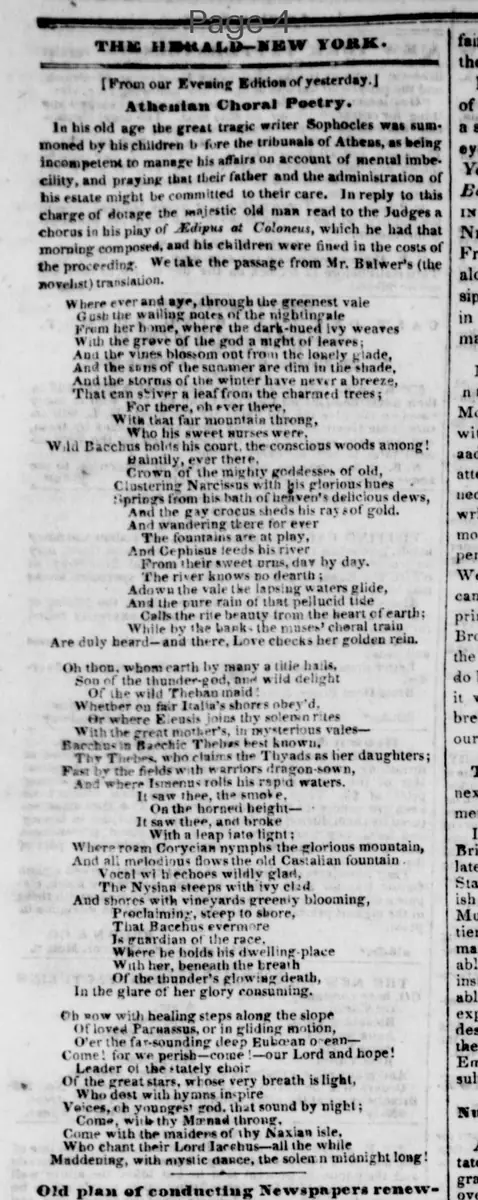
THE HERALD—NEW YORK.
[From our Evening Edition of yesterday.]
Athenian Choral Poetry.
In his old age the great tragic writer Sophocles was summoned by his children before the tribunals of Athens, as being incompetent to manage his affairs on account of mental imbecility, and praying that their father and the administration of his estate might be committed to their care. In reply to this charge of dotage the majestic old man read to the Judges a chorus in his play of Oedipus at Colonus, which he had that morning composed, and his children were fined in the costs of the proceeding. We take the passage from Mr. Bulwer's (the novelist) translation.
Where ever and aye, through the greenest vale
Gush the wailing notes of the nightingale
From her home, where the dark-hued ivy weaves
With the grove of the god a night of leaves;
And the vines blossom out from the lonely glade
And the suns of the summer are dim in the shade,
And the storms of the winter have never a breeze
That can stir a leaf from the charmed trees;
For there, oh ever there,
With that fair mountain throng,
Who his sweet nurses were.
With Bacchus holds his court. the conscious woods among!
Bacchically, ever there.
Crown of the mighty goddesses of old,
Clustering Narcissus with his glorious hues
Springs from his bath of heaven's delicious dews,
And the gay crocus sheds his rays of gold.
And wandering there for ever
The fountains are at play,
And Cephisus feeds his river
From their sweet urns, day by day.
The river knows no dearth;
Adown the vale the lapsing waters glide,
And the pure rain of that pellucid tide
Calls the rich beauty from the heart of earth;
While by the bank the muses' choral train
Are duly heard—and there, Love checks her golden rein.
Oh thou, whom earth by many a title hails,
Son of the thunder-god, and wild delight
Of the wild Theban maid:
Whether on fair Italia's shores obey'd,
Or where Eleusis joins thy solemn rites
With the great mother's, in mysterious vales—
Bacchus in Bacchic Thebes best known.
Thy Thebes. who claims the Thyads as her daughters;
Fast by the fields with warriors dragon-sown,
And where Ismenus rolls his rapid waters.
It saw thee, the smoke.
On the horned height—
It saw thee, and broke
With a leap into light;
Where roam Corycian nymphs the glorious mountain,
And all melodious flows the old Castalian fountain
Vocal with echoes wildly glad.
The Nysian steeps with ivy clad
And shores with vineyards greenly blooming,
Proclaiming, steep to shore,
That Bacchus evermore
Is guardian of the race.
Where he holds his dwelling-place
With her, beneath the breath
Of the thunder's glowing death,
In the glare of her glory consuming.
Oh come with healing steps along the slope
Of loved Parnassus, or in gliding motion
O'er the far-sounding deep Euboic ocean—
Come! for we perish—come!—our Lord and hope
Leader of the stately choir
Of the great stars, whose very breath is light,
Who dost with hymns inspire
Voices, oh youngest god, that sound by night;
Come, with thy Maenad throng,
Come with the maidens of thy Naxian isle.
Who chant their Lord Iacchus—all the while
Maddening, with mystic dance, the solemn midnight long.
[From our Evening Edition of yesterday.]
Athenian Choral Poetry.
In his old age the great tragic writer Sophocles was summoned by his children before the tribunals of Athens, as being incompetent to manage his affairs on account of mental imbecility, and praying that their father and the administration of his estate might be committed to their care. In reply to this charge of dotage the majestic old man read to the Judges a chorus in his play of Oedipus at Colonus, which he had that morning composed, and his children were fined in the costs of the proceeding. We take the passage from Mr. Bulwer's (the novelist) translation.
Where ever and aye, through the greenest vale
Gush the wailing notes of the nightingale
From her home, where the dark-hued ivy weaves
With the grove of the god a night of leaves;
And the vines blossom out from the lonely glade
And the suns of the summer are dim in the shade,
And the storms of the winter have never a breeze
That can stir a leaf from the charmed trees;
For there, oh ever there,
With that fair mountain throng,
Who his sweet nurses were.
With Bacchus holds his court. the conscious woods among!
Bacchically, ever there.
Crown of the mighty goddesses of old,
Clustering Narcissus with his glorious hues
Springs from his bath of heaven's delicious dews,
And the gay crocus sheds his rays of gold.
And wandering there for ever
The fountains are at play,
And Cephisus feeds his river
From their sweet urns, day by day.
The river knows no dearth;
Adown the vale the lapsing waters glide,
And the pure rain of that pellucid tide
Calls the rich beauty from the heart of earth;
While by the bank the muses' choral train
Are duly heard—and there, Love checks her golden rein.
Oh thou, whom earth by many a title hails,
Son of the thunder-god, and wild delight
Of the wild Theban maid:
Whether on fair Italia's shores obey'd,
Or where Eleusis joins thy solemn rites
With the great mother's, in mysterious vales—
Bacchus in Bacchic Thebes best known.
Thy Thebes. who claims the Thyads as her daughters;
Fast by the fields with warriors dragon-sown,
And where Ismenus rolls his rapid waters.
It saw thee, the smoke.
On the horned height—
It saw thee, and broke
With a leap into light;
Where roam Corycian nymphs the glorious mountain,
And all melodious flows the old Castalian fountain
Vocal with echoes wildly glad.
The Nysian steeps with ivy clad
And shores with vineyards greenly blooming,
Proclaiming, steep to shore,
That Bacchus evermore
Is guardian of the race.
Where he holds his dwelling-place
With her, beneath the breath
Of the thunder's glowing death,
In the glare of her glory consuming.
Oh come with healing steps along the slope
Of loved Parnassus, or in gliding motion
O'er the far-sounding deep Euboic ocean—
Come! for we perish—come!—our Lord and hope
Leader of the stately choir
Of the great stars, whose very breath is light,
Who dost with hymns inspire
Voices, oh youngest god, that sound by night;
Come, with thy Maenad throng,
Come with the maidens of thy Naxian isle.
Who chant their Lord Iacchus—all the while
Maddening, with mystic dance, the solemn midnight long.
What sub-type of article is it?
Poem
Hymn Or Psalm
What themes does it cover?
Religious
Nature
What keywords are associated?
Sophocles
Oedipus At Colonus
Bacchus
Choral Ode
Athenian Poetry
Colonus Grove
Nightingale
Parnassus
What entities or persons were involved?
Sophocles (Translated By Mr. Bulwer)
Literary Details
Title
Athenian Choral Poetry
Author
Sophocles (Translated By Mr. Bulwer)
Subject
Chorus From Oedipus At Colonus
Form / Style
Choral Ode In Verse
Key Lines
Where Ever And Aye, Through The Greenest Vale
Gush The Wailing Notes Of The Nightingale
For There, Oh Ever There,
With That Fair Mountain Throng,
Who His Sweet Nurses Were.
With Bacchus Holds His Court. The Conscious Woods Among!
Oh Come With Healing Steps Along The Slope
Of Loved Parnassus, Or In Gliding Motion
O'er The Far Sounding Deep Euboic Ocean—
Come! For We Perish—Come!—Our Lord And Hope
Leader Of The Stately Choir
Of The Great Stars, Whose Very Breath Is Light,
Who Dost With Hymns Inspire
Voices, Oh Youngest God, That Sound By Night;