Thank you for visiting SNEWPapers!
Sign up free
The Daily Advertiser
New York, New York County, New York
What is this article about?
On March 5, 1788, the New York House of Assembly debated the Attorney General's report on the Corporation of New York's historical claims to Fort George and adjacent lands in Manhattan, based on colonial charters from 1686 and 1730. Discussion focused on property rights, the need for fortifications to defend the city against threats like privateers, and proposals to vest the lands in trust for ornament and defense rather than sell them, amid concerns over litigation and value.
Merged-components note: This is a continuation of the House of Assembly proceedings narrative from page 2 to page 3, forming a single coherent story component. The label is updated to 'story' to reflect the full narrative article on legislative debate.
Clippings
1 of 2
OCR Quality
Full Text
POUGHKEEPSIE.
Wednesday, March 5, 1788.
[Continued.]
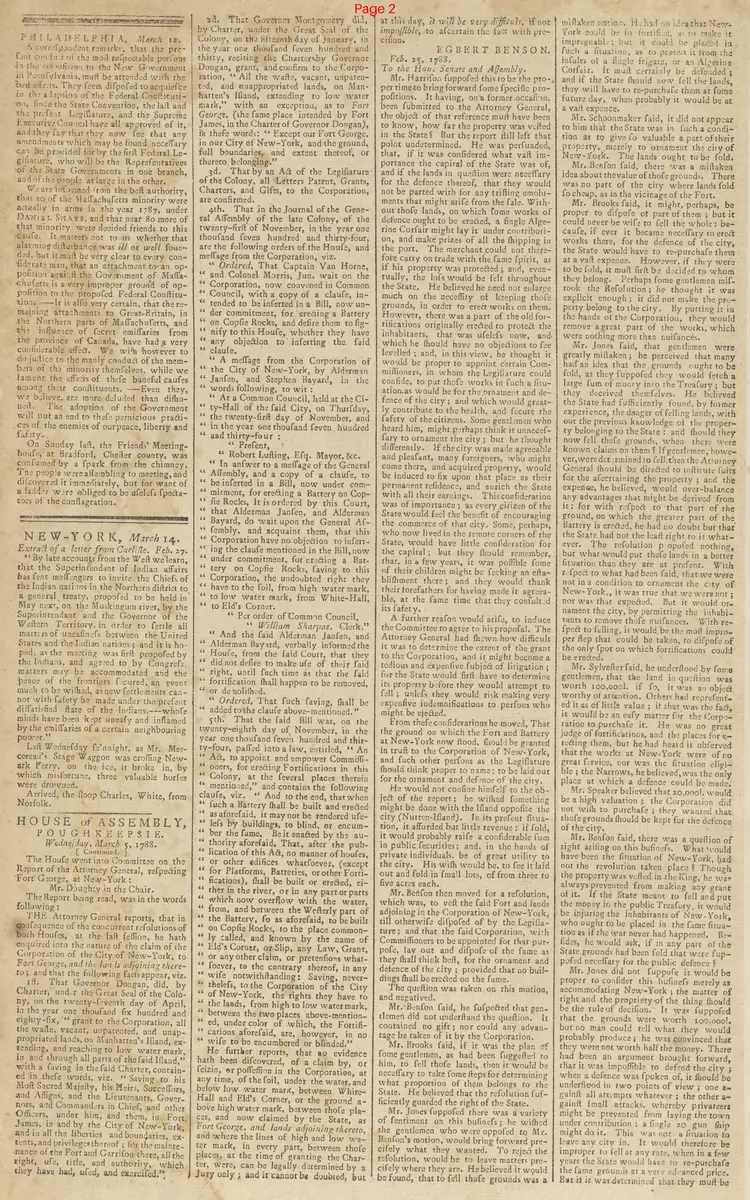
The House went into Committee on the Report of the Attorney General, respecting Fort George, at New-York:
Mr. Doughty in the Chair.
The Report being read, was in the words following:
THE Attorney General reports, that in consequence of the concurrent resolutions of both Houses, at the last session, he hath enquired into the nature of the claim of the Corporation of the City of New-York, to Fort George, and the lands adjoining thereto; and that the following facts appear, viz.
1st. That Governor Dongan, did, by Charter, under the Great Seal of the Colony, on the twenty-seventh day of April, in the year one thousand six hundred and eighty-six, "grant to the Corporation, all the waste, vacant, unpatented, and unappropriated lands, on Manhattan's Island, extending, and reaching to low water mark, in and through all parts of the said Island," with a saving in the said Charter, contained in these words, viz. "Saving to his Most Sacred Majesty, his Heirs, Successors, and Assigns, and the Lieutenants, Governors, and Commanders in Chief, and other Officers, under him, and them, in Fort James, in and by the City of New-York, and in all the liberties and boundaries, extents, and privileges thereof; for the maintenance of the Fort and Garrison there, all the right, use, title, and authority, which they have had, used, and exercised."
2d. That Governor Montgomery did, by Charter, under the Great Seal of the Colony, on the fifteenth day of January, in the year one thousand seven hundred and thirty, reciting the Charter by Governor Dongan, grant, and confirm to the Corporation, "All the waste, vacant, unpatented, and unappropriated lands, on Manhattan's Island, extending to low water mark," with an exception, as to Fort George, (the same place intended by Fort James, in the Charter of Governor Dongan), in these words: "Except our Fort George, in our City of New-York, and the ground, full boundaries, and extent thereof, or thereto belonging."
3d. That by an Act of the Legislature of the Colony, all Letters Patent, Grants, Charters, and Gifts, to the Corporation, are confirmed.
4th. That in the Journal of the General Assembly of the late Colony, of the twenty-first of November, in the year one thousand seven hundred and thirty-four, are the following orders of the House, and message from the Corporation, viz.
"Ordered, That Captain Van Horne, and Colonel Morris, Jun. wait on the Corporation, now convened in Common Council, with a copy of a clause, intended to be inserted in a Bill, now under commitment, for erecting a Battery on Corle's Rocks, and desire them to signify to this House, whether they have any objection to inserting the said clause."
"A message from the Corporation of the City of New-York, by Alderman Jansen, and Stephen Bayard, in the words following, to wit:
At a Common Council, held at the City-Hall of the said City, on Thursday, the twenty-first day of November, and in the year one thousand seven hundred and thirty-four:
Present,
Robert Lurting, Esq. Mayor, &c.
In answer to a message of the General Assembly, and a copy of a clause, to be inserted in a Bill, now under commitment, for erecting a Battery on Corle's Rocks, It is ordered by this Court, that Alderman Jansen, and Alderman Bayard, do wait upon the General Assembly, and acquaint them, that this Corporation have no objection to inserting the clause mentioned in the Bill, now under commitment, for erecting a Battery on Corle's Rocks, saving to this Corporation, the undoubted right they have to the soil, from high water mark, to low water mark, from White-Hall, to Eld's Corner.
Per order of Common Council,
William Sharparks, Clerk."
And the said Alderman Jansen, and Alderman Bayard, verbally informed the House, from the said Court, that they did not desire to make use of their said right, until such time as that the said fortification shall happen to be removed, or demolished.
"Ordered, That such saving, shall be added to the clause above-mentioned."
5th. That the said Bill was, on the twenty-eighth day of November, in the year one thousand seven hundred and thirty-four, passed into a law, entitled, "An Act, to appoint and empower Commissioners, for erecting Fortifications in this Colony, at the several places therein mentioned," and contains the following clause, viz. "And to the end, that when such a Battery shall be built and erected as aforesaid, it may not be rendered useless by buildings, to blind, or encumber the same, Be it enacted by the authority aforesaid. That, after the publication of this Act, no manner of houses, or other edifices whatsoever, (except for Platforms, Batteries, or other Fortifications), shall be built or erected, either in the river, or in any part or parts which now overflow with the water, from, and between the Westerly part of the Battery, so as aforesaid, to be built on Corle's Rocks, to the place commonly called, and known by the name of Eld's Corner, or Slip, any Law, Grant, or any other claim, or pretensions whatsoever, to the contrary thereof, in any wise notwithstanding: Saving, nevertheless, to the Corporation of the City of New-York, the rights they have to the lands, from high to low water mark, between the two places above-mentioned, under color of which, the Fortifications aforesaid, are, however, in no wise to be encumbered or blinded."
He further reports, that no evidence hath been discovered, of a claim by, or seizin, or possession in the Corporation, at any time, of the soil, under the water, and below low water mark, between White Hall and Eld's Corner, or the ground above high water mark, between those places, and now claimed by the State, as Fort George, and lands adjoining thereto, and where the lines of high and low water mark, in every part, between those places, at the time of granting the Charter, were, can be legally determined by a Jury only; and it cannot be doubted, but at this day, it will be very difficult, if not impossible, to ascertain the fact with precision.
EGBERT BENSON.
Feb. 25, 1788.
To the Hon. Senate and Assembly
Mr. Harrison supposed this to be the proper time to bring forward some specific propositions. It having, on a former occasion, been submitted to the Attorney General, the object of that reference must have been to know, how far the property was vested in the State? But the report still left that point undetermined. He was persuaded, that, if it was considered what vast importance the capital of the State was of, and if the lands in question were necessary for the defence thereof, that they would not be parted with for any trifling emoluments that might arise from the sale. Without those lands, on which some works of defence ought to be erected, a single Algerine Corsair might lay it under contribution, and make prizes of all the shipping in the port. The merchant could not therefore carry on trade with the same spirit, as if his property was protected; and, eventually, the loss would be felt throughout the State. He believed he need not enlarge much on the necessity of keeping those grounds, in order to erect works on them. However, there was a part of the old fortifications originally erected to protect the inhabitants, that was useless now, and which he should have no objections to see levelled; and, in this view, he thought it would be proper to appoint certain Commissioners, in whom the Legislature could confide, to put those works in such a situation as would be for the ornament and defence of the city; and which would greatly contribute to the health, and secure the safety of the citizens. Some gentlemen who heard him, might perhaps think it unnecessary to ornament the city; but he thought differently. If the city was made agreeable and pleasant, many foreigners, who might come there, and acquired property, would be induced to fix upon that place as their permanent residence, and enrich the State with all their earnings. This consideration was of importance; as every citizen of the State would feel the benefit of encouraging the commerce of that city. Some, perhaps, who now lived in the remote corners of the State, would have little consideration for the capital; but they should remember, that, in a few years, it was possible some of their children might be seeking an establishment there; and they would thank their forefathers for having made it agreeable, at the same time that they consulted its safety.
A further reason would arise, to induce the Committee to agree to his proposal. The Attorney General had shown how difficult it was to determine the extent of the grant to the Corporation, and it might become a tedious and expensive subject of litigation; for the State would first have to determine its property before they would attempt to sell; unless they would risk making very expensive indemnifications to persons who might be ejected.
From these considerations he moved, That the ground on which the Fort and Battery at New-York now stood, should be granted in trust to the Corporation of New-York, and such other persons as the Legislature should think proper to name; to be laid out for the ornament and defence of the city.
He would not confine himself to the object of the report; he wished something might be done with the Island opposite the city (Nutten-Island). In its present situation, it afforded but little revenue: if sold, it would probably raise a considerable sum in public securities; and, in the hands of private individuals, be of great utility to the city. His wish would be, to see it laid out and sold in small lots, of from three to five acres each.
Mr. Benson then moved for a resolution, which was, to vest the said Fort and lands adjoining in the Corporation of New-York, till otherwise disposed of by the Legislature; and that the said Corporation, with Commissioners to be appointed for that purpose, lay out and dispose of the same as they shall think best, for the ornament and defence of the city; provided that no buildings shall be erected on the same.
The question was taken on this motion, and negatived.
Mr. Benson said, he suspected that gentlemen did not understand the question. It contained no gift; nor could any advantage be taken of it by the Corporation.
Mr. Brooks said, if it was the plan of some gentlemen, as had been suggested to him, to sell those lands, then it would be necessary to take some steps for determining what proportion of them belongs to the State. He believed that the resolution sufficiently guarded the right of the State.
Mr. Jones supposed there was a variety of sentiment on this business; he wished the gentlemen who were opposed to Mr. Benson's motion, would bring forward precisely what they wanted. To reject the resolution, would be to leave matters precisely where they are. He believed it would be found, that to sell those grounds was a mistaken notion. He had no idea that New-York could be so fortified, as to make it impregnable; but it could be placed in such a situation, as to protect it from the insults of a single frigate, or an Algerine Corsair. It must certainly be defended; and if the State should now sell the lands, they will have to re-purchase them at some future day, when probably it would be at a vast expense.
Mr. Schoonmaker said, it did not appear to him that the State was in such a condition as to give so valuable a part of their property, merely to ornament the city of New-York. The lands ought to be sold.
Mr. Benson said, there was a mistaken idea about the value of those grounds. There was no part of the city where lands sold so cheap, as in the vicinage of the Fort.
Mr. Brooks said, it might, perhaps, be proper to dispose of part of them; but it could never be wise to sell the whole: because, if ever it became necessary to erect works there, for the defence of the city, the State would have to re-purchase them at a vast expense. However, if they were to be sold, it must first be decided to whom they belong. Perhaps some gentlemen mistook the Resolution; he thought it was explicit enough; it did not make the property belong to the city. By putting it in the hands of the Corporation, they would remove a great part of the works, which were nothing more than nuisances.
Mr. Jones said, that gentlemen were greatly mistaken; he perceived that many had an idea that the grounds ought to be sold, as they supposed they would fetch a large sum of money into the Treasury; but they deceived themselves. He believed the State had sufficiently found, by former experience, the danger of selling lands, without the previous knowledge of the property belonging to the State: and should they now sell these grounds, when there were known claims on them? If gentlemen, however, were determined to sell, then the Attorney General should be directed to institute suits for the ascertaining the property; and the expense, he believed, would over-balance any advantages that might be derived from it: for with respect to that part of the ground, on which the greater part of the Battery is erected, he had no doubt but that the State had not the least right to it whatever. The resolution proposed nothing, but what would put these lands in a better situation than they are at present. With respect to what had been said, that we were not in a condition to ornament the city of New-York, it was true that we were not; nor was that expected. But it would ornament the city, by permitting the inhabitants to remove those nuisances. With respect to selling, it would be the most improper step that could be taken, to dispose of the only spot on which fortifications could be erected.
Mr. Sylvester said, he understood by some gentlemen, that the land in question was worth 100,000l. if so, it was an object worthy of attention. Others had represented it as of little value; if that was the fact, it would be an easy matter for the Corporation to purchase it. He was no great judge of fortifications, and the places for erecting them, but he had heard it observed that the works at New-York were of no great service, nor was the situation eligible; the Narrows, he believed, was the only place at which a defence could be made.
Mr. Speaker believed that 20,000l. would be a high valuation; the Corporation did not wish to purchase; they wanted that those grounds should be kept for the defence of the city.
Mr. Benson said, there was a question of right arising on this business. What should have been the situation of New-York, had not the revolution taken place? Though the property was vested in the King, he was always prevented from making any grant of it. If the State meant to sell and put the money in the public Treasury, it would be injuring the inhabitants of New-York, who ought to be placed in the same situation as if the war never had happened. Besides, he would ask, if in any part of the State grounds had been sold that were supposed necessary for the public defence?
Mr. Jones did not suppose it would be proper to consider this business merely as accommodating New-York; the matter of right and the propriety of the thing should be the rule of decision. It was supposed that the grounds were worth 50,000l. but no man could tell what they would probably produce; he was convinced that they were not worth half the money. There had been an argument brought forward, that it was impossible to defend the city; when a defence was spoken of, it should be understood in two points of view; one against all attempts whatever; the other against small attacks, whereby privateers might be prevented from laying the town under contribution: a single 20 gun ship might do it. This was not a situation to leave any city in. It would therefore be improper to sell at any rate, when in a few years the State would have to re-purchase the same grounds at a very advanced price. But if it was determined that they must be sold...
fold, then let suits be instituted to determine the property by a jury, for in the present situation of it, he would pledge himself that no Commissioners could decide what actually was the property of the State.
Mr. Harrison concurred in opinion with the gentleman who spoke last. It was a question of right, and not altogether of public expediency and public utility. It was not merely New-York that should be thought of, for that place ought not to be considered with respect to itself, but to the whole State. It was, he said, the duty of Government to give that city all the protection it was possible to have. He did not suppose it was practicable to fortify it against large armaments, but it should not be left in such a situation, as that a few privateers might lay it under contribution. Wherever the State did not give that protection, it broke the social compact. One gentleman had supposed that the Narrows was a proper place to erect fortifications; he believed that all military men would declare, that no fortifications that could be erected there, would have any command of the river, and that there was no place so proper as the grounds in question. Every object of fortification should be considered as a general charge on the whole, and it was the duty of the State to provide for the defence of the whole. When on a large occasion, the State was in danger, he asked if the County of Orange alone, was called on to build the Forts on the river? Were they not a general charge? It was a part of the social duty that every Member should be protected, and every Member owed his services to ensure that protection. He had been out of the House during the greater part of this debate; he could not therefore take up all the arguments that had been offered. One further observation he would make, that it would be better for the State to preserve these lands for the purpose for which they had been heretofore preserved and were so well calculated, than by a sale to involve itself in disputes, and deprive one part of the community of those rights which they were entitled to, by one of the first principles of Government.
Mr. Schoonmaker said, that by the arguments of the gentlemen, it seemed as if the ground of disputation was considerably changed. It was now, whether the State has any authority there or not; If he understood the bounds of the Corporation, they were only from high to low water mark. It appeared to him necessary that these bounds should be ascertained; if the lands there are of no value, and difficult to be come at, then the State had better have nothing to do with them; if otherwise, they ought to be sold, as the money was wanted. The observations with respect to these grounds having been reserved for fortifications, had not much weight with him, for they were not situated for defence. He thought it would be most expedient to have an enquiry made, and to know what lands belong to the State. Respecting the amazing expenses of law suits, he did not know that the Corporation of New-York was more able to support them than the State, or would be so willing to go into them. They would have equal considerations of prudence; the Legislature ought not to be frightened about these things.
On motion the Committee then rose without coming to any decision, and asked for leave to sit again.
What sub-type of article is it?
What themes does it cover?
What keywords are associated?
What entities or persons were involved?
Where did it happen?
Story Details
Key Persons
Location
Poughkeepsie; New York; Fort George; Manhattan's Island
Event Date
1788 03 05
Story Details
The Assembly reviews Attorney General Egbert Benson's report on colonial charters granting lands to New York Corporation but excepting Fort George for defense. Debate ensues on vesting lands in trust for city defense and ornament versus selling them, highlighting litigation risks, low value, and necessity against threats like privateers; no decision reached.