Thank you for visiting SNEWPapers!
Sign up free
The Enquirer
Richmond, Henrico County, Virginia
What is this article about?
Alexandria newspaper publishes letters from Edward J. Coale of Baltimore and John Henry explaining Henry's political mission, treatment by British officials, and denial of exposing any US citizens, dated March 1812.
Merged-components note: Continuation of letter about John Henry; table is signature; sequential and content continuation.
Clippings
1 of 2
OCR Quality
Full Text
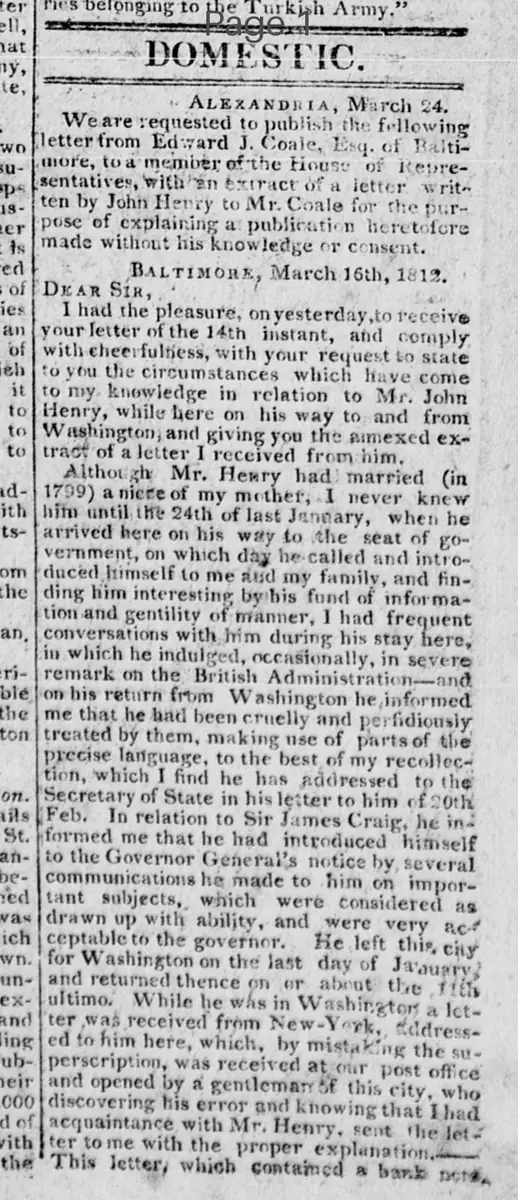
Alexandria, March 24.
We are requested to publish the following letter from Edward J. Coale, Esq. of Baltimore, to a member of the House of Representatives, with an extract of a letter written by John Henry to Mr. Coale for the purpose of explaining a publication heretofore made without his knowledge or consent.
BALTIMORE, March 16th, 1812.
DEAR SIR,
I had the pleasure, yesterday, to receive your letter of the 14th instant, and comply with cheerfulness, with your request to state to you the circumstances which have come to my knowledge in relation to Mr. John Henry, while here on his way to and from Washington, and giving you the annexed extract of a letter I received from him.
Although Mr. Henry had married (in 1799) a niece of my mother,—I never knew him until the 24th of last January, when he arrived here on his way to the seat of government, on which day he called and introduced himself to me and my family, and finding him interesting by his fund of information and gentility of manner, I had frequent conversations with him during his stay here, in which he indulged, occasionally, in severe remark on the British Administration—and on his return from Washington he informed me that he had been cruelly and perfidiously treated by them, making use of parts of the precise language, to the best of my recollection, which I find he has addressed to the Secretary of State in his letter to him of 20th Feb. In relation to Sir James Craig, he informed me that he had introduced himself to the Governor General's notice by several communications he made to him on important subjects, which were considered as drawn up with ability, and were very acceptable to the governor. He left this city for Washington on the last day of January, and returned thence on or about the 6th ultimo. While he was in Washington a letter was received from New-York, addressed to him here, which, by mistaking the superscription, was received at our post office and opened by a gentleman of this city, who discovering his error and knowing that I had acquaintance with Mr. Henry, sent the letter to me with the proper explanation. This letter.
for one hundred dollars. I handed to Mr. Henry on the day of his return from Washington (with others I received for him during his absence,) explaining to him the circumstance which had occasioned its being opened. He took out its enclosure of $100, enveloped it in my presence and at my desk, and returned it by the mail for New-York. On the 12th ultimo he proceeded on his journey eastward by the way of York and Lancaster, but being impeded by the ice in the Susquehanna, he returned to this city. On the morning of the 14th I received a short note from him, desiring to see me at his lodgings, and requesting that his being here should not be made known to any one, as he was much fatigued and not disposed for visits. Calling on him, he showed me a deed of conveyance, duly authenticated in Washington, of an estate in Languedoc, in France, made by a gentleman of that country, now in Washington, where the fact of this conveyance is, I am told, currently known and spoken of. On the morning on which he left our town the second and last time, (Monday the 17th ultimo) he called on me with a request to assist him in the negotiation with our banks of a certificate, which he showed to me, issued by the Bank of Columbia for forty-eight thousand dollars, purporting, in the usual bank phraseology I believe, that the said sum was placed on the books of the Bank of Columbia, "at the credit of the Mechanic's Bank of New-York, to the order of John Henry." I called on one of our banks, in pursuance of his request, with him, where his certificate was received, & exchanged to his satisfaction. On his reaching New York, he addressed to me a letter dated 27th ultimo, which being exhibited by me to several friends here, they suggested the propriety of forwarding authenticated extracts thereof into that neighborhood of our country where he represents having been (fruitlessly) employed to excite disaffection. This suggestion appearing to me just and reasonable, I have assented to the transmission to Boston of an authenticated extract from his said letter, (of which I annex a copy herewith) tending to counteract any unmerited insinuations, which the illiberal might be inclined to make in consequence of the erasure of some of the lines in that copy of his communications which he has given to our government.
With great respect,
I am, Dear Sir,
Your obedient servant,
EDWARD J. COALE.
P. S. In corroboration of Henry's declaration, contained in the annexed extract, that his mission or the papers connected with it, do not contain a single line that can expose any human being in the United States to censure, it may be proper for me to add, that he informed me in the course of his account of his connection with Sir J. Craig, that while at Boston he forwarded to the Gov. several important communications--I interrupted him by asking if they criminated any citizen of this country, he promptly replied that they did not, and added, "it was not in his power directly or indirectly to affect the reputation of any individual of the United States."
Extract of a letter from John Henry to Edward J. Coale, being the whole of the letter, except words complimentary to E. J. Coale's family.
"New York, 27th Feb. 1812.
In eight days I hope to find a good opportunity to cross the Atlantic. There are vessels bound both to England and France, and I am somewhat undecided as to which of the two it is most expedient to go for direct. Perhaps I may think it best to go to the continent--au
Know it I can
be useful to you, and give me such general instructions on that head, as may enable me to avail myself of circumstances. Of myself I have not much to say. You will recollect our conversations, and all I communicated on the subject of the perfidy and ingratitude of the British ministers. I find that my disappointment has been insidiously ascribed to my own indiscretion rather than to their dishonesty. But I have laid a plan for their punishment and exposure that will make them feel that I am no contemptible enemy. Should you see any publication on that subject at any time, I give you full liberty to repeat all I have told you, and be particularly careful to repel with indignation any insinuation the spirit of party may suggest, that my political mission or the papers connected with it, contain a single line that can expose any human being in the United States to censure. My view in exposing the British government is confined to general national affairs. I cannot ever reduce my political system or opinions to the miserable standard of party, nor yield the independence of my feelings or the suggestions of my experience to the directions of little local leaders, whose existence is ephemeral and information diminutive. In gratifying my personal resentments, I am obliged to consult only my individual feelings. With these no man has concern. I am alone the judge of the measure of retaliation and the satisfaction to be sought:
This letter I confide to you in confidence, until such time as you think it necessary to make use of it, and then I trust to your friendship to explain my motives.
Your sincere friend
| (Signed) | J. HENRY. |
What sub-type of article is it?
What keywords are associated?
What entities or persons were involved?
Where did it happen?
Domestic News Details
Primary Location
Baltimore
Event Date
March 16th, 1812
Key Persons
Outcome
explanation of prior publication to counteract insinuations; henry's mission did not expose any us citizens to censure.
Event Details
Edward J. Coale writes to a House member detailing interactions with John Henry during his travels in January and February 1812, including Henry's complaints about British treatment, financial transactions, and a letter from Henry denying exposure of US individuals in his political mission.