Thank you for visiting SNEWPapers!
Sign up free
Story
May 13, 1876
The Northern Star
Snohomish, Snohomish County, Washington
What is this article about?
Leonard Swett recounts Abraham Lincoln's legal acumen, emphasizing his analytical depth, clear argumentation that captivated audiences, unmatched trial skills, strategic fairness, and ability to outmaneuver opponents without deceit.
Clipping
OCR Quality
95%
Excellent
Full Text
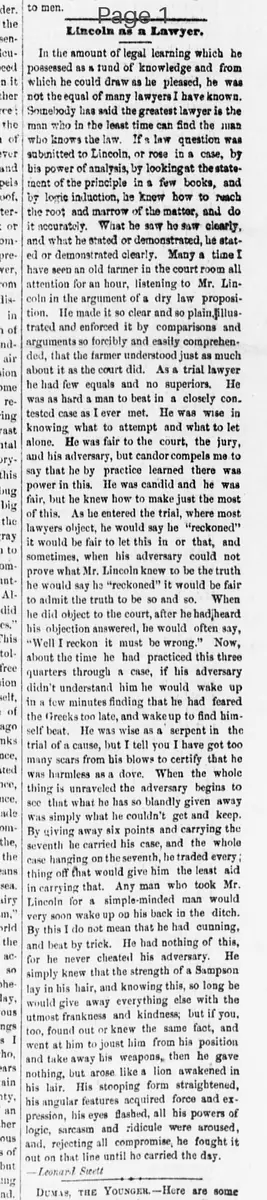
Lincoln as a Lawyer,
In the amount of legal learning which he possessed as a fund of knowledge and from which he could draw as he pleased, he was not the equal of many lawyers I have known. Somebody has said the greatest lawyer is the man who in the least time can find the man who knows the law. If a law question was submitted to Lincoln, or rose in a case, by his power of analysis, by looking at the statement of the principle in a few books, and by logic induction, he knew how to reach the root and marrow of the matter, and do it accurately. What he saw he saw clearly, and what he stated or demonstrated, he stated or demonstrated clearly. Many a time I have seen an old farmer in the court room all attention for an hour, listening to Mr. Lincoln in the argument of a dry law proposition. He made it so clear and so plain, illustrated and enforced it by comparisons and arguments so forcibly and easily comprehended, that the farmer understood just as much about it as the court did.
As a trial lawyer he had few equals and no superiors. He was as hard a man to beat in a closely contested case as I ever met. He was wise in knowing what to attempt and what to let alone. He was fair to the court, the jury, and his adversary, but candor compels me to say that he by practice learned there was power in this. He was candid and he was fair, but he knew how to make just the most of this. As he entered the trial, where most lawyers object, he would say he "reckoned" it would be fair to let this in or that, and sometimes, when his adversary could not prove what Mr. Lincoln knew to be the truth he would say he "reckoned" it would be fair to admit the truth to be so and so. When he did object to the court, after he had heard his objection answered, he would often say, "Well I reckon it must be wrong."
Now, about the time he had practiced this three quarters through a case, if his adversary didn't understand him he would wake up in a few minutes finding that he had feared the Greeks too late, and wake up to find himself beat. He was wise as a serpent in the trial of a cause, but I tell you I have got too many scars from his blows to certify that he was harmless as a dove. When the whole thing is unraveled the adversary begins to see that what he has so blandly given away was simply what he couldn't get and keep. By giving away six points and carrying the seventh he carried his case, and the whole case hanging on the seventh, he traded everything off that would give him the least aid in carrying that. Any man who took Mr. Lincoln for a simple-minded man would very soon wake up on his back in the ditch.
By this I do not mean that he had cunning, and beat by trick. He had nothing of this, for he never cheated his adversary. He simply knew that the strength of a Sampson lay in his hair, and knowing this, so long he would give away everything else with the utmost frankness and kindness; but if you, too, found out or knew the same fact, and went at him to joust him from his position and take away his weapons, then he gave nothing, but arose like a lion awakened in his lair. His stooping form straightened, his angular features acquired force and expression, his eyes flashed, all his powers of logic, sarcasm and ridicule were aroused, and, rejecting all compromise, he fought it out on that line until he carried the day —Leonard Swett
In the amount of legal learning which he possessed as a fund of knowledge and from which he could draw as he pleased, he was not the equal of many lawyers I have known. Somebody has said the greatest lawyer is the man who in the least time can find the man who knows the law. If a law question was submitted to Lincoln, or rose in a case, by his power of analysis, by looking at the statement of the principle in a few books, and by logic induction, he knew how to reach the root and marrow of the matter, and do it accurately. What he saw he saw clearly, and what he stated or demonstrated, he stated or demonstrated clearly. Many a time I have seen an old farmer in the court room all attention for an hour, listening to Mr. Lincoln in the argument of a dry law proposition. He made it so clear and so plain, illustrated and enforced it by comparisons and arguments so forcibly and easily comprehended, that the farmer understood just as much about it as the court did.
As a trial lawyer he had few equals and no superiors. He was as hard a man to beat in a closely contested case as I ever met. He was wise in knowing what to attempt and what to let alone. He was fair to the court, the jury, and his adversary, but candor compels me to say that he by practice learned there was power in this. He was candid and he was fair, but he knew how to make just the most of this. As he entered the trial, where most lawyers object, he would say he "reckoned" it would be fair to let this in or that, and sometimes, when his adversary could not prove what Mr. Lincoln knew to be the truth he would say he "reckoned" it would be fair to admit the truth to be so and so. When he did object to the court, after he had heard his objection answered, he would often say, "Well I reckon it must be wrong."
Now, about the time he had practiced this three quarters through a case, if his adversary didn't understand him he would wake up in a few minutes finding that he had feared the Greeks too late, and wake up to find himself beat. He was wise as a serpent in the trial of a cause, but I tell you I have got too many scars from his blows to certify that he was harmless as a dove. When the whole thing is unraveled the adversary begins to see that what he has so blandly given away was simply what he couldn't get and keep. By giving away six points and carrying the seventh he carried his case, and the whole case hanging on the seventh, he traded everything off that would give him the least aid in carrying that. Any man who took Mr. Lincoln for a simple-minded man would very soon wake up on his back in the ditch.
By this I do not mean that he had cunning, and beat by trick. He had nothing of this, for he never cheated his adversary. He simply knew that the strength of a Sampson lay in his hair, and knowing this, so long he would give away everything else with the utmost frankness and kindness; but if you, too, found out or knew the same fact, and went at him to joust him from his position and take away his weapons, then he gave nothing, but arose like a lion awakened in his lair. His stooping form straightened, his angular features acquired force and expression, his eyes flashed, all his powers of logic, sarcasm and ridicule were aroused, and, rejecting all compromise, he fought it out on that line until he carried the day —Leonard Swett
What sub-type of article is it?
Biography
What themes does it cover?
Triumph
Moral Virtue
Justice
What keywords are associated?
Lincoln Lawyer
Trial Tactics
Legal Analysis
Courtroom Strategy
Strategic Fairness
What entities or persons were involved?
Lincoln
Leonard Swett
Where did it happen?
Court Room
Story Details
Key Persons
Lincoln
Leonard Swett
Location
Court Room
Story Details
Leonard Swett describes Lincoln's legal expertise, including his analytical skills for grasping legal principles, ability to explain complex law clearly to laypeople, unmatched trial prowess through strategic concessions and fairness, and fierce defense of key points without deceit.