Thank you for visiting SNEWPapers!
Sign up free
Editorial
July 6, 1782
The New Hampshire Gazette And General Advertiser
Portsmouth, Exeter, Rockingham County, New Hampshire
What is this article about?
An editorial from Portsmouth recommends an essay arguing that religious knowledge is essential for civil society, promoting unity, morality, liberty, and preventing superstition and disorder. It emphasizes Christianity's role in good government and social improvement.
Clipping
OCR Quality
98%
Excellent
Full Text
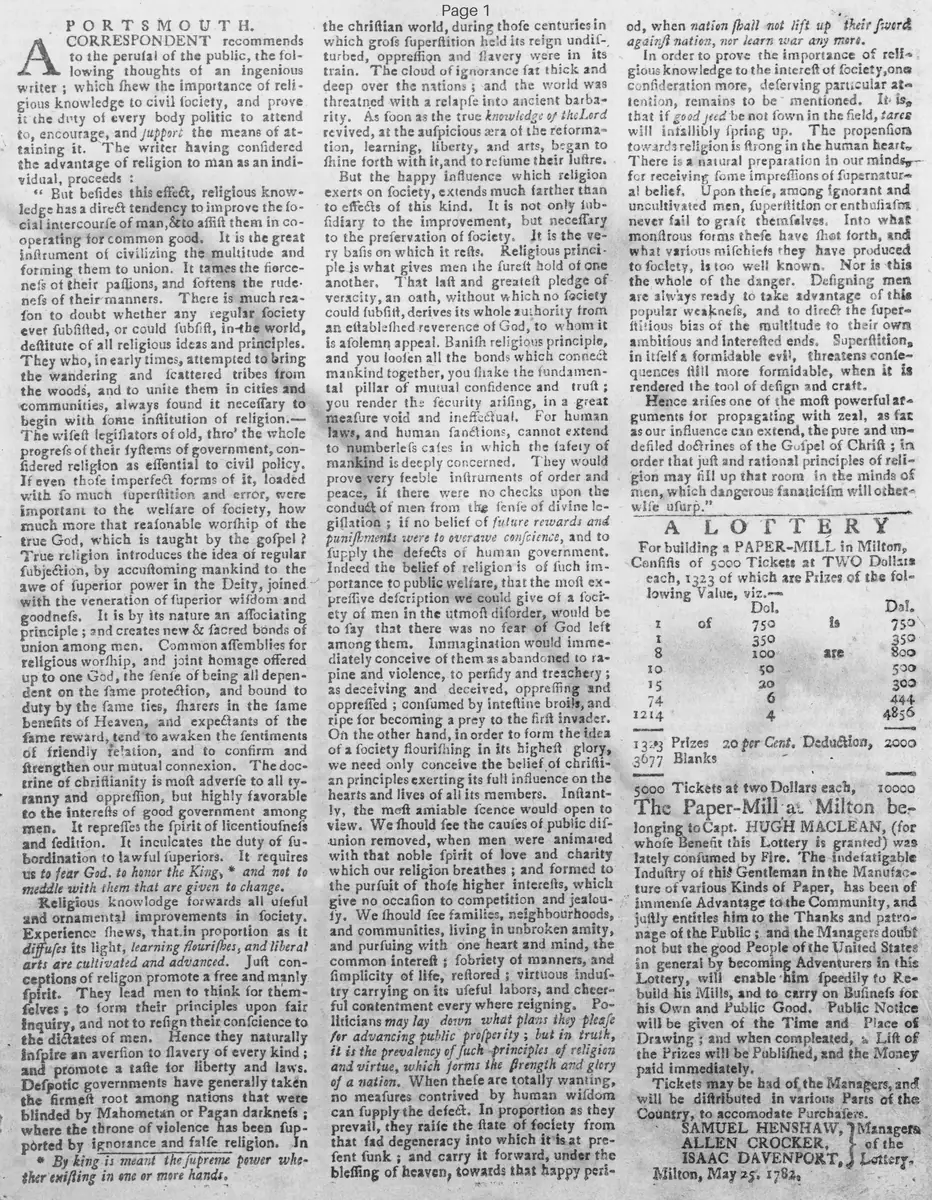
PORTSMOUTH.
A CORRESPONDENT recommends to the perusal of the public, the following thoughts of an ingenious writer; which shew the importance of religious knowledge to civil society, and prove it the duty of every body politic to attend to, encourage, and support the means of attaining it. The writer having considered the advantage of religion to man as an individual, proceeds:
But besides this effect, religious knowledge has a direct tendency to improve the social intercourse of man, and to aid them in cooperating for common good. It is the great instrument of civilizing the multitude and forming them to union. It tames the fierceness of their passions, and softens the rudeness of their manners. There is much reason to doubt whether any regular society ever subsisted, or could subsist, in the world destitute of all religious ideas and principles. They who, in early times, attempted to bring the wandering and scattered tribes from the woods, and to unite them in cities and communities, always found it necessary to begin with some institution of religion. The wisest legislators of old, thro' the whole progress of their systems of government, considered religion as essential to civil policy. If even those imperfect forms of it, loaded with so much superstition and error, were important to the welfare of society, how much more that reasonable worship of the true God, which is taught by the gospel?
True religion introduces the idea of regular subjection, by accustoming mankind to the awe of superior power in the Deity, joined with the veneration of superior wisdom and goodness. It is by its nature an associating principle; and creates new & sacred bonds of union among men. Common assemblies for religious worship, and joint homage offered up to one God, the sense of being all dependent on the same protection, and bound to duty by the same ties, sharers in the same benefits of Heaven, and expectants of the same reward, tend to awaken the sentiments of friendly relation, and to confirm and strengthen our mutual connexion. The doctrine of christianity is most adverse to all tyranny and oppression, but highly favorable to the interests of good government among men. It represses the spirit of licentiousness and sedition. It inculcates the duty of subordination to lawful superiors. It requires us to fear God, to honor the King, and not to meddle with them that are given to change.
Religious knowledge forwards all useful and ornamental improvements in society. Experience shews, that in proportion as it diffuses its light, learning flourishes, and liberal arts are cultivated and advanced. Just conceptions of religion promote a free and manly spirit. They lead men to think for themselves: to form their principles upon fair inquiry, and not to resign their conscience to the dictates of men. Hence they naturally inspire an aversion to slavery of every kind: and promote a taste for liberty and laws. Despotic governments have generally taken the firmest root among nations that were blinded by Mahometan or Pagan darkness; where the throne of violence has been supported by ignorance and false religion. In the christian world, during those centuries in which gross superstition held its reign undisturbed, oppression and slavery were in its train. The cloud of ignorance sat thick and deep over the nations; and the world was threatned with a relapse into ancient barbarity. As soon as the true knowledge of the Lord revived, at the auspicious era of the reformation, learning, liberty, and arts, began to shine forth with it, and to resume their lustre.
But the happy influence which religion exerts on society, extends much farther than to effects of this kind. It is not only subsidiary to the improvement, but necessary to the preservation of society. It is the very basis on which it rests. Religious principle is what gives men the surest hold of one another. That last and greatest pledge of veracity, an oath, without which no society could subsist, derives its whole authority from an established reverence of God, to whom it is a solemn appeal. Banish religious principle, and you loosen all the bonds which connect mankind together. You shake the fundamental pillar of mutual confidence and trust; you render the security arising, in a great measure void and ineffectual. For human laws, and human sanctions, cannot extend to numberless cases in which the safety of mankind is deeply concerned. They would prove very feeble instruments of order and peace, if there were no checks upon the conduct of men from the sense of divine legislation; if no belief of future rewards and punishments were to overawe conscience, and to supply the defects of human government.
Indeed the belief of religion is of such importance to public welfare, that the most expressive description we could give of a society of men in the utmost disorder, would be to say that there was no fear of God left among them. Imagination would immediately conceive of them as abandoned to rapine and violence, to perfidy and treachery; as deceiving and deceived, oppressing and oppressed; consumed by intestine broils, and ripe for becoming a prey to the first invader.
On the other hand, in order to form the idea of a society flourishing in its highest glory, we need only conceive the belief of christian principles exerting its full influence on the hearts and lives of all its members. Instantly, the most amiable scene would open to view. We should see the causes of public disunion removed, when men were animated with that noble spirit of love and charity which our religion breathes: and formed to the pursuit of those higher interests, which give no occasion to competition and jealousy. We should see families, neighbourhoods, and communities, living in unbroken amity, and pursuing with one heart and mind, the common interest: sobriety of manners, and simplicity of life, restored; virtuous industry carrying on its useful labors, and cheerful contentment every where reigning. Politicians may lay down what plans they please for advancing public prosperity; but in truth, it is the prevalency of such principles of religion and virtue, which forms the strength and glory of a nation. When these are totally wanting, no measures contrived by human wisdom can supply the defect. In proportion as they prevail, they raise the state of society from that sad degeneracy into which it is at present sunk: and carry it forward, under the blessing of heaven, towards that happy period, when nation shall not lift up their sword against nation, nor learn war any more.
In order to prove the importance of religious knowledge to the interest of society, one consideration more, deserving particular attention, remains to be mentioned. It is, that if good seed be not sown in the field, tares will infallibly spring up. The propension towards religion is strong in the human heart. There is a natural preparation in our minds for receiving some impressions of supernatural belief. Upon these, among ignorant and uncultivated men, superstition or enthusiasm never fail to graft themselves. Into what monstrous forms these have shot forth, and what various mischiefs they have produced to society, is too well known. Nor is this the whole of the danger. Designing men are always ready to take advantage of this popular weakness, and to direct the superstitious bias of the multitude to their own ambitious and interested ends. Superstition in itself a formidable evil, threatens consequences still more formidable, when it is rendered the tool of design and craft.
Hence arises one of the most powerful arguments for propagating with zeal, as far as our influence can extend, the pure and undefiled doctrines of the Gospel of Christ: in order that just and rational principles of religion may fill up that room in the minds of men, which dangerous fanaticism will otherwise usurp.
A CORRESPONDENT recommends to the perusal of the public, the following thoughts of an ingenious writer; which shew the importance of religious knowledge to civil society, and prove it the duty of every body politic to attend to, encourage, and support the means of attaining it. The writer having considered the advantage of religion to man as an individual, proceeds:
But besides this effect, religious knowledge has a direct tendency to improve the social intercourse of man, and to aid them in cooperating for common good. It is the great instrument of civilizing the multitude and forming them to union. It tames the fierceness of their passions, and softens the rudeness of their manners. There is much reason to doubt whether any regular society ever subsisted, or could subsist, in the world destitute of all religious ideas and principles. They who, in early times, attempted to bring the wandering and scattered tribes from the woods, and to unite them in cities and communities, always found it necessary to begin with some institution of religion. The wisest legislators of old, thro' the whole progress of their systems of government, considered religion as essential to civil policy. If even those imperfect forms of it, loaded with so much superstition and error, were important to the welfare of society, how much more that reasonable worship of the true God, which is taught by the gospel?
True religion introduces the idea of regular subjection, by accustoming mankind to the awe of superior power in the Deity, joined with the veneration of superior wisdom and goodness. It is by its nature an associating principle; and creates new & sacred bonds of union among men. Common assemblies for religious worship, and joint homage offered up to one God, the sense of being all dependent on the same protection, and bound to duty by the same ties, sharers in the same benefits of Heaven, and expectants of the same reward, tend to awaken the sentiments of friendly relation, and to confirm and strengthen our mutual connexion. The doctrine of christianity is most adverse to all tyranny and oppression, but highly favorable to the interests of good government among men. It represses the spirit of licentiousness and sedition. It inculcates the duty of subordination to lawful superiors. It requires us to fear God, to honor the King, and not to meddle with them that are given to change.
Religious knowledge forwards all useful and ornamental improvements in society. Experience shews, that in proportion as it diffuses its light, learning flourishes, and liberal arts are cultivated and advanced. Just conceptions of religion promote a free and manly spirit. They lead men to think for themselves: to form their principles upon fair inquiry, and not to resign their conscience to the dictates of men. Hence they naturally inspire an aversion to slavery of every kind: and promote a taste for liberty and laws. Despotic governments have generally taken the firmest root among nations that were blinded by Mahometan or Pagan darkness; where the throne of violence has been supported by ignorance and false religion. In the christian world, during those centuries in which gross superstition held its reign undisturbed, oppression and slavery were in its train. The cloud of ignorance sat thick and deep over the nations; and the world was threatned with a relapse into ancient barbarity. As soon as the true knowledge of the Lord revived, at the auspicious era of the reformation, learning, liberty, and arts, began to shine forth with it, and to resume their lustre.
But the happy influence which religion exerts on society, extends much farther than to effects of this kind. It is not only subsidiary to the improvement, but necessary to the preservation of society. It is the very basis on which it rests. Religious principle is what gives men the surest hold of one another. That last and greatest pledge of veracity, an oath, without which no society could subsist, derives its whole authority from an established reverence of God, to whom it is a solemn appeal. Banish religious principle, and you loosen all the bonds which connect mankind together. You shake the fundamental pillar of mutual confidence and trust; you render the security arising, in a great measure void and ineffectual. For human laws, and human sanctions, cannot extend to numberless cases in which the safety of mankind is deeply concerned. They would prove very feeble instruments of order and peace, if there were no checks upon the conduct of men from the sense of divine legislation; if no belief of future rewards and punishments were to overawe conscience, and to supply the defects of human government.
Indeed the belief of religion is of such importance to public welfare, that the most expressive description we could give of a society of men in the utmost disorder, would be to say that there was no fear of God left among them. Imagination would immediately conceive of them as abandoned to rapine and violence, to perfidy and treachery; as deceiving and deceived, oppressing and oppressed; consumed by intestine broils, and ripe for becoming a prey to the first invader.
On the other hand, in order to form the idea of a society flourishing in its highest glory, we need only conceive the belief of christian principles exerting its full influence on the hearts and lives of all its members. Instantly, the most amiable scene would open to view. We should see the causes of public disunion removed, when men were animated with that noble spirit of love and charity which our religion breathes: and formed to the pursuit of those higher interests, which give no occasion to competition and jealousy. We should see families, neighbourhoods, and communities, living in unbroken amity, and pursuing with one heart and mind, the common interest: sobriety of manners, and simplicity of life, restored; virtuous industry carrying on its useful labors, and cheerful contentment every where reigning. Politicians may lay down what plans they please for advancing public prosperity; but in truth, it is the prevalency of such principles of religion and virtue, which forms the strength and glory of a nation. When these are totally wanting, no measures contrived by human wisdom can supply the defect. In proportion as they prevail, they raise the state of society from that sad degeneracy into which it is at present sunk: and carry it forward, under the blessing of heaven, towards that happy period, when nation shall not lift up their sword against nation, nor learn war any more.
In order to prove the importance of religious knowledge to the interest of society, one consideration more, deserving particular attention, remains to be mentioned. It is, that if good seed be not sown in the field, tares will infallibly spring up. The propension towards religion is strong in the human heart. There is a natural preparation in our minds for receiving some impressions of supernatural belief. Upon these, among ignorant and uncultivated men, superstition or enthusiasm never fail to graft themselves. Into what monstrous forms these have shot forth, and what various mischiefs they have produced to society, is too well known. Nor is this the whole of the danger. Designing men are always ready to take advantage of this popular weakness, and to direct the superstitious bias of the multitude to their own ambitious and interested ends. Superstition in itself a formidable evil, threatens consequences still more formidable, when it is rendered the tool of design and craft.
Hence arises one of the most powerful arguments for propagating with zeal, as far as our influence can extend, the pure and undefiled doctrines of the Gospel of Christ: in order that just and rational principles of religion may fill up that room in the minds of men, which dangerous fanaticism will otherwise usurp.
What sub-type of article is it?
Moral Or Religious
Social Reform
Education
What keywords are associated?
Religious Knowledge
Civil Society
Christianity
Morality
Superstition
Liberty
Reformation
Gospel
Editorial Details
Primary Topic
Importance Of Religious Knowledge To Civil Society
Stance / Tone
Strongly Supportive Of Religion's Role In Society
Key Arguments
Religious Knowledge Improves Social Intercourse And Civilizes The Multitude
True Religion Fosters Union, Subjection To Authority, And Aversion To Tyranny
It Promotes Learning, Liberty, And Arts, As Seen In The Reformation
Religion Is Necessary For Society's Preservation, Underpinning Oaths And Mutual Trust
Without Religion, Society Descends Into Disorder And Violence
Christian Principles Lead To Amity, Virtue, And National Strength
Propagating True Religion Prevents Superstition And Fanaticism Exploited By Designing Men