Thank you for visiting SNEWPapers!
Sign up free
Story
July 29, 1863
The Grand Haven News
Grand Haven, Ottawa County, Michigan
What is this article about?
At the funeral of an elderly man, his aged wife, the sole true mourner among children and friends, gazes fondly at his face, recalls their shared life, kisses his cold lips in farewell, and contemplates her lonely future without him.
Clipping
OCR Quality
98%
Excellent
Full Text
THE OLD WIFE'S KISS.
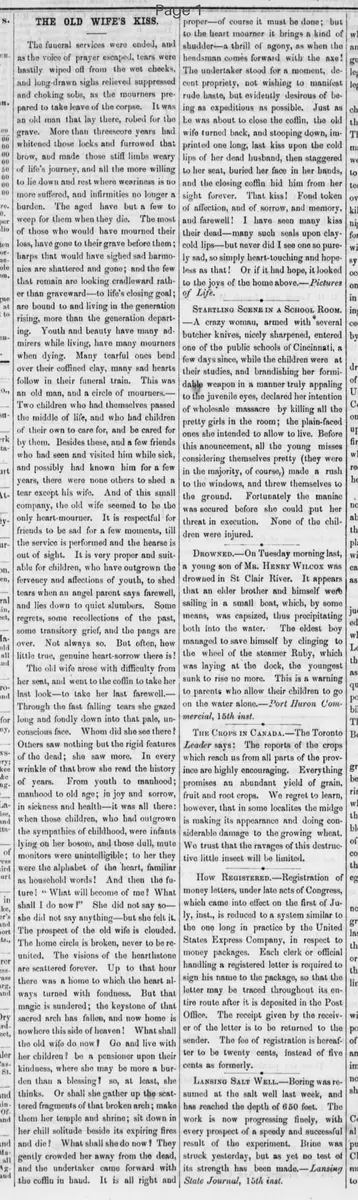
The funeral services were ended, and as the voice of prayer escaped, tears were hastily wiped off from the wet cheeks, and long-drawn sighs relieved suppressed and choking sobs, as the mourners prepared to take leave of the corpse. It was an old man that lay there, robed for the grave. More than threescore years had whitened those locks and furrowed that brow, and made those stiff limbs weary of life's journey, and all the more willing to lie down and rest where weariness is no more suffered, and infirmities no longer a burden. The aged have but a few to weep for them when they die. The most of those who would have mourned their loss, have gone to their grave before them; harps that would have sighed sad harmonies are shattered and gone; and the few that remain are looking cradleward rather than graveward—to life's closing goal; are bound to and living in the generation rising, more than the generation departing.
Youth and beauty have many admirers while living, have many mourners when dying. Many tearful ones bend over their coffined clay, many sad hearts follow in their funeral train. This was an old man, and a circle of mourners.—Two children who had themselves passed the middle of life, and who had children of their own to care for, and be cared for by them. Besides these, and a few friends who had seen and visited him while sick, and possibly had known him for a few years, there were none others to shed a tear except his wife. And of this small company, the old wife seemed to be the only heart-mourner. It is respectful for friends to be sad for a few moments, till the service is performed and the hearse is out of sight. It is very proper and suitable for children, who have outgrown the fervency and affections of youth, to shed tears when an angel parent says farewell and lies down to quiet slumbers. Some regrets, some recollections of the past, some transitory grief, and the pangs are over. Not always so. But often, how little true, genuine heart-sorrow there is!
The old wife arose with difficulty from her seat, and went to the coffin to take her last look—to take her last farewell.—Through the fast falling tears she gazed long and fondly down into that pale, unconscious face. Whom did she see there? Others saw nothing but the rigid features of the dead; she saw more. In every wrinkle of that brow she read the history of years. From youth to manhood; manhood to old age; in joy and sorrow, in sickness and health—it was all there: when those children, who had outgrown the sympathies of childhood, were infants lying on her bosom, and those dull, mute monitors were unintelligible; to her they were the alphabet of the heart, familiar as household words! And then the future! "What will become of me? What shall I do now?" She did not say so—she did not say anything—but she felt it. The prospect of the old wife is clouded. The home circle is broken, never to be re-united. The visions of the hearthstone are scattered forever. Up to that hour there was a home to which the heart always turned with fondness. But that magic is sundered; the keystone of that sacred arch has fallen, and now home is nowhere this side of heaven! What shall the old wife do now? Go and live with her children? be a pensioner upon their kindness, where she may be more a burden than a blessing? so, at least, she thinks. Or shall she gather up the scattered fragments of that broken arch; make them her temple and shrine; sit down in her chill solitude beside its expiring fires and die? What shall she do now? They gently crowded her away from the dead, and the undertaker came forward with the coffin in hand. It is all right and proper—of course it must be done; but to the heart mourner it brings a kind of shudder—a thrill of agony, as when the headsman comes forward with the axe! The undertaker stood for a moment, decent propriety, not wishing to manifest rude haste, but evidently desirous of being as expeditious as possible. Just as he was about to close the coffin, the old wife turned back, and stooping down, imprinted one long, last kiss upon the cold lips of her dead husband, then staggered to her seat, buried her face in her hands and the closing coffin hid him from her sight forever. That kiss! Fond token of affection, and of sorrow, and memory, and farewell! I have seen many kiss their dead—many such seals upon clay-cold lips—but never did I see one so purely sad, so simply heart-touching and hopeless as that! Or if it had hope, it looked to the joys of the home above.—Pictures of Life.
The funeral services were ended, and as the voice of prayer escaped, tears were hastily wiped off from the wet cheeks, and long-drawn sighs relieved suppressed and choking sobs, as the mourners prepared to take leave of the corpse. It was an old man that lay there, robed for the grave. More than threescore years had whitened those locks and furrowed that brow, and made those stiff limbs weary of life's journey, and all the more willing to lie down and rest where weariness is no more suffered, and infirmities no longer a burden. The aged have but a few to weep for them when they die. The most of those who would have mourned their loss, have gone to their grave before them; harps that would have sighed sad harmonies are shattered and gone; and the few that remain are looking cradleward rather than graveward—to life's closing goal; are bound to and living in the generation rising, more than the generation departing.
Youth and beauty have many admirers while living, have many mourners when dying. Many tearful ones bend over their coffined clay, many sad hearts follow in their funeral train. This was an old man, and a circle of mourners.—Two children who had themselves passed the middle of life, and who had children of their own to care for, and be cared for by them. Besides these, and a few friends who had seen and visited him while sick, and possibly had known him for a few years, there were none others to shed a tear except his wife. And of this small company, the old wife seemed to be the only heart-mourner. It is respectful for friends to be sad for a few moments, till the service is performed and the hearse is out of sight. It is very proper and suitable for children, who have outgrown the fervency and affections of youth, to shed tears when an angel parent says farewell and lies down to quiet slumbers. Some regrets, some recollections of the past, some transitory grief, and the pangs are over. Not always so. But often, how little true, genuine heart-sorrow there is!
The old wife arose with difficulty from her seat, and went to the coffin to take her last look—to take her last farewell.—Through the fast falling tears she gazed long and fondly down into that pale, unconscious face. Whom did she see there? Others saw nothing but the rigid features of the dead; she saw more. In every wrinkle of that brow she read the history of years. From youth to manhood; manhood to old age; in joy and sorrow, in sickness and health—it was all there: when those children, who had outgrown the sympathies of childhood, were infants lying on her bosom, and those dull, mute monitors were unintelligible; to her they were the alphabet of the heart, familiar as household words! And then the future! "What will become of me? What shall I do now?" She did not say so—she did not say anything—but she felt it. The prospect of the old wife is clouded. The home circle is broken, never to be re-united. The visions of the hearthstone are scattered forever. Up to that hour there was a home to which the heart always turned with fondness. But that magic is sundered; the keystone of that sacred arch has fallen, and now home is nowhere this side of heaven! What shall the old wife do now? Go and live with her children? be a pensioner upon their kindness, where she may be more a burden than a blessing? so, at least, she thinks. Or shall she gather up the scattered fragments of that broken arch; make them her temple and shrine; sit down in her chill solitude beside its expiring fires and die? What shall she do now? They gently crowded her away from the dead, and the undertaker came forward with the coffin in hand. It is all right and proper—of course it must be done; but to the heart mourner it brings a kind of shudder—a thrill of agony, as when the headsman comes forward with the axe! The undertaker stood for a moment, decent propriety, not wishing to manifest rude haste, but evidently desirous of being as expeditious as possible. Just as he was about to close the coffin, the old wife turned back, and stooping down, imprinted one long, last kiss upon the cold lips of her dead husband, then staggered to her seat, buried her face in her hands and the closing coffin hid him from her sight forever. That kiss! Fond token of affection, and of sorrow, and memory, and farewell! I have seen many kiss their dead—many such seals upon clay-cold lips—but never did I see one so purely sad, so simply heart-touching and hopeless as that! Or if it had hope, it looked to the joys of the home above.—Pictures of Life.
What sub-type of article is it?
Tragedy
Family Drama
Biography
What themes does it cover?
Tragedy
Family
Love
What keywords are associated?
Funeral Mourning
Widow's Grief
Last Kiss
Old Age Death
Family Loss
What entities or persons were involved?
Old Wife
Old Man
Two Children
Story Details
Key Persons
Old Wife
Old Man
Two Children
Story Details
At the funeral of an elderly man, his devoted wife mourns deeply as the only true heart-sorrow among superficial mourners; she recalls their shared life from youth to old age, kisses his cold lips in a poignant farewell, and faces the prospect of a broken home and lonely future.