Thank you for visiting SNEWPapers!
Sign up free
Foreign News
August 20, 1819
Richmond Enquirer
Richmond, Richmond County, Virginia
What is this article about?
Excerpt from a foreign constitutional document outlining the structure, election, powers, and procedures of the Chamber of Representatives and Senate, including qualifications, terms, and impeachment processes.
Clipping
OCR Quality
95%
Excellent
Full Text
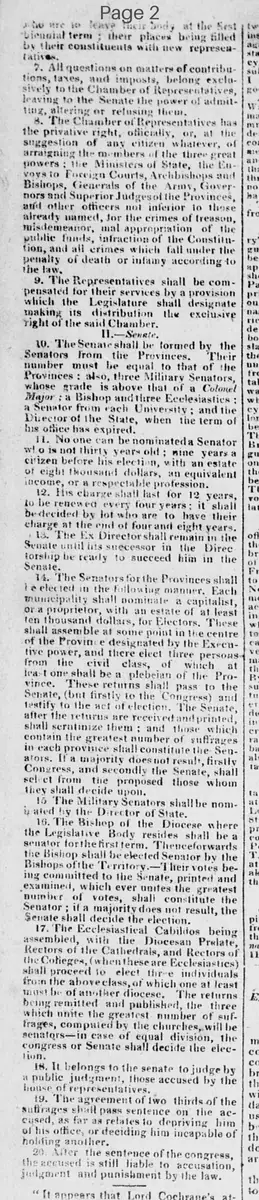
Members are to leave their seats at the next biennial term: their places being filled by their constituents with new representatives.
7. All questions on matters of contributions, taxes, and imposts, belong exclusively to the Chamber of Representatives, leaving to the Senate the power of admitting, altering or refusing them.
8. The Chamber of Representatives has the prerogative right, officially, or, at the suggestion of any citizen whatever, of arraigning the members of the three great powers: the Ministers of State, the Envoys to Foreign Courts, Archbishops and Bishops, Generals of the Army, Governors and Superior Judges of the Provinces, and other officers not inferior to those already named, for the crimes of treason, misdemeanor, malappropriation of the public funds, infraction of the Constitution, and all crimes which fall under the penalty of death or infamy according to the law.
9. The Representatives shall be compensated for their services by a provision which the Legislature shall designate, making its distribution the exclusive right of the said Chamber.
I. Senate.
10. The Senate shall be formed by the Senators from the Provinces. Their number must be equal to that of the Provinces: also, three Military Senators, whose grade is above that of a Colonel Major: a Bishop and three Ecclesiastics, a Senator from each University: and the Director of the State, when the term of his office has expired.
11. No one can be nominated a Senator who is not thirty years old: nine years a citizen before his election, with an estate of eight thousand dollars, an equivalent income, or a respectable profession.
12. His charge shall last for 12 years, to be renewed every four years: it shall be decided by lot who are to have their charge at the end of four and eight years.
13. The Ex Director shall remain in the Senate until his successor in the Directorship be ready to succeed him in the Senate.
14. The Senators for the Provinces shall be elected in the following manner. Each municipality shall nominate a capitalist, or a proprietor, with an estate of at least ten thousand dollars, for Electors. These shall assemble at some point in the centre of the Province, designated by the Executive power, and there elect three persons from the civil class, of which at least one shall be a plebeian of the Province. These returns shall pass to the Senate (but firstly to the Congress) and testify to the act of election. The Senate, after the returns are received and printed, shall scrutinize them: and those which contain the greatest number of suffrages in each province shall constitute the Senators. If a majority does not result, firstly Congress, and secondly the Senate, shall select from the proposed those whom they shall decide upon.
15. The Military Senators shall be nominated by the Director of State.
16. The Bishop of the Diocese where the Legislative Body resides shall be a senator for the first term. Thenceforwards the Bishop shall be elected Senator by the Bishops of the Territory. Their votes being committed to the Senate, printed and examined, whichever unites the greatest number of votes, shall constitute the Senator: if a majority does not result, the Senate shall decide the election.
17. The Ecclesiastical Cabildo being assembled, with the Diocesan Prelate, Rectors of the Cathedrals, and Rectors of the Colleges (when these are Ecclesiastics) shall proceed to elect three individuals from the above class, of which one at least must be of another diocese. The returns being remitted and published, the three which unite the greatest number of suffrages, computed by the churches, will be senators—in case of equal division, the Congress or Senate shall decide the election.
18. It belongs to the senate to judge by a public judgment, those accused by the house of representatives.
19. The agreement of two thirds of the suffrages shall pass sentence on the accused, as far as relates to depriving him of his office, or deciding him incapable of holding another.
20. After the sentence of the congress, the accused is still liable to accusation, judgment and punishment by the law.
7. All questions on matters of contributions, taxes, and imposts, belong exclusively to the Chamber of Representatives, leaving to the Senate the power of admitting, altering or refusing them.
8. The Chamber of Representatives has the prerogative right, officially, or, at the suggestion of any citizen whatever, of arraigning the members of the three great powers: the Ministers of State, the Envoys to Foreign Courts, Archbishops and Bishops, Generals of the Army, Governors and Superior Judges of the Provinces, and other officers not inferior to those already named, for the crimes of treason, misdemeanor, malappropriation of the public funds, infraction of the Constitution, and all crimes which fall under the penalty of death or infamy according to the law.
9. The Representatives shall be compensated for their services by a provision which the Legislature shall designate, making its distribution the exclusive right of the said Chamber.
I. Senate.
10. The Senate shall be formed by the Senators from the Provinces. Their number must be equal to that of the Provinces: also, three Military Senators, whose grade is above that of a Colonel Major: a Bishop and three Ecclesiastics, a Senator from each University: and the Director of the State, when the term of his office has expired.
11. No one can be nominated a Senator who is not thirty years old: nine years a citizen before his election, with an estate of eight thousand dollars, an equivalent income, or a respectable profession.
12. His charge shall last for 12 years, to be renewed every four years: it shall be decided by lot who are to have their charge at the end of four and eight years.
13. The Ex Director shall remain in the Senate until his successor in the Directorship be ready to succeed him in the Senate.
14. The Senators for the Provinces shall be elected in the following manner. Each municipality shall nominate a capitalist, or a proprietor, with an estate of at least ten thousand dollars, for Electors. These shall assemble at some point in the centre of the Province, designated by the Executive power, and there elect three persons from the civil class, of which at least one shall be a plebeian of the Province. These returns shall pass to the Senate (but firstly to the Congress) and testify to the act of election. The Senate, after the returns are received and printed, shall scrutinize them: and those which contain the greatest number of suffrages in each province shall constitute the Senators. If a majority does not result, firstly Congress, and secondly the Senate, shall select from the proposed those whom they shall decide upon.
15. The Military Senators shall be nominated by the Director of State.
16. The Bishop of the Diocese where the Legislative Body resides shall be a senator for the first term. Thenceforwards the Bishop shall be elected Senator by the Bishops of the Territory. Their votes being committed to the Senate, printed and examined, whichever unites the greatest number of votes, shall constitute the Senator: if a majority does not result, the Senate shall decide the election.
17. The Ecclesiastical Cabildo being assembled, with the Diocesan Prelate, Rectors of the Cathedrals, and Rectors of the Colleges (when these are Ecclesiastics) shall proceed to elect three individuals from the above class, of which one at least must be of another diocese. The returns being remitted and published, the three which unite the greatest number of suffrages, computed by the churches, will be senators—in case of equal division, the Congress or Senate shall decide the election.
18. It belongs to the senate to judge by a public judgment, those accused by the house of representatives.
19. The agreement of two thirds of the suffrages shall pass sentence on the accused, as far as relates to depriving him of his office, or deciding him incapable of holding another.
20. After the sentence of the congress, the accused is still liable to accusation, judgment and punishment by the law.
What sub-type of article is it?
Political
What keywords are associated?
Chamber Of Representatives
Senate Structure
Elections
Impeachment
Constitutional Provisions
Ecclesiastical Senators
Foreign News Details
Event Details
The text details the composition, election processes, qualifications, terms, powers, and impeachment procedures for the Chamber of Representatives and Senate in a foreign legislative system, including provincial senators, military senators, ecclesiastical representatives, and the role of the Director of State.