Thank you for visiting SNEWPapers!
Sign up free
Literary
July 3, 1790
Gazette Of The United States
New York, New York County, New York
What is this article about?
An essay from The Tablet, No. CXXVIII, extolling the power of simplicity and truth over artifice, pretense, and fiction. It critiques coxcombs and quacks who promote false propriety, urging adherence to unmingled truth despite prejudice and habit.
Clipping
OCR Quality
98%
Excellent
Full Text
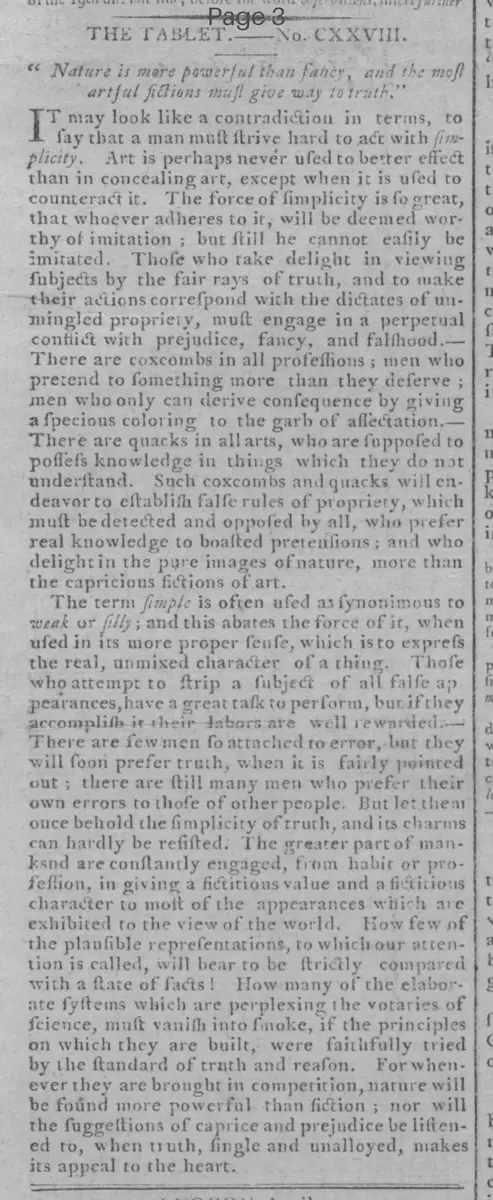
THE TABLET. NO. CXXVIII.
"Nature is more powerful than fancy, and the most artful fictions must give way to truth."
It may look like a contradiction in terms, to say that a man must strive hard to act with simplicity. Art is perhaps never used to better effect than in concealing art, except when it is used to counteract it. The force of simplicity is so great, that whoever adheres to it, will be deemed worthy of imitation; but still he cannot easily be imitated. Those who take delight in viewing subjects by the fair rays of truth, and to make their actions correspond with the dictates of unmingled propriety, must engage in a perpetual conflict with prejudice, fancy, and falsehood.
There are coxcombs in all professions; men who pretend to something more than they deserve; men who only can derive consequence by giving a specious coloring to the garb of affectation. There are quacks in all arts, who are supposed to possess knowledge in things which they do not understand. Such coxcombs and quacks will endeavor to establish false rules of propriety, which must be detected and opposed by all, who prefer real knowledge to boasted pretensions; and who delight in the pure images of nature, more than the capricious fictions of art.
The term simple is often used as synonymous to weak or silly; and this abates the force of it, when used in its more proper sense, which is to express the real, unmixed character of a thing. Those who attempt to strip a subject of all false appearances, have a great task to perform, but if they accomplish it their labors are well rewarded.
There are few men so attached to error, but they will soon prefer truth, when it is fairly pointed out; there are still many men who prefer their own errors to those of other people. But let them once behold the simplicity of truth, and its charms can hardly be resisted. The greater part of mankind are constantly engaged, from habit or profession, in giving a fictitious value and a fictitious character to most of the appearances which are exhibited to the view of the world. How few of the plausible representations, to which our attention is called, will bear to be strictly compared with a state of facts! How many of the elaborate systems which are perplexing the votaries of science, must vanish into smoke, if the principles on which they are built, were faithfully tried by the standard of truth and reason. For whenever they are brought in competition, nature will be found more powerful than fiction; nor will the suggestions of caprice and prejudice be listened to, when truth, single and unalloyed, makes its appeal to the heart.
"Nature is more powerful than fancy, and the most artful fictions must give way to truth."
It may look like a contradiction in terms, to say that a man must strive hard to act with simplicity. Art is perhaps never used to better effect than in concealing art, except when it is used to counteract it. The force of simplicity is so great, that whoever adheres to it, will be deemed worthy of imitation; but still he cannot easily be imitated. Those who take delight in viewing subjects by the fair rays of truth, and to make their actions correspond with the dictates of unmingled propriety, must engage in a perpetual conflict with prejudice, fancy, and falsehood.
There are coxcombs in all professions; men who pretend to something more than they deserve; men who only can derive consequence by giving a specious coloring to the garb of affectation. There are quacks in all arts, who are supposed to possess knowledge in things which they do not understand. Such coxcombs and quacks will endeavor to establish false rules of propriety, which must be detected and opposed by all, who prefer real knowledge to boasted pretensions; and who delight in the pure images of nature, more than the capricious fictions of art.
The term simple is often used as synonymous to weak or silly; and this abates the force of it, when used in its more proper sense, which is to express the real, unmixed character of a thing. Those who attempt to strip a subject of all false appearances, have a great task to perform, but if they accomplish it their labors are well rewarded.
There are few men so attached to error, but they will soon prefer truth, when it is fairly pointed out; there are still many men who prefer their own errors to those of other people. But let them once behold the simplicity of truth, and its charms can hardly be resisted. The greater part of mankind are constantly engaged, from habit or profession, in giving a fictitious value and a fictitious character to most of the appearances which are exhibited to the view of the world. How few of the plausible representations, to which our attention is called, will bear to be strictly compared with a state of facts! How many of the elaborate systems which are perplexing the votaries of science, must vanish into smoke, if the principles on which they are built, were faithfully tried by the standard of truth and reason. For whenever they are brought in competition, nature will be found more powerful than fiction; nor will the suggestions of caprice and prejudice be listened to, when truth, single and unalloyed, makes its appeal to the heart.
What sub-type of article is it?
Essay
What themes does it cover?
Moral Virtue
What keywords are associated?
Simplicity
Truth
Fiction
Affectation
Propriety
Prejudice
Nature
Literary Details
Title
The Tablet. No. Cxxviii.
Key Lines
"Nature Is More Powerful Than Fancy, And The Most Artful Fictions Must Give Way To Truth."
The Force Of Simplicity Is So Great, That Whoever Adheres To It, Will Be Deemed Worthy Of Imitation; But Still He Cannot Easily Be Imitated.
For Whenever They Are Brought In Competition, Nature Will Be Found More Powerful Than Fiction; Nor Will The Suggestions Of Caprice And Prejudice Be Listened To, When Truth, Single And Unalloyed, Makes Its Appeal To The Heart.