Thank you for visiting SNEWPapers!
Sign up free
The Enquirer
Richmond, Henrico County, Virginia
What is this article about?
Reports from Paris papers detail the French Grand Army's advances in the Ulm campaign, including battles at Wertingen and Gunzburg, pursuits of Austrian forces, and encirclement near Ulm in October 1805. Supplementary intelligence from Vienna, Berlin, and other cities covers Russian movements, Prussian reactions, alliances, proclamations, and logistical strains amid the War of the Third Coalition.
Merged-components note: Continuation of European intelligence reports, spanning pages 2 and 3.
Clippings
1 of 2
OCR Quality
Full Text
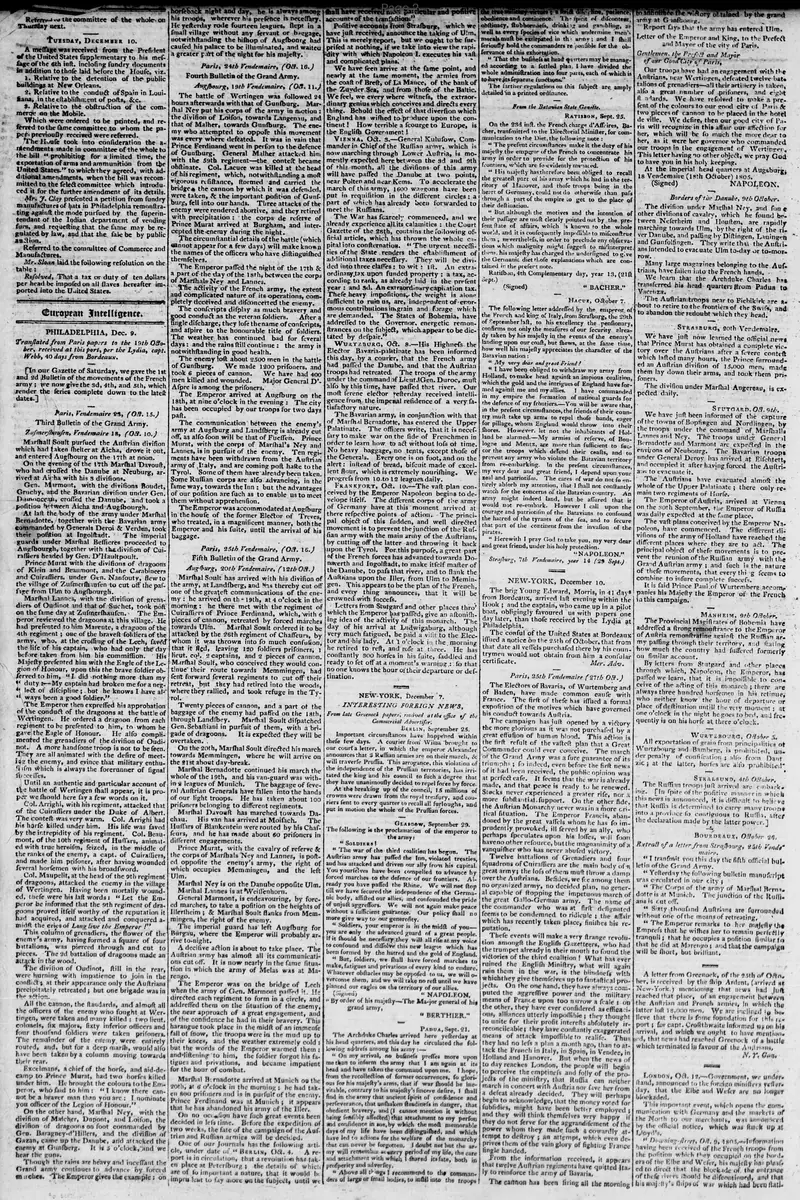
PHILADELPHIA, Dec. 9.
Translated from Paris papers to the 19th October, received at this port, per the Lydia, capt. Webb, 40 days from Bordeaux.
In our Gazette of Saturday, we gave the 1st and 2d Bulletin of the movements of the French army; we now give the 3d, 4th, and 5th, which render the series complete down to the latest dates.
Paris, Vendemaire 23, (Oct. 15.)
Third Bulletin of the Grand Army.
Zumserhausen, Vendemaire 18, (Oct. 10.)
Marshal Soult pursued the Austrian division which had taken shelter at Aicha, drove it out, and entered Augbourg on the 17th at noon.
On the evening of the 17th Marshal Davoust, who had crossed the Danube at Neuburg, arrived at Aicha with his 5 divisions.
Gen. Marmont, with the divisions Boudet, Grouchy, and the Bavarian division under Gen. Duroc, crossed the Danube; and took a position between Aicha and Augbourg.
At last the body of the army under Marshal Bernadotte, together with the Bavarian army commanded by Generals Deroy & Werden, took their position at Ingolstadt. The imperial guards under Marshal Bessières proceeded to Augbourg, together with the division of Cuirassiers headed by Gen. D'Hautpout.
Prince Murat with the divisions of dragoons of Klein and Beaumont, and the Carabiniers and Cuirassiers, under Gen. Nansouty, flew to the village of Zumserhausen to cut off the passage from Ulm to Augbourg.
Marshal Lannes, with the division of grenadiers of Oudinot and that of Suchet, took post on the same day at Zumserhausen. The Emperor reviewed the dragoons at this village. He had presented to him Marente, a dragoon of the 4th regiment; one of the bravest soldiers of the army, who, at the crossing of the Lech, saved the life of his captain, who had only the day before taken from him his commission. His Majesty presented him with the Eagle of the Legion of Honour, upon this the brave soldier observed to him, "I did nothing more than my duty—My captain had broken me for a neglect of discipline; but he knows I have always been a good soldier."
The Emperor then expressed his approbation of the conduct of the dragoons at the battle of Wertingen. He ordered a dragoon from each regiment to be presented to him, to whom he gave the Eagle of Honour. He also complimented the grenadiers of the division of Oudinot. A more handsome troop is not to be seen. They are all animated with the desire of meeting the enemy, and evince that military enthusiasm which is always the forerunner of signal successes.
Until an authentic and particular account of the battle of Wertingen shall appear, it is proper we should here say a few words on it.
Col. Arrighi, with his regiment, attacked that of the Cuirassiers under the Duke of Aich. The contest was very warm. Col. Arrighi had his horse killed under him. His life was saved by the intrepidity of his regiment. Col. Beaumont, of the 10th regiment of Hussars, animated with true heroism, seized, in the middle of the ranks of the enemy, a capt. of Cuirassiers, and made him prisoner, after having wounded several horsemen with his broadsword.
Col. Maupetit, at the head of the 9th regiment of dragoons, attacked the enemy in the village of Wertingen. Having been mortally wounded, these were his last words: "Let the Emperor be informed that the 9th regiment of dragoons proved itself worthy of the reputation it had acquired, and attacked and conquered amidst the cries of Long live the Emperor!"
This column of grenadiers, the flower of the enemy's army, having formed a square of four battalions, was pierced through and cut to pieces. The 2d battalion of dragoons made an attack in the wood.
The division of Oudinot, still in the rear, were burning with impatience to join in the conflict; at their appearance only the Austrians precipitately retreated; but one brigade was in the action.
All the cannon, the standards, and almost all the officers of the enemy who fought at Wertingen, were taken and many killed: two lieut. colonels, six majors, sixty inferior officers and four thousand soldiers were taken prisoners.
The remainder of the enemy, were entirely routed, and, but for a deep marsh, would also have been taken by a column moving towards their rear.
Excelmans, a chief of the horse, and aid-de-camp to Prince Murat, had two horses killed under him. He brought the colours to the Emperor, who said to him: "I know there cannot be a braver man than you are: I nominate you officer of the Legion of Honour."
On the other hand, Marshal Ney, with the division of Malher, Dupont, and Loisin, the division of dragoons on foot commanded by Gen. Baraguay-d'Hilliers, and the division of Gazan, came up the Danube, and attacked the enemy at Gunzburg. It is 5 o'clock, and we hear the guns.
Though the rains are heavy and incessant the Grand army continues to advance by forced marches. The Emperor gives the example: on horseback night and day, he is always among his troops, wherever his presence is necessary. He yesterday rode fourteen leagues, slept in a small village without any servant or baggage, notwithstanding the bishop of Augbourg had caused his palace to be illuminated, and waited a greater part of the night for his majesty.
Paris, 24th Vendemaire, (Oct. 16.)
Fourth Bulletin of the Grand Army.
Augsbourg, 19th Vendemaire, (Oct. 11.)
The battle of Wertingen was followed 24 hours afterwards with that of Gunzburg. Marshal Ney put his corps of the army in motion: the division of Loisin, towards Langenau, and that of Malher, towards Gunzburg. The enemy who attempted to oppose this movement was everywhere defeated. It was in vain that Prince Ferdinand went in person to the defence of Gunzburg. General Malher attacked him with the 59th regiment—the contest became obstinate. Col. Lacuée was killed at the head of his regiment, which, notwithstanding a most vigorous resistance, stormed and carried the bridges the cannon by which it was defended, were taken, & the important position of Gunzburg, fell into our hands. Three attacks of the enemy were rendered abortive, and they retired with precipitation: the corps de reserve of Prince Murat arrived at Gunzburg, and intercepted the enemy during the night.
The circumstantial details of the battle (which cannot appear for a few days) will make known the names of the officers who have distinguished themselves.
The Emperor passed the night of the 17th & a part of the day of the 18th, between the corps of Marshals Ney and Lannes.
The activity of the French army, the extent and complicated nature of its operations, completely deceived and disconcerted the enemy.
The conscripts display as much bravery and good conduct as the veteran soldiers. After a single discharge; they lose the name of conscripts, and aspire to the honourable title of soldiers.
The weather has continued bad for several days: and the rains still continue: the army is notwithstanding in good health.
The enemy lost about 2500 men in the battle of Gunzburg. We made 1200 prisoners, and took 6 pieces of cannon.
We have had 400 men killed and wounded. Major General D'Aspreis among the prisoners.
The Emperor arrived at Augsburg on the 18th, at nine o'clock in the evening: The city has been occupied by our troops for two days past.
The communication between the enemy's army at Augsburg and Landsberg is already cut off, as also soon will be that of Ulm. Prince Murat, with the corps of Marshals Ney and Lannes, is in pursuit of the enemy. Ten regiments have been withdrawn from the Austrian army of Italy, and are coming post haste to the Tyrol. Some of them have already been taken.
Some Russian corps are also advancing, in the same way, towards the Inn: but the advantages of our position are such as to enable us to meet them without apprehension.
The Emperor was accommodated at Augsburg in the house of the former Elector of Treves, who treated, in a magnificent manner, both the Emperor and his suite, until the arrival of his baggage.
Paris, 25th Vendemaire, (Oct. 16.)
Fifth Bulletin of the Grand Army.
Augsbourg, 20th Vendemaire, (12th Oct.)
Marshal Soult has arrived with his division of the army, at Landsberg. and Has thereby cut off one of the greatest communications of the enemy: he arrived on the 19th, at 4 o'clock in the morning: he there met with the regiment of Cuirassiers of Prince Ferdinand, which, with 6 pieces of cannon, retreated by forced marches towards Ulm. Marshal Soult ordered it to be attacked by the 26th regiment of Chasseurs, by whom it was thrown into so much confusion, that it fled, leaving 120 soldiers prisoners, 1 lieut. col. 2 captains, and 2 pieces of cannon.
Marshal Soult, who conceived they would continue their route towards Memmingen, had sent forward several regiments to cut off their retreat, but they had retired into the woods, where they rallied, and took refuge in the Tyrol.
Twenty pieces of cannon, and a part of the baggage of the enemy had passed on the 18th, through Landsberg.
Marshal Soult dispatched Gen. Sebastiani in pursuit of them, with a brigade of dragoons.
It is expected they will be overtaken.
On the 20th, Marshal Soult directed his march towards Memmingen, where he will arrive on the 21st about day-break.
Marshal Bernadotte continued his march the whole of the 19th, and his van-guard was within 8 leagues of Munich. The baggage of several Austrian Generals have fallen into the hands of our light troops. He has taken about 100 prisoners belonging to different regiments.
Marshal Davoust has marched towards Dachau. His van has arrived at Moosburg. The Hussars of Blankenstein were routed by his Chasseurs, and he has made about 60 prisoners in different engagements.
Prince Murat, with the cavalry of reserve & the corps of Marshals Ney and Lannes, is posted opposite the enemy's army, the right of which occupies Memmingen, and the left Ulm.
Marshal Ney is on the Danube opposite Ulm.
Marshal Lannes is at Ulm.
General Marmont, is endeavouring, by forced marches, to take a position on the heights of Illertheim: & Marshal Soult flanks from Memmingen, the right of the enemy.
The imperial guard has left Augsburg for Burgau, where the Emperor will probably arrive to-night.
A decisive action is about to take place. The Austrian army has almost all its communications cut off. It is now nearly in the same situation in which the army of Melas was at Marengo.
The Emperor was on the bridge of Lech when the army of Gen. Marmont passed it. He directed each regiment to form in a circle, and addressed them on the situation of the enemy, the near approach of a great engagement, and of the confidence he had in their bravery. This harangue took place in the midst of an immense fall of snow, the troops were in the mud up to their knees, and the weather extremely cold: but the words of the Emperor warmed them: and listening to him, the soldier forgot his fatigues and privations, and became impatient for the hour of combat.
Marshal Bernadotte arrived at Munich on the 20th; at 6 o'clock in the morning: he had taken 800 prisoners and is in pursuit of the enemy.
Prince Ferdinand was at Munich; it appears that he has abandoned his army of the Iller.
On no occasion have such great events been decided in less time. Before the expiration of two weeks, the fate of the campaign of the Austrian and Russian armies will be decided.
One of our Journals has the following article, under date of "Berlin, Oct. 4. A report is in circulation, that a revolution has taken place at Petersburg; the details of which are of so important a nature, that it would be imprudent to say more on the subject, until we shall have received more particular and positive accounts of the transaction."
Positive accounts from Strasburg, which we have just received, announce the taking of Ulm.
This is merely report, but we ought to be surprised at nothing, if we take into view the rapidity with which Napoleon I. executes his vast and complicated plans:
We have seen arrive at the same point, and nearly at the same moment, the armies from the coast of Brest, of La Mancha, of the banks of the Zuyder Sea, and from those of the Baltic.
We feel, we everywhere witness, the extraordinary genius which conceives and directs everything. Behold the effect of that diversion which England has wished to produce upon the continent! How terrible a scourge to Europe, is the English Government!
Vienna, Oct. 3. General Kutusow, Commander in Chief of the Russian army, which is now marching through Lower Austria, is momentarily expected here between the 3d and 5th of this month. all the divisions of this army will have passed the Danube at two points, near Polten and near Krems. To accelerate the march of this army, 1600 waggons have been put in requisition in the different circles: a part of which has already been forwarded to meet the Russians.
The War has scarcely commenced, and we already experience all its calamities: the Court Gazette of the 25th, contains the following official article, which has thrown the whole capital into consternation. "The urgent necessities of the State renders the establishment of additional taxes necessary. They will be divided into three classes: to wit: 1st. An extraordinary tax upon funded property: 2d. a tax, according to rank, as already laid in the present year: and 3d. An extraordinary capitation tax."
These heavy impositions, the weight is alone sufficient to ruin us, are, independent of enormous contributions in grain and Forage which are demanded. The States of Bohemia, have addressed to the Governor, energetic remonstrances on the subject, which appear to be dictated by despair."
WURTZBURG, Oct. 8.--His Highness the Elector Bavaria-Palatinate has been informed this day, by a courier, that the French army had passed the Danube, and that the Austrian troops had retreated. The troops of the army under the command of Lieut. Gen. Duroc, must also by this time, have passed that river. Our most serene elector yesterday received intelligence from the imperial residence of a very satisfactory nature.
The Bavarian army, in conjunction with that of Marshal Bernadotte, has entered the Upper Palatinate. The officers write, that it is necessary to make war on the side of Frenchmen in order to learn how to act without loss of time.
No heavy baggage, no tents, except those of the Generals. Every one is on foot, and on the alert: instead of bread, biscuit made of excellent flour, which is extremely nourishing. We progress from 10 to 12 leagues daily.
FRANKFORT, Oct. 10.--The vast plan conceived by the Emperor Napoleon begins to develope itself. The different corps of the army of Germany have at this moment arrived at their respective points of action. The principal object of this sudden, and well directed movement is to prevent the junction of the Russian army with the main army of the Austrians, by cutting off the latter -and throwing it back upon the Tyrol. For this purpose, a great part of the French forces has advanced towards Donauwerth and Ingolstadt, to make itself master of the Danube, to pass that river, and to flank the Austrians upon the Iller, from Ulm to Memmingen. This appears to be the plan of the French, and every thing announces, that it will be crowned with success.
Letters from Stutgard and other places through which the Emperor has passed, give an astonishing idea of the activity of this monarch. The day of his arrival at Ludwigsburg, although very much fatigued, he paid a visit to the Elector and his lady. At 1 o'clock in the morning he retired to rest, and rose at three. He has constantly 300 horses in his suite, saddled and ready to set off at a moment's warning: so that no one knows the hour of their departure or destination.
NEW-YORK, December 7.
INTERESTING FOREIGN NEWS,
From late Greenock papers, received at the office of the Commercial Advertiser:
BERLIN, September 25.
Important circumstances have happened within these few days. A courier from Vienna brought to our court a letter, in which the emperor Alexander announces that 5 Russian armies are on their march, & will traverse Prussia. This arrogance, this violation of the independence of the Prussian territories, has irritated the king and his council to such a degree that they have unanimously decided to repel force by force.
At the breaking up of the council, 15 millions of crowns were drawn from the royal treasury, and couriers sent to every quarter to recall all furloughs, and put in motion the whole of the Prussian forces.
GLASGOW, September 29.
The following is the proclamation of the emperor to the army:
"SOLDIERS!
The war of the third coalition has begun. The Austrian army has passed the Inn, violated treaties, and has attacked and driven our ally from his capital. You yourselves have been compelled to advance by forced marches to the defence of our frontiers. Already you have passed the Rhine. We will not stop till we have secured the independence of the Germanic body, assisted our allies, and confounded the pride of unjust aggressors. We will not again make peace without a sufficient guarantee. Our policy shall no more give way to our generosity.
Soldiers, your emperor is in the midst of you—you are only the advanced guard of a great people. If it should be necessary they will all rise at my voice to confound and dissolve this new league which has been formed by the hatred and the gold of England.
But, soldiers, we shall have forced marches to make, fatigues and privations of every kind to endure. Whatever obstacles may be opposed to us, we will overcome them, and we will take no rest until we have planted our eagles on the territory of our allies."
(Signed)
"NAPOLEON."
"By order of his majesty—The Major general of his grand army,
"BERTHIER."
PADUA, Sept. 21.
The Archduke Charles arrived here yesterday at his head quarters, and this day he circulated the following address amongst his army:~
"On my arrival, no business presses more upon me than to inform the army that I am again at its head and have taken the command upon me. I hope, from the recollection of former occurrences, so glorious for his majesty's arms, that if war should be inevitable, contrary to his majesty's sincere desire, I shall find in the army that ancient spirit of confidence and perseverance, that unshaken steadiness in danger, that obedient bravery, and (I cannot mention it without being sensibly affected) that attachment to my person and confidence in me, by which the most memorable days of my life have been distinguished, and which have led to actions for the welfare of the monarchy that can never be forgotten, I doubt not but the army will remember at every period of my life, the care and attachment with which I shared its fate, both in prosperity and adversity.
Above all things I recommend to the commanders of large or small bodies, to instil into the troops the theme of discipline, patience, obedience and continence. The spirit of discontent, obstinacy, stubbornness, drinking and gambling, as well as every species of vice which undermine men's morals must be extirpated in the army: and I shall seriously hold the commanders responsible for the observance of this exhortation.
That the business at head quarters may be managed according to a settled plan, I have divided the whole administration into four parts, each of which is to have its separate functions."
The farther regulations on this subject are amply detailed in a printed ordinance.
From the Batavian State Gazette.
RATISBON, Sept. 25.
On the 23d inst. the French charge d'Affaires, Bacher, transmitted to the Directorial Minister, for communication to the Diet, the following note:
"The present circumstances make it the duty of his majesty the emperor of the French to concentrate his army in order to provide for the protection of his frontiers, which are so evidently menaced.
His majesty has therefore been obliged to recall the greatest part of his army which he had in the territory of Hanover, and those troops being in the heart of Germany, could not do otherwise than pass through a part of the empire to get to the place of their destination.
But although the motives and the intention of their passage are most clearly pointed out by the present state of affairs, which is known to the whole world, and it is consequently impossible to misconstue them; nevertheless, in order to preclude any observations which malignity might suggest to misinterpret them, his majesty has charged the undersigned to give the Germanic diet those explanations which are contained in the present note."
Ratisbon, 4th Complementary day, year 13, (21st Sept.)
(Signed)
"BACHER."
THE HAGUE, October 7.
The following letter addressed by the emperor of the French and king of Italy, from Strasburg, the 29th of September last, to his excellency the pensionary, confirms not only the measures of our security already taken by his majesty in the events of the enemy's landing upon our coast, but shews, at the same time, how well his majesty appreciates the character of the Batavian nation:
"My very dear and great Friend!
I have been obliged to withdraw my army from Holland, to make head against an impious coalition, which the gold and the intrigues of England have formed against me and my allies. I have commanded in my empire the formation of national guards for the defence of my frontiers. You will be aware that, in the present circumstances, the friends of their country must take up arms to repel those bands, eager for pillage, whom England would throw into their shores. However, let not the inhabitants of Holland be alarmed. My armies of reserve, of Boulogne and Mentz, are more than sufficient to succour the troops which defend their coasts, and to prevent any army who violate the Batavian territory from re-embarking. In the present circumstances, my very dear and great friend, I depend upon your zeal and patriotism. The cares of war do not so entirely absorb my attention, that I shall not constantly watch for the concerns of the Batavian country. An army might indeed land, but be assured that it would not re-embark. However I call upon the courage and patriotism of the Batavians to confound the hatred of the tyrants of the sea, and to secure that part of the continent from the invasion of the pirates.
Herewith I pray God to take you, my very dear and great friend, under his holy protection.
"NAPOLEON."
Strasburg, 7th Vendemaire, year 14 (29 Sept.)
NEW-YORK, December 10.
The brig Young Edward, Morris, in 41 days from Bordeaux, arrived last evening within the Hook; and the captain, who came up in a pilot boat, obligingly favoured us with papers one day later, than those received by the Lydia at Philadelphia.
The consul of the United States at Bordeaux issued a notice on the 25th of October, that from that date all vessels purchased there by his countrymen would not obtain from him a consular certificate.
Mr. Adams.
Paris, 25th Vendemaire (27th Oct.)
The Electors of Bavaria, of Wurtemberg and of Baden, have made common cause with France. The first of these has issued a formal exposition of the motives which have governed his conduct towards Austria.
The campaign has just opened by a victory the more glorious as it was not purchased by a great effusion of human blood. This action is the first result of the vastest plan that a Great Commander could ever conceive. The march of the Grand Army was a sure guarantee of its triumphs; so indeed, even before the first news of it had been received, the public opinion was at perfect ease. It seems that the war is already made, and that peace is ready to be renewed.
Stocks never experienced a greater rise, nor a more substantial support. On the other side, the Austrian Monarchy never was in a more critical Situation. The Emperor Francis, abandoned by the great vassals whom he has so imprudently provoked, ill served by an ally, who perhaps speculates upon his losses, will soon have no other resource, but the magnanimity of a vanquisher who has never abused victory.
Twelve battalions of Grenadiers and four squadrons of Cuirassiers are the main body of a great army; the loss of them must throw a damp over the Austrians. Besides, we see among them no organized army, no decided plan, no general capable of stopping the impetuous march of the great Gallo-German army. The name of the commander who was at first designated seems to be condemned to ridicule; the affair which has recently taken place, finishes his reputation.
These events will make a very strange revolution amongst the English Gazetteers, who had the trumpet already in their mouth to sound the victories of the third coalition! What has ever ruined the English Ministry, what will again ruin them in the war, is the blindness with which they give themselves up to fantastical projects. On the one hand, they have always computed the aggressive power and the military means of France upon too narrow a scale: on the other, they have ever considered as efficacious, alliances utterly impossible; they thought to unite for their profit interests absolutely irreconcileable; they have constantly exaggerated means of attack impossible to realize. Thus they had no less a plan a month ago, than to attack the French in Italy, in Spain, in Vendee, in Holland and Hanover. But when the news of to day reaches London, the people will begin to perceive the emptiness and folly of the projects of the ministry, that Russia can neither march in concert with Austria nor save her from a defeat already decided. They will perhaps begin to acknowledge, that the money voted for subsidies, might have been better employed; and they will think themselves very happy if they do not serve for the aggrandizement of the power whom they made such a cowardly attempt to destroy; an attempt, which even deprives them of the vain glory of fighting France single handed.
From the information received, it appears that twelve Austrian regiments have quitted Italy to reinforce the army of Bavaria,
The cannon has been firing all the morning to announce the victory obtained by the grand army at Gunzburg.
Report says: that the army has entered Ulm.
Letter of the Emperor and King, to the Prefect and Mayor of the city of Paris.
Gentlemen, the Prefect and Mayor of our Good City of Paris,
Our troops have had an engagement with the Austrians, near Wertingen, defeated twelve battalions of grenadiers—all their artillery is taken, also a great number of prisoners, and eight standards. We have resolved to make a present of the colours to our good city of Paris & two pieces of cannon to be placed in the hotel de ville. We desire, then our good city of Paris will recognize in this affair our affection for her, which will be so much the more dear to her, as it were her governor who commanded our troops in the engagement of Wertingen.
This letter having no other object, we pray God to have you in his holy keeping.
At the imperial head quarters at Augsburg, 18 Vendemaire (10th October) 1805.
(Signed)
NAPOLEON.
Borders of the Danube, 9th October
The division under Marshal Ney, and one other divisions of cavalry, which he found be. tween Neuburg and Nurenburg, are rapidly marching towards Ulm, by the right of the river Danube, and passing by Dillingen, Lauingen and Gunzolfingen. They write that the Austrians intended to evacuate Ulm to-day or to-morrow.
Many large magazines belonging to the Austrians, have fallen into the French hands.
We learn that the Archduke Charles has transferred his head quarters from Padua to Verona.
The Austrian troops near to Freiburg are about to retire to the frontiers of the Swiss, and to abandon the redoubt which they head.
STRASBURG, 30th Vendemaire.
We have just now learned the official news that Prince Murat has obtained a complete victory over the Austrians after a severe contest which lasted many hours, the Prince surrounded an Austrian division of 15,000 men, made them lay down their arms, and took them prisoners.
The division under Marshal Augereau, is expected daily.
STUTTGARD, Oct. 9th.
We have just been informed of the capture of the towns of Bopfingen and Nordlingen, by the troops under the command of Marshals Lannes and Ney. The troops under General Bernadotte and Marmont are expected in the environs of Neuburg. The Bavarian troops under General Deroy has arrived at Eichstadt, and occupied it after having forced the Austrians to evacuate it.
The Austrians have evacuated almost the whole of the Upper Palatinate; there only remain two regiments of Horse.
The Emperor of Austria, arrived at Vienna on the 20th September, the Emperor of Russia was daily expected at the same place.
The vast plans conceived by the Emperor Napoleon, have commenced. The different divisions of the army of Holland have reached the different places where they are to act. The principal object of these movements is to prevent the reunion of the Russian army with the Grand Austrian army; and such is the nature of these movements, that every thing seems to combine to insure complete success.
It is said Prince Paul of Wurtemberg accompanies his Majesty the Emperor of the French in this campaign.
MANHEIM, 9th October.
The Provincial Magistrates of Bohemia have addressed a strong remonstrance to the Emperor of Austria remonstrating against the Russian army passing through their territory, and stating how much the country had suffered formerly on similar account.
By letters from Stutgard and other places through which, Napoleon, the Emperor, has passed we learn, that it is impossible to conceive of the acting of this monarch; there are always three hundred horsemen in his retinue, who neither know the hour of departure or place of destination untill the very moment: at one o'clock in the night he goes to bed, and frequently is on his horse at three o'clock.
WURTZBOURG, OCTOBER 5.
All exportation of grain from principalities of Wurtzburg and Bamberg, is prohibited, under penalty of confiscation: also from Darmstadt at the latter, horses are also prohibited
STRALSUND, 4th October.
The Russian troops just arrived are embarking. [In spite of the positive manner in which this news is announced, it is difficult to believe that Russia is determined to carry many troops into a province so contiguous to Russia, after the declaration made by the latter power. ]
BOURDEAUX, October 23.
Extract of a letter from Strasburg, 25th Vendemiaire.
"I transmit you this day the fifth official bulletin of the Grand Army.
Yesterday the following bulletin manuscript was circulated in our city;
The Corps of the army of Marshal Bernadotte is at Munich. The junction of the Russians is cut off.
Sixty thousand Austrians are surrounded without one of the means of retreating.
The Emperor remarks to her majesty the Empress that he wishes her to remain perfectly tranquil: that he occupies a position similar to that he did at Marengo; and that the campaign will be short, but brilliant,
A letter from Greenock, of the 25th of October, is received by the ship Ardent, (arrived at New-York, mentioning that news had just reached that place, of an engagement between the Austrian and French armies, In which the latter lost 15,000 men, We are inclined to believe that there is some foundation for this report; for capt. Crosthwaite informed us on his arrival, and which we ought to have mentioned, that news had reached Greenock of a battle which terminated in favour of the Austrians,
N. Y. Gas.
LONDON, Oct. 12,--Government, we understand, announced to the foreign ministers yesterday, that the Elbe and Weser are no longer blockaded,
This important event, which opens the communication with Germany and the markets of the North to our merchants, was announced by the official notice, which was stuck up at Lloyd's.
"Downing-street, Oct. 9. 1805.--Information having been received of the French troops from the position which they occupied on the borders of the Elbe and Weser, his majesty has pleased to direct that the blockade of. the entrance of these rivers should be discontinued, and that his majesty's ships of war which had been stationed there for that purpose, be withdrawn."
J. SHERBROOKE.
Stationed at the mouths of them, for the purpose of blockading the same, should be withdrawn.
(Signed)
"MULGRAVE."
What sub-type of article is it?
What keywords are associated?
What entities or persons were involved?
Where did it happen?
Foreign News Details
Primary Location
Ulm And Augsburg Region
Event Date
October 1805
Key Persons
Outcome
battle of wertingen: french took all cannon, standards, almost all officers, 2 lieut. colonels, 6 majors, 60 inferior officers, 4000 soldiers prisoners; many killed. battle of gunzburg: austrians lost 2500 men, 1200 prisoners, 6 cannon; french 400 killed/wounded. various pursuits: hundreds of prisoners, cannon captured. austrian communications cut off, army encircled near ulm. reports of ulm capture and 15,000 austrian prisoners.
Event Details
French Grand Army under Napoleon advances rapidly across Danube, pursues and defeats Austrian forces at Wertingen and Gunzburg, cuts communications, encircles Austrian army near Ulm. Marshals Soult, Ney, Lannes, Bernadotte, Davoust, and Prince Murat lead divisions in maneuvers and battles. Bavarian allies join. Russian reinforcements approach but junction prevented. Proclamations, addresses, and diplomatic notes detail coalition tensions, Prussian mobilization, alliances with Bavaria, Wurtemberg, Baden. Austrian logistical strains with taxes and requisitions. British end Elbe/Weser blockade.