Thank you for visiting SNEWPapers!
Sign up free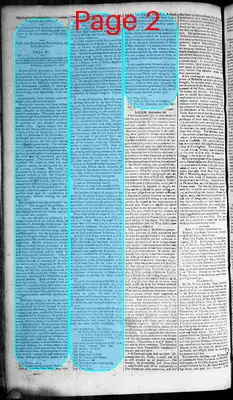
Literary
September 28, 1805
Alexandria Daily Advertiser
Alexandria, Virginia
What is this article about?
Essay XV from Political Essays defends Aristotle's credibility on government against Aurora's attacks, detailing his life, education under Plato, friendships, and contributions, in context of analyzing democracies, republics, and the US Constitution.
Clipping
OCR Quality
95%
Excellent
Full Text
POLITICAL ESSAYS
On the essential and distinctive qualities of
Democracies and Republics with reference
to the Constitution of the United
States.
From the Baltimore Republican, or
Anti-Democrat.
ESSAY XV.
"It was not from the repudiated and pernicious abjectly of Aristotle, that we were to deduce principles that
were calculated for the happiness of the whole society,"
AURORA, August 30, 1803.
As those ancient governments have long
ceased to exist, it will not, it is presumed,
be denied by men of science, that whatever information the moderns may possess,
in relation to the histories, names, kinds,
and characteristic qualities, of those governments,
is wholly derived, and can be
derived only, from the writings of the ancients.
Consequently, these writings must contain
the best evidence on all points.
Among the ancients who have written
expressly on government, Aristotle is the
most extensive in information, and profound
in judgment. This great man drew
his knowledge of government, from a careful
examination of the theory and practice
of upwards of two hundred commonwealths (61). Grotius assigns him the
first station among philosophers, whether
"estimated by the perspicuity of his method,
the acuteness of his distinctions, or
the weight and solidity of his arguments"; (62)--and Locke, the first place among
the writers on government. The testimony
of the latter comes with peculiar weight.
as it is given to a friend in a private communication,
and under circumstances when
the mind may be considered most free
from prejudice. The reverend Mr. King
requested Mr. Locke to favor him with
a plan of reading on politics, for the use
of a young gentleman. Mr. Locke, in
his answer to the request, observes-- "To
proceed orderly in this, the foundation
should be laid in inquiring into the ground
and nature of civil society, and how it is
formed into different forms of government;
and what are the several species of it. Aristotle
is allowed a master in this science,
and few enter upon the consideration of
governments, without reading his politics." (63)
But Aristotle is not a favorite with "the
Editor". "The weight of his evidence, it
would seem, alarmed him. He is therefore
charged with various crimes, and acts
of baseness and turpitude.
"He was selected, he exclaims in the
number from which our text is taken, as
the tutor of Alexander, by the tyrant that
destroyed Greece, would seem to be an indifferent
evidence to produce on an impartial
investigation, into the principles or efficacy
of free government. He who was repudiated
by Plato would seem to be at least
suspicious. Besides Demochares accused him of an attempt to betray
others, and that his letters for the purpose
were intercepted, and for which he
fled from popular indignation. This attempt
has been questioned, but a more
heinous atrocity is admitted, he betrayed
his native country, Stagyrus, to the Macedonians,
and when Olynthus was taken by
Philip, he had the execrable baseness to
point out to the tyrant his former friends,
the most wealthy of the Olynthians, as objects
of plunder. Hoary-headed error is
no longer sacred. The opinion of such an
authority cannot be cited, with moral consistency,
against any form of government;
even when he states facts, we are bound to
doubt unless better authority corroborates
him."
After this manner is the profoundest
thinker of all antiquity treated; the man
esteemed and respected through so many
centuries, by schoolmen, divines, and politicians;
the man extolled by Grotius and
recommended by Locke, as a fit guide and
director to youth, in the science of government.
And by whom is the citizen of Stagyrus
thus aspersed? By an unknown writer
or "The Editor" of a public paper, which
for years has been chiefly, and almost daily
devoted to the execrable employment of
obscuring truth, propagating revolutionary
principles, and vilifying those most to
whom their country is most indebted. The
spirit of delusion the wildest effort of democracy
only, could conceive the idea, that
a philosopher loses all pretensions to veracity,
merely because he had educated a
prince. How greatly did the author of Temper
Paricius, vol. 3:
(61) Paricius, vol. 3.
(62) Grotius, on war and peace. Preface.
(63) Letter to Rev. Wm. King, July 5, 1702.
demachus, the good bishop of Cambary, err,
in undertaking this task!
Was Aristotle indeed an infamous character?
Was he guilty of the enormities
wherewith he here stands accused? A summary
of the most remarkable facts in the life
of this great man, will be the best refutation of these calumnies.
Aristotle was born in the first year of the
99th Olympiad, in Stagyra, a city on the
coast of Thrace, in the neighborhood of
Mount Athos, upon the Strymonic Gulf
(64). He lost his parents, from whom he
inherited a large fortune, almost in his
childhood, and was brought up by Proxenus
of Atarneus, a city of Mysia, opposite
the island of Lesbos (65).
The care which Proxenus bestowed upon
his education seems to have made a lasting
impression on Aristotle, in whose character
gratitude formed a predominant feature.
He not only honored the memory of
the guardian of his youth with a statue, but
he instructed his son Nicanor in the liberal
sciences, adopted him, and with his estate,
bequeathed to him his daughter Pythias.
(66).
At the age of seventeen Aristotle went
to Athens, attracted by the love of learning,
and the desire of hearing Plato in the
academy, the best school of science as well
as morals then existing in the world (67).
Being recommended to Plato, he became
his disciple, and lived with him twenty
years; even until his death (68). The preceptor
appears to have very early noticed
his talents, and to have esteemed him highly.
The powers of the young Aristotle's
mind were such, that he was wont to call
him "the soul of the school" (69): and
when he chanced not to be present at
any of his lectures, would say "the philosopher
of truth is absent" [70]. Such was the unexampled industry of Aristotle,
in perusing and copying manuscripts, that
Plato, from this circumstance, would frequently
call his own house, "the house of
the great reader," and would often say,
"let us go to the great reader's house." [71]
Soon after Plato's death: Aristotle, in
testimony of the extraordinary affection he
bore him, erected a monument to his memory,
with the following inscription.
To Plato's sacred name this tomb is rear'd,
A name by Aristotle long rever'd:
Far hence, ye vulgar herd, nor dare to stain
With impious praise, this ever-hallow'd fane.
But besides this mark of respect for his
memory, he speaks of him in some of his
latest writings, with a degree of respect approaching
to reverence; he composed. also,
an oration in his praise, which comprehended an account of his life; and he highly
extolled him in his elegies to Eudemus [72]
Plato died in the first year of the 108th
Olympiad. Aristotle being then thirty-seven
years of age. After the death of him
whose name had drawn him to Athens, he
returned to Atarneus. the city in which he
had spent the happy years of his youth, under
the kind protection of Proxenus. (73)
Atarneus and Assus were then governed,
in the language of those days, by the
tyrant Hermias. who had been the fellow
disciple of Aristotle under Plato, and who
had a particular esteem for him, which time
cemented into unalterable friendship.---
Hermias received him with every testimony of love and respect (74). Here he remained
three years, prosecuting his philosophical
researches. At the close of this
period, his fellow student and sovereign, was deprived
of his crown, by the perfidy of Mentor,
a Greek in the service of Artaxerxes,
and hanged, as a traitor, by order of that
prince.
To avoid the punishment that fell on the
ambition of his friend, Aristotle, by a seasonable
flight, escaped to the isle of Lesbos,
with Pythias, the kinswoman, or, according
to some, the sister of Hermias. a woman of extraordinary virtue. and
the adopted heiress of the king of Assus
and Atarneus, now reduced to poverty and
distress.
Aristotle placed a statue of his friend in
the temple of Delphos, and married Pythias,
who died soon after leaving him an infant daughter, whom he named after his beloved
wife, who had repaid his affection
with the most tender sensibility. "It
was her last request, that when Aristotle
should die, (which might the gods long avert !) her own bones might be disinterred,
& inclosed within the tomb of her admired
husband." (75)
(64) Apollodorus. Dion Halicarn.
In Brucker's life of Aristotle, drawn up
by Enfield, Stagyrus is stated to have
been, at the time of his birth, subject
to Philip of Macedon,
(65) Ammonius Give Philoponus in Vit. Arist.
(66) Laert. Ammon. Dion. Hal.
(67) Ammon, vit. Arist.
(68) Laert. 5. 9.
(69) Diog. Laert in Arist.
(70) Vit. Interp. apud Nunes.
(71) Laert. ro. 26.
(72) Olmp- Comment. in Georg. Plat.
(73) Laert. l. c.
(74) Diog, Laert.
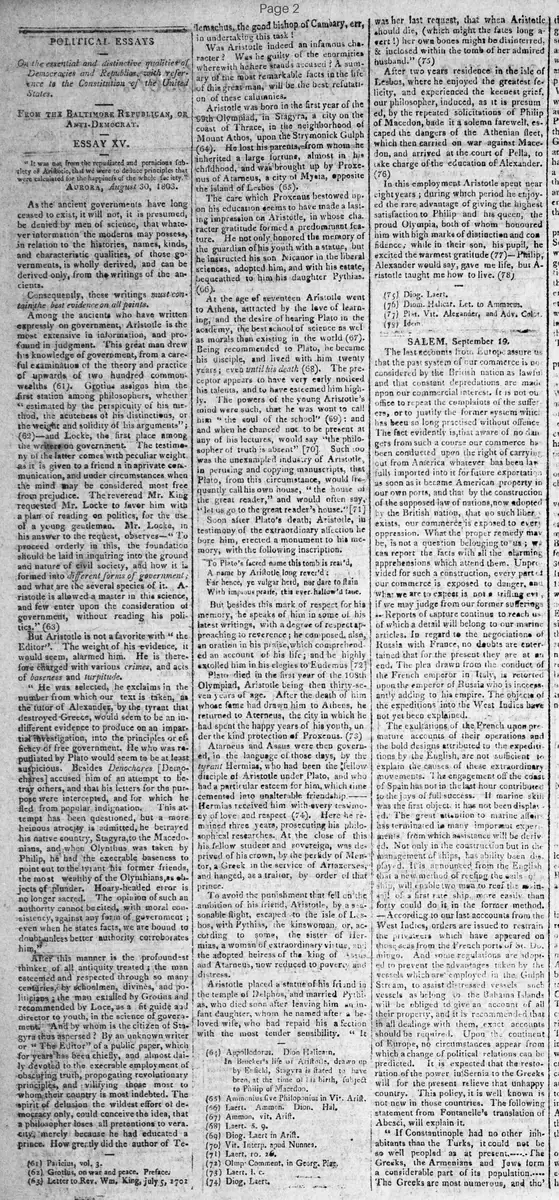
On the essential and distinctive qualities of
Democracies and Republics with reference
to the Constitution of the United
States.
From the Baltimore Republican, or
Anti-Democrat.
ESSAY XV.
"It was not from the repudiated and pernicious abjectly of Aristotle, that we were to deduce principles that
were calculated for the happiness of the whole society,"
AURORA, August 30, 1803.
As those ancient governments have long
ceased to exist, it will not, it is presumed,
be denied by men of science, that whatever information the moderns may possess,
in relation to the histories, names, kinds,
and characteristic qualities, of those governments,
is wholly derived, and can be
derived only, from the writings of the ancients.
Consequently, these writings must contain
the best evidence on all points.
Among the ancients who have written
expressly on government, Aristotle is the
most extensive in information, and profound
in judgment. This great man drew
his knowledge of government, from a careful
examination of the theory and practice
of upwards of two hundred commonwealths (61). Grotius assigns him the
first station among philosophers, whether
"estimated by the perspicuity of his method,
the acuteness of his distinctions, or
the weight and solidity of his arguments"; (62)--and Locke, the first place among
the writers on government. The testimony
of the latter comes with peculiar weight.
as it is given to a friend in a private communication,
and under circumstances when
the mind may be considered most free
from prejudice. The reverend Mr. King
requested Mr. Locke to favor him with
a plan of reading on politics, for the use
of a young gentleman. Mr. Locke, in
his answer to the request, observes-- "To
proceed orderly in this, the foundation
should be laid in inquiring into the ground
and nature of civil society, and how it is
formed into different forms of government;
and what are the several species of it. Aristotle
is allowed a master in this science,
and few enter upon the consideration of
governments, without reading his politics." (63)
But Aristotle is not a favorite with "the
Editor". "The weight of his evidence, it
would seem, alarmed him. He is therefore
charged with various crimes, and acts
of baseness and turpitude.
"He was selected, he exclaims in the
number from which our text is taken, as
the tutor of Alexander, by the tyrant that
destroyed Greece, would seem to be an indifferent
evidence to produce on an impartial
investigation, into the principles or efficacy
of free government. He who was repudiated
by Plato would seem to be at least
suspicious. Besides Demochares accused him of an attempt to betray
others, and that his letters for the purpose
were intercepted, and for which he
fled from popular indignation. This attempt
has been questioned, but a more
heinous atrocity is admitted, he betrayed
his native country, Stagyrus, to the Macedonians,
and when Olynthus was taken by
Philip, he had the execrable baseness to
point out to the tyrant his former friends,
the most wealthy of the Olynthians, as objects
of plunder. Hoary-headed error is
no longer sacred. The opinion of such an
authority cannot be cited, with moral consistency,
against any form of government;
even when he states facts, we are bound to
doubt unless better authority corroborates
him."
After this manner is the profoundest
thinker of all antiquity treated; the man
esteemed and respected through so many
centuries, by schoolmen, divines, and politicians;
the man extolled by Grotius and
recommended by Locke, as a fit guide and
director to youth, in the science of government.
And by whom is the citizen of Stagyrus
thus aspersed? By an unknown writer
or "The Editor" of a public paper, which
for years has been chiefly, and almost daily
devoted to the execrable employment of
obscuring truth, propagating revolutionary
principles, and vilifying those most to
whom their country is most indebted. The
spirit of delusion the wildest effort of democracy
only, could conceive the idea, that
a philosopher loses all pretensions to veracity,
merely because he had educated a
prince. How greatly did the author of Temper
Paricius, vol. 3:
(61) Paricius, vol. 3.
(62) Grotius, on war and peace. Preface.
(63) Letter to Rev. Wm. King, July 5, 1702.
demachus, the good bishop of Cambary, err,
in undertaking this task!
Was Aristotle indeed an infamous character?
Was he guilty of the enormities
wherewith he here stands accused? A summary
of the most remarkable facts in the life
of this great man, will be the best refutation of these calumnies.
Aristotle was born in the first year of the
99th Olympiad, in Stagyra, a city on the
coast of Thrace, in the neighborhood of
Mount Athos, upon the Strymonic Gulf
(64). He lost his parents, from whom he
inherited a large fortune, almost in his
childhood, and was brought up by Proxenus
of Atarneus, a city of Mysia, opposite
the island of Lesbos (65).
The care which Proxenus bestowed upon
his education seems to have made a lasting
impression on Aristotle, in whose character
gratitude formed a predominant feature.
He not only honored the memory of
the guardian of his youth with a statue, but
he instructed his son Nicanor in the liberal
sciences, adopted him, and with his estate,
bequeathed to him his daughter Pythias.
(66).
At the age of seventeen Aristotle went
to Athens, attracted by the love of learning,
and the desire of hearing Plato in the
academy, the best school of science as well
as morals then existing in the world (67).
Being recommended to Plato, he became
his disciple, and lived with him twenty
years; even until his death (68). The preceptor
appears to have very early noticed
his talents, and to have esteemed him highly.
The powers of the young Aristotle's
mind were such, that he was wont to call
him "the soul of the school" (69): and
when he chanced not to be present at
any of his lectures, would say "the philosopher
of truth is absent" [70]. Such was the unexampled industry of Aristotle,
in perusing and copying manuscripts, that
Plato, from this circumstance, would frequently
call his own house, "the house of
the great reader," and would often say,
"let us go to the great reader's house." [71]
Soon after Plato's death: Aristotle, in
testimony of the extraordinary affection he
bore him, erected a monument to his memory,
with the following inscription.
To Plato's sacred name this tomb is rear'd,
A name by Aristotle long rever'd:
Far hence, ye vulgar herd, nor dare to stain
With impious praise, this ever-hallow'd fane.
But besides this mark of respect for his
memory, he speaks of him in some of his
latest writings, with a degree of respect approaching
to reverence; he composed. also,
an oration in his praise, which comprehended an account of his life; and he highly
extolled him in his elegies to Eudemus [72]
Plato died in the first year of the 108th
Olympiad. Aristotle being then thirty-seven
years of age. After the death of him
whose name had drawn him to Athens, he
returned to Atarneus. the city in which he
had spent the happy years of his youth, under
the kind protection of Proxenus. (73)
Atarneus and Assus were then governed,
in the language of those days, by the
tyrant Hermias. who had been the fellow
disciple of Aristotle under Plato, and who
had a particular esteem for him, which time
cemented into unalterable friendship.---
Hermias received him with every testimony of love and respect (74). Here he remained
three years, prosecuting his philosophical
researches. At the close of this
period, his fellow student and sovereign, was deprived
of his crown, by the perfidy of Mentor,
a Greek in the service of Artaxerxes,
and hanged, as a traitor, by order of that
prince.
To avoid the punishment that fell on the
ambition of his friend, Aristotle, by a seasonable
flight, escaped to the isle of Lesbos,
with Pythias, the kinswoman, or, according
to some, the sister of Hermias. a woman of extraordinary virtue. and
the adopted heiress of the king of Assus
and Atarneus, now reduced to poverty and
distress.
Aristotle placed a statue of his friend in
the temple of Delphos, and married Pythias,
who died soon after leaving him an infant daughter, whom he named after his beloved
wife, who had repaid his affection
with the most tender sensibility. "It
was her last request, that when Aristotle
should die, (which might the gods long avert !) her own bones might be disinterred,
& inclosed within the tomb of her admired
husband." (75)
(64) Apollodorus. Dion Halicarn.
In Brucker's life of Aristotle, drawn up
by Enfield, Stagyrus is stated to have
been, at the time of his birth, subject
to Philip of Macedon,
(65) Ammonius Give Philoponus in Vit. Arist.
(66) Laert. Ammon. Dion. Hal.
(67) Ammon, vit. Arist.
(68) Laert. 5. 9.
(69) Diog. Laert in Arist.
(70) Vit. Interp. apud Nunes.
(71) Laert. ro. 26.
(72) Olmp- Comment. in Georg. Plat.
(73) Laert. l. c.
(74) Diog, Laert.
What sub-type of article is it?
Essay
What themes does it cover?
Political
What keywords are associated?
Aristotle
Government
Democracy
Republic
Plato
Politics
Biography
Defense
What entities or persons were involved?
From The Baltimore Republican, Or Anti Democrat.
Literary Details
Title
Essay Xv. On The Essential And Distinctive Qualities Of Democracies And Republics With Reference To The Constitution Of The United States.
Author
From The Baltimore Republican, Or Anti Democrat.
Subject
Defense Of Aristotle Against Criticisms In The Aurora Regarding His Authority On Free Government.
Form / Style
Biographical Political Essay Refuting Calumnies.
Key Lines
"It Was Not From The Repudiated And Pernicious Abjectly Of Aristotle, That We Were To Deduce Principles That Were Calculated For The Happiness Of The Whole Society," Aurora, August 30, 1803.
Aristotle Is Allowed A Master In This Science, And Few Enter Upon The Consideration Of Governments, Without Reading His Politics."
To Plato's Sacred Name This Tomb Is Rear'd, A Name By Aristotle Long Rever'd: Far Hence, Ye Vulgar Herd, Nor Dare To Stain With Impious Praise, This Ever Hallow'd Fane.