Thank you for visiting SNEWPapers!
Sign up free
Richmond Enquirer
Richmond, Richmond County, Virginia
What is this article about?
Reprint from Edinburgh Review in N.Y. Evening Post critiquing London press: praises Morning Chronicle for balance and reporting; criticizes The Times as heavy and commercial; dismisses Courier, Sun; notes Traveller's soundness; reviews weeklies like Cobbett's power, Examiner's talent, News' excellence, Observer's sensationalism.
Clipping
OCR Quality
Full Text
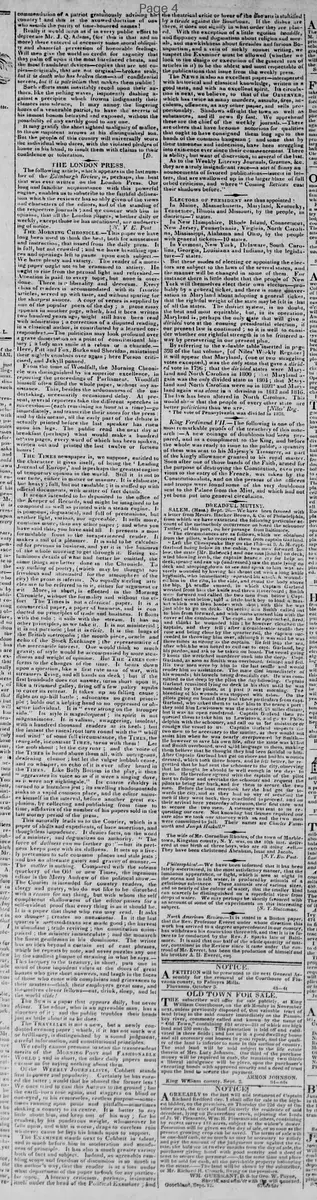
The following article, which appears in the last number of the Edinburgh Review, is, perhaps, the best that was ever written on the London Press. Our long and familiar acquaintance with this powerful engine, enables us to subscribe to the faithful delineation which the reviewer has so ably given of the views and characters of the editors, and of the standing of the respective journals and we concur with him in opinion, that all the London papers, whether daily or weekly, except those he has mentioned, are undeserving of notice.
N.Y. Eve. Post
The Morning Chronicle.—This paper we have long been used to think the best, both for amusement and instruction, that issued from the daily press. It is full, but not crowded ; and we have breathing spaces and openings left to pause upon each subject.—We have plenty and variety. The reader of a morning paper ought not to be crammed to satiety. He ought to rise from the perusal light and refreshed.—Attention is paid to every topic, but none is overdone. There is liberality and decorum. Every class of readers is accommodated with its favorite articles, served up with taste, and without sparing for the sharpest sauces. A copy of verses is supplied by one of the popular poets of the day ; a prose essay appears in another page, which, had it been written two hundred years ago, might still have been read with admiration ; a correction of a disputed reading, in a classical author, is contributed by a learned correspondent.—The politician may look profound over a grave dissertation on a point of constitutional history ; a lady may smile at a rebus or a charade.—Here, Pitt and Fox, Burke and Sheridan, maintained their nightly combats over again; here Porson criticised, and Jekyll punned.
From the time of Woodfall, the Morning Chronicle was distinguished by its superior excellence, in reporting the proceedings of Parliament. Woodfall himself often filled the whole paper, without any assistance. This, besides the arduousness of the undertaking, necessarily occasioned delay. At present, several reporters take the different speeches in succession—(each remaining an hour at a time)—go immediately, and transcribe their notes for the press : and by this means, all the early part of the debate is actually printed before the last speaker has risen upon his legs. The public read the next day at breakfast (perhaps what would make a hundred octavo pages, every word of which has been spoken, written out and printed the last twelve or fourteen hours!)
The Times newspaper is, we suppose, entitled to the character it gives itself, of being the 'Leading Journal of Europe,' and is perhaps the greatest engine of temporary opinion in the world. Still it is not to our taste, either in matter or manner. It is elaborate, but heavy ; full, but not readable ; it is stuffed up with official documents, with matter of fact details. It seems intended to be deposited in the office of the Keeper of Records, and might be imagined to be composed as well as printed with a steam engine. It is pompous, dogmatical, and full of pretensions, but neither light, various, nor agreeable. It sells more, contains more, than any other paper ; and when you have said this, you have said all: presents a most formidable front to the inexperienced reader. It makes a toil of a pleasure. It is said to be calculated for persons in business, and yet it is the business of the whole morning to get through it. Bating voluminous details of what had better be omitted, the same things are better done in the Chronicle. To say nothing of poetry, (which may be thought too frivolous and attenuated for the atmosphere of the city) the prose is inferior. No equally sterling articles are to be referred to in it, either for argument or wit More, in short, is effected in the Morning Chronicle, without the formality and without the effort The Times is not a classical paper. It is a commercial paper, a paper of business, and is conducted on principles of trade and business. It floats with the tide ; it sails with the stream. It has no other principles, as we take it. It is not ministerial ; it is not patriotic ; but it is civic. It is the lungs of the British metropolis ; the mouth piece, oracle and echo of the Stock Exchange ; the representative of the mercantile interest. One would think so much gravity of style would be accompanied by more steadiness and weight of opinion. But The Times conforms to the changes of the time. It bears down upon a question, like a first rate man of war, with streamers flying, and all hands on deck ; but if the first broadside does not answer, turns short upon it, like a trimmed galley, firing off a few paltry squibs to cover its retreat. It takes up no falling cause ; fights no up-hill battle ; advocates no great principle ; holds out a helping hand to no oppressed or obscure individual. It is ' ever strong on the stronger side.' Its style is magniloquent; its spirit is not magnanimous. It is valiant, swaggering, insolent, with a hundred thousand readers at its heels ; but the instant the rascal rout turn round with the' whiff and wind' of some full circumstance, the Times, the renegade, inconstant Times, turns with them! Let the mob shout ; let the city roar; and the voice of the Times is heard above them all, with outrageous, deafening clamor ; but let the vulgar hubbub cease, and no whisper, no echo of it is ever after heard in the Times. Like Bolly Bottom in the play, it then 'aggravates its voice so as if it were a singing dove as it were any nightingale.' Its coarse ribaldry is turned to a harmless jest; its swelling rhodomontade sinks to a vapid common place, and the editor amuses himself in the interval, before another great explosion, by collecting and publishing from time to time, affidavits of the number of his papers sold in the last stormy period of the press.
This naturally leads us to the Courier, which is a paper of shifts and expedients, of bare assertions, and thoughtless impudence. It denies facts, on the word of a minister, and dogmatizes on authority. ' The force of dullness can no farther go:'—but its pertness keeps pace with its dullness. It sets up a lively pretension to safe common places and stale jests ; and has an alternate gaiety and gravity of manner.—The matter is nothing. Compared with the solemn quackery of the Old or new Times, the ingenious editor is the Merry Andrew of the political show.—The Courier is intended for country readers, the clergy and gentry, who do not like to be disturbed with a reason for any thing, but with whom the self complacent shallowness of the editor passes for a self-evident proof that every thing is as it should be. It is a paper that those who run may read. It asks no thought ; creates no uneasiness. In it the last quarter's assessed-taxes are made good; the harvest is abundant ; trade reviving; the constitution unimpaired ; the minister immaculate; and the monarch the finest gentleman in his dominions. The writer has no idea beyond a certain set of cant phrases which he repeats by note, and never puzzles any one by the smallest glimpse of meaning in what he says.—This hackney to the treasury, in short, puts one in mind of those impudent valets at the doors of great houses who give short answers, and laugh in the faces of those who come with complaints and grievances to their masters—think their employers great men, and themselves clever fellows—eat, drink, sleep, and let the world slide!
The Sun is a paper that appears daily, but never shines. The editor, who is an agreeable man, has a sinecure of it ; and the public troubles their heads just as little about it as he does.
The Traveller is not a new, but a newly conducted evening paper ; which, if it has not much wit or brilliancy, is distinguished by a sound judgment, careful information, and constitutional principles.
We really cannot presume to scan the transcendent merits of the Morning Post and Fashionable World ; and in short, the other daily papers must excuse us for saying nothing about them
Of the Weekly Journalists, Cobbett stands first in power and popularity. Certainly he has earned the latter ; would that he abused the former less! We once tried to cast this Antæus to the ground ; but the earth-born rose again, and staggers on blind or one-eyed, to his remorseless, restless purpose—sometimes running upon posts and pitfalls—sometimes shaking a country to its centre. It is better to say little about him, and keep out of his way ; for he crushes, by his ponderous weight, whomsoever he falls upon, and what is worse, drags to careless ruin whatever cause he lays his hands upon to support.
The Examiner stands next to Cobbett in talent. and is much before him in moderation and steadiness of principle. It has also a much greater variety both of fact and subject. Indeed, an agreeable rambling scope and freedom of discussion is so much in the author's way, that the reader is at a loss under what department of the paper to look for any particular topic. A literary criticism, perhaps, insinuates itself under the head of the Political Examiner ;and the theatrical critic or lover of the fine arts is stultified by a tirade against the Bourbons. If the dishes are there, it does not signify in what order they are placed. With the exception of a little egotism loaden, and flippancy and dogmatism about religion and morals, and mawkishness about firesides and furious Bouapartism, and a vein of sickly sonnet writing, we suspect the Examiner must be allowed (whether we look to the design or execution of the general run of articles in it) to be the ablest and most respectable of the publications that issue from the weekly press.
The News is also an excellent paper—interspersed with historical and classical knowledge, written in a good taste, and with an excellent spirit. Its circulation is next, we believe, to that of the Observer; which has twice as many murders, assaults, fires, accidents, offences, as any other paper, and sells proportionably. Shadows affright the town as well as substances, and ill news flies fast. We apprehend these are the chief of the weekly journals. There are others that have become notorious for qualities that ought to have consigned them long ago to the hands of the common hangman ; and some that by their tameness and indecision, have been struggling into existence ever since their commencement. There is ability, but want of discretion, in several of the last.
As to the Weekly Literary Journals, Gazettes, &c. they are a truly insignificant race—a sort of flimsy announcements of favored publications—insects interlopers, that are swallowed up in the larger blaze of full orbed criticism, and where 'Coming Reviews cast their shadows before.'
What sub-type of article is it?
What keywords are associated?
What entities or persons were involved?
Where did it happen?
Story Details
Key Persons
Location
London
Story Details
Critical review of London newspapers from Edinburgh Review, praising Morning Chronicle's balance, variety, and parliamentary reporting; critiquing The Times as heavy, commercial, and opportunistic; dismissing Courier as dull and impudent; noting Sun's irrelevance, Traveller's soundness; reviewing weeklies: Cobbett's power, Examiner's talent and variety, News' excellence, Observer's sensationalism; deeming literary journals insignificant.