Thank you for visiting SNEWPapers!
Sign up free
Editorial
April 12, 1819
Alexandria Gazette & Daily Advertiser
Alexandria, Virginia
What is this article about?
Editorial from Washington City Gazette critiques political intrigue surrounding 1820 U.S. presidential election candidates including Monroe, Crawford, Clay, Clinton, Tompkins, and J.Q. Adams. Advocates direct public election over caucus system, exposes corruption and rivalries.
Clipping
OCR Quality
95%
Excellent
Full Text
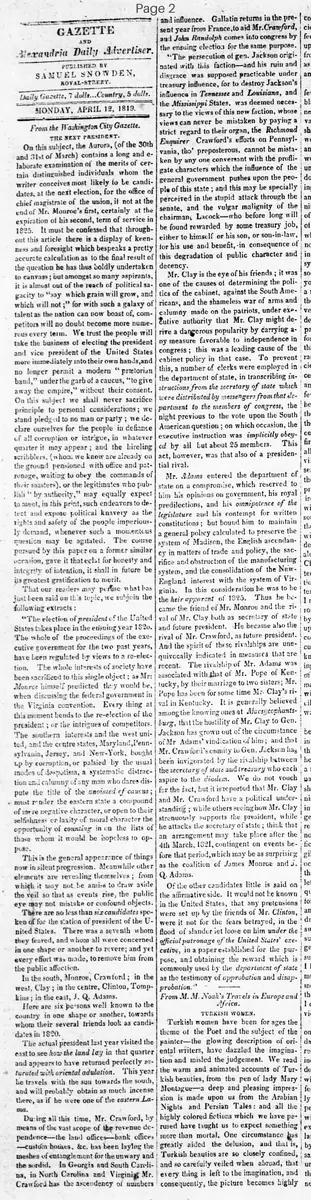
From the Washington City Gazette.
THE NEXT PRESIDENT.
On this subject, the Aurora, (of the 30th and 31st of March) contains a long and elaborate examination of the merits of certain distinguished individuals whom the writer conceives most likely to be candidates, at the next election, for the office of chief magistrate of the union, if not at the end of Mr. Monroe's first, certainly at the expiration of his second term of service in 1825. It must be confessed that throughout this article there is a display of keenness and foresight which bespeaks a pretty accurate calculation as to the final result of the question he has thus boldly undertaken to canvass; out amongst so many aspirants, it is almost out of the reach of political sagacity to "say which grain will grow, and which will not;" for with such a galaxy of talent as the nation can now boast of, competitors will no doubt become more numerous every term. We trust the people will take the business of electing the president and vice president of the United States more immediately into their own hands, and no longer permit a modern "praetorian band," under the garb of a caucus, "to give away the empire," without their consent.
On this subject we shall never sacrifice principle to personal considerations; we stand pledged to no man or party; we declare ourselves for the people in defiance of all corruption or intrigue, in whatever quarter it may appear; and the hireling scribblers, (whom we know are already on the ground pensioned with office and patronage, waiting to obey the commands of their masters), or the legitimates who publish "by authority," may equally expect to meet, in this print, such endeavors to detect and expose political knavery as the rights and safety of the people imperiously demand, whenever such a momentous question may be agitated. The course pursued by this paper on a former similar occasion, gave it that eclat for honesty and integrity of intention, it shall in future be its greatest gratification to merit.
That our readers may peruse what has just been said on this topic, we subjoin the following extracts:
"The election of president of the United States takes place in the ensuing year 1820. The whole of the proceedings of the executive government for the two past years, have been regulated by views to a re-election. The whole interests of society have been sacrificed to this single object; as Mr. Monroe himself predicted they would be, when discussing the federal government in the Virginia convention. Every thing at this moment bends to the re-election of the president; or the intrigues of competitors. The southern interests and the west united, and the centre states, Maryland, Pennsylvania, Jersey, and New-York, bought up by corruption, or palsied by the usual modes of despotism, a systematic distraction and calumny of any man who dares dispute the title of the anointed of caucus; must render the eastern state a compound of mere negative character, or open to their selfishness or laxity of moral character the opportunity of counting in on the lists of those whom it would be hopeless to oppose.
This is the general appearance of things now in silent progression. Meanwhile other elements are revealing themselves; from which it may not be amiss to draw aside the veil so that as events rise, the public eye may not mistake or confound objects.
There are no less than six candidates spoken of for the station of president of the United States. There was a seventh whom they feared, and whom all were concerned in one shape or another to revere; and yet every effort was made, to remove him from the public affection.
In the south, Monroe, Crawford; in the west, Clay; in the centre, Clinton, Tompkins: in the east, J. Q. Adams.
Here are six persons well known to the country in one shape or another, towards whom their several friends look as candidates in 1820.
The actual president last year visited the east to see how the land lay in that quarter and appears to have returned perfectly saturated with oriental adulation. This year he travels with the sun towards the south, and will probably obtain as much incense there, as if he were one of the eastern Lama.
During all this time. Mr. Crawford, by means of the vast scope of the revenue dependence--the land offices--bank offices &c. custom houses, &c. has been laying the meshes of entanglement for the unwary and the sordid. In Georgia and South Carolina, in North Carolina and Virginia, Mr. Crawford has the ascendency of numbers and influence. Gallatin returns in the present year from France, to aid Mr. Crawford. and John Randolph comes into congress by the ensuing election for the same purpose.
"The persecution of gen. Jackson originated with this faction--and his ruin and disgrace was supposed practicable under treasury influence, for to destroy Jackson's influence in Tennessee and Louisiana, and the Mississippi States, was deemed necessary to the views of this new faction, whose views can never be mistaken by paying a strict regard to their organ, the Richmond Enquirer Crawford's efforts on Pennsylvania, tho' preposterous, cannot be mistaken by any one conversant with the profligate characters which the influence of the general government pushes upon the people of this state; and this may be specially perceived in the stupid attack through the senate, and the vulgar malignity of the chairman, Lacock--who before long will be found rewarded by some treasury job, either to himself or his son, or son-in-law. for his use and benefit, -in consequence of this degradation of public character and decency.
Mr. Clay is the eye of his friends; it was one of the causes of determining the politics of the cabinet, against the South Americans, and the shameless war of arms and calumny made on the patriots, under executive authority that Mr. Clay might derive a dangerous popularity by carrying any measure favorable to independence in congress; this was a leading cause of the cabinet policy in that case. To prevent this, a number of clerks were employed in the department of state, in transcribing instructions from the secretary of state which were distributed by messengers from that department to the members of congress, the night previous to the vote upon the South American question; on which occasion, the executive instruction was implicitly obeyed by all but about 25 members.
This act, however, was that also of a presidential rival.
Mr. Adams entered the department of state on a compromise, which reserved to him his opinions on government, his royal predilections, and his omnipotence of the legislature and his contempt for written constitutions; but bound him to maintain a general policy calculated to preserve the system of Madison, the English ascendancy in matters of trade and policy, the sacrifice and obstruction of the manufacturing system, and the consolidation of the New-England interest with the system of Virginia. In this consideration he was to be the heir apparent of 1825. Thus he became the friend of Mr. Monroe and the rival of Mr. Clay both as secretary of state and future president. He became also the rival of Mr. Crawford, as future president. And the spirit of these rivalships are unequivocally indicated in measures that are recent. The rivalry of Mr. Adams was associated with that of Mr. Pope of Kentucky, by their marriage to two sisters; Mr. Pope has been for some time Mr. Clay's rival in Kentucky. It is generally believed among the knowing ones at Mac-sycophants-burg, that the hostility of Mr. Clay to Gen. Jackson has grown out of the circumstance of Mr. Adams' vindication of him; and that Mr. Crawford's enmity to Gen. Jackson has been invigorated by the rivalry between the secretary of state and treasury who each aspire to the diadem. We do not vouch for the fact, but it is reported that Mr. Clay and Mr. Crawford have a political understanding; while others seeing how Mr. Clay strenuously supports the president, while he attacks the secretary of state; think that an arrangement may take place after the 4th March, 1821, contingent on events before that period, which may be as surprising as the coalition of James Monroe and J. Q. Adams.
Of the other candidates little is said on the affirmative side. It would not be known in the United States, that any pretensions were set up by the friends of Mr. Clinton, were it not for the fears betrayed, in the flood of slander let loose on him under the official patronage of the United States' executive, in a paper established for the purpose, and obtaining the reward which is commonly used by the department of state as the testimony of approbation and disapprobation."
THE NEXT PRESIDENT.
On this subject, the Aurora, (of the 30th and 31st of March) contains a long and elaborate examination of the merits of certain distinguished individuals whom the writer conceives most likely to be candidates, at the next election, for the office of chief magistrate of the union, if not at the end of Mr. Monroe's first, certainly at the expiration of his second term of service in 1825. It must be confessed that throughout this article there is a display of keenness and foresight which bespeaks a pretty accurate calculation as to the final result of the question he has thus boldly undertaken to canvass; out amongst so many aspirants, it is almost out of the reach of political sagacity to "say which grain will grow, and which will not;" for with such a galaxy of talent as the nation can now boast of, competitors will no doubt become more numerous every term. We trust the people will take the business of electing the president and vice president of the United States more immediately into their own hands, and no longer permit a modern "praetorian band," under the garb of a caucus, "to give away the empire," without their consent.
On this subject we shall never sacrifice principle to personal considerations; we stand pledged to no man or party; we declare ourselves for the people in defiance of all corruption or intrigue, in whatever quarter it may appear; and the hireling scribblers, (whom we know are already on the ground pensioned with office and patronage, waiting to obey the commands of their masters), or the legitimates who publish "by authority," may equally expect to meet, in this print, such endeavors to detect and expose political knavery as the rights and safety of the people imperiously demand, whenever such a momentous question may be agitated. The course pursued by this paper on a former similar occasion, gave it that eclat for honesty and integrity of intention, it shall in future be its greatest gratification to merit.
That our readers may peruse what has just been said on this topic, we subjoin the following extracts:
"The election of president of the United States takes place in the ensuing year 1820. The whole of the proceedings of the executive government for the two past years, have been regulated by views to a re-election. The whole interests of society have been sacrificed to this single object; as Mr. Monroe himself predicted they would be, when discussing the federal government in the Virginia convention. Every thing at this moment bends to the re-election of the president; or the intrigues of competitors. The southern interests and the west united, and the centre states, Maryland, Pennsylvania, Jersey, and New-York, bought up by corruption, or palsied by the usual modes of despotism, a systematic distraction and calumny of any man who dares dispute the title of the anointed of caucus; must render the eastern state a compound of mere negative character, or open to their selfishness or laxity of moral character the opportunity of counting in on the lists of those whom it would be hopeless to oppose.
This is the general appearance of things now in silent progression. Meanwhile other elements are revealing themselves; from which it may not be amiss to draw aside the veil so that as events rise, the public eye may not mistake or confound objects.
There are no less than six candidates spoken of for the station of president of the United States. There was a seventh whom they feared, and whom all were concerned in one shape or another to revere; and yet every effort was made, to remove him from the public affection.
In the south, Monroe, Crawford; in the west, Clay; in the centre, Clinton, Tompkins: in the east, J. Q. Adams.
Here are six persons well known to the country in one shape or another, towards whom their several friends look as candidates in 1820.
The actual president last year visited the east to see how the land lay in that quarter and appears to have returned perfectly saturated with oriental adulation. This year he travels with the sun towards the south, and will probably obtain as much incense there, as if he were one of the eastern Lama.
During all this time. Mr. Crawford, by means of the vast scope of the revenue dependence--the land offices--bank offices &c. custom houses, &c. has been laying the meshes of entanglement for the unwary and the sordid. In Georgia and South Carolina, in North Carolina and Virginia, Mr. Crawford has the ascendency of numbers and influence. Gallatin returns in the present year from France, to aid Mr. Crawford. and John Randolph comes into congress by the ensuing election for the same purpose.
"The persecution of gen. Jackson originated with this faction--and his ruin and disgrace was supposed practicable under treasury influence, for to destroy Jackson's influence in Tennessee and Louisiana, and the Mississippi States, was deemed necessary to the views of this new faction, whose views can never be mistaken by paying a strict regard to their organ, the Richmond Enquirer Crawford's efforts on Pennsylvania, tho' preposterous, cannot be mistaken by any one conversant with the profligate characters which the influence of the general government pushes upon the people of this state; and this may be specially perceived in the stupid attack through the senate, and the vulgar malignity of the chairman, Lacock--who before long will be found rewarded by some treasury job, either to himself or his son, or son-in-law. for his use and benefit, -in consequence of this degradation of public character and decency.
Mr. Clay is the eye of his friends; it was one of the causes of determining the politics of the cabinet, against the South Americans, and the shameless war of arms and calumny made on the patriots, under executive authority that Mr. Clay might derive a dangerous popularity by carrying any measure favorable to independence in congress; this was a leading cause of the cabinet policy in that case. To prevent this, a number of clerks were employed in the department of state, in transcribing instructions from the secretary of state which were distributed by messengers from that department to the members of congress, the night previous to the vote upon the South American question; on which occasion, the executive instruction was implicitly obeyed by all but about 25 members.
This act, however, was that also of a presidential rival.
Mr. Adams entered the department of state on a compromise, which reserved to him his opinions on government, his royal predilections, and his omnipotence of the legislature and his contempt for written constitutions; but bound him to maintain a general policy calculated to preserve the system of Madison, the English ascendancy in matters of trade and policy, the sacrifice and obstruction of the manufacturing system, and the consolidation of the New-England interest with the system of Virginia. In this consideration he was to be the heir apparent of 1825. Thus he became the friend of Mr. Monroe and the rival of Mr. Clay both as secretary of state and future president. He became also the rival of Mr. Crawford, as future president. And the spirit of these rivalships are unequivocally indicated in measures that are recent. The rivalry of Mr. Adams was associated with that of Mr. Pope of Kentucky, by their marriage to two sisters; Mr. Pope has been for some time Mr. Clay's rival in Kentucky. It is generally believed among the knowing ones at Mac-sycophants-burg, that the hostility of Mr. Clay to Gen. Jackson has grown out of the circumstance of Mr. Adams' vindication of him; and that Mr. Crawford's enmity to Gen. Jackson has been invigorated by the rivalry between the secretary of state and treasury who each aspire to the diadem. We do not vouch for the fact, but it is reported that Mr. Clay and Mr. Crawford have a political understanding; while others seeing how Mr. Clay strenuously supports the president, while he attacks the secretary of state; think that an arrangement may take place after the 4th March, 1821, contingent on events before that period, which may be as surprising as the coalition of James Monroe and J. Q. Adams.
Of the other candidates little is said on the affirmative side. It would not be known in the United States, that any pretensions were set up by the friends of Mr. Clinton, were it not for the fears betrayed, in the flood of slander let loose on him under the official patronage of the United States' executive, in a paper established for the purpose, and obtaining the reward which is commonly used by the department of state as the testimony of approbation and disapprobation."
What sub-type of article is it?
Partisan Politics
What keywords are associated?
Presidential Election
1820 Candidates
Political Intrigue
Caucus System
Corruption
Monroe Administration
Candidate Rivalries
What entities or persons were involved?
James Monroe
William Crawford
Henry Clay
Dewitt Clinton
Daniel Tompkins
John Quincy Adams
Andrew Jackson
James Gallatin
John Randolph
William H. Crawford
Abner Lacock
Editorial Details
Primary Topic
Potential Candidates For 1820 U.S. Presidential Election And Political Intrigues
Stance / Tone
Critical Of Caucus System And Corruption, Advocating Direct Public Election
Key Figures
James Monroe
William Crawford
Henry Clay
Dewitt Clinton
Daniel Tompkins
John Quincy Adams
Andrew Jackson
James Gallatin
John Randolph
William H. Crawford
Abner Lacock
Key Arguments
Caucus System Undermines Public Choice In Presidential Elections
Monroe's Administration Prioritizes Re Election Over National Interests
Crawford Uses Federal Offices For Influence In Southern States
Clay's Popularity Blocked Through Foreign Policy Manipulations
Adams Compromises Principles For Future Presidency
Jackson Persecuted By Crawford Faction
Clinton Slandered By Executive Patronage
Rivalries Among Candidates Drive Political Maneuvers