Thank you for visiting SNEWPapers!
Sign up free
New Hampshire Statesman
Concord, Merrimack County, New Hampshire
What is this article about?
This letter critiques the caucus nomination system for the 1824 U.S. presidential election, arguing it is outdated, unconstitutional, and disadvantages small states like New Hampshire in favor of larger ones. It defends the House of Representatives election process and implicitly supports John Quincy Adams against William H. Crawford.
Merged-components note: Continuation of the same long letter 'THE PRESIDENTIAL QUESTION' across pages 2 and 3.
Clippings
1 of 2
OCR Quality
Full Text
No. I.
THE PRESIDENTIAL QUESTION.
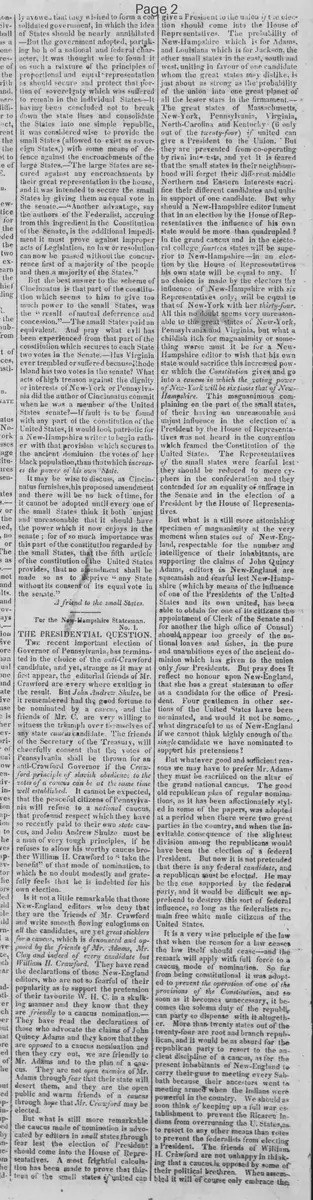
The recent important election of Governor of Pennsylvania, has terminated in the choice of the anti-Crawford candidate, and yet, strange as it may at first appear, the editorial friends of Mr. Crawford are every where exulting in the result. But John Andrew Shulze, be it remembered had the good fortune to be nominated by a caucus, and the friends of Mr. C. are very willing to witness the triumph over themselves of any state caucus candidate. The friends of the Secretary of the Treasury, will cheerfully consent that the votes of Pennsylvania shall be thrown for an anti-Crawford Governor if the Crawford principle of slavish obedience to the votes of a caucus can be at the same time well established. It cannot be expected, that the peaceful citizens of Pennsylvania will refuse to a national caucus, that profound respect which they have so recently paid to their own state caucus, and John Andrew Shulze must be a man of very tough principles, if he refuses to allow his worthy caucus brother William H. Crawford to "take the benefit" of that mode of nomination, to which he no doubt modestly and gratefully feels that he is indebted for his own election.
Is it not a little remarkable that those New-England editors who deny that they are the friends of Mr. Crawford and write smooth flowing eulogiums on all the candidates, are yet great sticklers for a caucus, which is denounced and opposed by the friends of Mr. Adams, Mr. Clay and indeed of every candidate but William H. Crawford. They have read the declarations of those New-England editors, who are not so fearful of their popularity as to support the pretension of their favourite W. H. C. in a skulking manner and they know that they are friendly to a caucus nomination.—They have read the declarations of those who advocate the claims of John Quincy Adams and they know that they are opposed to a caucus nomination and then they cry out, we are friendly to Mr. Adams and to the plan of a caucus. They are not open enemies of Mr. Adams through fear that their state will desert them, and they are the open public and warm friends of a caucus through hope that Mr. Crawford may be elected.
But what is still more remarkable the caucus mode of nomination is advocated by editors in small states through fear lest the election of President should come into the House of Representatives. A most frightful calculation has been made to prove that thirteen of the small states if united can give a President to the union if the election should come into the House of Representatives. The probability of New-Hampshire which is for Adams, and Louisiana which is for Jackson, the other small states in the east, south and west, uniting in favour of one candidate whom the great states may dislike, is just about as strong as the probability of the union into one great planet of all the lesser stars in the firmament.—The great states of Massachusetts, New-York, Pennsylvania, Virginia, North-Carolina and Kentucky—(6 only out of the twenty-four) if united can give a President to the Union. But they are prevented from co-operating by rival interests, and yet it is feared that the small states in their neighbourhood will forget their different middle Northern and Eastern interests sacrifice their different candidates and unite in support of one candidate. But why should a New-Hampshire editor lament that in an election by the House of Representatives the influence of his own state would be more than quadrupled? In the grand caucus and in the electoral college fourteen states will be superior to New-Hampshire—in an election by the House of Representatives his own state will be equal to any. If no choice is made by the electors the influence of New-Hampshire with six Representatives only, will be equal to that of New-York with her thirty-four. All this no doubt seems very unreasonable to the great states of New York, Pennsylvania and Virginia, but what a childish itch for magnanimity or something worse must it be for a New-Hampshire editor to wish that his own state would sacrifice this increased power which the Constitution gives and go into a caucus in which the voting power of New-York will be six times that of New-Hampshire. This magnanimous complaining on the part of the small states, of their having an unreasonable and unjust influence in the election of a President by the House of Representatives was not heard in the convention which framed the Constitution of the United States. The Representatives of the small states were fearful lest they should be reduced to mere cyphers in the confederation and they contended for an equality of suffrage in the Senate and in the election of a President by the House of Representatives.
But what is a still more astonishing specimen of magnanimity at the very moment when states out of New-England, respectable for the number and intelligence of their inhabitants, are supporting the claims of John Quincy Adams, editors in New-England are squeamish and fearful lest New-Hampshire (which by means of the influence of one of the Presidents of the United States and its own united, has been able to obtain for one of its citizens the appointment of Clerk of the Senate and for another the high office of Consul should appear too greedy of the national loaves and fishes, in the pure and unambitious eyes of the ancient dominion which has given to the union only four Presidents. But pray does it reflect no honour upon New-England, that she has a great statesman to offer as a candidate for the office of President. Four gentlemen in other sections of the United States have been nominated, and would it not be somewhat disgraceful to us of New-England if we cannot think highly enough of the single candidate we have nominated to support his pretensions?
But whatever good and sufficient reasons we may have to prefer Mr. Adams they must be sacrificed on the altar of the grand national caucus. The good old republican plan of regular nominations, as it has been affectionately styled in some of the papers, was adopted at a period when there were two great parties in the country, and when the inevitable consequence of the slightest division among the republicans would have been the election of a federal President. But now it is not pretended that there is any federal candidate, and a republican must be elected. He may be the one supported by the federal party, and it would be difficult we apprehend to destroy this sort of federal influence, so long as the federalists remain free white male citizens of the United States.
It is a very wise principle of the law that when the reason for a law ceases the law itself should cease—and the remark will apply with full force to a caucus mode of nomination. So far from being constitutional it was adopted to prevent the operation of one of the provisions of the Constitution, and so soon as it becomes unnecessary, it becomes the solemn duty of the republican party to dispense with it altogether. More than twenty states out of the twenty-four are root and branch republican, and it would be as absurd for the republican party to resort to the ancient discipline of a caucus, as for the present inhabitants of New-England to carry their guns to meeting every Sabbath because their ancestors went to meeting armed when the Indians were powerful in the country. It should as soon think of keeping up a full war establishment to prevent the Kickapoo Indians from overrunning the U. States, as to resort to any other means than votes to prevent the federalists from electing a President. The friends of William H. Crawford are not unhappy in thinking that a caucus is opposed by some of their political brethren. When assembled it will of course only embrace the republican members, and as the federalists cannot be admitted, the caucus will be a republican caucus, and the candidate nominated will be a republican candidate, and as such will be supported by the republican party.
friends of Mr. Crawford and his nomination if not election is sure. They will call upon their brethren in the most moving and patriotic strains to sacrifice their candidates and vote for the person whom the friends of Mr. William H. Crawford in caucus assembled have been pleased to nominate, kindly intimating that if the said caucus composed of the friends of Mr. C. had after long deliberation on the merits of Mr. C. and much abuse of Mr. Adams, thought proper to recommend Mr. A. to the people they would cheerfully and earnestly have supported him. As to the right of the members of Congress to nominate a President for us the poor lazy ignorant sovereign people, it is derived from the acquiescence of their master. The servants have had twenty years enjoyment and possession which will give them a good title as against the caucus at Pittsfield or any other place; but not against the people. To sacrifice the valuable privilege of making a President and enjoy nothing but the common right of voting for the electors, will no doubt be a great sacrifice even for members as enlightened and patriotic as those which compose the eighteenth Congress.
The members of the House of Representatives have been reconciled to the agency which the Senate under the Constitution, enjoy in the distribution of offices by the power which they have enjoyed over the Constitution of making the President who nominates to office and in fact appoints; for as Mr. King said in the late convention in N. York "When his nomination comes before the Senate they never enquire into the comparative merits of the person nominated or whether a better man could not have been found, but they only enquire whether there is any positive disqualification." The effects of a caucus upon our servants at Washington both executive and legislative I shall make the subject of another and shorter number. An Elector of the Electors.
What sub-type of article is it?
What themes does it cover?
What keywords are associated?
What entities or persons were involved?
Letter to Editor Details
Author
An Elector Of The Electors
Recipient
New Hampshire Statesman
Main Argument
the caucus nomination system is an outdated, unconstitutional mechanism designed to counter federalist threats that no longer exist; it disadvantages small states like new hampshire, which benefit more from election by the house of representatives, and should be abandoned in favor of direct voter choice.
Notable Details