Thank you for visiting SNEWPapers!
Sign up free
Story
November 24, 1788
The Daily Advertiser
New York, New York County, New York
What is this article about?
Detailed report on the American Cotton Manufactory in Philadelphia, concluding an experiment showing profitability through reduced costs of raw materials like flax and cotton, improved efficiency, and recommendations for expansion via subscriptions to promote the industry.
Clipping
OCR Quality
98%
Excellent
Full Text
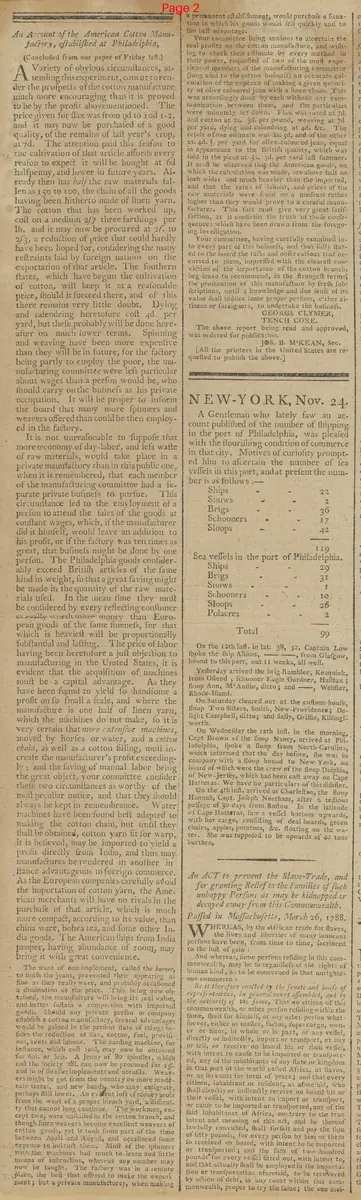
An Account of the American Cotton Manufactory, established at Philadelphia.
(Concluded from our paper of Friday last.)
Variety of obvious circumstances, attending this experiment, concur to render the prospects of the cotton manufacture much more encouraging than it is proved to be by the profit abovementioned. The price given for flax was from 10d to 1s 0d 1/2, and it may now be purchased of a good quality, of the remains of last year's crop, at 7d. The attention paid this season to the cultivation of that article affords every reason to expect it will be bought at 6d halfpenny, and lower in future years. Already then has half the raw materials fallen as low as 15s to 10s, the chain of all the goods having been hitherto made of linen yarn.
The cotton that has been worked up, cost on a medium 2s 7 three farthings per lb. and it may now be procured at 2s. to 2s 3d, a reduction of price that could hardly have been hoped for, considering the many restraints laid by foreign nations on the exportation of that article. The southern states, which have begun the cultivation of cotton, will keep it at a reasonable price, should it succeed there, and of this there remains very little doubt. Dying and calendering heretofore cost 4d. per yard, but these probably will be done hereafter on much lower terms. Spinning and weaving have been more expensive than they will be in future, for the factory being partly to employ the poor, the manufacturing committee were less particular about wages than a person would be, who should carry on the business as his private occupation. It will be proper to inform the board that many more spinners and weavers offered than could be then employed in the factory.
It is not unreasonable to suppose that more economy of day-labor, and less waste of raw materials, would take place in a private manufactory than in this public one, when it is remembered, that each member of the manufacturing committee had a separate private business to pursue. This circumstance led to the employment of a person to attend the sales of the goods at constant wages, which, if the manufacturer did it himself, would leave an addition to his profit, or if the factory was ten times as great, that business might be done by one person. The Philadelphia goods considerably exceed British articles of the same kind in weight, so that a great saving might be made in the quantity of the raw materials used. In the mean time they must be considered by every reflecting consumer as really worth more money than European goods of the same fineness, for that which is heaviest will be proportionally substantial and lasting. The price of labor having been heretofore a just objection to manufacturing in the United States, it is evident that the acquisition of machines must be a capital advantage. As they have been found to yield so handsome a profit on so small a scale, and where the manufacture is one half of linen yarn, which the machines do not make, so it is very certain that more extensive machines, moved by horses or water, and a cotton chain, as well as a cotton filling, must increase the manufacturer's profit exceedingly; and the saving of manual labor being the great object, your committee consider these two circumstances as worthy of the most peculiar notice, and that they should always be kept in remembrance. Water machines have been found best adapted to making the cotton chain, but until they shall be obtained, cotton yarn fit for warp, it is believed, may be imported to yield a profit directly from India, and thus may manufactures be rendered in another instance advantageous to foreign commerce.
As the European companies carefully avoid the importation of cotton yarn, the American merchants will have no rivals in the purchase of that article, which is much more compact, according to its value, than china ware, bohea tea, and some other India goods. The American ships from India proper, having abundance of room, may bring it with great convenience.
The want of one implement, called the burner, to finish the jeans, prevented their appearing as fine as they really were, and probably occasioned a diminution of the price. This being now obtained, the manufacture will bring its real value, and better sustain a comparison with imported goods. Should any private person or company establish a cotton manufactory, several advantages would be gained in the present state of things besides the reduction of flax, cotton, fuel, provisions, rents and labour. The carding machine, for instance, which cost 100l. may now be obtained for 60l. or less. A Jenny of 80 spindles, which cost the society 28l. can now be procured for 15l. and so of smaller implements and utensils. Weavers might be got from the country on more moderate terms, and new hands, who may emigrate, perhaps still lower. An evident loss of money arose from the want of a proper bleach yard, a difficulty that cannot long continue. The workmen, except two, were unskilled in the cotton branch, and though linen weavers become excellent weavers of cotton goods, yet it took some part of the time between April and August, and occasioned some expense to instruct them. Most of the spinners with the machines had much to learn and little means of instruction, whereas any number may now be taught. The factory was in a remote place, the best that offered to make the experiment; but a private manufacturer, when making a permanent establishment, would purchase a situation in which his goods would sell quickly and to the best advantage.
Your committee being anxious to ascertain the real profits on the cotton manufacture, and wishing to check their estimate by every method in their power, requested of two of the most experienced members of the manufacturing committee (long used to the cotton business) an accurate calculation of the expense of making a given quantity of olive coloured jean with a linen chain. This was accordingly done by each without any communication between them, and the particulars were minutely set down. Flax was stated at 7d. and cotton at 2s. 3d. per pound, weaving at 7d per yard, dying and calendering at 4d. &c. The result of one estimate was 2s. 5d. and of the other 2s. 4d. per yard for olive-coloured jean, equal in appearance to the British quality, which was sold in the piece at 3s. 3d. per yard last summer.
It must be observed that the American goods, on which the calculation was made, are above half an inch wider and much heavier than the imported, and that the rates of labour, and prices of the raw materials were fixed on a medium rather higher than they would prove to a careful manufacturer. This fact must give very great satisfaction, as it confirms the truth of those consequences which have been drawn from the foregoing investigation.
Your committee, having carefully examined into every part of this business, and thus fully stated to the board the facts and observations that occurred to them, impressed with the clearest conviction of the importance of the cotton branch, beg leave to recommend, in the strongest terms, the prosecution of this manufacture by fresh subscriptions, until a knowledge and due sense of its value shall induce some proper persons, either citizens or foreigners, to undertake the business.
GEORGE CLYMER,
TENCH COXE.
The above report being read and approved, was ordered for publication.
JOS. B. M'KEAN, Sec.
[All the printers in the United States are requested to publish the above.]
(Concluded from our paper of Friday last.)
Variety of obvious circumstances, attending this experiment, concur to render the prospects of the cotton manufacture much more encouraging than it is proved to be by the profit abovementioned. The price given for flax was from 10d to 1s 0d 1/2, and it may now be purchased of a good quality, of the remains of last year's crop, at 7d. The attention paid this season to the cultivation of that article affords every reason to expect it will be bought at 6d halfpenny, and lower in future years. Already then has half the raw materials fallen as low as 15s to 10s, the chain of all the goods having been hitherto made of linen yarn.
The cotton that has been worked up, cost on a medium 2s 7 three farthings per lb. and it may now be procured at 2s. to 2s 3d, a reduction of price that could hardly have been hoped for, considering the many restraints laid by foreign nations on the exportation of that article. The southern states, which have begun the cultivation of cotton, will keep it at a reasonable price, should it succeed there, and of this there remains very little doubt. Dying and calendering heretofore cost 4d. per yard, but these probably will be done hereafter on much lower terms. Spinning and weaving have been more expensive than they will be in future, for the factory being partly to employ the poor, the manufacturing committee were less particular about wages than a person would be, who should carry on the business as his private occupation. It will be proper to inform the board that many more spinners and weavers offered than could be then employed in the factory.
It is not unreasonable to suppose that more economy of day-labor, and less waste of raw materials, would take place in a private manufactory than in this public one, when it is remembered, that each member of the manufacturing committee had a separate private business to pursue. This circumstance led to the employment of a person to attend the sales of the goods at constant wages, which, if the manufacturer did it himself, would leave an addition to his profit, or if the factory was ten times as great, that business might be done by one person. The Philadelphia goods considerably exceed British articles of the same kind in weight, so that a great saving might be made in the quantity of the raw materials used. In the mean time they must be considered by every reflecting consumer as really worth more money than European goods of the same fineness, for that which is heaviest will be proportionally substantial and lasting. The price of labor having been heretofore a just objection to manufacturing in the United States, it is evident that the acquisition of machines must be a capital advantage. As they have been found to yield so handsome a profit on so small a scale, and where the manufacture is one half of linen yarn, which the machines do not make, so it is very certain that more extensive machines, moved by horses or water, and a cotton chain, as well as a cotton filling, must increase the manufacturer's profit exceedingly; and the saving of manual labor being the great object, your committee consider these two circumstances as worthy of the most peculiar notice, and that they should always be kept in remembrance. Water machines have been found best adapted to making the cotton chain, but until they shall be obtained, cotton yarn fit for warp, it is believed, may be imported to yield a profit directly from India, and thus may manufactures be rendered in another instance advantageous to foreign commerce.
As the European companies carefully avoid the importation of cotton yarn, the American merchants will have no rivals in the purchase of that article, which is much more compact, according to its value, than china ware, bohea tea, and some other India goods. The American ships from India proper, having abundance of room, may bring it with great convenience.
The want of one implement, called the burner, to finish the jeans, prevented their appearing as fine as they really were, and probably occasioned a diminution of the price. This being now obtained, the manufacture will bring its real value, and better sustain a comparison with imported goods. Should any private person or company establish a cotton manufactory, several advantages would be gained in the present state of things besides the reduction of flax, cotton, fuel, provisions, rents and labour. The carding machine, for instance, which cost 100l. may now be obtained for 60l. or less. A Jenny of 80 spindles, which cost the society 28l. can now be procured for 15l. and so of smaller implements and utensils. Weavers might be got from the country on more moderate terms, and new hands, who may emigrate, perhaps still lower. An evident loss of money arose from the want of a proper bleach yard, a difficulty that cannot long continue. The workmen, except two, were unskilled in the cotton branch, and though linen weavers become excellent weavers of cotton goods, yet it took some part of the time between April and August, and occasioned some expense to instruct them. Most of the spinners with the machines had much to learn and little means of instruction, whereas any number may now be taught. The factory was in a remote place, the best that offered to make the experiment; but a private manufacturer, when making a permanent establishment, would purchase a situation in which his goods would sell quickly and to the best advantage.
Your committee being anxious to ascertain the real profits on the cotton manufacture, and wishing to check their estimate by every method in their power, requested of two of the most experienced members of the manufacturing committee (long used to the cotton business) an accurate calculation of the expense of making a given quantity of olive coloured jean with a linen chain. This was accordingly done by each without any communication between them, and the particulars were minutely set down. Flax was stated at 7d. and cotton at 2s. 3d. per pound, weaving at 7d per yard, dying and calendering at 4d. &c. The result of one estimate was 2s. 5d. and of the other 2s. 4d. per yard for olive-coloured jean, equal in appearance to the British quality, which was sold in the piece at 3s. 3d. per yard last summer.
It must be observed that the American goods, on which the calculation was made, are above half an inch wider and much heavier than the imported, and that the rates of labour, and prices of the raw materials were fixed on a medium rather higher than they would prove to a careful manufacturer. This fact must give very great satisfaction, as it confirms the truth of those consequences which have been drawn from the foregoing investigation.
Your committee, having carefully examined into every part of this business, and thus fully stated to the board the facts and observations that occurred to them, impressed with the clearest conviction of the importance of the cotton branch, beg leave to recommend, in the strongest terms, the prosecution of this manufacture by fresh subscriptions, until a knowledge and due sense of its value shall induce some proper persons, either citizens or foreigners, to undertake the business.
GEORGE CLYMER,
TENCH COXE.
The above report being read and approved, was ordered for publication.
JOS. B. M'KEAN, Sec.
[All the printers in the United States are requested to publish the above.]
What sub-type of article is it?
Historical Event
Curiosity
What themes does it cover?
Triumph
Fortune Reversal
What keywords are associated?
Cotton Manufactory
Philadelphia Factory
Raw Material Costs
Manufacturing Profit
American Industry
Linen Yarn
Machines
Economic Report
What entities or persons were involved?
George Clymer
Tench Coxe
Jos. B. M'kean
Where did it happen?
Philadelphia
Story Details
Key Persons
George Clymer
Tench Coxe
Jos. B. M'kean
Location
Philadelphia
Event Date
Between April And August
Story Details
Report details the establishment of the cotton manufactory, cost reductions in flax and cotton, profitability calculations showing American goods cheaper and superior to British, and recommends continued support for the industry.