Thank you for visiting SNEWPapers!
Sign up free
Editorial
July 17, 1855
Washington Sentinel
Washington, District Of Columbia
What is this article about?
This editorial robustly defends Virginia's educational system, orators, editors, and institutions against Northern critics, especially from Massachusetts. It argues that Virginia's education produces superior moral, political, and constitutional outcomes, contrasting it with Massachusetts' fanaticism and disloyalty, while listing prominent schools and colleges.
Clipping
OCR Quality
95%
Excellent
Full Text
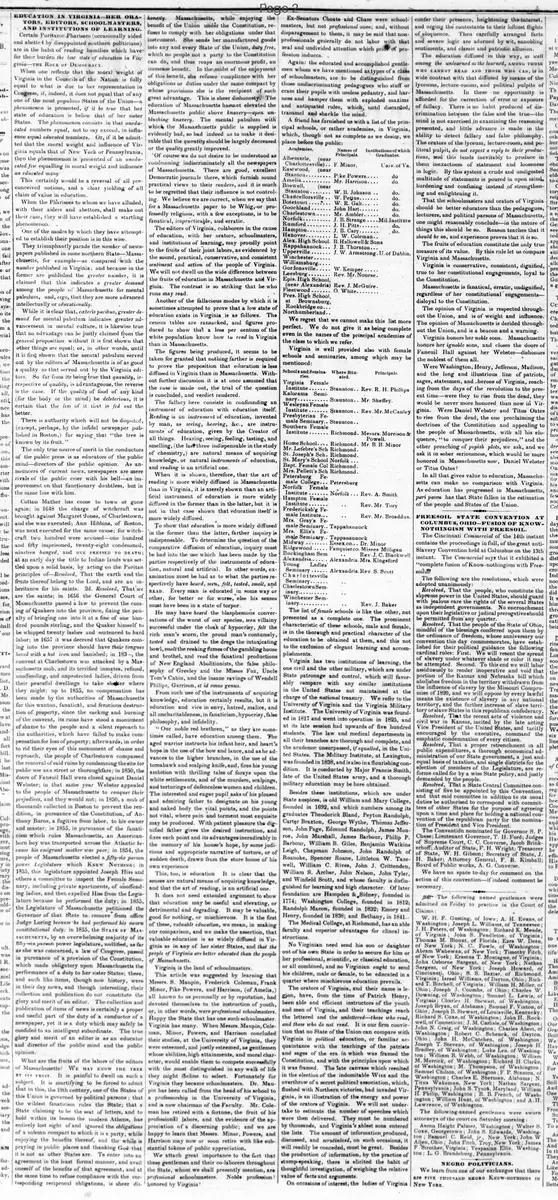
EDUCATION IN VIRGINIA—HER ORATORS, EDITORS, SCHOOLMASTERS, AND INSTITUTIONS OF LEARNING.
Certain Puritanic Pharisees (occasionally aided and abetted by disappointed southern politicians) are in the habit of reading homilies which have for their burden the low state of education in Virginia—the Rock of Democracy.
When one reflects that the moral weight of Virginia in the Councils of the Nation is fully equal to what is due to her representation in Congress, if, indeed, it does not equal that of any one of the most populous States of the Union—a phenomenon is presented, if it be true that her state of education is below that of her sister States. The phenomenon consists in that uneducated numbers equal, not to say exceed, in influence educated numbers. Or, if it be admitted that the moral weight and influence of Virginia equals that of New York or Pennsylvania, then the phenomenon is presented of an uneducated few equalling in moral weight and influence an educated many.
This certainly would be a reversal of all preconceived notions, and a clear yielding of all claim of value in education.
When the Pharisees to whom we have alluded, with their aiders and abettors, shall make out their case, they will have established a startling phenomenon.
One of the modes by which they have attempted to establish their position is in this wise. They triumphantly parade the number of newspapers published in some northern State—Massachusetts, for example—as compared with the number published in Virginia; and because in the former are published the greater number, it is claimed that this indicates a greater demand among the people of Massachusetts for mental pabulum, and, ergo, that they are more advanced intellectually or educationally.
While it is clear that, cæteris paribus, greater demand for mental pabulum indicates greater advancement in mental culture, it is likewise true that no advantage can be justly claimed from the general proposition without it is first shown that other things are equal; or, in other words, until it is first shown that the mental pabulum served out by the editors of Massachusetts is of as good a quality as that served out by the Virginia editors. So far from its being true that quantity, irrespective of quality, is advantageous, the reverse is the case. If the quality of food of any kind (for the body or the mind) be deleterious, it is certain that the less of it that is fed out the better.
There is authority which will not be disputed, except, perhaps, by the infidel newspaper published in Boston, for saying that "the tree is known by its fruit."
The only true source of merit in the conductors of the public press is as educators of the public mind—directors of the public opinion. As announcers of current news, newspapers are mere rivals of the public crier with his bell—an improvement on that functionary doubtless, but in the same line with him.
Cotton Mather has come to town or gone again; in 1648 the charge of witchcraft was brought against Margaret Jones, of Charlestown, and she was executed: Ann Hibbins, of Boston, was next executed for the same cause: for witchcraft two hundred were accused—one hundred and fifty imprisoned, twenty-eight condemned, nineteen hanged, and one pressed to death; at an early day the title to Indian lands was settled upon a solid basis, by acting on the Puritan principles of—Resolved, That the earth and the fruits thereof belong to the Lord, and are an inheritance for his saints. 2d. Resolved, That we are the saints; in 1656 the General Court of Massachusetts passed a law to prevent the coming of Quakers into the province, fixing the penalty of bringing one into it at a fine of one hundred pounds sterling, and the Quaker himself to be whipped twenty lashes and sentenced to hard labor: in 1657 it was decreed that Quakers coming into the province should have their tongues bored with a hot iron and banished; in 1834 the convent at Charlestown was attacked by a Massachusetts mob, and its terrified inmates, refined, unoffending, and unprotected ladies, driven from their peaceful dwellings to take shelter where they might; up to 1855, no compensation has been made by the authorities of Massachusetts for this wanton, fanatical, and ferocious destruction of property, since the sacking and burning of the convent, its ruins have stood a monument of shame to the people and a silent reproach to the authorities, which have failed to make compensation for loss of property: afterwards, in order to rid their eyes of this monument of shame and reproach, the people of Charlestown compassed the removal of said ruins by condemning the site for public use as a street or thoroughfare: in 1850, the doors of Faneuil Hall were closed against Daniel Webster: in that same year Webster appealed to the people of Massachusetts to conquer their prejudices, and they would not: in 1850, a mob of thousands collected in Boston to prevent the rendition, in pursuance of the Constitution, of Anthony Burns, a fugitive from labor, to his owner and master: in 1855, in pursuance of the fanaticism which rules Massachusetts, an American-born boy was transported across the Atlantic because his emigrant mother was poor; in 1854, the people of Massachusetts elected a fifty-six parson power Legislature which knew nothing; in 1855, this legislature appointed Joseph Hiss and others a committee to inspect the Female Seminary, including private apartments, of unoffending ladies, and then expelled Hiss from the Legislature because he performed the duty; in 1855, the Legislature of Massachusetts petitioned the Governor of that State to remove from office Judge Loring because he had performed his sworn constitutional duty; in 1855, the State of Massachusetts, by an overwhelming majority of its fifty-six parson power legislature, nullified, as far as she was concerned, a law of Congress, passed in pursuance of a provision of the Constitution, which made obligatory upon Massachusetts the performance of a duty to her sister States; these, and such like items, though now history, were in their day news, and though interesting, their collection and publication do not constitute the glory and merit of an editor. The collection and publication of items of news is certainly a proper and useful part of the duty of a conductor of a newspaper, yet it is a duty which may safely be confided to an intelligent subordinate. The true glory and merit of an editor is as an educator and director of the public mind and the public opinion.
What are the fruits of the labors of the editors of Massachusetts? We may know the tree by its fruit. It is painful to dwell on such a subject. It is mortifying to be forced to admit that in this, the 19th century, one of the States of this Union is governed by political parsons; that the wildest fanaticism rules the State; that a State claiming to be the seat of letters, and to hold within its bosom the modern Athens, has entirely lost sight of and ignored the obligations of a solemn compact to which it is a party, while enjoying the benefits thereof, and the while is praying in public places and thanking God that it is not as other States are. To enter into an agreement in the least formal manner, and avail oneself of the benefits of that agreement, and at the same time to refuse compliance with the corresponding reciprocal obligations, is sheer dishonesty. Massachusetts, while enjoying the benefit of the Union under the Constitution, refuses to comply with her obligations under that instrument. She sends her manufactured goods into any and every State of the Union, duty free, which no people not a party to the Constitution can do, and thus reaps an enormous profit, an immense benefit. In the midst of the enjoyment of this benefit, she refuses compliance with her obligations or duties under the same compact by whose provisions she is the recipient of such great advantage. This is sheer dishonesty. The education of Massachusetts has not elevated the Massachusetts public above knavery—open, unblushing knavery. The mental pabulum with which the Massachusetts public is supplied is evidently bad, so bad indeed as to make it desirable that the quantity should be largely decreased or the quality greatly improved.
Of course we do not desire to be understood as condemning indiscriminately all the newspapers of Massachusetts. There are good, excellent Democratic journals there, which furnish sound practical views to their readers, and it is much to be regretted that their influence is not controlling. We believe we are correct, when we say that for a Massachusetts paper to be Whig, or professedly religious, with a few exceptions, is to be fanatical, impracticable, and erratic.
The editors of Virginia, co-laborers in the cause of education, with her orators, schoolmasters, and institutions of learning, may proudly point to the fruits of their joint labors, as evidenced by the sound, practical, conservative, and consistent sentiment and action of the people of Virginia. We will not dwell on the wide difference between the fruits of education in Massachusetts and Virginia. The contrast is so striking that he who runs may read.
Another of the fallacious modes by which it is sometimes attempted to prove that a low state of education exists in Virginia is as follows. The census tables are ransacked, and figures produced to show that a less per centum of the white population know how to read in Virginia than in Massachusetts.
The figures being produced, it seems to be taken for granted that nothing farther is required to prove the proposition that education is less diffused in Virginia than in Massachusetts. Without further discussion it is at once assumed that the case is made out, the trial of the question is concluded, and verdict rendered.
The fallacy here consists in confounding an instrument of education with education itself. Reading is an instrument of education, invented by man, as seeing, hearing, &c., are instruments of education, given by the Creator of all things. Hearing, seeing, feeling, tasting, and smelling, (the last three indispensable in the study of chemistry,) are natural means of acquiring knowledge, or natural instruments of education, and reading is an artificial one.
When it is shown, therefore, that the art of reading is more widely diffused in Massachusetts than in Virginia, it is merely shown that an artificial instrument of education is more widely diffused in the former than in the latter, but it is not in that case shown that education itself is more widely diffused.
To show that education is more widely diffused in the former than the latter, farther inquiry is indispensable. To determine the question of the comparative diffusion of education, inquiry must be had into the use which has been made by the parties respectively of the instruments of education, natural and artificial. In other words, examination must be had as to what the parties respectively have heard, seen, felt, tasted, smelt, and read. Every man is educated in some way or other, for better or for worse, else his senses must have been in a state of torpor.
He may have heard the blasphemous conversations of the worst of our species, seen villainy successful under the cloak of hypocrisy, felt the rich man's scorn, the proud man's contumely, tasted and drained to the dregs the intoxicating bowl, smelt the reeking fumes of the gambling house and brothel, and read the fanatical productions of New England Abolitionists, the false philosophy of Greeley and the Misses Fox, Uncle Tom's Cabin, and the insane ravings of Wendell Phillips, Garrison, et id omne genus.
From such use of the instruments of acquiring knowledge, education certainly results, but it is education and vice in envy, hatred, malice, and all uncharitableness, in fanaticism, hypocrisy, false philosophy, and infidelity.
Our noble red brethren, as they are sometimes called, have education among them. The aged warrior instructs his infant heir, and heart's hope in the use of the bow and lance, and as he advances to the higher branches, in the use of the tomahawk and scalping knife, and fires his young ambition with thrilling tales of forays upon the white settlements, and of the murders, scalpings, and torturings of defenceless women and children.
The interested and eager pupil asks of his pleased and admiring father to designate on his young and naked body the vital points, and the points not vital, where pain and torment most exquisite may be produced. With patient pleasure the dignified father gives the desired instruction, and fixes each point and its advantages ineradicably in the memory of his house's hope, by some judicious and appropriate narrative of torture, or of sudden death, drawn from the store house of his own experience.
This, too, is education. It is clear that the senses are natural means of acquiring knowledge and that the art of reading, is an artificial one. It does not need extended argument to show that education may be useful and elevating, or detrimental and degrading. It may be valuable, good for nothing, or mischievous. It is the first of these, valuable education, we mean, in making our comparison, and we make the assertion, that valuable education is as widely diffused in Virginia as in any of her sister States, and that the people of Virginia are better educated than the people of Massachusetts.
Virginia is the land of schoolmasters. This article was suggested by learning that Messrs. S. Maupin, Frederick Coleman, Frank Minor, Pike Powers, and Harrison, (of Amelia,) all known to us personally or by reputation, had devoted themselves to the instruction of youth, or, in other words, were professional schoolmasters.
Happy the State that has one such schoolmaster. Virginia has many. When Messrs. Maupin, Coleman, Minor, Powers, and Harrison concluded their studies, at the University of Virginia, they were esteemed, and justly esteemed, as gentlemen whose abilities, high attainments, and moral character, would enable them to compete successfully with the most distinguished in any walk of life they might incline to select. Fortunately for Virginia they became schoolmasters. Dr. Maupin has been called from the head of his school to a professorship in the University of Virginia, and is now chairman of the Faculty. Mr. Coleman has retired with a fortune, the fruit of his professional labors, and the evidence of the appreciation of a discerning public; and we are happy to learn that Messrs. Minor, Powers, and Harrison may now or soon retire with like substantial tokens of public appreciation.
We attach great importance to the fact that these gentlemen and their co-laborers throughout the State, whom we shall presently mention, are professional schoolmasters.
Noble profession! honored by Virginia.
Ex-Senators Choate and Chase were schoolmasters, but not professional ones; and, without disparagement to them, it may be said that non-professionals generally do not labor with that zeal and undivided attention which pride of profession induces.
Again: the educated and accomplished gentlemen whom we have mentioned as types of a class of schoolmasters, are to be distinguished from those undiscriminating pedagogues who stuff or cram their pupils with useless pedantry, and harness and hamper them with exploded maxims and antiquated rules, which, until discarded, trammel and shackle the mind.
A friend has furnished us with a list of the principal schools, or rather academies, in Virginia, which, though not as complete as we desire, we place before the public:
Albemarle (near Charlottesville) F. Minor, Univ. of Va.; Eastwood (near Staunton) Pike Powers, do; Amelia Mr. Harrison, do; Boswell (near Staunton) W. B. Johnson, do; Charlottesville W. Penns, do; Botetourt W. R. Gall, do; Goochland John Hart, do; Charlestown Mr. Ambler, do; Norfolk J. B. Strange, Mil. Institute; Rumford J. E. Pitto, do; Hampton J. B. Cary, do; Hanover L. W. Coleman; Alexandria High School B. Hallowell & Sons; Rappahannock J. B. Thornton; Upperville; Winchester; Williamsburg; Gordonsville W. Kemper; Leesburg Rev. Mr. Nourse; Episcopal High School (near Alexandria) Rev. J. McGuire; Fleetwood O. White; Presbyterian High School at Brownsburg, Rockbridge co.; Northumberland.
We regret that we cannot make this list more perfect. We do not give it as being complete even in the names of the principal academies of the class to which we refer.
Virginia is well provided also with female schools and seminaries, among which may be mentioned:
Virginia Female Institute Staunton Rev. R. H. Phillips; Kalorama Seminary Staunton Mr. Sheffey; Wesleyan Female Institute Staunton Rev. Mr. McCauley; Presbyterian Female Seminary Staunton; Southern Female Institute Richmond Messrs. Morrison & Powell; Home School Richmond Mr. B. B. Minor; Mr. Lefebvre's School Richmond; St. Joseph's School Richmond; St. Mary's School Norfolk; Baptist Female College Richmond; Mrs. Pellett's School Richmond; Petersburg Female College Petersburg; Norfolk Female Institute Norfolk Rev. A. Smith; Hampton Female Institute Rev. Mr. Tory; Fredericksburg Female Institute Rev. Mr. Broaddus; Mrs. Gray's Female Seminary Tappahannock; Mrs. Ellis's Female Seminary Tappahannock; Midway Essex co. Dr. Minor; Ridgewood Fauquier co. Misses Milligan; Buckingham Seminary Rev. J. C. Blackwell; Alexandria Mrs. Kingsford; Young Ladies Seminary Alexandria Rev. S. Scott; Charlottesville Seminary; Charlestown Seminary; Winchester Seminary Rev. J. Baker.
The list of female schools is like the other, not presented as a complete one. The prominent characteristic of these schools, male and female, is in the thorough and practical character of the education to be obtained at them, and this not to the exclusion of elegant learning and accomplishments.
Virginia has two institutions of learning, the one civil and the other military, which are under State patronage and control, which will favorably compare with any similar institutions in the United States not maintained at the charge of the national treasury. We refer to the University of Virginia and the Virginia Military Institute. The University of Virginia was founded in 1817 and went into operation in 1825, and at its late session had upwards of five hundred students. The law and medical departments in all their branches are thorough and complete, and the academic unsurpassed, if equalled, in the United States. The Military Institute, at Lexington, was founded in 1838, and is also in a flourishing condition. It is conducted by Major Francis Smith, late of the United States army, and a thorough military education may be here obtained.
Besides these institutions, which are under State auspices, is old William and Mary College, founded in 1692, and which numbers among its graduates Theodorick Bland, Peyton Randolph, Carter Braxton, George Wythe, Thomas Jefferson, John Page, Edmund Randolph, James Monroe, John Marshall, James Barbour, Philip P. Barbour, William B. Giles, Benjamin Watkins Leigh, Chapman Johnson, John Randolph of Roanoke, Spencer Roane, Littleton W. Tazewell, William C. Rives, John J. Crittenden, William S. Archer, John Nelson, John Tyler, and Winfield Scott, and whose faculty is distinguished for learning and high character. Of later foundation are Hampden & Sidney, founded in 1774; Washington College, founded in 1812; Randolph Macon, founded in 1832; Emory and Henry, founded in 1838; and Bethany, in 1841.
The Medical College, at Richmond, has an able faculty and superior advantages for clinical instructions.
No Virginian need send his son or daughter out of his own State in order to secure for him or her professional, scientific, or classical education, or all combined, and no Virginian ought to send his children, male or female, to be educated in a quarter where mischievous education prevails.
The orators of Virginia, and their name is legion, have, from the time of Patrick Henry, been able and efficient instructors of the youth and men of Virginia, and their teachings reach the lettered and the unlettered—those who read, and those who do not read. It is our firm conviction that no State of the Union can compare with Virginia in political education, or familiar acquaintance with the teachings of the patriots and sages of the era in which was framed the Constitution, and with the principles upon which it was framed. The late canvass which resulted in the election of the indomitable Wise and the overthrow of a secret political association, which, flushed with Northern victories, had invaded Virginia, is an illustration of the energy and power of the orators of Virginia. We will not undertake to estimate the number of speeches which were then delivered. They must be numbered by thousands, and Virginia's ablest sons entered the lists. The amount of information produced, discussed, and scrutinized, on such occasions, it will readily be conceded, must be great. Besides the production of information, by the practice of stump-speaking, there is elicited the habit of thoughtful investigation, of weighing the relative value of facts and arguments.
On occasions of interest, the ladies of Virginia confer their presence, heightening the interest, and urging the contestants to their loftiest flights of eloquence. Then carefully arranged facts and severe logic are adorned by wit, ennobling sentiments, and classic and patriotic allusion.
The education diffused in this way, as well among the unlearned as the learned, among those who cannot read and those who can, is in wide contrast with that diffused by means of the lyceums, lecture-rooms, and political pulpits of Massachusetts. In these no opportunity is afforded for the correction of error or exposure of fallacy. There is no habit produced of discrimination between the false and the true—the mind is not exercised in examining the reasoning presented, and little advance is made in the ability to detect fallacy and false philosophy.
The orators of the lyceum, lecture-room, and political pulpit, do not expect a reply to their productions, and this tends inevitably to produce in them inexactness of statement and looseness in logic. By this system a crude and undigested multitude of statements is poured in upon mind, burdening and confusing instead of strengthening and enlightening it.
That the schoolmasters and orators of Virginia should be better educators than the pedagogues, lecturers, and political parsons of Massachusetts, one might reasonably conclude—in the nature of things this should be so. Reason teaches that it should be so, and experience proves that it is so.
The fruits of education constitute the only true measure of its value. By this rule let us compare Virginia and Massachusetts.
Virginia is conservative, consistent, dignified, true to her constitutional engagements, loyal to the Constitution.
Massachusetts is fanatical, erratic, undignified, regardless of her constitutional engagements—disloyal to the Constitution.
The opinion of Virginia is respected throughout the Union, and is of weight and influence.
The opinion of Massachusetts is derided throughout the Union, and is a beacon and a warning.
Virginia honors her noble sons. Massachusetts honors her ignoble sons, and closes the doors of Faneuil Hall against her Webster—dishonors the noblest of them all.
Were Washington, Henry, Jefferson, Madison, and the long and illustrious line of patriots, sages, statesmen, and heroes of Virginia, reaching from the days of the revolution to the present time—were they to rise from the dead, they would be never more honored than now in Virginia. Were Daniel Webster and Titus Oates to rise from the dead, the one proclaiming the doctrines of the Constitution and appealing to the people of Massachusetts, with all his eloquence, "to conquer their prejudices," and the other preaching of popish plots, we ask, and we ask it in sober seriousness, which would be more honored in Massachusetts now, Daniel Webster or Titus Oates?
In all that gives value to education, Massachusetts can make no comparison with Virginia.
As education has progressed in Massachusetts, pari passu has that State fallen in the estimation of the people and States of the Union.
Certain Puritanic Pharisees (occasionally aided and abetted by disappointed southern politicians) are in the habit of reading homilies which have for their burden the low state of education in Virginia—the Rock of Democracy.
When one reflects that the moral weight of Virginia in the Councils of the Nation is fully equal to what is due to her representation in Congress, if, indeed, it does not equal that of any one of the most populous States of the Union—a phenomenon is presented, if it be true that her state of education is below that of her sister States. The phenomenon consists in that uneducated numbers equal, not to say exceed, in influence educated numbers. Or, if it be admitted that the moral weight and influence of Virginia equals that of New York or Pennsylvania, then the phenomenon is presented of an uneducated few equalling in moral weight and influence an educated many.
This certainly would be a reversal of all preconceived notions, and a clear yielding of all claim of value in education.
When the Pharisees to whom we have alluded, with their aiders and abettors, shall make out their case, they will have established a startling phenomenon.
One of the modes by which they have attempted to establish their position is in this wise. They triumphantly parade the number of newspapers published in some northern State—Massachusetts, for example—as compared with the number published in Virginia; and because in the former are published the greater number, it is claimed that this indicates a greater demand among the people of Massachusetts for mental pabulum, and, ergo, that they are more advanced intellectually or educationally.
While it is clear that, cæteris paribus, greater demand for mental pabulum indicates greater advancement in mental culture, it is likewise true that no advantage can be justly claimed from the general proposition without it is first shown that other things are equal; or, in other words, until it is first shown that the mental pabulum served out by the editors of Massachusetts is of as good a quality as that served out by the Virginia editors. So far from its being true that quantity, irrespective of quality, is advantageous, the reverse is the case. If the quality of food of any kind (for the body or the mind) be deleterious, it is certain that the less of it that is fed out the better.
There is authority which will not be disputed, except, perhaps, by the infidel newspaper published in Boston, for saying that "the tree is known by its fruit."
The only true source of merit in the conductors of the public press is as educators of the public mind—directors of the public opinion. As announcers of current news, newspapers are mere rivals of the public crier with his bell—an improvement on that functionary doubtless, but in the same line with him.
Cotton Mather has come to town or gone again; in 1648 the charge of witchcraft was brought against Margaret Jones, of Charlestown, and she was executed: Ann Hibbins, of Boston, was next executed for the same cause: for witchcraft two hundred were accused—one hundred and fifty imprisoned, twenty-eight condemned, nineteen hanged, and one pressed to death; at an early day the title to Indian lands was settled upon a solid basis, by acting on the Puritan principles of—Resolved, That the earth and the fruits thereof belong to the Lord, and are an inheritance for his saints. 2d. Resolved, That we are the saints; in 1656 the General Court of Massachusetts passed a law to prevent the coming of Quakers into the province, fixing the penalty of bringing one into it at a fine of one hundred pounds sterling, and the Quaker himself to be whipped twenty lashes and sentenced to hard labor: in 1657 it was decreed that Quakers coming into the province should have their tongues bored with a hot iron and banished; in 1834 the convent at Charlestown was attacked by a Massachusetts mob, and its terrified inmates, refined, unoffending, and unprotected ladies, driven from their peaceful dwellings to take shelter where they might; up to 1855, no compensation has been made by the authorities of Massachusetts for this wanton, fanatical, and ferocious destruction of property, since the sacking and burning of the convent, its ruins have stood a monument of shame to the people and a silent reproach to the authorities, which have failed to make compensation for loss of property: afterwards, in order to rid their eyes of this monument of shame and reproach, the people of Charlestown compassed the removal of said ruins by condemning the site for public use as a street or thoroughfare: in 1850, the doors of Faneuil Hall were closed against Daniel Webster: in that same year Webster appealed to the people of Massachusetts to conquer their prejudices, and they would not: in 1850, a mob of thousands collected in Boston to prevent the rendition, in pursuance of the Constitution, of Anthony Burns, a fugitive from labor, to his owner and master: in 1855, in pursuance of the fanaticism which rules Massachusetts, an American-born boy was transported across the Atlantic because his emigrant mother was poor; in 1854, the people of Massachusetts elected a fifty-six parson power Legislature which knew nothing; in 1855, this legislature appointed Joseph Hiss and others a committee to inspect the Female Seminary, including private apartments, of unoffending ladies, and then expelled Hiss from the Legislature because he performed the duty; in 1855, the Legislature of Massachusetts petitioned the Governor of that State to remove from office Judge Loring because he had performed his sworn constitutional duty; in 1855, the State of Massachusetts, by an overwhelming majority of its fifty-six parson power legislature, nullified, as far as she was concerned, a law of Congress, passed in pursuance of a provision of the Constitution, which made obligatory upon Massachusetts the performance of a duty to her sister States; these, and such like items, though now history, were in their day news, and though interesting, their collection and publication do not constitute the glory and merit of an editor. The collection and publication of items of news is certainly a proper and useful part of the duty of a conductor of a newspaper, yet it is a duty which may safely be confided to an intelligent subordinate. The true glory and merit of an editor is as an educator and director of the public mind and the public opinion.
What are the fruits of the labors of the editors of Massachusetts? We may know the tree by its fruit. It is painful to dwell on such a subject. It is mortifying to be forced to admit that in this, the 19th century, one of the States of this Union is governed by political parsons; that the wildest fanaticism rules the State; that a State claiming to be the seat of letters, and to hold within its bosom the modern Athens, has entirely lost sight of and ignored the obligations of a solemn compact to which it is a party, while enjoying the benefits thereof, and the while is praying in public places and thanking God that it is not as other States are. To enter into an agreement in the least formal manner, and avail oneself of the benefits of that agreement, and at the same time to refuse compliance with the corresponding reciprocal obligations, is sheer dishonesty. Massachusetts, while enjoying the benefit of the Union under the Constitution, refuses to comply with her obligations under that instrument. She sends her manufactured goods into any and every State of the Union, duty free, which no people not a party to the Constitution can do, and thus reaps an enormous profit, an immense benefit. In the midst of the enjoyment of this benefit, she refuses compliance with her obligations or duties under the same compact by whose provisions she is the recipient of such great advantage. This is sheer dishonesty. The education of Massachusetts has not elevated the Massachusetts public above knavery—open, unblushing knavery. The mental pabulum with which the Massachusetts public is supplied is evidently bad, so bad indeed as to make it desirable that the quantity should be largely decreased or the quality greatly improved.
Of course we do not desire to be understood as condemning indiscriminately all the newspapers of Massachusetts. There are good, excellent Democratic journals there, which furnish sound practical views to their readers, and it is much to be regretted that their influence is not controlling. We believe we are correct, when we say that for a Massachusetts paper to be Whig, or professedly religious, with a few exceptions, is to be fanatical, impracticable, and erratic.
The editors of Virginia, co-laborers in the cause of education, with her orators, schoolmasters, and institutions of learning, may proudly point to the fruits of their joint labors, as evidenced by the sound, practical, conservative, and consistent sentiment and action of the people of Virginia. We will not dwell on the wide difference between the fruits of education in Massachusetts and Virginia. The contrast is so striking that he who runs may read.
Another of the fallacious modes by which it is sometimes attempted to prove that a low state of education exists in Virginia is as follows. The census tables are ransacked, and figures produced to show that a less per centum of the white population know how to read in Virginia than in Massachusetts.
The figures being produced, it seems to be taken for granted that nothing farther is required to prove the proposition that education is less diffused in Virginia than in Massachusetts. Without further discussion it is at once assumed that the case is made out, the trial of the question is concluded, and verdict rendered.
The fallacy here consists in confounding an instrument of education with education itself. Reading is an instrument of education, invented by man, as seeing, hearing, &c., are instruments of education, given by the Creator of all things. Hearing, seeing, feeling, tasting, and smelling, (the last three indispensable in the study of chemistry,) are natural means of acquiring knowledge, or natural instruments of education, and reading is an artificial one.
When it is shown, therefore, that the art of reading is more widely diffused in Massachusetts than in Virginia, it is merely shown that an artificial instrument of education is more widely diffused in the former than in the latter, but it is not in that case shown that education itself is more widely diffused.
To show that education is more widely diffused in the former than the latter, farther inquiry is indispensable. To determine the question of the comparative diffusion of education, inquiry must be had into the use which has been made by the parties respectively of the instruments of education, natural and artificial. In other words, examination must be had as to what the parties respectively have heard, seen, felt, tasted, smelt, and read. Every man is educated in some way or other, for better or for worse, else his senses must have been in a state of torpor.
He may have heard the blasphemous conversations of the worst of our species, seen villainy successful under the cloak of hypocrisy, felt the rich man's scorn, the proud man's contumely, tasted and drained to the dregs the intoxicating bowl, smelt the reeking fumes of the gambling house and brothel, and read the fanatical productions of New England Abolitionists, the false philosophy of Greeley and the Misses Fox, Uncle Tom's Cabin, and the insane ravings of Wendell Phillips, Garrison, et id omne genus.
From such use of the instruments of acquiring knowledge, education certainly results, but it is education and vice in envy, hatred, malice, and all uncharitableness, in fanaticism, hypocrisy, false philosophy, and infidelity.
Our noble red brethren, as they are sometimes called, have education among them. The aged warrior instructs his infant heir, and heart's hope in the use of the bow and lance, and as he advances to the higher branches, in the use of the tomahawk and scalping knife, and fires his young ambition with thrilling tales of forays upon the white settlements, and of the murders, scalpings, and torturings of defenceless women and children.
The interested and eager pupil asks of his pleased and admiring father to designate on his young and naked body the vital points, and the points not vital, where pain and torment most exquisite may be produced. With patient pleasure the dignified father gives the desired instruction, and fixes each point and its advantages ineradicably in the memory of his house's hope, by some judicious and appropriate narrative of torture, or of sudden death, drawn from the store house of his own experience.
This, too, is education. It is clear that the senses are natural means of acquiring knowledge and that the art of reading, is an artificial one. It does not need extended argument to show that education may be useful and elevating, or detrimental and degrading. It may be valuable, good for nothing, or mischievous. It is the first of these, valuable education, we mean, in making our comparison, and we make the assertion, that valuable education is as widely diffused in Virginia as in any of her sister States, and that the people of Virginia are better educated than the people of Massachusetts.
Virginia is the land of schoolmasters. This article was suggested by learning that Messrs. S. Maupin, Frederick Coleman, Frank Minor, Pike Powers, and Harrison, (of Amelia,) all known to us personally or by reputation, had devoted themselves to the instruction of youth, or, in other words, were professional schoolmasters.
Happy the State that has one such schoolmaster. Virginia has many. When Messrs. Maupin, Coleman, Minor, Powers, and Harrison concluded their studies, at the University of Virginia, they were esteemed, and justly esteemed, as gentlemen whose abilities, high attainments, and moral character, would enable them to compete successfully with the most distinguished in any walk of life they might incline to select. Fortunately for Virginia they became schoolmasters. Dr. Maupin has been called from the head of his school to a professorship in the University of Virginia, and is now chairman of the Faculty. Mr. Coleman has retired with a fortune, the fruit of his professional labors, and the evidence of the appreciation of a discerning public; and we are happy to learn that Messrs. Minor, Powers, and Harrison may now or soon retire with like substantial tokens of public appreciation.
We attach great importance to the fact that these gentlemen and their co-laborers throughout the State, whom we shall presently mention, are professional schoolmasters.
Noble profession! honored by Virginia.
Ex-Senators Choate and Chase were schoolmasters, but not professional ones; and, without disparagement to them, it may be said that non-professionals generally do not labor with that zeal and undivided attention which pride of profession induces.
Again: the educated and accomplished gentlemen whom we have mentioned as types of a class of schoolmasters, are to be distinguished from those undiscriminating pedagogues who stuff or cram their pupils with useless pedantry, and harness and hamper them with exploded maxims and antiquated rules, which, until discarded, trammel and shackle the mind.
A friend has furnished us with a list of the principal schools, or rather academies, in Virginia, which, though not as complete as we desire, we place before the public:
Albemarle (near Charlottesville) F. Minor, Univ. of Va.; Eastwood (near Staunton) Pike Powers, do; Amelia Mr. Harrison, do; Boswell (near Staunton) W. B. Johnson, do; Charlottesville W. Penns, do; Botetourt W. R. Gall, do; Goochland John Hart, do; Charlestown Mr. Ambler, do; Norfolk J. B. Strange, Mil. Institute; Rumford J. E. Pitto, do; Hampton J. B. Cary, do; Hanover L. W. Coleman; Alexandria High School B. Hallowell & Sons; Rappahannock J. B. Thornton; Upperville; Winchester; Williamsburg; Gordonsville W. Kemper; Leesburg Rev. Mr. Nourse; Episcopal High School (near Alexandria) Rev. J. McGuire; Fleetwood O. White; Presbyterian High School at Brownsburg, Rockbridge co.; Northumberland.
We regret that we cannot make this list more perfect. We do not give it as being complete even in the names of the principal academies of the class to which we refer.
Virginia is well provided also with female schools and seminaries, among which may be mentioned:
Virginia Female Institute Staunton Rev. R. H. Phillips; Kalorama Seminary Staunton Mr. Sheffey; Wesleyan Female Institute Staunton Rev. Mr. McCauley; Presbyterian Female Seminary Staunton; Southern Female Institute Richmond Messrs. Morrison & Powell; Home School Richmond Mr. B. B. Minor; Mr. Lefebvre's School Richmond; St. Joseph's School Richmond; St. Mary's School Norfolk; Baptist Female College Richmond; Mrs. Pellett's School Richmond; Petersburg Female College Petersburg; Norfolk Female Institute Norfolk Rev. A. Smith; Hampton Female Institute Rev. Mr. Tory; Fredericksburg Female Institute Rev. Mr. Broaddus; Mrs. Gray's Female Seminary Tappahannock; Mrs. Ellis's Female Seminary Tappahannock; Midway Essex co. Dr. Minor; Ridgewood Fauquier co. Misses Milligan; Buckingham Seminary Rev. J. C. Blackwell; Alexandria Mrs. Kingsford; Young Ladies Seminary Alexandria Rev. S. Scott; Charlottesville Seminary; Charlestown Seminary; Winchester Seminary Rev. J. Baker.
The list of female schools is like the other, not presented as a complete one. The prominent characteristic of these schools, male and female, is in the thorough and practical character of the education to be obtained at them, and this not to the exclusion of elegant learning and accomplishments.
Virginia has two institutions of learning, the one civil and the other military, which are under State patronage and control, which will favorably compare with any similar institutions in the United States not maintained at the charge of the national treasury. We refer to the University of Virginia and the Virginia Military Institute. The University of Virginia was founded in 1817 and went into operation in 1825, and at its late session had upwards of five hundred students. The law and medical departments in all their branches are thorough and complete, and the academic unsurpassed, if equalled, in the United States. The Military Institute, at Lexington, was founded in 1838, and is also in a flourishing condition. It is conducted by Major Francis Smith, late of the United States army, and a thorough military education may be here obtained.
Besides these institutions, which are under State auspices, is old William and Mary College, founded in 1692, and which numbers among its graduates Theodorick Bland, Peyton Randolph, Carter Braxton, George Wythe, Thomas Jefferson, John Page, Edmund Randolph, James Monroe, John Marshall, James Barbour, Philip P. Barbour, William B. Giles, Benjamin Watkins Leigh, Chapman Johnson, John Randolph of Roanoke, Spencer Roane, Littleton W. Tazewell, William C. Rives, John J. Crittenden, William S. Archer, John Nelson, John Tyler, and Winfield Scott, and whose faculty is distinguished for learning and high character. Of later foundation are Hampden & Sidney, founded in 1774; Washington College, founded in 1812; Randolph Macon, founded in 1832; Emory and Henry, founded in 1838; and Bethany, in 1841.
The Medical College, at Richmond, has an able faculty and superior advantages for clinical instructions.
No Virginian need send his son or daughter out of his own State in order to secure for him or her professional, scientific, or classical education, or all combined, and no Virginian ought to send his children, male or female, to be educated in a quarter where mischievous education prevails.
The orators of Virginia, and their name is legion, have, from the time of Patrick Henry, been able and efficient instructors of the youth and men of Virginia, and their teachings reach the lettered and the unlettered—those who read, and those who do not read. It is our firm conviction that no State of the Union can compare with Virginia in political education, or familiar acquaintance with the teachings of the patriots and sages of the era in which was framed the Constitution, and with the principles upon which it was framed. The late canvass which resulted in the election of the indomitable Wise and the overthrow of a secret political association, which, flushed with Northern victories, had invaded Virginia, is an illustration of the energy and power of the orators of Virginia. We will not undertake to estimate the number of speeches which were then delivered. They must be numbered by thousands, and Virginia's ablest sons entered the lists. The amount of information produced, discussed, and scrutinized, on such occasions, it will readily be conceded, must be great. Besides the production of information, by the practice of stump-speaking, there is elicited the habit of thoughtful investigation, of weighing the relative value of facts and arguments.
On occasions of interest, the ladies of Virginia confer their presence, heightening the interest, and urging the contestants to their loftiest flights of eloquence. Then carefully arranged facts and severe logic are adorned by wit, ennobling sentiments, and classic and patriotic allusion.
The education diffused in this way, as well among the unlearned as the learned, among those who cannot read and those who can, is in wide contrast with that diffused by means of the lyceums, lecture-rooms, and political pulpits of Massachusetts. In these no opportunity is afforded for the correction of error or exposure of fallacy. There is no habit produced of discrimination between the false and the true—the mind is not exercised in examining the reasoning presented, and little advance is made in the ability to detect fallacy and false philosophy.
The orators of the lyceum, lecture-room, and political pulpit, do not expect a reply to their productions, and this tends inevitably to produce in them inexactness of statement and looseness in logic. By this system a crude and undigested multitude of statements is poured in upon mind, burdening and confusing instead of strengthening and enlightening it.
That the schoolmasters and orators of Virginia should be better educators than the pedagogues, lecturers, and political parsons of Massachusetts, one might reasonably conclude—in the nature of things this should be so. Reason teaches that it should be so, and experience proves that it is so.
The fruits of education constitute the only true measure of its value. By this rule let us compare Virginia and Massachusetts.
Virginia is conservative, consistent, dignified, true to her constitutional engagements, loyal to the Constitution.
Massachusetts is fanatical, erratic, undignified, regardless of her constitutional engagements—disloyal to the Constitution.
The opinion of Virginia is respected throughout the Union, and is of weight and influence.
The opinion of Massachusetts is derided throughout the Union, and is a beacon and a warning.
Virginia honors her noble sons. Massachusetts honors her ignoble sons, and closes the doors of Faneuil Hall against her Webster—dishonors the noblest of them all.
Were Washington, Henry, Jefferson, Madison, and the long and illustrious line of patriots, sages, statesmen, and heroes of Virginia, reaching from the days of the revolution to the present time—were they to rise from the dead, they would be never more honored than now in Virginia. Were Daniel Webster and Titus Oates to rise from the dead, the one proclaiming the doctrines of the Constitution and appealing to the people of Massachusetts, with all his eloquence, "to conquer their prejudices," and the other preaching of popish plots, we ask, and we ask it in sober seriousness, which would be more honored in Massachusetts now, Daniel Webster or Titus Oates?
In all that gives value to education, Massachusetts can make no comparison with Virginia.
As education has progressed in Massachusetts, pari passu has that State fallen in the estimation of the people and States of the Union.
What sub-type of article is it?
Education
Constitutional
Moral Or Religious
What keywords are associated?
Virginia Education
Massachusetts Fanaticism
Schoolmasters
Constitutional Loyalty
Orators
Institutions Of Learning
Moral Influence
What entities or persons were involved?
Virginia Schoolmasters (Maupin, Coleman, Minor, Powers, Harrison)
University Of Virginia
Virginia Military Institute
William And Mary College
Patrick Henry
Daniel Webster
Anthony Burns
Wendell Phillips
Garrison
Editorial Details
Primary Topic
Defense Of Virginia's Education And Moral Superiority Over Massachusetts
Stance / Tone
Strongly Pro Virginia, Critical Of Massachusetts Fanaticism And Disloyalty
Key Figures
Virginia Schoolmasters (Maupin, Coleman, Minor, Powers, Harrison)
University Of Virginia
Virginia Military Institute
William And Mary College
Patrick Henry
Daniel Webster
Anthony Burns
Wendell Phillips
Garrison
Key Arguments
Virginia's Moral Influence Equals Or Exceeds That Of More Populous States Despite Alleged Low Education
Newspaper Quantity Does Not Indicate Quality; Virginia Editors Provide Better Mental Pabulum
True Education Measured By Fruits: Virginia Conservative And Loyal, Massachusetts Fanatical And Dishonest
Literacy Is An Instrument, Not Education Itself; Virginia's Use Of Educational Tools Yields Valuable Results
Virginia Abounds In Professional Schoolmasters And Institutions Providing Thorough, Practical Education
Orators Like Patrick Henry Educate Politically, Fostering Thoughtful Investigation Unlike Massachusetts Lectures