Thank you for visiting SNEWPapers!
Sign up free
Letter to Editor
February 15, 1783
The New Hampshire Gazette And General Advertiser
Portsmouth, Exeter, Rockingham County, New Hampshire
What is this article about?
A letter urges better support for education in America, arguing it is essential for wise governance and societal happiness. It criticizes low teacher salaries and poor payment practices, contrasting with ancient Greece's patronage of learning.
Clipping
OCR Quality
95%
Excellent
Full Text
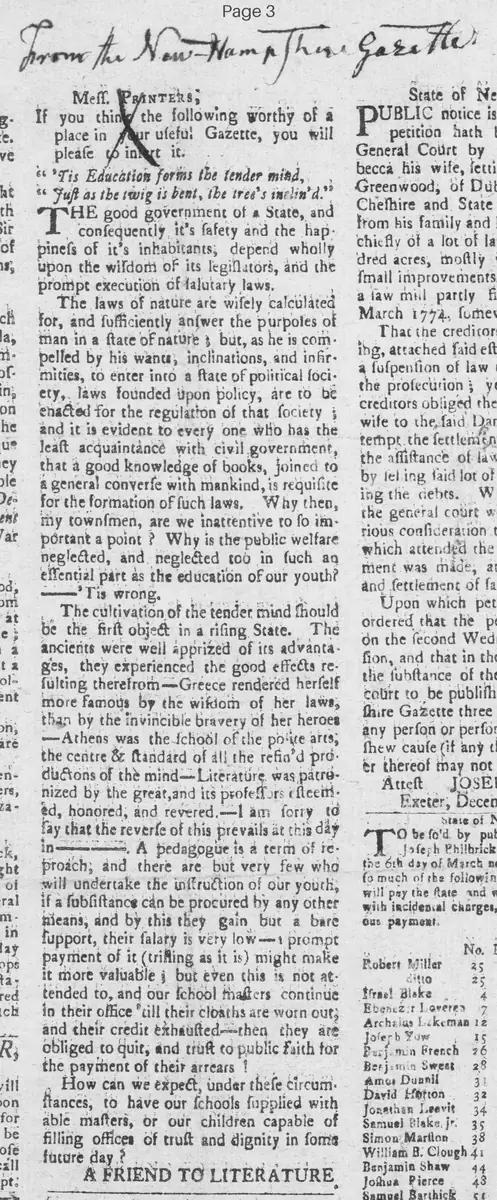
Mess. PRINTERS:
If you think the following worthy of a place in your useful Gazette, you will please to insert it.
'Tis Education forms the tender mind,
As the twig is bent, the tree's inclin'd."
The good government of a State, and consequently, it's safety and the happiness of it's inhabitants, depend wholly upon the wisdom of its legislators, and the prompt execution of salutary laws.
The laws of nature are wisely calculated for, and sufficiently answer the purposes of man in a state of nature: but, as he is compelled by his wants, inclinations, and infirmities, to enter into a state of political society, laws founded upon policy, are to be enacted for the regulation of that society; and it is evident to every one who has the least acquaintance with civil government that a good knowledge of books, joined to a general converse with mankind, is requisite for the formation of such laws. Why then, my townsmen, are we inattentive to so important a point? Why is the public welfare neglected, and neglected too in such an essential part as the education of our youth?
'Tis wrong.
The cultivation of the tender mind should be the first object in a rising State. The ancients were well apprised of its advantages, they experienced the good effects resulting therefrom—Greece rendered herself more famous by the wisdom of her laws, than by the invincible bravery of her heroes—Athens was the school of the polite arts: the centre & standard of all the refined productions of the mind. Literature was patronized by the great, and its professors esteemed, honored, and revered. I am sorry to say that the reverse of this prevails at this day in America. A pedagogue is a term of reproach: and there are but very few who will undertake the instruction of our youth; if a subsistence can be procured by any other means, and by this they gain but a bare support, their salary is very low—the prompt payment of it (trifling as it is) might make it more valuable; but even this is not attended to, and our school masters continue in their office till their cloaths are worn out; and their credit exhausted—then they are obliged to quit, and trust to public faith for the payment of their arrears.
How can we expect, under these circumstances, to have our schools supplied with able masters, or our children capable of filling offices of trust and dignity in some future day?
A FRIEND TO LITERATURE
If you think the following worthy of a place in your useful Gazette, you will please to insert it.
'Tis Education forms the tender mind,
As the twig is bent, the tree's inclin'd."
The good government of a State, and consequently, it's safety and the happiness of it's inhabitants, depend wholly upon the wisdom of its legislators, and the prompt execution of salutary laws.
The laws of nature are wisely calculated for, and sufficiently answer the purposes of man in a state of nature: but, as he is compelled by his wants, inclinations, and infirmities, to enter into a state of political society, laws founded upon policy, are to be enacted for the regulation of that society; and it is evident to every one who has the least acquaintance with civil government that a good knowledge of books, joined to a general converse with mankind, is requisite for the formation of such laws. Why then, my townsmen, are we inattentive to so important a point? Why is the public welfare neglected, and neglected too in such an essential part as the education of our youth?
'Tis wrong.
The cultivation of the tender mind should be the first object in a rising State. The ancients were well apprised of its advantages, they experienced the good effects resulting therefrom—Greece rendered herself more famous by the wisdom of her laws, than by the invincible bravery of her heroes—Athens was the school of the polite arts: the centre & standard of all the refined productions of the mind. Literature was patronized by the great, and its professors esteemed, honored, and revered. I am sorry to say that the reverse of this prevails at this day in America. A pedagogue is a term of reproach: and there are but very few who will undertake the instruction of our youth; if a subsistence can be procured by any other means, and by this they gain but a bare support, their salary is very low—the prompt payment of it (trifling as it is) might make it more valuable; but even this is not attended to, and our school masters continue in their office till their cloaths are worn out; and their credit exhausted—then they are obliged to quit, and trust to public faith for the payment of their arrears.
How can we expect, under these circumstances, to have our schools supplied with able masters, or our children capable of filling offices of trust and dignity in some future day?
A FRIEND TO LITERATURE
What sub-type of article is it?
Persuasive
Informative
Ethical Moral
What themes does it cover?
Education
Politics
Morality
What keywords are associated?
Education Importance
Teacher Salaries
Youth Instruction
Ancient Greece
American Governance
Public Welfare
What entities or persons were involved?
A Friend To Literature
Mess. Printers
Letter to Editor Details
Author
A Friend To Literature
Recipient
Mess. Printers
Main Argument
education is crucial for wise legislation and societal well-being; america neglects youth education by underpaying and mistreating teachers, unlike ancient greece.
Notable Details
Quotes Poem On Education Forming The Mind
Contrasts Ancient Greece And Athens With Modern America
Criticizes Low Teacher Salaries And Delayed Payments