Thank you for visiting SNEWPapers!
Sign up free
Bridgeton Pioneer
Bridgeton, Cumberland County, New Jersey
What is this article about?
A speaker at a recent dairymen's meeting recommended feeding cows twice daily to save labor without reducing milk yield, though he hesitated to change. The writer successfully transitioned his cows to two feedings over four days with no milk loss observed.
Clipping
OCR Quality
Full Text
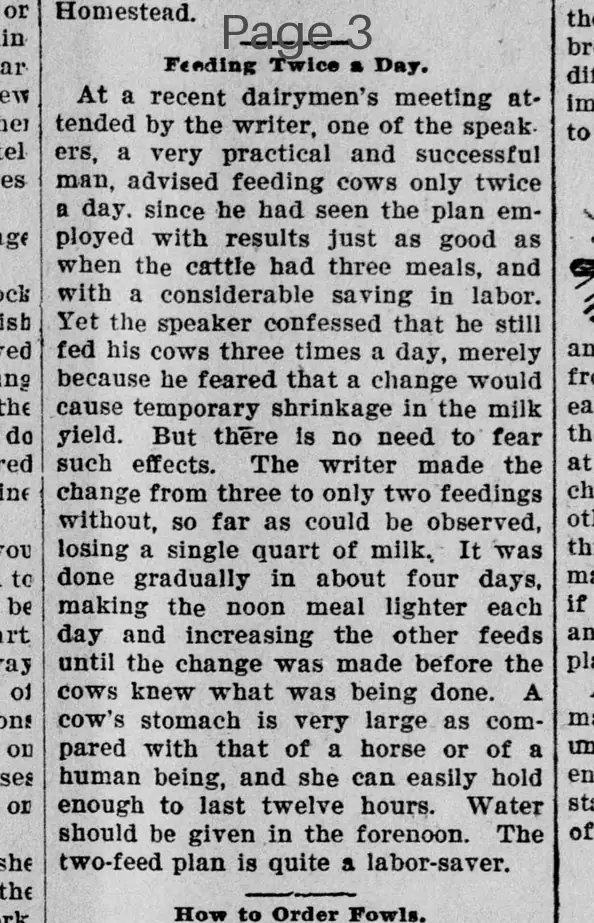
At a recent dairymen's meeting attended by the writer, one of the speakers, a very practical and successful man, advised feeding cows only twice a day, since he had seen the plan employed with results just as good as when the cattle had three meals, and with a considerable saving in labor.
Yet the speaker confessed that he still fed his cows three times a day, merely because he feared that a change would cause temporary shrinkage in the milk yield. But there is no need to fear such effects. The writer made the change from three to only two feedings without, so far as could be observed, losing a single quart of milk. It was done gradually in about four days, making the noon meal lighter each day and increasing the other feeds until the change was made before the cows knew what was being done.
A cow's stomach is very large as compared with that of a horse or of a human being, and she can easily hold enough to last twelve hours. Water should be given in the forenoon. The two-feed plan is quite a labor-saver.
What sub-type of article is it?
What keywords are associated?
Domestic News Details
Event Date
Recent
Outcome
no loss in milk yield; labor-saving
Event Details
At a recent dairymen's meeting, a speaker advised feeding cows twice a day, claiming results as good as three feedings with labor savings, though he still fed three times due to fear of milk yield drop. The writer changed to two feedings gradually over four days without observable milk loss, noting cows' large stomachs can hold enough for twelve hours, with water in the forenoon.