Thank you for visiting SNEWPapers!
Sign up free
Story
December 27, 1897
The Morning News
Savannah, Chatham County, Georgia
What is this article about?
Farmers' Bulletin 18 discusses successful cultivation of red clover in southern U.S. states on suitable rich soils, with experiences from North Carolina, Florida, Louisiana, and Mississippi. It yields heavy hay but succumbs to grasses; recommends August sowing on alluvial and prairie soils.
Clipping
OCR Quality
98%
Excellent
Full Text
Red Clover in the South.
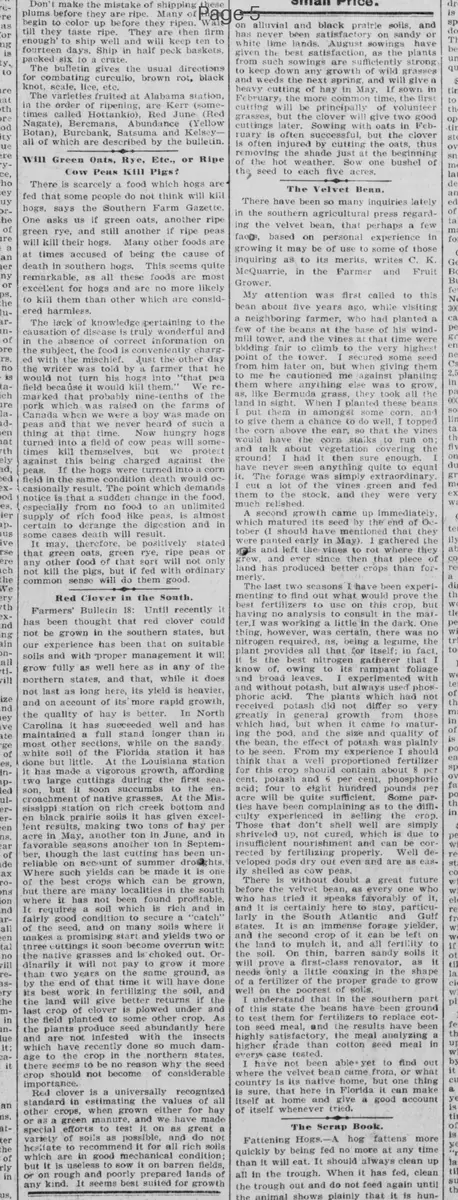
Farmers' Bulletin 18: Until recently it has been thought that red clover could not be grown in the southern states, but our experience has been that on suitable soils and with proper management it will grow fully as well here as in any of the northern states, and that, while it does not last as long here, its yield is heavier, and on account of its more rapid growth, the quality of hay is better. In North Carolina it has succeeded well and has maintained a full stand longer than in most other sections, while on the sandy, white soil of the Florida station it has done but little. At the Louisiana station it has made a vigorous growth, affording two large cuttings during the first season, but it soon succumbs to the encroachment of native grasses. At the Mississippi station on rich creek bottom and on black prairie soils it has given excellent results, making two tons of hay per acre in May, another ton in June, and in favorable seasons another ton in September, though the last cutting has been unreliable on account of summer droughts.
Where such yields can be made it is one of the best crops which can be grown, but there are many localities in the south where it has not been found profitable. It requires a soil which is rich and in fairly good condition to secure a "catch" of the seed, and on many soils where it makes a promising start and yields two or three cuttings it soon become overrun with the native grasses and is choked out. Ordinarily it will not pay to grow it more than two years on the same ground, as by the end of that time it will have done its best work in fertilizing the soil, and the land will give better returns if the last crop of clover is plowed under and the field planted to some other crop. As the plants produce seed abundantly here and are not infested with the insects which have recently done so much damage to the crop in the northern states, there seems to be no reason why the seed crop should not become of considerable importance.
Red clover is a universally recognized standard in estimating the values of all other crops, when grown either for hay or as a green manure, and we have made special efforts to test it on as great a variety of soils as possible, and do not hesitate to recommend it for all rich soils which are in good mechanical condition; but it is useless to sow it on barren fields, or on rough and poorly prepared lands of any kind. It seems best suited for growth on alluvial and black prairie soils, and has never been satisfactory on sandy or white lime lands. August sowings have given the best satisfaction, as the plants from such sowings are sufficiently strong to keep down any growth of wild grasses and weeds the next spring, and will give a heavy cutting of hay in May. If sown in February, the more common time, the first cutting will be principally of volunteer grasses, but the clover will give two good cuttings later. Sowing with oats in February is often successful, but the clover is often injured by cutting the oats, thus removing the shade just at the beginning of the hot weather. Sow one bushel of the seed to each five acres.
Farmers' Bulletin 18: Until recently it has been thought that red clover could not be grown in the southern states, but our experience has been that on suitable soils and with proper management it will grow fully as well here as in any of the northern states, and that, while it does not last as long here, its yield is heavier, and on account of its more rapid growth, the quality of hay is better. In North Carolina it has succeeded well and has maintained a full stand longer than in most other sections, while on the sandy, white soil of the Florida station it has done but little. At the Louisiana station it has made a vigorous growth, affording two large cuttings during the first season, but it soon succumbs to the encroachment of native grasses. At the Mississippi station on rich creek bottom and on black prairie soils it has given excellent results, making two tons of hay per acre in May, another ton in June, and in favorable seasons another ton in September, though the last cutting has been unreliable on account of summer droughts.
Where such yields can be made it is one of the best crops which can be grown, but there are many localities in the south where it has not been found profitable. It requires a soil which is rich and in fairly good condition to secure a "catch" of the seed, and on many soils where it makes a promising start and yields two or three cuttings it soon become overrun with the native grasses and is choked out. Ordinarily it will not pay to grow it more than two years on the same ground, as by the end of that time it will have done its best work in fertilizing the soil, and the land will give better returns if the last crop of clover is plowed under and the field planted to some other crop. As the plants produce seed abundantly here and are not infested with the insects which have recently done so much damage to the crop in the northern states, there seems to be no reason why the seed crop should not become of considerable importance.
Red clover is a universally recognized standard in estimating the values of all other crops, when grown either for hay or as a green manure, and we have made special efforts to test it on as great a variety of soils as possible, and do not hesitate to recommend it for all rich soils which are in good mechanical condition; but it is useless to sow it on barren fields, or on rough and poorly prepared lands of any kind. It seems best suited for growth on alluvial and black prairie soils, and has never been satisfactory on sandy or white lime lands. August sowings have given the best satisfaction, as the plants from such sowings are sufficiently strong to keep down any growth of wild grasses and weeds the next spring, and will give a heavy cutting of hay in May. If sown in February, the more common time, the first cutting will be principally of volunteer grasses, but the clover will give two good cuttings later. Sowing with oats in February is often successful, but the clover is often injured by cutting the oats, thus removing the shade just at the beginning of the hot weather. Sow one bushel of the seed to each five acres.
What sub-type of article is it?
Agricultural Report
Farming Advice
What keywords are associated?
Red Clover
Southern Agriculture
Hay Yield
Soil Types
Sowing Methods
Crop Rotation
Where did it happen?
Southern States, North Carolina, Florida, Louisiana, Mississippi
Story Details
Location
Southern States, North Carolina, Florida, Louisiana, Mississippi
Story Details
Red clover grows well on rich southern soils like alluvial and black prairie, yielding heavy hay (up to 4 tons/acre in Mississippi), but fails on sandy soils and is overtaken by grasses. Best sown in August; lasts 1-2 years, fertilizes soil. No insect issues, potential for seed crop.