Thank you for visiting SNEWPapers!
Sign up free
Poem
March 11, 1773
The Virginia Gazette
Richmond, Williamsburg, Richmond County, Virginia
What is this article about?
A collection of short rhymed verses reflecting on divine and moral subjects, extolling virtue, piety, retirement, and divine providence while critiquing worldly vices, folly, and ambition.
Clipping
OCR Quality
95%
Excellent
Full Text
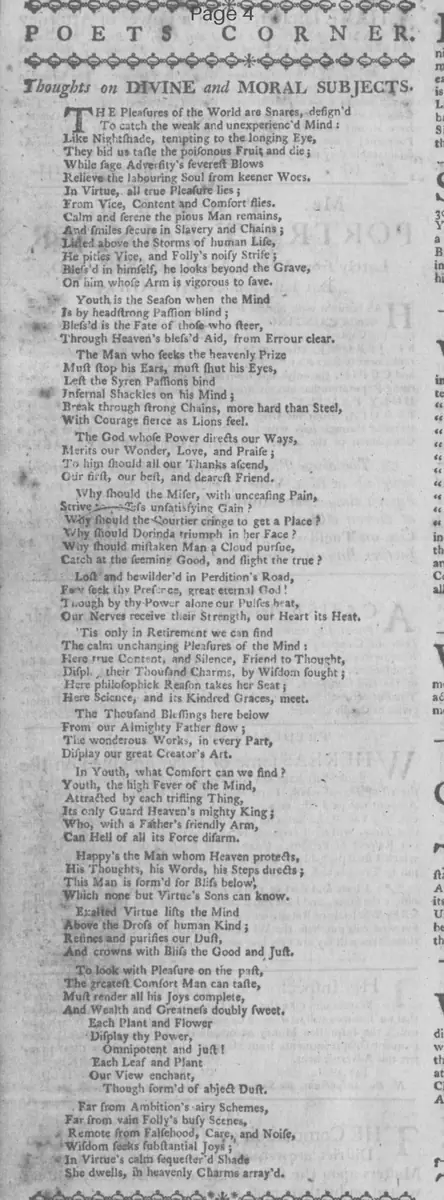
POETS CORNER.
Thoughts on DIVINE and MORAL SUBJECTS.
The Pleasures of this World are Snares, design'd
To catch the weak and unexperienc'd Mind:
Like Nightshade, tempting to the longing Eye,
They bid us taste the poisonous Fruit and die;
While sage Adversity's severest Blows
Relieve the labouring Soul from keener Woes.
In Virtue, all true Pleasure lies;
From Vice, Content and Comfort flies.
Calm and serene the pious Man remains,
And smiles secure in Slavery and Chains;
Lifted above the Storms of human Life,
He pities Vice, and Folly's noisy Strife;
Bless'd in himself, he looks beyond the Grave,
On him whose Arm is vigorous to save.
Youth is the Season when the Mind
Is by headstrong Passion blind;
Bless'd is the Fate of those who steer,
Through Heaven's bless'd Aid, from Error clear.
The Man who seeks the heavenly Prize
Must stop his Ears, must shut his Eyes,
Lest the Syren Passions bind
Infernal Shackles on his Mind;
Break through strong Chains, more hard than Steel,
With Courage fierce as Lions feel.
The God whose Power directs our Ways,
Merits our Wonder, Love, and Praise;
To him should all our Thanks ascend,
Our first, our best, and dearest Friend.
Why should the Miser, with unceasing Pain,
Strive unsatisfying Gain?
Why should the Courtier cringe to get a Place?
Why should Dorinda triumph in her Face?
Why should mistaken Man a Cloud pursue,
Catch at the seeming Good, and slight the true?
Lost and bewilder'd in Perdition's Road,
Forsake thy Presence, great eternal God!
Though by thy Power alone our Pulses beat,
Our Nerves receive their Strength, our Heart its Heat.
'Tis only in Retirement we can find
The calm unchanging Pleasures of the Mind:
Here true Content, and Silence, Friend to Thought
Display their Thousand Charms, by Wisdom taught;
Here philosophick Reason takes her Seat;
Here Science, and its Kindred Graces, meet.
The Thousand Blessings here below
From our Almighty Father flow;
The wonderous Works, in every Part
Display our great Creator's Art.
In Youth, what Comfort can we find?
Youth, the high Fever of the Mind,
Attracted by each trifling Thing,
Its only Guard Heaven's mighty King;
Who, with a Father's friendly Arm,
Can Hell of all its Force disarm.
Happy's the Man whom Heaven protects,
His Thoughts, his Words, his Steps directs;
This Man is form'd for Bliss below
Which none but Virtue's Sons can know.
Exalted Virtue lifts the Mind
Above the Dross of human Kind;
Refines and purifies our Dust,
And crowns with Bliss the Good and Just.
To look with Pleasure on the past,
The greatest Comfort Man can taste,
Must render all his Joys complete,
And Wealth and Greatness doubly sweet.
Each Plant and Flower
Display thy Power,
Omnipotent and just!
Each Leaf and Plant
Our View enchant,
Though form'd of abject Dust.
Far from Ambition's airy Schemes,
Far from vain Folly's busy Scenes,
Remote from Falsehood, Care, and Noise,
Wisdom seeks substantial Joys;
In Virtue's calm sequester'd Shade
She dwells, in heavenly Charms array'd.
Thoughts on DIVINE and MORAL SUBJECTS.
The Pleasures of this World are Snares, design'd
To catch the weak and unexperienc'd Mind:
Like Nightshade, tempting to the longing Eye,
They bid us taste the poisonous Fruit and die;
While sage Adversity's severest Blows
Relieve the labouring Soul from keener Woes.
In Virtue, all true Pleasure lies;
From Vice, Content and Comfort flies.
Calm and serene the pious Man remains,
And smiles secure in Slavery and Chains;
Lifted above the Storms of human Life,
He pities Vice, and Folly's noisy Strife;
Bless'd in himself, he looks beyond the Grave,
On him whose Arm is vigorous to save.
Youth is the Season when the Mind
Is by headstrong Passion blind;
Bless'd is the Fate of those who steer,
Through Heaven's bless'd Aid, from Error clear.
The Man who seeks the heavenly Prize
Must stop his Ears, must shut his Eyes,
Lest the Syren Passions bind
Infernal Shackles on his Mind;
Break through strong Chains, more hard than Steel,
With Courage fierce as Lions feel.
The God whose Power directs our Ways,
Merits our Wonder, Love, and Praise;
To him should all our Thanks ascend,
Our first, our best, and dearest Friend.
Why should the Miser, with unceasing Pain,
Strive unsatisfying Gain?
Why should the Courtier cringe to get a Place?
Why should Dorinda triumph in her Face?
Why should mistaken Man a Cloud pursue,
Catch at the seeming Good, and slight the true?
Lost and bewilder'd in Perdition's Road,
Forsake thy Presence, great eternal God!
Though by thy Power alone our Pulses beat,
Our Nerves receive their Strength, our Heart its Heat.
'Tis only in Retirement we can find
The calm unchanging Pleasures of the Mind:
Here true Content, and Silence, Friend to Thought
Display their Thousand Charms, by Wisdom taught;
Here philosophick Reason takes her Seat;
Here Science, and its Kindred Graces, meet.
The Thousand Blessings here below
From our Almighty Father flow;
The wonderous Works, in every Part
Display our great Creator's Art.
In Youth, what Comfort can we find?
Youth, the high Fever of the Mind,
Attracted by each trifling Thing,
Its only Guard Heaven's mighty King;
Who, with a Father's friendly Arm,
Can Hell of all its Force disarm.
Happy's the Man whom Heaven protects,
His Thoughts, his Words, his Steps directs;
This Man is form'd for Bliss below
Which none but Virtue's Sons can know.
Exalted Virtue lifts the Mind
Above the Dross of human Kind;
Refines and purifies our Dust,
And crowns with Bliss the Good and Just.
To look with Pleasure on the past,
The greatest Comfort Man can taste,
Must render all his Joys complete,
And Wealth and Greatness doubly sweet.
Each Plant and Flower
Display thy Power,
Omnipotent and just!
Each Leaf and Plant
Our View enchant,
Though form'd of abject Dust.
Far from Ambition's airy Schemes,
Far from vain Folly's busy Scenes,
Remote from Falsehood, Care, and Noise,
Wisdom seeks substantial Joys;
In Virtue's calm sequester'd Shade
She dwells, in heavenly Charms array'd.
What sub-type of article is it?
Epigram
Hymn
What themes does it cover?
Moral Virtue
Religious Faith
What keywords are associated?
Virtue Pleasures
Vice Snares
Pious Man
Youth Passion
Divine Power
Retirement Content
Heavenly Prize
Poem Details
Title
Thoughts On Divine And Moral Subjects.
Subject
Divine And Moral Subjects
Form / Style
Rhymed Couplets And Stanzas
Key Lines
In Virtue, All True Pleasure Lies;
From Vice, Content And Comfort Flies.
The God Whose Power Directs Our Ways,
Merits Our Wonder, Love, And Praise;
'Tis Only In Retirement We Can Find
The Calm Unchanging Pleasures Of The Mind: