Thank you for visiting SNEWPapers!
Sign up free
Editorial
May 1, 1840
Southern Christian Advocate
Charleston, Charleston County, South Carolina
What is this article about?
Discourse by the Senate chaplain at the U.S. Capitol on March 1, 1840, from the Western Christian Advocate, based on 'Take heed unto thyself,' cautioning against selfishness, urging vigilance over thoughts, words, acts, motives, and eternal consequences for personal and public morality.
Clipping
OCR Quality
98%
Excellent
Full Text
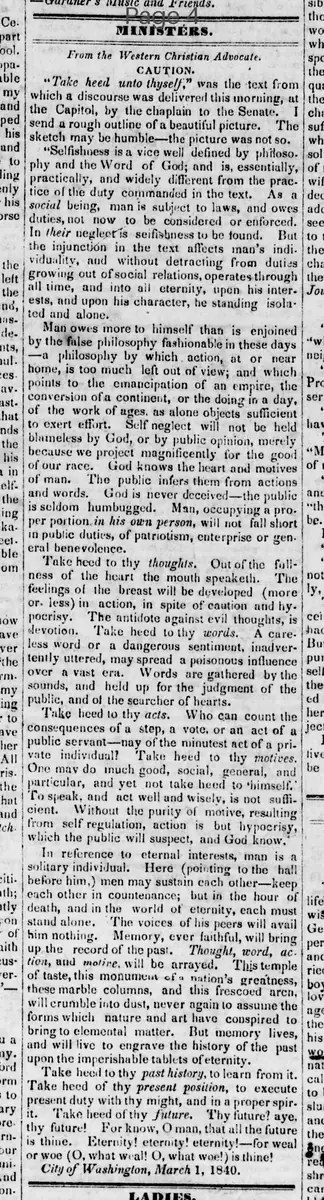
MINISTERS
From the Western Christian Advocate.
CAUTION.
"Take heed unto thyself," was the text from
which a discourse was delivered this morning, at the
Capitol, by the chaplain to the Senate. I send a rough
outline of a beautiful picture. The sketch may be
humble--the picture was not so. "Selfishness is a vice
well defined by philosophy and the Word of God; and
is, essentially, practically, and widely different from
the practice of the duty commanded in the text. As a
social being, man is subject to laws, and owes duties,
not now to be considered or enforced. In their neglect
is selfishness to be found. But the injunction in the
text affects man's individuality, and without
detracting from duties growing out of social relations,
operates through all time, and into all eternity, upon
his interests, and upon his character, he standing
isolated and alone.
Man owes more to himself than is enjoined by the
false philosophy fashionable in these days--a
philosophy by which action, at or near home, is too
much let out of view; and which points to the
emancipation of an empire, the conversion of a
continent, or the doing in a day of the work of ages, as
alone objects sufficient to exert effort. Self neglect
will not be held blameless by God, or by public
opinion, merely because we project magnificently for
the good of our race. God knows the heart and motives
of man. The public infers them from actions and
words. God is never deceived--the public is seldom
humbugged. Man, occupying a proper portion in his
own person, will not fall short in public duties, of
patriotism, enterprise or general benevolence.
Take heed to thy thoughts. Out of the fullness of
the heart the mouth speaketh. The feelings of the
breast will be developed (more or less) in action, in
spite of caution and hypocrisy. The antidote against
evil thoughts, is devotion. Take heed to thy words. A
careless word or a dangerous sentiment,
inadvertently uttered, may spread a poisonous
influence over a vast era. Words are gathered by the
winds, and held up for the judgment of the public,
and of the searcher of hearts.
Take heed to thy acts. Who can count the
consequences of a step, a vote, or an act of a public
servant--nay of the minutest act of a private
individual? Take heed to thy motives. One may do
much good, social, general, and particular, and yet
not take heed to himself. To speak, and act well and
wisely, is not sufficient. Without the purity of motive,
resulting from self regulation, action is but
hypocrisy, which the public will suspect, and God
knows. In reference to eternal interests, man is a
solitary individual. Here (pointing to the hall before
him,) men may sustain each other--keep each other in
countenance; but in the hour of death, and in the
world of eternity, each must stand alone. The voices
of his peers will avail him nothing. Memory, ever
faithful, will bring up the record of the past.
Thought, word, action, and motive, will be arrayed.
This temple of taste, this monument of a nation's
greatness--these marble columns, and this frescoed
arch, will crumble into dust, never again to assume
the forms which nature and art have conspired to
bring to elemental matter. But memory lives, and will
live to engrave the history of the past upon the
imperishable tablets of eternity.
Take heed to thy past history, to learn from it.
Take heed of thy present position, to execute present
duty with thy might, and in a proper spirit. Take heed
of thy future. Thy future? aye, thy future! For know,
O man, that all the future is thine. Eternity! eternity!
eternity!--or weal or woe (O, what weal! O, what woe!)
is thine!
City of Washington, March 1, 1840.
From the Western Christian Advocate.
CAUTION.
"Take heed unto thyself," was the text from
which a discourse was delivered this morning, at the
Capitol, by the chaplain to the Senate. I send a rough
outline of a beautiful picture. The sketch may be
humble--the picture was not so. "Selfishness is a vice
well defined by philosophy and the Word of God; and
is, essentially, practically, and widely different from
the practice of the duty commanded in the text. As a
social being, man is subject to laws, and owes duties,
not now to be considered or enforced. In their neglect
is selfishness to be found. But the injunction in the
text affects man's individuality, and without
detracting from duties growing out of social relations,
operates through all time, and into all eternity, upon
his interests, and upon his character, he standing
isolated and alone.
Man owes more to himself than is enjoined by the
false philosophy fashionable in these days--a
philosophy by which action, at or near home, is too
much let out of view; and which points to the
emancipation of an empire, the conversion of a
continent, or the doing in a day of the work of ages, as
alone objects sufficient to exert effort. Self neglect
will not be held blameless by God, or by public
opinion, merely because we project magnificently for
the good of our race. God knows the heart and motives
of man. The public infers them from actions and
words. God is never deceived--the public is seldom
humbugged. Man, occupying a proper portion in his
own person, will not fall short in public duties, of
patriotism, enterprise or general benevolence.
Take heed to thy thoughts. Out of the fullness of
the heart the mouth speaketh. The feelings of the
breast will be developed (more or less) in action, in
spite of caution and hypocrisy. The antidote against
evil thoughts, is devotion. Take heed to thy words. A
careless word or a dangerous sentiment,
inadvertently uttered, may spread a poisonous
influence over a vast era. Words are gathered by the
winds, and held up for the judgment of the public,
and of the searcher of hearts.
Take heed to thy acts. Who can count the
consequences of a step, a vote, or an act of a public
servant--nay of the minutest act of a private
individual? Take heed to thy motives. One may do
much good, social, general, and particular, and yet
not take heed to himself. To speak, and act well and
wisely, is not sufficient. Without the purity of motive,
resulting from self regulation, action is but
hypocrisy, which the public will suspect, and God
knows. In reference to eternal interests, man is a
solitary individual. Here (pointing to the hall before
him,) men may sustain each other--keep each other in
countenance; but in the hour of death, and in the
world of eternity, each must stand alone. The voices
of his peers will avail him nothing. Memory, ever
faithful, will bring up the record of the past.
Thought, word, action, and motive, will be arrayed.
This temple of taste, this monument of a nation's
greatness--these marble columns, and this frescoed
arch, will crumble into dust, never again to assume
the forms which nature and art have conspired to
bring to elemental matter. But memory lives, and will
live to engrave the history of the past upon the
imperishable tablets of eternity.
Take heed to thy past history, to learn from it.
Take heed of thy present position, to execute present
duty with thy might, and in a proper spirit. Take heed
of thy future. Thy future? aye, thy future! For know,
O man, that all the future is thine. Eternity! eternity!
eternity!--or weal or woe (O, what weal! O, what woe!)
is thine!
City of Washington, March 1, 1840.
What sub-type of article is it?
Moral Or Religious
What keywords are associated?
Take Heed
Selfishness
Self Neglect
Motives
Eternity
Public Duty
Moral Caution
Thoughts Words Acts
What entities or persons were involved?
Chaplain To The Senate
God
Editorial Details
Primary Topic
Take Heed Unto Thyself
Stance / Tone
Moral Exhortation
Key Figures
Chaplain To The Senate
God
Key Arguments
Selfishness Is Neglecting Duties To Oneself As Defined By Philosophy And The Word Of God
Man Owes Duties To Himself Beyond Fashionable False Philosophy That Ignores Personal Action
Self Neglect Is Not Excused By Grand Public Projects; God And Public Opinion Judge Motives
Take Heed To Thy Thoughts; Antidote Is Devotion
Take Heed To Thy Words; They May Spread Poisonous Influence
Take Heed To Thy Acts; Consequences Are Incalculable Even For Private Individuals
Take Heed To Thy Motives; Without Purity, Actions Are Hypocrisy
In Eternity, Each Man Stands Alone; Memory Records Thoughts, Words, Actions, Motives
Take Heed To Past History, Present Position, And Future Eternity