Thank you for visiting SNEWPapers!
Sign up free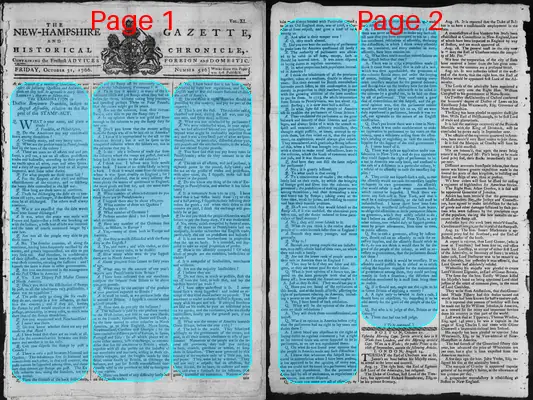
The New Hampshire Gazette And Historical Chronicle
Portsmouth, Greenland, Rockingham County, New Hampshire
What is this article about?
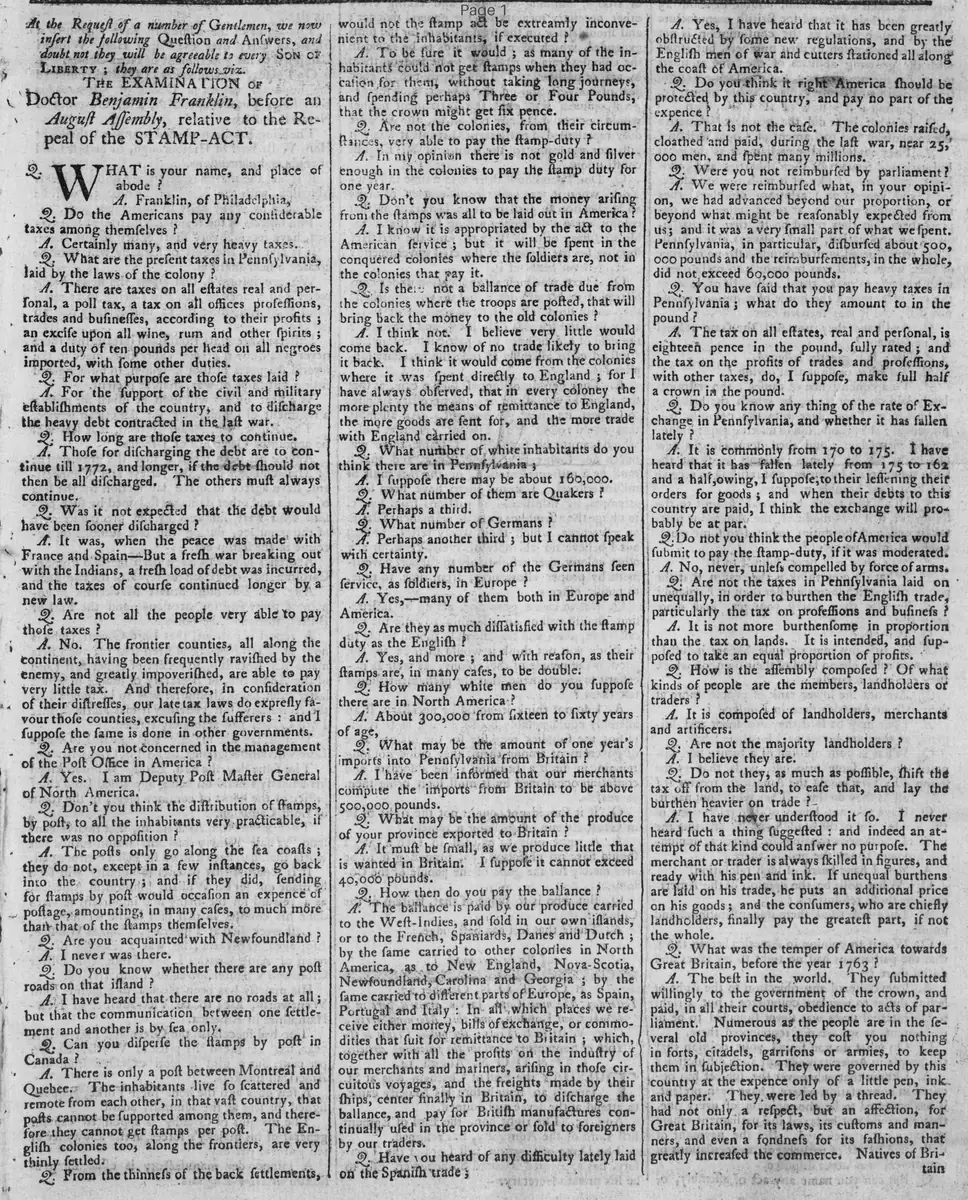
Transcript of Benjamin Franklin's 1766 examination before the British House of Commons regarding the Stamp Act, colonial taxes, ability to pay, and opposition to taxation without representation in Parliament.
Merged-components note: These components form a single continuous story: the examination of Doctor Benjamin Franklin before the House of Assembly regarding the Stamp Act, spanning pages 1 and 2.
Clippings
1 of 2
OCR Quality
Full Text
THE EXAMINATION OF
Doctor Benjamin Franklin, before an House Assembly, relative to the Repeal of the STAMP-ACT.
Q. What is your name, and place of abode?
A. Franklin, of Philadelphia.
Q. Do the Americans pay any considerable taxes among themselves?
A. Certainly many, and very heavy taxes.
Q. What are the present taxes in Pennsylvania, laid by the laws of the colony?
A. There are taxes on all estates real and personal, a poll tax, a tax on all offices professions, trades and business, according to their profits; an excise upon all wine, rum and other spirits; and a duty of ten pounds per head on all negroes imported, with some other duties.
Q. For what purpose are those taxes laid?
A. For the support of the civil and military establishments of the country, and to discharge the heavy debt contracted in the last war.
Q. How long are those taxes to continue?
A. Those for discharging the debt are to continue till 1772, and longer, if the debt should not then be all discharged. The others must always continue.
Q. Was it not expected that the debt would have been sooner discharged?
A. It was, when the peace was made with France and Spain. But a fresh war breaking out with the Indians, a fresh load of debt was incurred, and the taxes of course continued longer by a new law.
Q. Are not all the people very able to pay those taxes?
A. No. The frontier counties, all along the continent, having been frequently ravaged by the enemy, and greatly impoverished, are able to pay very little tax. And therefore, in consideration of their distress, our late tax laws do expressly favour those counties, excusing the sufferers; and I suppose the same is done in other governments.
Q. Are you not concerned in the management of the Post Office in America?
A. Yes. I am Deputy Post Master General of North America.
Q. Don't you think the distribution of stamps, by post, to all the inhabitants very practicable, if there was no opposition?
A. The posts only go along the sea coasts; they do not, except in a few instances, go back into the country; and if they did, sending for stamps by post would occasion an expense of postage, amounting, in many cases, to much more than that of the stamps themselves.
Q. Are you acquainted with Newfoundland?
A. I never was there.
Q. Do you know whether there are any post roads on that island?
A. I have heard that there are no roads at all; but that the communication between one settlement and another is by sea only.
Q. Can you disperse the stamps by post in Canada?
A. There is only a post between Montreal and Quebec. The inhabitants live so scattered and remote from each other, in that vast country, that posts cannot be supported among them, and therefore they cannot get stamps per post. The English colonies too, along the frontiers, are very thinly settled.
Q. From the thinness of the back settlements, would not the stamp Act be extremely inconvenient to the inhabitants, if executed?
A. To be sure it would; as many of the inhabitants could not get stamps when they had occasion for them, without taking long journeys, and spending perhaps Three or Four Pounds, that the crown might get six pence.
Q. Are not the colonies, from their circumstances, very able to pay the stamp-duty?
A. In my opinion there is not gold and silver enough in the colonies to pay the stamp duty for one year.
Q. Don't you know that the money arising from the stamps was all to be laid out in America?
A. I know it is appropriated by the Act to the American service; but it will be spent in the conquered colonies where the soldiers are, not in the colonies that pay it.
Q. Is there not a balance of trade due from the colonies where the troops are posted, that will bring back the money to the old colonies?
A. I think not. I believe very little would come back. I know of no trade likely to bring it back. I think it would come from the colonies where it was spent directly to England; for I have always observed, that in every colony the more plenty the means of remittance to England, the more goods are sent for, and the more trade with England carried on.
Q. What number of white inhabitants do you think there are in Pennsylvania?
A. I suppose there may be about 160,000.
Q. What number of them are Quakers?
A. Perhaps a third.
Q. What number of Germans?
A. Perhaps another third; but I cannot speak with certainty.
Q. Have any number of the Germans been in service as soldiers, in Europe?
A. Yes, many of them both in Europe and America.
Q. Are they as much dissatisfied with the stamp duty as the English?
A. Yes, and more; and with reason, as their stamps are, in many cases, to be double.
Q. How many white men do you suppose there are in North America?
A. About 300,000 from Sixteen to sixty years of age.
Q. What may be the amount of one year's imports into Pennsylvania from Britain?
A. I have been informed that our merchants compute the imports from Britain to be above 500,000 pounds.
Q. What may be the amount of the produce of your province exported to Britain?
A. It must be small, as we produce little that is wanted in Britain. I suppose it cannot exceed 40,000 pounds.
Q. How then do you pay the balance?
A. The balance is paid by our produce carried to the West-Indies, and sold in our own islands, or to the French, Spaniards, Danes and Dutch; by the same carried to other colonies in North America, as to New England, Nova-Scotia, Newfoundland, Carolina and Georgia; by the same carried to different parts of Europe, as Spain, Portugal and Italy: In all which places we receive either money, bills of exchange, or commodities that suit for remittance to Britain; which, together with all the profits on the industry of our merchants and mariners, arising in those circuitous voyages, and the freights made by their ships, finally center in Britain, to discharge the balance, and pay for British manufactures continually used in the province or sold to foreigners by our traders.
Q. Have you heard of any difficulty lately laid on the Spanish trade?
A. Yes, I have heard that it has been greatly obstructed by some new regulations, and by the English men of war and cutters stationed all along the coast of America.
Q. Do you think it right America should be protected by this country, and pay no part of the expense?
A. That is not the case. The colonies raised, clothed and paid, during the last war, near 25,000 men, and spent many millions.
Q. Were you not reimbursed by parliament?
A. We were reimbursed what, in your opinion, we had advanced beyond our proportion, or beyond what might be reasonably expected from us; and it was a very small part of what we spent. Pennsylvania, in particular, disbursed about 200,000 pounds and the reimbursements, in the whole, did not exceed 60,000 pounds.
Q. You have said that you pay heavy taxes in Pennsylvania; what do they amount to in the pound?
A. The tax on all estates, real and personal, is eighteen pence in the pound, fully rated; and the tax on the profits of trades and professions, with other taxes, do, I suppose, make full half a crown in the pound.
Q. Do you know anything of the rate of Exchange in Pennsylvania, and whether it has fallen lately?
A. It is commonly from 170 to 175. I have heard that it has fallen lately from 175 to 162 and a half, owing, I suppose, to their lessening their orders for goods; and when their debts to this country are paid, I think the exchange will probably be at par.
Q. Do not you think the people of America would submit to pay the stamp-duty, if it was moderated?
A. No, never, unless compelled by force of arms.
Q. Are not the taxes in Pennsylvania laid on unequally, in order to burthen the English trade, particularly the tax on professions and business?
A. It is not more burthensome in proportion than the tax on lands. It is intended, and supposed to take an equal proportion of profits.
Q. How is the assembly composed? Of what kinds of people are the members, landholders or traders?
A. It is composed of landholders, merchants and artificers.
Q. Are not the majority landholders?
A. I believe they are.
Q. Do not they, as much as possible, shift the tax off from the land, to ease that, and lay the burthen heavier on trade?
A. I have never understood it so. I never heard such a thing suggested; and indeed an attempt of that kind could answer no purpose. The merchant or trader is always quick in figures, and ready with his pen and ink. If unequal burdens are laid on his trade, he puts an additional price on his goods; and the consumers, who are chiefly landholders, finally pay the greatest part, if not the whole.
Q. What was the temper of America towards Great Britain, before the year 1763?
A. The best in the world. They submitted willingly to the government of the crown, and paid, in all their courts, obedience to acts of parliament. Numerous as the people are in the several old provinces, they cost you nothing in forts, citadels, garrisons or armies, to keep them in subjection. They were governed by this country at the expense only of a little pen, ink and paper. They were led by a thread. They had not only a respect, but an affection, for Great Britain, for its laws, its customs and manners, and even a fondness for its fashions, that greatly increased the commerce. Natives of Britain
Certain were always treated with particular regard to be an old England man, was of itself, a character of some respect, and gave a kind of rank among us.
G. And what is their temper now?
A. O, very much altered.
Q. Did you ever hear the authority of parliament to make laws for America questioned till lately?
A. The authority of parliament was allowed to be valid in all laws, except such as should lay internal taxes. It was never disputed in laying duties to regulate commerce.
Q. In what proportion hath population increased in America?
A. I think the inhabitants of all the provinces together, taken at a medium, double in about 25 years. But their demand for British manufactures increases much faster, as the consumption is not merely in proportion to their numbers, but grows with the growing abilities of the same numbers to pay for them. In 1723, the whole importation from Britain to Pennsylvania, was but about 15,000 l. sterling ; it is now near half a million.
Q. In what light did the people of America use to consider the parliament of Great Britain?
A. They considered the parliament as the great bulwark and security of their liberties and privileges, and always spoke of it with the utmost respect and veneration : arbitrary ministers, they thought might possibly, at times, attempt to oppress them, but they relied on it, that the parliament, on application, would always give redress. They remembered, with gratitude, a strong instance of this, when a bill was brought into parliament, with a clause to make royal instructions, laws in the colonies, which the house of commons would not pass, and it was thrown out.
Q. And have they not till the same respect for parliament?
A. No; it is greatly lessened.
Q. To what cause is that owing?
A. To a concurrence of causes; the restraints lately laid on their trade, by which the bringing of foreign gold and silver into the colonies was prevented; the prohibition of making paper money among themselves; and then demanding a new and heavy tax by stamps; taking away at the same time, trials by juries, and refusing to receive and hear their humble petitions.
Q. Don't you think they would submit to the stamp act, if it was modified, the obnoxious parts taken out, and the duties reduced to some particulars of small moment?
A. No; they will never submit to it.
Q. What do you think is the reason that the people of America increase faster than in England?
A. Because they marry younger, and more generally.
Q. Why so?
A. Because any young couple that are industrious, may easily obtain land of their own, on which they can raise a family.
Q. Are not the lower rank of people more at their ease in America than in England?
A. They may be so if they are sober and diligent, as they are better paid for their labor.
Q. What is your opinion of a future tax, imposed on the same principle with that of the stamp act: how would the Americans receive it?
A. Just as they do this. They would not pay it.
Q. Have you not heard of the resolutions of this house, and of the house of lords, asserting the right of parliament relating to America, including a power to tax the people there?
A. Yes, I have heard of such resolution.
Q. What will be the opinion of the Americans on those resolutions?
A. They will think them unconstitutional, and unjust.
Q. Was it an opinion in America before 1763, that the parliament had no right to lay taxes and duties there?
A. I never heard any objection to the right of laying duties to regulate commerce; but a right to lay internal taxes was never supposed to be in parliament, as we are not represented there.
Q. On what do you found your opinion that the people in America made any such distinction?
A. I know that whenever the subject has occurred in conversation where I have been present, it has appeared to be the opinion of every one, that we could not be taxed in a parliament where we were not represented. -But the payment of duties laid by act of parliament, as regulations of commerce, was never disputed.
Q. But can you name any act of assembly, or
public act of any of your governments, that made such distinction?
A. I do not know that there was any; I think there was never an occasion to make any such act, till now that you have attempted to tax us; that has occasioned resolutions of assembly, declaring the distinction, in which I think every assembly on the continent, and every member in every assembly, have been unanimous.
Q. What then could occasion conversations on that subject before that time?
A. There was in 1754 a proposition made (I think it came from hence) that in case of a war, which was then apprehended, the governors of the colonies should meet, and order the levying of troops, building of forts, and taking every other necessary measure for the general defence: and should draw on the treasury here for the sums expended, which were afterwards to be raised in the colonies by a general tax, to be laid on them by act of parliament. This occasioned a good deal of conversation on the subject, and the general opinion was, that the parliament neither would nor could lay any tax on us, till we were duly represented in parliament, because it was not just, nor agreeable to the nature of an English constitution.
Q. Don't you know there was a time in New-York, when it was under consideration to make an application to parliament to lay taxes on that colony, upon a deficiency arising from the assembly's refusing or neglecting to raise the necessary supplies for the support of the civil government?
A. I never heard of it.
Q. There was such an application under consideration in New-York; and do you apprehend they could suppose the right of parliament to lay a tax in America was only local, and confined to the case of a deficiency in a particular colony, by a refusal of its assembly to raise the necessary supplies?
A. They could not suppose such a case, as that the assembly would not raise the necessary supplies to support its own government. An assembly that would refuse it must want common sense, which cannot be supposed. I think, there was never any such case at New York, and that it must be a misrepresentation, or the fact must be misunderstood. I know there have been some attempts, by ministerial instructions from hence, to oblige the assemblies to settle permanent salaries on governors, which they wisely refused to do: but I believe no assembly of New-York, or any other colony, ever refused duly to support government by proper allowances, from time to time, to public officers.
Q. But in case a governor, acting by instruction, should call on an assembly to raise the necessary supplies, and the assembly should refuse to do it, do you not think it would then be for the good of the people of the colony, as well as necessary to government, -that the parliament should tax them?
A. I do not think it would be necessary. If an assembly could possibly be so absurd as to refuse raising the supplies requisite for the maintenance of government among them, they could not long remain in such a situation; the disorders and confusion occasioned by it must soon bring them to reason.
Q. If it should not, ought not the right to be in Great Britain of applying a remedy?
A. A right only to be used in such a case, I should have no objection to, supposing it to be used merely for the good of the people of the Colony.
Q. But who is to judge of that, Britain or the Colony?
A. Those that feel can best judge.
To be continued.
What sub-type of article is it?
What themes does it cover?
What keywords are associated?
What entities or persons were involved?
Where did it happen?
Story Details
Key Persons
Location
Philadelphia, North America
Event Date
1766
Story Details
Benjamin Franklin testifies before the House of Commons on colonial taxes, the impracticality and opposition to the Stamp Act, trade balances, population growth, and the distinction between external duties and internal taxation without representation.