Thank you for visiting SNEWPapers!
Sign up free
New York Daily Tribune
New York, New York County, New York
What is this article about?
Political commentary from Boston, Nov. 12, 1859, on Massachusetts election: total vote slightly up from 1856, Republicans strong, opposition weakened; discusses re-elections, district issues, Gardner altercation, and jailing of Burnham for contempt in liquor probe.
Clipping
OCR Quality
Full Text
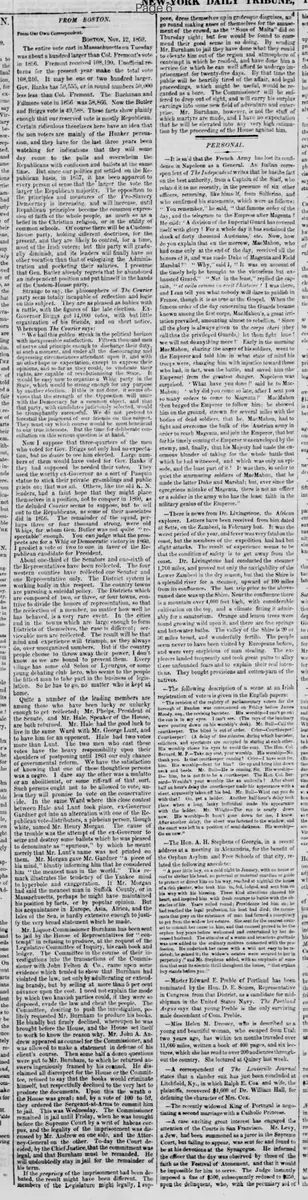
Boston, Nov. 12, 1859.
The entire vote cast in Massachusetts on Tuesday was about a hundred larger than Col. Fremont's vote in 1856. Fremont received 108,190. Unofficial returns for the present year make the total vote 108,246. It may be one or two hundred larger.
Gov. Banks has 58,555, or in round numbers 50,000 less than Col. Fremont. The Buchanan and Fillmore vote in 1856 was 58,866. Now the Butler and Briggs vote is 49,585. These facts show plainly enough that our reserved vote is mostly Republican.
Certain ridiculous theorizers here have an idea that the non-voters are mainly of the Hunker persuasion, and they have for the last three years been watching for indications that they will some day come to the polls and overwhelm the Republicans with confusion and ballots at the same time. But since our politics got settled on the Republican basis, in 1857, it has been apparent to every person of sense that the larger the vote the larger the Republican majority. The opposition to the principles and measures of the Pro-Slavery Democracy is increasing, and will increase, until Republican principles become the common expression of faith of the whole people, as much so as a belief in the Christian religion, or in the utility of common schools. Of course there will be a Custom-House party, holding different doctrines, for the present, and they are likely to control, for a time, most of the Irish voters; but this party will gradually diminish, and its leaders will finally have no other vocation than that of eulogizing the Administration and pocketing their salaries. I presume that Gen. Butler already regrets that he abandoned an independent position and put himself in the hands of the Custom-House party.
Strange to say, the philosophers of The Courier party seem totally incapable of reflection and logic on this subject. They are as pleased as babies with a rattle, with the figures of the late election. Ex-Governor Briggs got 14,000 votes, with but little organization of his friends, and on short notice. Whereupon The Courier says:
"We hail this golden streak in the political horizon with inexpressible satisfaction. Fifteen thousand men of nerve and principle enough to discharge their duty, at such a moment, and under all the discouraging and depressing circumstances attendant upon it, and with no other hope or expectation, except to express their opinions, aid so far as they could, to vindicate their rights, are capable of revolutionizing the State. It would be easy now to organize a Whig party in the State, which would be strong enough for any purpose by another election. If this is not done, it seems obvious that the strength of the Opposition will unite with the Democracy for a common object, and that that party, with candidates judiciously selected, would be triumphantly successful. We do not pretend to forestall the judgment of our friends on this subject. They must say which course would be most beneficial to our true interests. But the time for deliberate consultation on this serious question is at hand."
Now I suppose that three-quarters of the men who voted for Gov. Briggs not only had no expectation, but no desire to see him elected. Large numbers of them would have voted for Gov. Banks if they had supposed he needed their votes. They used the worthy ex-Governor as a sort of Pasquin statue to stick their private grumblings and public griefs on; that was all. Others, like the old K. N. leaders, had a faint hope that they might place themselves in a position, not to conquer in 1860, as the deluded Courier seems to suppose, but to sell out to the Republicans, as some of their associates did in 1856. The remainder of the squad, perhaps three or four thousand strong, were old Whigs, for whom Gen. Butler was not quite "respectable" enough. You can judge what the prospects are for a Whig or Democratic victory in 1860. I predict a vote of two to one in favor of the Republican candidate for President.
About one-third of the Senators and one-sixth of the Representatives have been re-elected. The four western counties have re-elected one Senator and one Representative only. The District system is working badly in this respect. The country towns are pursuing a suicidal policy. The Districts which are composed of two, or three, or four towns, contrive to divide the honors of representation, so that the re-election of a member, no matter how well he has behaved, is a very rare event. In the cities and in the towns which are large enough to form Districts of themselves, the case is different: serviceable men are re-elected. The result will be that mind and experience will triumph, as they always do, over unorganized numbers. But if the country people choose to throw away their power, I don't know as we are bound to prevent them. Every village has some old Solon or Lycurgus, or some young debating club hero, who seems to the people the fittest man to take part in the business of legislation. So he has to go, no matter who is kept at home.
Quite a number of the leading members are among those who have been lucky or unlucky enough to get re-elected; Mr. Phelps, President of the Senate, and Mr. Hale, Speaker of the House, are both returned. Mr. Hale had the good luck to live in the same Ward with Mr. George Lunt, and to have him for an opponent. Hale had two votes more than Lunt. The two men who cast these votes have the heavy responsibility upon their shoulders of postponing until 1861 our only chance of governmental reform. We have the satisfaction of knowing that one of these thoughtless persons was a negro. I dare say the other was a mulatto or an abolitionist, or some riff-raff of that sort. Such persons ought not to be allowed to vote, unless they will promise to vote on the conservative side. In the same Ward where this close contest between Hale and Lunt took place, ex-Governor Gardner got into an altercation with one of the Republican vote-distributors, a plebeian person, though white, named Mr. Henry Morgan. The cause of the trouble was the attempt of the ex-Governor to seize and destroy some ballots which he was pleased to denominate as "spurious," by which he meant merely that Mr. Lunt's name was not printed on them. Mr. Morgan gave Mr. Gardner a piece of his mind, bluntly informing him that he considered him "the meanest man in the world." This remark illustrates the tendency of the Yankee mind to hyperbole and exaggeration. If Mr. Morgan had said the meanest man in Suffolk County, or in Massachusetts, perhaps he might have maintained his position by facts, or by popular opinion. But his acquaintance in Europe, Asia, Africa, and the Isles of the Sea, is hardly extensive enough to justify the very broad statement which he made.
Mr. Liquor-Commissioner Burnham has been sent to jail by the House of Representatives for "contempt" in refusing to produce, at the request of the Legislative Committee of Inquiry, his cash book and ledger. The Committee in the course of their investigations into the transactions of the Commissioner with John Felton & Co., came upon some evidence which tended to show that Burnham had violated the law, not only by adulterating or extending brandy, but by selling at more than 5 per cent advance upon the cost. I need not explain the mode by which two knavish parties could, if they were so disposed, evade the law and cheat the people. The Committee, desiring to push the investigation, politely requested Mr. Burnham to produce his books. He blandly but firmly declined, whereupon he was brought before the House, and the House set itself to work to know the reason why. Mr. John A. Andrew appeared as counsel for the Commissioner, and was allowed to make a statement in defense of his client's course. Then some half a dozen questions were put to Mr. Burnham, to which he returned answers ingeniously framed by his counsel. He disclaimed all disrespect for the House or the Committee, refused to say that the books would criminate himself, but respectfully declined to the very last to produce the documents. Upon this the wrath of the House was great; and, by a vote of 100 to 52, they ordered the Sergeant-at-Arms to commit him to jail. This was Wednesday. The Commissioner remained in jail until Friday, when he was brought before the Supreme Court by a writ of habeas corpus, and the legality of the imprisonment was discussed by Mr. Andrew on one side, and the Attorney-General on the other. To-day the Court decided, by the Chief Justice, that the commitment was legal, and that Burnham must be remanded. He will undoubtedly stay in jail for the remainder of his term.
If the propriety of the imprisonment had been debated, the result might have been different. The members of the Legislature might legally, I suppose, have committed him for contempt, but they would have done better to indict him for misdemeanor, dress themselves up in grotesque disguises, and go round making asses of themselves for the amusement of the crowd, as the "Sons of Malta" did on Thursday night; but few would be found to commend their good sense in so doing. By sending Mr. Burnham to jail they have done what they could to elevate him out of the region and atmosphere of contempt in which he resided, and have done him a service for which he can well afford to undergo imprisonment for twenty-five days. By that time the public will be heartily tired of the affair, and legal proceedings, which might be useful, would be regarded as a bore. The Commissioner will be suffered to drop out of sight, and will carry his surplus earnings into some new field of adventure and enterprise. Mr. Burnham, however, is not the stuff of which martyrs are made, and I have no expectation that he will be elevated into any very high estimation by the proceeding of the House against him.
What sub-type of article is it?
What themes does it cover?
What keywords are associated?
What entities or persons were involved?
Where did it happen?
Story Details
Key Persons
Location
Boston, Massachusetts
Event Date
November 1859
Story Details
Analysis of the 1859 Massachusetts election results showing slight increase in total vote over 1856, Republican Gov. Banks receiving fewer votes than Fremont but opposition declining; critique of Democratic and Whig strategies; discussion of legislative re-elections and district system issues; altercation involving ex-Governor Gardner; imprisonment of Liquor-Commissioner Burnham for refusing to produce books in investigation of liquor law violations.