Thank you for visiting SNEWPapers!
Sign up free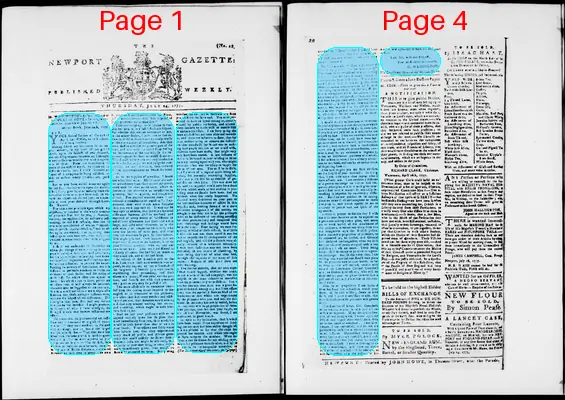
The Newport Gazette
Newport, Newport County, Rhode Island
What is this article about?
George Washington's letter to Sir William Howe from Middle Brook, June 30, 1777, responds to Howe's demands on prisoner exchanges, defends American treatment of British prisoners, refutes claims of mistreatment, and proposes terms for partial and general exchanges, including conditions for General Lee and Lt. Col. Campbell.
Merged-components note: Merging the initial part of George Washington's letter to Sir William Howe on page 1 with its explicit continuation on page 4, as indicated by '(For the remaining of this letter, see next page)'. The content forms a single coherent narrative correspondence.
Clippings
1 of 2
OCR Quality
Full Text
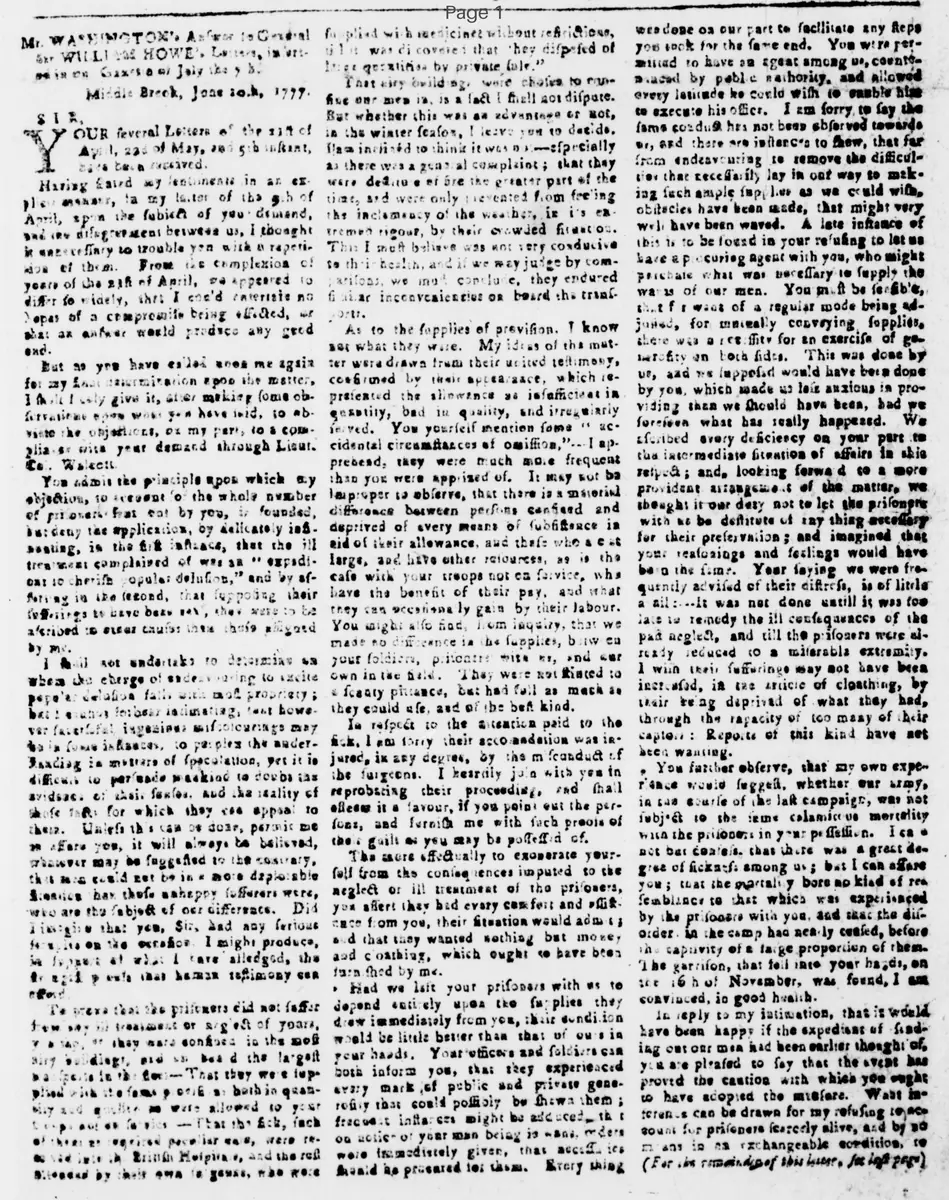
Sir William Howe's Letter, in return.
Middle Brook, June 30th, 1777.
SIR,
OUR several Letters of the 21st of May, and 5th instant, 'tis true received.
Having heard my sentiments in an express manner, in my letter of the 9th of April, upon the subject of your demand, and seeing disagreement between us, I thought it unnecessary to trouble you with a repetition of them. From the complexion of yours of the 9th of April, it appeared to differ so widely, that I could entertain no hopes of a compromise being found, as that an answer would produce any good end.
But as you have thought proper to require it, after mature reflection some observations on what you have said, to obviate the objection, on my part, to a compliance with your demand through Lieut. Col. Walcott.
You admit the principle upon which my objection, in amount to the whole number of prisoners taken by you, is founded, but deny the application, by delicately insinuating, in the first place, that the ill treatment complained of was an 'exceeding to certain popular delusion,' and by affirming in the second, that supposing their sufferings to have been real, they were to be ascribed to our cause: instead though charged by us.
I do not undertake to determine whether the charge of indiscretion to excite popular delusion fall so and prosperity; but surely February intimating, and however factual ingenious miscolorings may do in one instance, to perplex the understanding. Judicious in matters of speculation, yet it is difficult to guard mankind to doubt its evidence of casual fevers, and reality of those facts for which they can appeal to them. Their less said both in a more deplorable situation than those unhappy sufferers were, who are the object of our differences. Did I imagine that you, Sir, had any serious intention the effusion. Imight produce, in support of what I have alleged, the Or rp:i p en!a taa) haax tesimony cer efod
To prove that the prisoners did not suffer from our imprisonment or shortage of yours, in a way, as they are confess in the post airy judicial, and as. be a the largest da fze.ioio vh:tai--Tnat thuy wee iupe Dliod sit tiofen g coe a bathingran- wy a.d aala m vare alloped co yesr t ep. aot do ooies - That th ask, inch •s ·bee: 3' vsrited pssnliar sas, werd te- c vidinio BniufhMoipirao, and sbo ref Sxioaaad by theis qma ta'xeyxs, nho roke
supplied with necessaries without restrictive, tj l t was dicoveie: that hey difpefed of i:ge qu:xtitioa by private lnle. Inot siry ovild nz, wore chalra to run- hae onr men ia, is a iaat Ifhall aoi dispute. But whether this was an zdvantage or wot, in ths winier feafon. I ieev; rwn to deeido. fjaa inchinid to thini it was n msfprcially as there wasa zens a) complaiot; that thay were deditu e ef bre the prtater part of the tine, asd were only jievented hom freing the inclameocy o the wes:ber. ix i's ex. tremed rigoup, bv their crewded hranton. Thit I muf bshzve was aot:ery coxducive so thi-healtn. and if we wavjudge by com- , ariloas, we ino condlu e. they endured fiai.ar inccaveaiencies ox board :he tranf- .J.t:.
A: to the fopplies of previfion. I know net wbat theywaie. Myid:as ol the mut- ter wsradrawa frum tbeir ucited tef:mony, confrmed by thaie apceaaace, which ie- prtiexted the alowancs gs jfaficieat in zeantity, bnd in qoaliiy, snd irreguiariy ieved. Yov von:feif mention some" ac- cidental cireumsaeces f omiffion,"...I ap- prebead, tkey were mach mo.e frequent :hao yor were apprized of. I: may kot ba laup:eper to obferve, shat there ia x maiorinl diffnrence berween perfo.ns canfeed and dep:ived of every means of fubfitexce ia aidoftisir allowance, aud thnfe whe a eat Iargs, ard hive other raiourcss, a9 is the cafo with your sreops not cn fe:vice. whs have the bonefit of tbeir pay, aod what they can occoniona ly gain by their labour. You woighi alfo fad, L.om iaguiry, that we made no d-frcance ia he fuopiies, b.iw en jour foldiere, p.ilcntr: wisn ar, and aur own in tie fisld. Thsv were xot tiaced :o s fcaary pittance, but had full as mach ao they could sfe. aed of ghe bef. kind.
In refpeet to the ateaticn paid to tho fck. I am iorrv :heir accoandasion was ir- jured, ix aay degres, by the m fcanduct af ibe fuirecns. I hearcily jjia aita yen in reprobating sheir proceedise, sad hall feeg it a favour, ifyou pqiat eut the per- foas, sad furnia me vith fach preots of thet guilt as yey axay be pofeff:d of. Ths excre sffe&tuailv to exonerate you:- folf from ths conine rences imputed to tie nezleat or ii! treatment of tho prifoners, yox aer! thev bad evary casfeit and ofit- :nce f:om you, their sruation weuld adw s3 a.d that thay wanted nothiog but mnone, aod coatbing, which ought so bave been fu:a Mhed by m<.
, Fiad we lsft your prifonsrs with ns to jopond eati:ely upoa tke fu plies thty d.rew iamediajaly frcm yen, :hiair dundi.ion woald belitle beter rhan that of ous ia yeuer haods. Yoar'oticare and foldiers can boti iaform jos, tha: they experieaced svaiy markcf pubiic snd grivale gane- rouy tbst corld poGoiy bn hewa them : frecoe.t infiarces might be adcuced th t on actie-ot yonr man beiagis -ani. rders woro incdistely given, thas aec:s. ics haaid ae prasared toi chsm. Erery ching
we have done on our part to facilitate any reply you took for the same end. You will per- haps maintain to have an agent among us, countenanced by public authority, and allowed every latitude he could wish to gamble bi. to execute his office. I am sorry, to say the same conduct has not been observed towards wr, and there are instances to show, that far from endeavouring to remove the difficult- ties that necessarily lay in our way to make such ample supplies as we could wish, obstacles have been made, that might very well have been waived. A late instance of this is to be found in your refusing to let us have a procuring agent with you, who might purchasable what was necessary to supply the wants of our men. You must be sensible, that for want of a regular mode being adopted, for occasionally conveying supplies, there was a necessity for an exercise of ge intohty on both sides. This was done by us, and as supposed would have been done by you, which made us less anxious in pro- viding than we should have been, had we foreseen what has really happened. We ascribed every deficiency on your part to the intermediate station of affairs in skio rsipet; and, looking forward to a more provident arrangement of the matter, we thought it our duty not to let the prisoners be destitute of any thing necessary for their preservation; and imagined that your reasonings and feelings would have been the same. Your saying we were frequently advised of their distress, is of little avail;...it was not done until it was too late to remedy the ill consequences of the past neglect, and till the prisoners were already reduced to a miserable extremity.
I wish their sufferings may not have been increased, in the article of clothing, by their being deprived of what they had, through the rapacity of too many of their captains. Reports of this kind have not been wanting.
You further observe, that by own expe~ rience would suggest, whether our army, in such course of the last campaign, was not subject to the same calamitous mortality with the prisoners in your possession. I can not but confess, that there was great de- gree of sickness among us; but I can assure you, that the mortality bore no kind of resemblance to that which was experienced by the prisoners with you, and that the disorder in the camp had nearly ceased, before the captivity of a large proportion of them- The garrison, that fell into your hands, on the 16th of November, was found, I am convinced, in good health.
In reply to my intimation, that it would have been happy if the expedient of sending out our men had been earlier thought of, you are pleased to say that the event has proved the caution with which you could so have adopted the measure. What in- ference can be drawn for my refusing to account for prisoners scarcely alive, and by no means in an exchangeable condition, to (For the remaining of this letter, see next page)
I should hardly believe you to be serious in your application of the exception, to which you allude, in the case of Major General Lee. It may have been performed in a different manner in raising one. I did not entertain the most distant idea, than he could have been appointed to come many. the definition contained in it; and so far from such a construction upon that gentleman's circumstances, however it may be an evidence of ingenuity, is but an indifferent specimen of candour. I still adhere to what I have already advanced on this head, and can by no means think of departing from it.
I now give you my final decision on the subject of your demands. In doing this, I can say no more than repeat what I have already said. I am extremely desirous of a general exchange on liberal and impartial principles, and it is with great concern I see a matter so mutually interesting is impeded by unnecessary obstructions. But I cannot consent to its taking place on terms disadvantageous to those you propose, and which appear to me so contrary to justice and the spirit of the agreement.
I think it proper to declare that I wish the difference between us to be adjusted on a generous and equitable plan, and mean not to avail myself of the enlargement of the prisoners, to extort any thing from you but compatible with the strictest justice. Let a considerable proportion of prisoners, to be accounted for, be paroled, and General Lee declared exchangeable, when we shall have an officer of yours of equal rank in our possession; I ask no more. These being granted, I shall be happy to proceed to a general exchange. But, in the mean time, I am willing that a partial one should take place for the prisoners now in your hands, as far as those in ours will extend, except with regard to Lieutenant Colonel Campbell and the Hessian field officers, who will be detained until you shall seize General Lee as a prisoner of war, and place him on the footing I claim.
This latter proposition I am induced to make, from the distinction which your letter, of the 22d of May, seems to hold out; and I think it necessary to add, that your conduct towards prisoners will govern mine.
The situation of Lieut. Col. Campbell, as represented to you, is such as I neither wished or approve. Upon the first intimation of his complaint, I wrote upon the subject, and hoped there would have been no taste the cause of mischief. But General Burgoyne, I am persuaded, will do me the justice to say he has received from my instance. Unnecessary severity and every species of insult detested, and I trust none will ever have just season to censure me in this respect. I have written again on your remembrance, and have no doubt in his case of conduct it be adopted, as will be sufficient of all the dictates of humanity, and agreeable to both his and your wishes.
I am, Sir, with due Respect,
Your most obedient Servant,
G. WASHINGTON.
To His Excellency General Sir William Howe.
What sub-type of article is it?
What themes does it cover?
What keywords are associated?
What entities or persons were involved?
Where did it happen?
Story Details
Key Persons
Location
Middle Brook
Event Date
June 30th, 1777
Story Details
Washington responds to Howe's letter on prisoner treatment, defends American care for British prisoners against claims of mistreatment due to shortages and conditions, proposes partial exchange excluding certain officers until General Lee is properly accounted for, and conditions future conduct on British treatment of prisoners.