Thank you for visiting SNEWPapers!
Sign up free
Literary
December 9, 1818
The Rhode Island Republican
Newport, Newport County, Rhode Island
What is this article about?
This essay excerpt from a review explores the historical evolution of women's roles and influence on manners and literature, from austere Roman domesticity and later licentiousness, through Christianity's elevation of female virtues, to chivalric gallantry in medieval Europe.
Clipping
OCR Quality
92%
Excellent
Full Text
MISCELLANY.
From a Review, entitled, the Influence of Women on manners and literature.
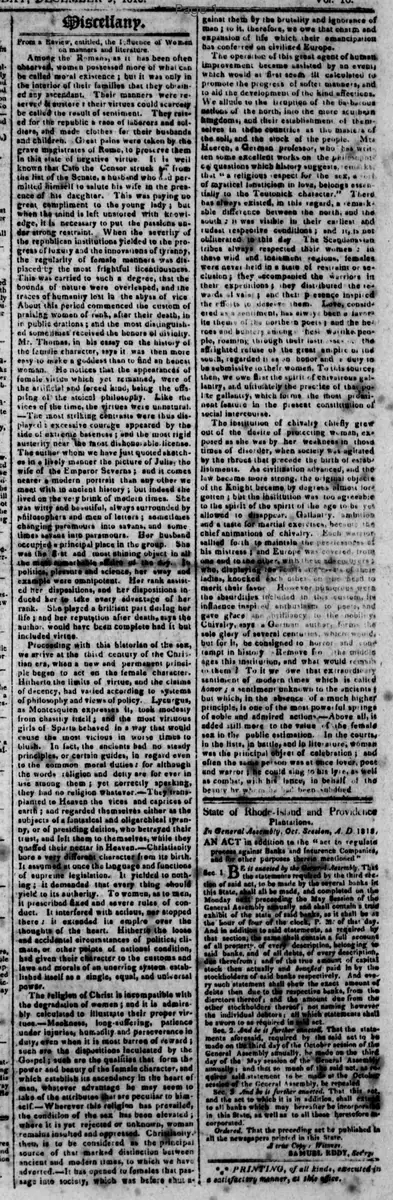
Among the Romans, as it has been often observed, women possessed more of what can be called moral existence; but it was only in the interior of their families that they obtained any ascendant. Their manners were reserved & austere; their virtues could scarcely be called the result of sentiment. They gained for the republic a race of laborers and soldiers, and made clothes--for their husbands and children. Great pains were taken by the grave magistrates of Rome, to preserve them in this state of lucrative virtue. It is well known that Cato the Censor struck from the list of the Senate, a husband who had permitted himself to salute his wife in the presence of his daughter. This was paying no great compliment to the young lady; but when the mind is left unstored with knowledge, it is necessary to put the passions under strong restraint. When the severity of the republican institutions yielded to the progress of luxury and the innovations of tyranny, the regularity of female manners was displaced--by the most frightful licentiousness. This was carried to such a degree, that the bounds of nature were overleaped, and the traces of humanity lost in the abyss of vice. About this period commenced the custom of praising women of rank, after their death, in public orations; and the most distinguished sometimes received the honors of divinity. Mr. Thomas, in his essay on the history of the female character, says it was then more easy to make a goddess than to find an honest woman. He notices that the appearances of female virtue which yet remained, were of the artificial and forced kind, being the offspring of the stoical philosophy. Like the vices of the time, the virtues were unnatural.--The most striking Contrasts were thus displayed: excessive courage appeared by the side of extreme baseness; and the most rigid austerity near the most dishonorable license. The author whom we have just quoted sketches in lively manner the picture of Julia the wife of the Emperor Severus; and it comes nearer modern portrait than any other we meet with in ancient history; but indeed she lived on the very brink of modern times. She was witty and beautiful, always surrounded by philosophers and men of letters; sometimes changing paramours into savans, and sometimes savans into paramours. Her husband occupied principal place in the group. She was the first and most shining object in all the remarkable affairs of the day. In politics, pleasure and science, her sway and example were omnipotent. Her rank assisted her dispositions, and her dispositions induced her to take every advantage of her rank. She played a brilliant part during her life; and her reputation after death, says the author, would have been complete had it but included virtue.
Proceeding with this historian of the sex, we arrive at the third century of the Christian era, when a new and permanent principle began to act on the female character. Hitherto the limits of virtue, and the claims of decency, had varied according to systems of philosophy and views of policy. Lycurgus, as Montesquieu expresses it, took modesty from chastity itself; and the most virtuous girls of Sparta behaved in a way that would cause the most vicious in worse times to blush. In fact, the ancients had no steady principles, or certain guides, in regard even to the common moral duties: for although the words religion and deity are for ever in use among them; yet correctly speaking, they had no religion whatever.--They transplanted to Heaven the vices and caprices of earth; and regarded themselves either as the subjects of a fantastical and oligarchical tyranny, or of presiding deities, who betrayed their trust, and left them to themselves; while they quaffed their nectar in Heaven.--Christianity bore a very different character from its birth. It assumed at once the language and functions of supreme legislation. It yielded to nothing; it demanded that every thing should yield to its authority. To women, as to men, it prescribed fixed and severe rules of conduct. It interfered with actions, but stopped there: it extended its empire over the thoughts of the heart. Hitherto the loose and accidental circumstances of politics; climate, or other points of national condition, had given their character to the customs and laws and morals of a people: but now an unerring system established itself as a single, equal, and universal power.
The Religion of Christ is incompatible with the degradation of women; and it is admirably calculated to illustrate their proper virtues.--Meekness, long-suffering, patience under injury, humanity and perseverance in duty, even when it is most barren of reward; such are the dispositions inculcated by the Gospel; such are the qualities that form the power and beauty of the female character, and which establish its ascendancy in the heart of man, whatever advantage he may seem to take of the attributes that are peculiar to himself.--Wherever this religion has prevailed, the condition of the sex has been elevated; where it is yet rejected or unknown, woman remains insulted and oppressed. Christianity, then, is to be considered as the principal source of that marked distinction between ancient and modern times, to which we have adverted.--It has opened to females that passage into society, which was before shut against them. By the brutality and ignorance of man it to it, therefore, we owe that charm and expansion of life which she emancipation has conferred on civilized Europe.
The operation of this great agent of human improvement became assisted by an event which would at first seem ill calculated to promote the progress of social manners, and to aid the development of the kind affections. We allude to the irruption of the barbarous nations of the north, into the more civilized kingdoms, and their establishment of themselves in these countries as the rulers of the soil and the stock of the people. Mr. Herder, a German professor, who has written some excellent works on the philosophical questions which history suggests, remarks, that "a religious respect for the sex," out of mystical fanaticism in love, belongs essentially to the Teutonick character." There has always existed, in this regard, a remarkable difference between the north, and the south: it was visible in their earliest and rudest respective conditions; and it is not obliterated. to this day-- The Scandinavian tribes always respected their women: in these wild and licentious regions,' females were never held in a state of restraint or seclusion; they accompanied the warriors in their expeditions; they distributed the rewards of valor; and their presence inspired the efforts to deserve them. Love, considered as a sentiment, has always been a favorite theme of the northern poets; and the heroes and chieftains among these warlike people, roaming through their fastnesses and the affrighted ruins of the great empire of the south, regarded it as an honor and a duty to be submissive to their women. To this source then, we owe first the spirit of chivalrous gallantry, and unfortunately the practice of that polite gallantry, which forms the chief predominant feature in the present constitution of social intercourse.
The institution of chivalry chiefly grew out of the desire of protecting woman, exposed as she was by her weakness in those times of disorder, when society was agitated by the throes that precede the birth of establishments. As civilization advanced, and the law became more strong, the original object of the Knight became by degrees almost forgotten; but the institution was too agreeable to the spirit of the age to be allowed to disappear. Gallantry, ambition and a taste for martial exercises, became the chief animators of chivalry. Each warrior sallied forth to maintain the peerlessness of his mistress and Europe was covered, from one end to the other, with these adventurous knights; who, displaying the scarfs of their ladies, knocked each other on the head to merit their favor However preposterous were the absurdities included in this custom, its influence inspired enthusiasm to poets, and gave grace and brilliancy to the nobility Chivalry, says a German author, forms the sole glory of several centuries, which would. but for it, be consigned to horror and contempt in history Remove from the middle ages this institution, and what would remain to them ? To it we owe that extraordinary sentiment of modern times which is called Honor ; a sentiment unknown to the ancients but which, in the absence of a much higher principle, is one of the most powerful springs of noble and admired actions. Above all, it added still more to the value of the female sex in the public estimation. In the courts, in the lists, in battle and in literature; woman was the principal object of celebration ; and after tho same person was at once lover, poet and warrior ; he could sing to his lute, as well as combat, with his lance, in behalf of the beauty by whom he had been subjugated
From a Review, entitled, the Influence of Women on manners and literature.
Among the Romans, as it has been often observed, women possessed more of what can be called moral existence; but it was only in the interior of their families that they obtained any ascendant. Their manners were reserved & austere; their virtues could scarcely be called the result of sentiment. They gained for the republic a race of laborers and soldiers, and made clothes--for their husbands and children. Great pains were taken by the grave magistrates of Rome, to preserve them in this state of lucrative virtue. It is well known that Cato the Censor struck from the list of the Senate, a husband who had permitted himself to salute his wife in the presence of his daughter. This was paying no great compliment to the young lady; but when the mind is left unstored with knowledge, it is necessary to put the passions under strong restraint. When the severity of the republican institutions yielded to the progress of luxury and the innovations of tyranny, the regularity of female manners was displaced--by the most frightful licentiousness. This was carried to such a degree, that the bounds of nature were overleaped, and the traces of humanity lost in the abyss of vice. About this period commenced the custom of praising women of rank, after their death, in public orations; and the most distinguished sometimes received the honors of divinity. Mr. Thomas, in his essay on the history of the female character, says it was then more easy to make a goddess than to find an honest woman. He notices that the appearances of female virtue which yet remained, were of the artificial and forced kind, being the offspring of the stoical philosophy. Like the vices of the time, the virtues were unnatural.--The most striking Contrasts were thus displayed: excessive courage appeared by the side of extreme baseness; and the most rigid austerity near the most dishonorable license. The author whom we have just quoted sketches in lively manner the picture of Julia the wife of the Emperor Severus; and it comes nearer modern portrait than any other we meet with in ancient history; but indeed she lived on the very brink of modern times. She was witty and beautiful, always surrounded by philosophers and men of letters; sometimes changing paramours into savans, and sometimes savans into paramours. Her husband occupied principal place in the group. She was the first and most shining object in all the remarkable affairs of the day. In politics, pleasure and science, her sway and example were omnipotent. Her rank assisted her dispositions, and her dispositions induced her to take every advantage of her rank. She played a brilliant part during her life; and her reputation after death, says the author, would have been complete had it but included virtue.
Proceeding with this historian of the sex, we arrive at the third century of the Christian era, when a new and permanent principle began to act on the female character. Hitherto the limits of virtue, and the claims of decency, had varied according to systems of philosophy and views of policy. Lycurgus, as Montesquieu expresses it, took modesty from chastity itself; and the most virtuous girls of Sparta behaved in a way that would cause the most vicious in worse times to blush. In fact, the ancients had no steady principles, or certain guides, in regard even to the common moral duties: for although the words religion and deity are for ever in use among them; yet correctly speaking, they had no religion whatever.--They transplanted to Heaven the vices and caprices of earth; and regarded themselves either as the subjects of a fantastical and oligarchical tyranny, or of presiding deities, who betrayed their trust, and left them to themselves; while they quaffed their nectar in Heaven.--Christianity bore a very different character from its birth. It assumed at once the language and functions of supreme legislation. It yielded to nothing; it demanded that every thing should yield to its authority. To women, as to men, it prescribed fixed and severe rules of conduct. It interfered with actions, but stopped there: it extended its empire over the thoughts of the heart. Hitherto the loose and accidental circumstances of politics; climate, or other points of national condition, had given their character to the customs and laws and morals of a people: but now an unerring system established itself as a single, equal, and universal power.
The Religion of Christ is incompatible with the degradation of women; and it is admirably calculated to illustrate their proper virtues.--Meekness, long-suffering, patience under injury, humanity and perseverance in duty, even when it is most barren of reward; such are the dispositions inculcated by the Gospel; such are the qualities that form the power and beauty of the female character, and which establish its ascendancy in the heart of man, whatever advantage he may seem to take of the attributes that are peculiar to himself.--Wherever this religion has prevailed, the condition of the sex has been elevated; where it is yet rejected or unknown, woman remains insulted and oppressed. Christianity, then, is to be considered as the principal source of that marked distinction between ancient and modern times, to which we have adverted.--It has opened to females that passage into society, which was before shut against them. By the brutality and ignorance of man it to it, therefore, we owe that charm and expansion of life which she emancipation has conferred on civilized Europe.
The operation of this great agent of human improvement became assisted by an event which would at first seem ill calculated to promote the progress of social manners, and to aid the development of the kind affections. We allude to the irruption of the barbarous nations of the north, into the more civilized kingdoms, and their establishment of themselves in these countries as the rulers of the soil and the stock of the people. Mr. Herder, a German professor, who has written some excellent works on the philosophical questions which history suggests, remarks, that "a religious respect for the sex," out of mystical fanaticism in love, belongs essentially to the Teutonick character." There has always existed, in this regard, a remarkable difference between the north, and the south: it was visible in their earliest and rudest respective conditions; and it is not obliterated. to this day-- The Scandinavian tribes always respected their women: in these wild and licentious regions,' females were never held in a state of restraint or seclusion; they accompanied the warriors in their expeditions; they distributed the rewards of valor; and their presence inspired the efforts to deserve them. Love, considered as a sentiment, has always been a favorite theme of the northern poets; and the heroes and chieftains among these warlike people, roaming through their fastnesses and the affrighted ruins of the great empire of the south, regarded it as an honor and a duty to be submissive to their women. To this source then, we owe first the spirit of chivalrous gallantry, and unfortunately the practice of that polite gallantry, which forms the chief predominant feature in the present constitution of social intercourse.
The institution of chivalry chiefly grew out of the desire of protecting woman, exposed as she was by her weakness in those times of disorder, when society was agitated by the throes that precede the birth of establishments. As civilization advanced, and the law became more strong, the original object of the Knight became by degrees almost forgotten; but the institution was too agreeable to the spirit of the age to be allowed to disappear. Gallantry, ambition and a taste for martial exercises, became the chief animators of chivalry. Each warrior sallied forth to maintain the peerlessness of his mistress and Europe was covered, from one end to the other, with these adventurous knights; who, displaying the scarfs of their ladies, knocked each other on the head to merit their favor However preposterous were the absurdities included in this custom, its influence inspired enthusiasm to poets, and gave grace and brilliancy to the nobility Chivalry, says a German author, forms the sole glory of several centuries, which would. but for it, be consigned to horror and contempt in history Remove from the middle ages this institution, and what would remain to them ? To it we owe that extraordinary sentiment of modern times which is called Honor ; a sentiment unknown to the ancients but which, in the absence of a much higher principle, is one of the most powerful springs of noble and admired actions. Above all, it added still more to the value of the female sex in the public estimation. In the courts, in the lists, in battle and in literature; woman was the principal object of celebration ; and after tho same person was at once lover, poet and warrior ; he could sing to his lute, as well as combat, with his lance, in behalf of the beauty by whom he had been subjugated
What sub-type of article is it?
Essay
What themes does it cover?
Social Manners
Religious
Political
What keywords are associated?
Women Influence
Roman Virtue
Christianity Women
Chivalry Gallantry
Female Character
Literary Details
Title
Miscellany. From A Review, Entitled, The Influence Of Women On Manners And Literature.
Subject
Historical Influence Of Women On Manners And Literature From Ancient Rome To Modern Times
Key Lines
Among The Romans, As It Has Been Often Observed, Women Possessed More Of What Can Be Called Moral Existence; But It Was Only In The Interior Of Their Families That They Obtained Any Ascendant.
It Is Well Known That Cato The Censor Struck From The List Of The Senate, A Husband Who Had Permitted Himself To Salute His Wife In The Presence Of His Daughter.
Christianity Bore A Very Different Character From Its Birth. It Assumed At Once The Language And Functions Of Supreme Legislation.
The Religion Of Christ Is Incompatible With The Degradation Of Women; And It Is Admirably Calculated To Illustrate Their Proper Virtues.
To This Source Then, We Owe First The Spirit Of Chivalrous Gallantry, And Unfortunately The Practice Of That Polite Gallantry, Which Forms The Chief Predominant Feature In The Present Constitution Of Social Intercourse.