Thank you for visiting SNEWPapers!
Sign up free
The Massachusetts Spy, And Worcester County Advertiser
Worcester, Worcester County, Massachusetts
What is this article about?
Persuasive article arguing that a railroad would benefit Worcester County farmers by lowering transportation costs to Boston market, enabling competition with out-of-state suppliers, with examples from 1827 hay sales and Boston's annual consumptions of local products.
Clipping
OCR Quality
Full Text
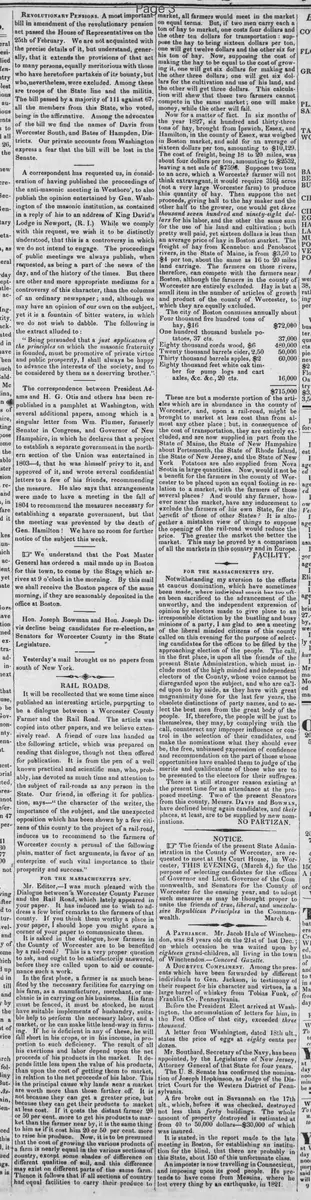
It will be recollected that we some time since published an interesting article, purporting to be a dialogue between a Worcester County Farmer and the Rail Road. The article was copied into other papers, and we believe extensively read. A friend of ours has handed us the following article, which was prepared on reading that dialogue, though not then offered for publication. It is from the pen of a well known practical and scientific man, who, probably, has devoted as much time and attention to the subject of rail-roads as any person in the State. Our friend, in offering it for publication, says—"the character of the writer, the importance of the subject, and the unexpected opposition which has been shown by a few citizens of this county to the project of a rail-road, induces us to recommend to the farmers of Worcester county a perusal of the following plain, matter of fact arguments, in favor of an enterprize of such vital importance to their prosperity and success."
FOR THE MASSACHUSETTS SPY.
Mr. Editor,—I was much pleased with the Dialogue between a Worcester County Farmer and the Rail Road, which lately appeared in your paper. It has induced me to wish to address a few brief remarks to the farmers of that county. If you think them worthy a place in your paper, I should hope you might spare a corner of your paper to communicate them.
It is asked in the dialogue, how farmers in the County of Worcester are to be benefited by a rail-road? This is a very proper question to ask, and ought to be satisfactorily answered, before they are called upon to aid or countenance such a work.
In the first place, a farmer is as much benefited by the necessary facilities for carrying on his farm, as a manufacturer, merchant, or mechanic is in carrying on his business. His farm must be fenced, it must be stocked, he must have suitable implements of husbandry, suitable help to perform the necessary labor, and a market, or he can make little head-way in farming. If he is deficient in any of these, he will fall short in his crops, or in his income, in proportion to such deficiency. The result of all his exertions and labor depend upon the net proceeds of his products in the market. It depends little less upon the value of his products than upon the cost of getting them to market, in relation to the net proceeds of his labor. This is the principal cause why lands near a market are worth more than those farther off. It is not because they can get a greater price, but because they can get their products to market at less cost. If it costs the distant farmer 20 or 50 per cent. more to get his products to market than the farmer near by, it is the same thing to him as if it cost him 20 or 50 per cent. more to raise his produce. Now, it is to be presumed that the cost of growing the various products of a farm is nearly equal in the various sections of country, except some shades of difference on different qualities of soil, and this difference may exist on different parts of the same farm. Thence it follows that if all sections of country had equal facilities to carry their produce to market, all farmers would meet in the market on equal terms. But, if two men carry each a ton of hay to market, one costs four dollars and the other ten dollars for transportation: suppose the hay to bring sixteen dollars per ton, one will get twelve dollars and the other six for his ton of hay. Now, supposing the cost of making the hay to be equal to the cost of growing it, one will get six dollars for making and the other three dollars; one will get six dollars for the cultivation and use of his land, and the other will get three dollars. This calculation will shew that these two farmers cannot compete in the same market; one will make money, while the other will fail.
Now for a matter of fact. In six months of the year 1827, six hundred and thirty-three tons of hay, brought from Ipswich, Essex, and Hamilton, in the county of Essex, was weighed in Boston market, and sold for an average of sixteen dollars per ton, amounting to $10,129. The cost of freight, being 18 to 20 miles, was about four dollars per ton, amounting to $2532, leaving a net sale of $7596. Suppose two tons to an acre, which a Worcester farmer will not think extravagant, it would require 316 acres (not a very large Worcester farm) to produce this quantity of hay. Then suppose the net proceeds, giving half to the hay maker and the other half to the grower, one would get three thousand seven hundred and ninety-eight dollars for his labor, and the other the same sum for the use of his land and cultivation; both pretty well paid, yet sixteen dollars is less than an average price of hay in Boston market. The freight of hay from Kennebec and Penobscot rivers, in the State of Maine, is from $3,50 to $4 per ton, about the same as 16 to 20 miles land carriage. The farmers on those rivers, therefore, can compete with the farmers near Boston, although the farmers in the county of Worcester are entirely excluded. Hay is but a small item in the number of articles of growth and product of the county of Worcester, to which they are equally excluded.
The city of Boston consumes annually about
Four thousand five hundred tons of hay, $16 $72,000
One hundred thousand bushels potatoes, 37 cts. 37,000
Eighty thousand cords wood, $6 480,000
Twenty thousand barrels cider, 2,50 50,000
Thirty thousand barrels apples, $2 60,000
Eighty thousand feet white oak timber for pump logs and cart axles, &c. &c., 20 cts. 16,000
$715,000
These are but a moderate portion of the articles which are in abundance in the county of Worcester, and, upon a rail-road, might be brought to market at less cost than from almost any other place; but, in consequence of the cost of transportation, they are entirely excluded, and are now supplied in part from the State of Maine, the State of New Hampshire about Portsmouth, the State of Rhode Island, the State of New Jersey, and the State of New York. Potatoes are also supplied from Nova Scotia in large quantities. Now, would it not be a benefit for the farmers in the county of Worcester to be placed upon an equal footing in relation to a market, with the farmers of those several places? And would any farmer, however near the market, have any inducement to exclude the farmers of his own State, for the benefit of those of other States? It is altogether a mistaken view of things to suppose the opening of the rail-road would reduce the price. The greater the market the better the market. This may be proved by a comparison of all the markets in this country and in Europe.
What sub-type of article is it?
What keywords are associated?
Where did it happen?
Story Details
Location
Worcester County, Massachusetts; Boston, Massachusetts
Event Date
1827
Story Details
Article responds to a dialogue by arguing that railroads would reduce transportation costs for Worcester farmers, allowing them to compete in Boston market with suppliers from Maine, New Hampshire, Rhode Island, New Jersey, New York, and Nova Scotia; includes 1827 hay sales example and Boston's annual consumption figures for hay, potatoes, wood, cider, apples, and timber.