Thank you for visiting SNEWPapers!
Sign up free
Toledo Union Journal
Toledo, Lucas County, Ohio
What is this article about?
The AFL-CIO urged Congress to reassert control over U.S. monetary policies, criticizing the Eisenhower Administration's tight-money approach for raising interest rates and harming the public. They proposed amendments to include broader representation on the Federal Reserve Board and other measures for balanced growth.
Clipping
OCR Quality
Full Text
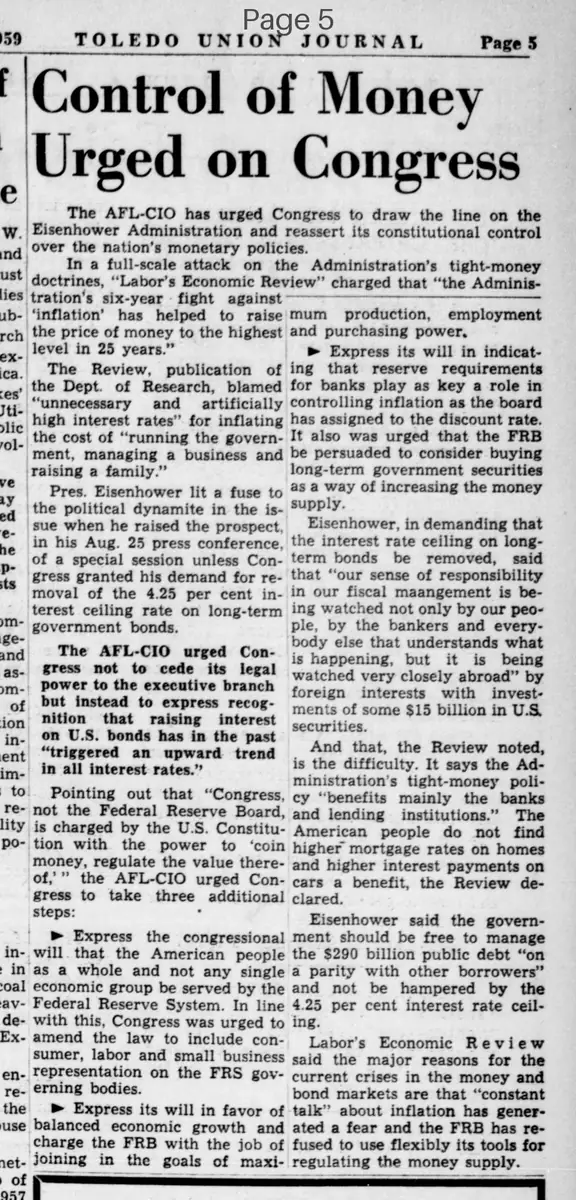
Control of Money Urged on Congress
The AFL-CIO has urged Congress to draw the line on the Eisenhower Administration and reassert its constitutional control over the nation's monetary policies.
In a full-scale attack on the Administration's tight-money doctrines, "Labor's Economic Review" charged that "the Administration's six-year fight against 'inflation' has helped to raise the price of money to the highest level in 25 years."
The Review, publication of the Dept. of Research, blamed "unnecessary and artificially high interest rates" for inflating the cost of "running the government, managing a business and raising a family."
Pres. Eisenhower lit a fuse to the political dynamite in the issue when he raised the prospect, in his Aug. 25 press conference, of a special session unless Congress granted his demand for removal of the 4.25 per cent interest ceiling rate on long-term government bonds.
The AFL-CIO urged Congress not to cede its legal power to the executive branch but instead to express recognition that raising interest on U.S. bonds has in the past "triggered an upward trend in all interest rates."
Pointing out that "Congress, not the Federal Reserve Board, is charged by the U.S. Constitution with the power to coin money, regulate the value thereof," the AFL-CIO urged Congress to take three additional steps:
Express the congressional will that the American people as a whole and not any single economic group be served by the Federal Reserve System. In line with this, Congress was urged to amend the law to include consumer, labor and small business representation on the FRS governing bodies.
Express its will in favor of balanced economic growth and charge the FRB with the job of joining in the goals of maximum employment and production.
Express its will in indicating that reserve requirements for banks play as key a role in controlling inflation as the board has assigned to the discount rate.
It also was urged that the FRB be persuaded to consider buying long-term government securities as a way of increasing the money supply.
Eisenhower, in demanding that the interest rate ceiling on long-term bonds be removed, said that "our sense of responsibility in our fiscal management is being watched not only by our people, by the bankers and everybody else that understands what is happening, but it is being watched very closely abroad" by foreign interests with investments of some $15 billion in U.S. securities.
And that, the Review noted, is the difficulty. It says the Administration's tight-money policy "benefits mainly the banks and lending institutions." The American people do not find higher mortgage rates on homes and higher interest payments on cars a benefit, the Review declared.
Eisenhower said the government should be free to manage the $290 billion public debt "on a parity with other borrowers" and not be hampered by the 4.25 per cent interest rate ceiling.
Labor's Economic Review said the major reasons for the current crises in the money and bond markets are that "constant talk" about inflation has generated a fear and the FRB has refused to use flexibly its tools for regulating the money supply.
What sub-type of article is it?
What keywords are associated?
What entities or persons were involved?
Domestic News Details
Key Persons
Outcome
the afl-cio's publication criticized high interest rates and urged congressional actions to reform federal reserve policies for broader economic benefits.
Event Details
The AFL-CIO, through 'Labor's Economic Review,' attacked the Eisenhower Administration's tight-money policies for raising interest rates to 25-year highs, blaming them for increased costs in government, business, and family life. They urged Congress to retain control over monetary policy, avoid ceding power to the executive, and take steps to include diverse representation on the Federal Reserve Board, promote balanced growth, adjust reserve requirements, and increase money supply via securities purchases. Eisenhower demanded removal of the 4.25% ceiling on long-term bonds to manage the $290 billion public debt freely, citing international scrutiny.