Thank you for visiting SNEWPapers!
Sign up free
The New Hampshire Gazette
Portsmouth, Rockingham County, New Hampshire
What is this article about?
Political commentary in Maine defending President Jackson's 1832 veto of the U.S. Bank charter as embodying Democratic principles, criticizing opponents, and citing the recent presidential election as public endorsement.
Clipping
OCR Quality
Full Text
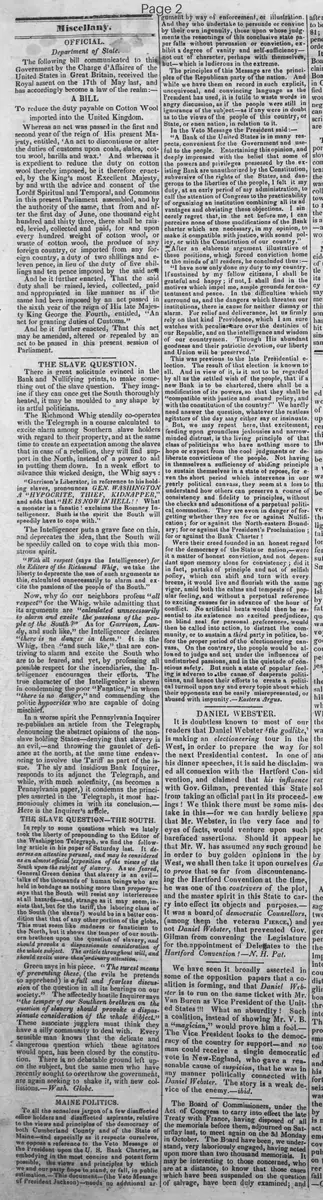
To all the senseless jargon of a few disaffected office holders and disaffected aspirants, relative to the views and principles of the democracy of both Cumberland County and of the State of Maine—and especially as it respects ourselves, we oppose a reference to the Veto Message of the President upon the U. S. Bank Charter, as embodying in the most concise and potent form possible, the views and principles by which we and our party hope to stand, or fall, in public estimation.—This document—(the Veto Message of President Jackson)—needs no additional argument by way of enforcement, or illustration.
And they who undertake to persuade or convince by their own ingenuity, those upon whose judgments the reasonings of this conclusive state paper falls without persuasion or conviction, exhibit a degree of vanity and self-sufficiency—not out of character, perhaps with themselves, but—which is ludicrous in the extreme.
The principles of this Message are the principles of the Republican party of the nation. And while we have them on record in such explicit, unequivocal, and convincing language as the President has used, it is futile to waste words in angry discussion, as if the people were still in ignorance of the subject—as if any were in doubt as to the views of the people of this country, or State, or even nation, in relation to it.
In the Veto Message the President said:-
"A Bank of the United States is in many respects, convenient for the Government and useful to the people. Entertaining this opinion, and deeply impressed with the belief that some of the powers and privileges possessed by the existing Bank are unauthorized by the Constitution, subversive of the rights of the States, and dangerous to the liberties of the people, I felt it my duty, at an early period of my administration, to call the attention of Congress to the practicability of organizing an institution combining all its advantages and obviating these objections, I sincerely regret that, in the act before me, I can perceive none of those modifications of the Bank charter which are necessary, in my opinion, to make it compatible with justice, with sound policy, or with the Constitution of our country."
*After an elaborate argument illustrative of these positions, which forced conviction home to the minds of all readers, he concluded thus:-
"I have now only done my duty to my country. If sustained by my fellow citizens, I shall be grateful and happy; if not, I shall find in the motives which impel me, ample grounds for contentment and peace. In the difficulties which surround us, and the dangers which threaten our institutions, there is cause for neither dismay or alarm. For relief and deliverance, let us firmly rely on that kind Providence, which I am sure watches with peculiar care over the destinies of our Republic, and on the intelligence and wisdom of our countrymen. Through His abundant goodness and their patriotic devotion, our liberty and Union will be preserved."
This was previous to the late Presidential election. The result of that election is known to all. And in view of it, is it not to be regarded by all as the settled wish of the people, that if a new Bank is to be chartered, there shall be a modification of its powers, so that they shall be "compatible with justice and sound policy, and with the constitution of the country?" We hardly need answer the question, whatever the restless agitators of the day may either say or insinuate.
But, we may repeat here, that excitement, feeding upon groundless jealousies and narrow-minded distrust, is the living principle of that class of politicians who have nothing more to hope or expect from the cool judgments or deliberate convictions of the people. Not having in themselves a sufficiency of abiding principle to sustain themselves in a state of repose, for even the short period which intervenes in our yearly political canvass, they seem at a loss to understand how others can preserve a course of consistency and fidelity to principles, without the checks and admonitions of a perpetual political commotion. They are even in danger of forgetting whether they are for or against Nullification; for or against the North-eastern Boundary; for or against the President's Proclamation; for or against the Bank Charter!
Were their creed founded in an honest regard for the democracy of the State or nation,—were it a matter of honest conviction, and not dependent upon memory alone for consistency; did it in fact, partake of principle and not of selfish policy, which can shift and turn with every breeze, it would live and flourish with the same vigor, amid both the calms and tempests of popular feeling, and without a perpetual reference to exciting causes far in advance of the hour of conflict. No artificial heats would then be essential to its existence; no excited prejudices, no blind zeal for personal preferences, would then be called into action, to distract the community, or to sustain a third party in politics, before the proper period of the electioneering canvass. On the contrary, the people would be allowed to judge and act under the influences of undisturbed passions, and in the quietude of conscious safety. But such a state of popular feeling is adverse to the cause of desperate politicians, and hence their efforts to create a political turmoil upon any and every topic about which their opponents can be easily misrepresented, or abused with impunity.—Eastern Argus.
What sub-type of article is it?
What keywords are associated?
What entities or persons were involved?
Where did it happen?
Domestic News Details
Primary Location
Cumberland County, Maine
Key Persons
Outcome
jackson's re-election in the late presidential election affirmed public support for the veto's principles on modifying the bank charter.
Event Details
Editorial defends Democratic views in Maine by referencing President Jackson's Veto Message on the U.S. Bank Charter, criticizing disaffected opponents as vain and inconsistent, and asserting the message's principles as those of the Republican party, endorsed by the recent election.