Thank you for visiting SNEWPapers!
Sign up free
The Augusta Courier
Augusta, Richmond County, Georgia
What is this article about?
Columnist Roy V. Harris discusses why sons of wealthy men often become political liberals, contrasting them with self-made conservatives. Drawing from a U.S. News & World Report interview with professors Newcomb and Dahl, he argues privilege leads to liberal views, cites historical examples like Marx and modern figures like FDR and JFK, and notes wealth's advantages in costly politics.
Merged-components note: Merged continuations of the 'STRICTLY PERSONAL' editorial column by Roy V. Harris spanning pages 1-4. Relabeled the page 2 continuation from 'story' to 'editorial'.
Clippings
1 of 4
OCR Quality
Full Text
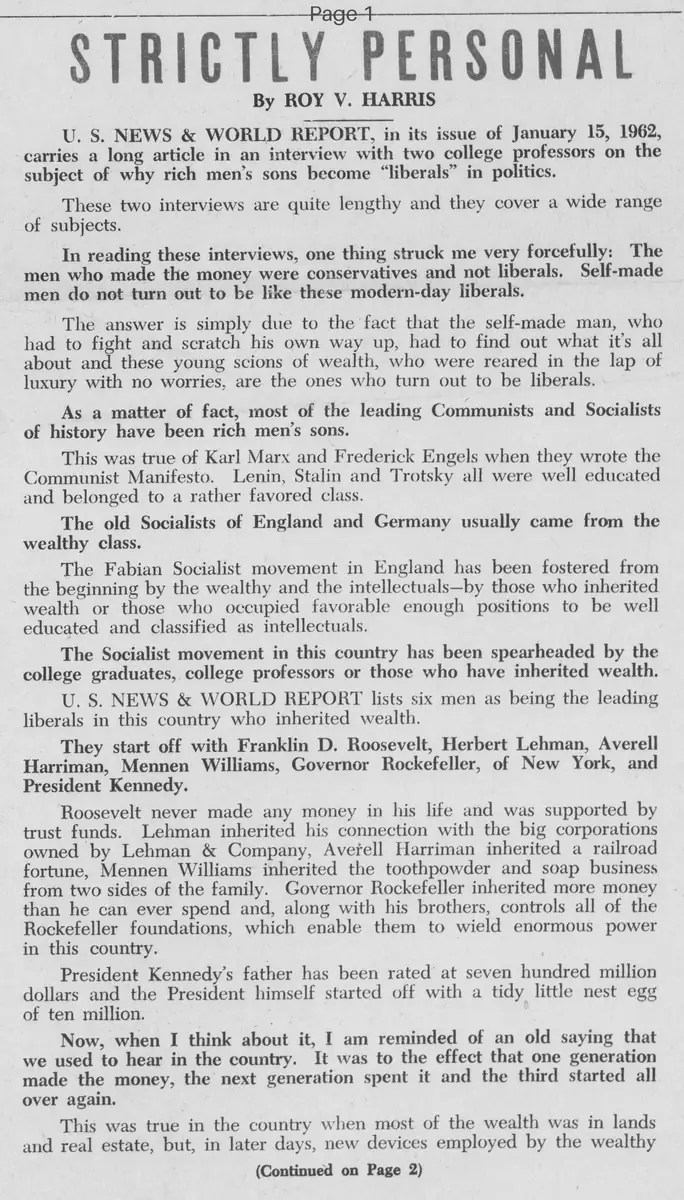
By ROY V. HARRIS
U. S. NEWS & WORLD REPORT, in its issue of January 15, 1962, carries a long article in an interview with two college professors on the subject of why rich men's sons become "liberals" in politics.
These two interviews are quite lengthy and they cover a wide range of subjects.
In reading these interviews, one thing struck me very forcefully: The men who made the money were conservatives and not liberals.
Self-made men do not turn out to be like these modern-day liberals.
The answer is simply due to the fact that the self-made man, who had to fight and scratch his own way up, had to find out what it's all about and these young scions of wealth, who were reared in the lap of luxury with no worries, are the ones who turn out to be liberals.
As a matter of fact, most of the leading Communists and Socialists of history have been rich men's sons.
This was true of Karl Marx and Frederick Engels when they wrote the Communist Manifesto. Lenin, Stalin and Trotsky all were well educated and belonged to a rather favored class.
The old Socialists of England and Germany usually came from the wealthy class.
The Fabian Socialist movement in England has been fostered from the beginning by the wealthy and the intellectuals-by those who inherited wealth or those who occupied favorable enough positions to be well educated and classified as intellectuals.
The Socialist movement in this country has been spearheaded by the college graduates, college professors or those who have inherited wealth.
U. S. NEWS & WORLD REPORT lists six men as being the leading liberals in this country who inherited wealth.
They start off with Franklin D. Roosevelt, Herbert Lehman, Averell Harriman, Mennen Williams, Governor Rockefeller, of New York, and President Kennedy.
Roosevelt never made any money in his life and was supported by trust funds. Lehman inherited his connection with the big corporations owned by Lehman & Company, Averell Harriman inherited a railroad fortune, Mennen Williams inherited the toothpowder and soap business from two sides of the family. Governor Rockefeller inherited more money than he can ever spend and, along with his brothers, controls all of the Rockefeller foundations, which enable them to wield enormous power in this country.
President Kennedy's father has been rated at seven hundred million dollars and the President himself started off with a tidy little nest egg of ten million.
Now, when I think about it, I am reminded of an old saying that we used to hear in the country. It was to the effect that one generation made the money, the next generation spent it and the third started all over again.
This was true in the country when most of the wealth was in lands and real estate, but, in later days, new devices employed by the wealthy
have enabled them to hand their wealth down through several generations by means of various kinds of trust estates and devices of that kind.
As a result of these modern-day legal contrivances, wealthy men's sons and grandsons have nothing to do with running the business, or businesses, which feed them and they sit back and clip dividends, collect interest, or clip coupons.
Some of them are not required to go to this much trouble. Some bank, or trust company, is trustee of the estate and sends them a check each month.
According to the old country theory, the hard-working, two-fisted men built up the wealth and then proceeded to bring their children up in luxury so that they would not be forced to share the hardships which the parents themselves had to suffer.
Consequently, they were brought up as hothouse plants and all they knew how to do was spend money.
So, they usually spent it and then their children, or grandchildren, had to start all over from scratch and see what they could do.
It seems that the same psychology involved in this country theory holds good for the rich men's sons in politics today.
They didn't make the money. They were reared in the laps of luxury and have had every opportunity to secure the best training in the best schools, had an opportunity to travel extensively and then placed in some influential office of some kind somewhere to occupy a position where no great amount of brains or ability is necessary.
They are not familiar with the process of making money, but have only been trained to spend it. Since a liberal philosophy is one of spending money, their training equips them to fit in very well with spending policies.
Most of them remind me of a governor I once knew. One of his friends said, "That rascal spends the State's money just as freely as he spends his own!"
One of the men interviewed by U. S. NEWS & WORLD REPORT was Professor Theodore M. Newcomb, of the University of Michigan.
Professor Newcomb was asked if rich men's sons in general espoused liberal causes.
Here is his reply:
"Again I would say, more so than you would expect-particularly in view of their backgrounds. They aren't like their fathers and grandfathers."
The professor says very few self-made men tend to move in a liberal direction.
Here's how he explains it:
". . . This is because the 'conservative' tradition in this country has been to the effect that a man's fate depends upon himself and his internal qualities, but the 'liberal' position has generally been that a man is a consequence, in considerable part, of the social conditions which surround him. The self-made man finds that hard to accept."
Why do rich men's sons go into politics?
The professor says these men feel a little isolated and wonder if they are accepted by the world. "So the political life could be viewed as a way of attaining power in one's own right, just like anybody else, and thus proving to the world that you're not merely inheriting power. If you win politically, then you have acceptance as well as power," he added.
In explaining why they usually favor labor over business, he said that in his opinion it isn't out of any inherent love for labor, but because of the political winds and social winds which have been blowing that way in recent years.
Asked if they usually feel that they must espouse liberal causes to get elected, he said:
That is certainly the case. On the other hand, most of the people we've been talking about give the impression of a good deal of sincerity.
But to come from a wealthy background with perhaps overtones of 'robber baronage' and, at the same time, to espouse a 'conservative' cause is a kind of a double handicap. And I suspect that people, like Nelson Rockefeller, for example, find it politically advantageous - quite apart from the question of sincerity, and I'm not questioning it in his case- to take a somewhat 'liberal' position.
Professor Robert A. Dahl, Chairman of the Department of Political Science at Yale University, was also interviewed.
He was asked to explain why people of inherited wealth and social position turn out to be liberals in politics more so than those who make their own wealth. He said this is true in the United States and markedly so elsewhere.
Here's what he said about England:
"In England, for example, people of aristocratic background tend to have a certain contempt for business, or at least a certain amount of disdain and detachment from business.
In England, the merchant who became wealthy often bought himself a piece of landed property, he or his son perhaps acquired a title, and, after three generations, his heirs were very disdainful of people who had made their own money.
"It has not been unusual, therefore, for the aristocrat to be a militant 'liberal' - socialist Tory, or Laborite.
Then, talking about the American "liberal", he added:
The wealthy aristocrat has not struggled for money. He has probably had an education under the liberalizing influences of the great schools of the country. Though he is wealthy, he may be concerned about acting ostentatiously like wealthy men. He is somewhat detached from business. He isn't particularly attracted by the ideology of business. And he has to be concerned, if he goes into politics at all, about winning a popular following.
"If on no other grounds than political strategy, he would be wise to choose a liberal rather than a 'conservative' public philosophy."
Then he explained that in America these men of inherited wealth usually come from sections where one either has to be a liberal to be elected or where it helps to be a liberal.
Then, when it gets down to a question of geography, he explained it as follows:
"My guess is that geography doesn't matter, except indirectly - that it's a matter of where in the United States you have had wealth for a sufficient number of generations to develop a class structure with a kind of an aristocratic or patrician group at the top. And this is most likely to be New England, New York and the Eastern seaboard."
"What you need for the development of the liberal aristocrat is a set of patrician families. To develop a patrician family requires a considerable period of time plus a certain amount of prosperity so that it is possible to acquire wealth, invest it, and maintain it more or less intact in the family over several generations."
Then, the professor hints that probably a guilty conscience has something to do with rich men's sons' turning liberal. A lot of their fathers were known as robber barons and weren't particularly popular over the manner in which they amassed their wealth.
Then it develops that it is his idea that wealth is no longer a handicap to being elected and, instead, wealth is sometimes necessary for election.
Here's why he says it isn't a handicap:
"One reason, I think, that inherited wealth isn't a handicap is a common feeling that wealthy people don't have to be corrupt. One widespread view of politics is that politicians are inherently inclined to corruption. One way to combat this, in the minds of at least some ordinary voters, is to elect a rich man to office."
"What's more, it is undoubtedly true that people of inherited wealth would be difficult to corrupt by financial means. There would be no point to it. They would risk their entire career, if it were discovered, for something they already possess. The temptation scarcely exists."
And then, as to the advantages of wealth to the politician, he says:
There is no doubt in my mind that, if a person has sufficient wealth so that he doesn't have to worry about a job or his career, it is a great advantage to him when he wants to go into politics. Politics is a very costly business. For one thing, just running a campaign is a terribly expensive affair these days. And one needs to have some security to fall back on when out of office.
I know enough about politics to know how much it costs.
I have managed and been connected with a lot of political campaigns over the past forty years and I probably have spent more campaign funds during political races than any living man in Georgia.
The cost of politics is becoming prohibitive. It is almost an impossibility for a decent candidate to get up enough money to run.
If a candidate happens to have the Kennedy millions behind him it proves to be very convenient.
In the first place, to run for Governor of a State, a man has to start four or five years in advance and devote most of his time to making speeches and meeting the people.
All this takes money. It takes money for a man to live on while he's doing this and it takes money to move around.
Few men are able to do it.
There are only two classes that are in proper position to run for office. One is the man who happens to hold some office and can travel around making speeches at government expense and the other man is the one who has inherited more money than he has sense.
Then, when campaign time comes, some four or five years later, the candidate finds the propaganda campaign is rather expensive. It takes enormous sums of money for radio and television appearances and it takes a lot of money for newspaper advertising.
As a matter of fact, it almost takes more money than there is.
So, these privileged characters who inherit more money than they can spend are very favorably situated to turn to politics.
Take President Kennedy, as an illustration. He spent fifteen years running for President and it took an enormous amount of money to finance over this long period of time.
Then, probably he spent ten million dollars getting the nomination and then, after he was nominated by the Democrats, it took another twenty million to elect him.
These figures are minimum figures and my guess is that it took more than this in both instances.
But, you can see what's happening to us and why.
noticeable spiritual revival in Europe to essential principles. Technically, it is progressing rapidly. But at the same time the ethics of its leaders are diminishing at an alarming pace.
The world, at present," the French president is reported to have said to a prominent representative of a European power recently, "has lost its attachments
De Gaulle's hostility to the United Nations
What sub-type of article is it?
What keywords are associated?
What entities or persons were involved?
Editorial Details
Primary Topic
Why Rich Men's Sons Become Liberals In Politics
Stance / Tone
Critical Of Wealthy Liberal Heirs, Supportive Of Self Made Conservatives
Key Figures
Key Arguments