Thank you for visiting SNEWPapers!
Sign up free
Literary
December 1, 1837
Southern Christian Advocate
Charleston, Charleston County, South Carolina
What is this article about?
A prose reflection arguing that people readily trust human authorities like parents, pilots, friends, coachmen, and doctors without suspicion, yet fail to trust God, who is fully competent in will and power to fulfill His promises. Attributed to Hannah Moore.
Clipping
OCR Quality
98%
Excellent
Full Text
TRUST IN GOD.
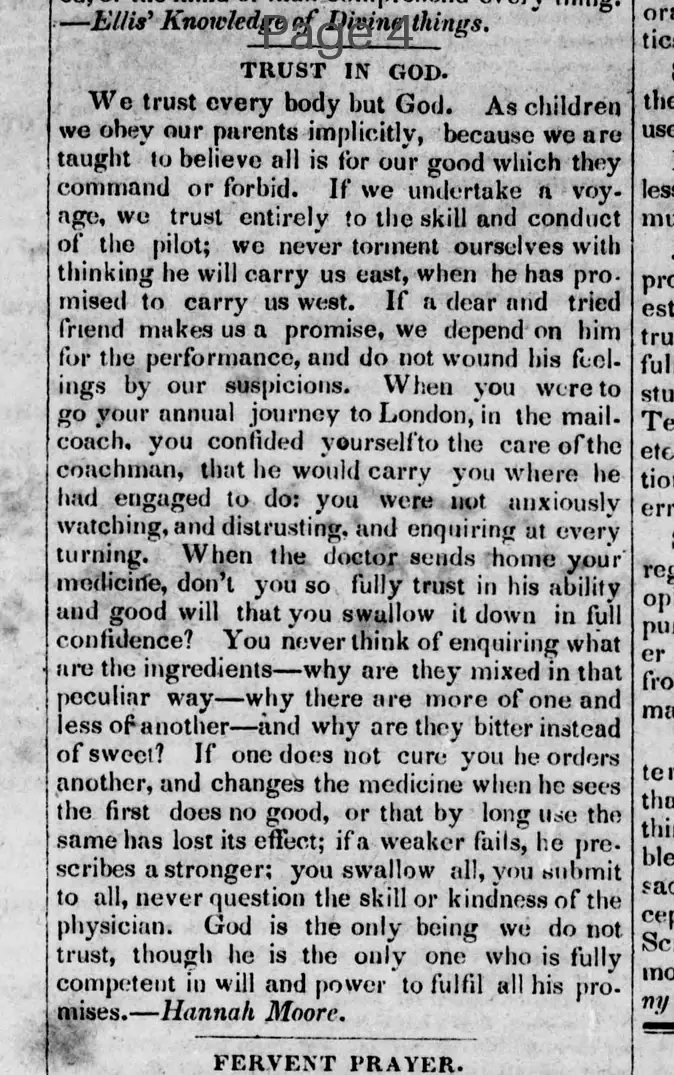
We trust every body but God. As children we obey our parents implicitly, because we are taught to believe all is for our good which they command or forbid. If we undertake a voyage, we trust entirely to the skill and conduct of the pilot; we never torment ourselves with thinking he will carry us east, when he has promised to carry us west. If a dear and tried friend makes us a promise, we depend on him for the performance, and do not wound his feelings by our suspicions. When you were to go your annual journey to London, in the mail coach, you confided yourself to the care of the coachman, that he would carry you where he had engaged to do: you were not anxiously watching, and distrusting, and enquiring at every turning. When the doctor sends home your medicine, don't you so fully trust in his ability and good will that you swallow it down in full confidence? You never think of enquiring what are the ingredients--why are they mixed in that peculiar way--why there are more of one and less of another--and why are they bitter instead of sweet? If one does not cure you he orders another, and changes the medicine when he sees the first does no good, or that by long use the same has lost its effect; if a weaker fails, he prescribes a stronger; you swallow all, you submit to all, never question the skill or kindness of the physician. God is the only being we do not trust, though he is the only one who is fully competent in will and power to fulfil all his promises.--Hannah Moore.
We trust every body but God. As children we obey our parents implicitly, because we are taught to believe all is for our good which they command or forbid. If we undertake a voyage, we trust entirely to the skill and conduct of the pilot; we never torment ourselves with thinking he will carry us east, when he has promised to carry us west. If a dear and tried friend makes us a promise, we depend on him for the performance, and do not wound his feelings by our suspicions. When you were to go your annual journey to London, in the mail coach, you confided yourself to the care of the coachman, that he would carry you where he had engaged to do: you were not anxiously watching, and distrusting, and enquiring at every turning. When the doctor sends home your medicine, don't you so fully trust in his ability and good will that you swallow it down in full confidence? You never think of enquiring what are the ingredients--why are they mixed in that peculiar way--why there are more of one and less of another--and why are they bitter instead of sweet? If one does not cure you he orders another, and changes the medicine when he sees the first does no good, or that by long use the same has lost its effect; if a weaker fails, he prescribes a stronger; you swallow all, you submit to all, never question the skill or kindness of the physician. God is the only being we do not trust, though he is the only one who is fully competent in will and power to fulfil all his promises.--Hannah Moore.
What sub-type of article is it?
Essay
What themes does it cover?
Religious
Moral Virtue
What keywords are associated?
Trust In God
Faith
Divine Competence
Moral Reflection
Human Trust
What entities or persons were involved?
Hannah Moore.
Literary Details
Title
Trust In God.
Author
Hannah Moore.
Subject
Trust In God Compared To Trust In Human Authorities
Key Lines
We Trust Every Body But God.
God Is The Only Being We Do Not Trust, Though He Is The Only One Who Is Fully Competent In Will And Power To Fulfil All His Promises.