Thank you for visiting SNEWPapers!
Sign up free
Literary
September 18, 1828
The Litchfield County Post
Litchfield, Litchfield County, Connecticut
What is this article about?
In this conclusion to a French story, Louis enlists as a soldier to escape his forbidden love for Jacqueline, rises to prominence during the French Revolution, and becomes Comte de Regnault. Years later, his daughter Pauline falls in love with her drawing teacher Henri de Feuillars, mirroring his past. The Comte intervenes to end the affair, discovering a connection to his own history via an old letter.
Merged-components note: These components form a single continued literary piece, 'A Roland for an Oliver,' spanning across pages 1 and 2.
Clippings
1 of 2
OCR Quality
98%
Excellent
Full Text
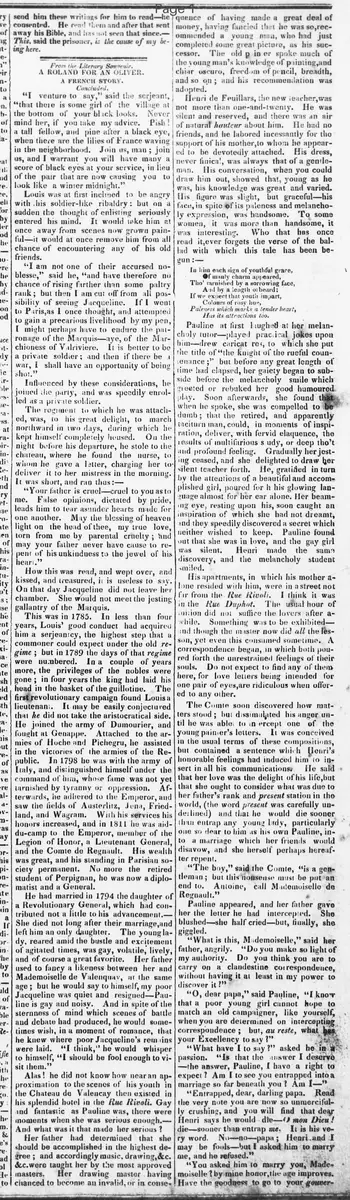
From the Literary Souvenir.
A ROLAND FOR AN OLIVER.
A FRENCH STORY.
Concluded,
"I venture to say," said the serjeant, "that there is some girl of the village at the bottom of your black looks. Never mind her, if you take my advice. Pish! a tall fellow, and pine after a black eye, when there are the lilies of France waving in the neighborhood. Join us, man; join us, and I warrant you will have many a score of black eyes at your service, in lieu of the pair that are now causing you to look like a winter midnight."
Louis was at first inclined to be angry with his soldier-like ribaldry: but on a sudden the thought of enlisting seriously entered his mind. It would take him at once away from scenes now grown painful—it would at once remove him from all chance of encountering any of his old friends.
"I am not one of their accursed noblesse." said he, "and have therefore no chance of rising farther than some paltry rank; but then I am cut off from all possibility of seeing Jacqueline. If I went to Paris, as I once thought, and attempted to gain a precarious livelihood by my pen, I might perhaps have to endure the patronage of the Marquis—aye, of the Marchioness of Valriviere. It is better to be a private soldier: and then if there be a war, I shall have an opportunity of being shot."
Influenced by these considerations, he joined the party, and was speedily enrolled as a private soldier.
The regiment to which he was attached, was, to his great delight, to march northward in two days, during which he kept himself completely housed. On the night before his departure, he stole to the chateau, where he found the nurse, to whom he gave a letter, charging her to deliver it to her mistress in the morning. It was short, and ran thus:-
"Your father is cruel—cruel to you as to me. False opinions, dictated by pride, leads him to tear asunder hearts made for one another. May the blessing of heaven light on the head of thee, my true love, torn from me by parental cruelty ; and may your father never have cause to repent of his unkindness to the jewel of his heart."
How this was read, and wept over, and kissed, and treasured, it is useless to say. On that day Jacqueline did not leave her chamber. She would not meet the jesting gallantry of the Marquis.
This was in 1785. In less than four years, Louis' good conduct had acquired him a serjeantcy, the highest step that a commoner could expect under the old regime ; but in 1789 the days of that regime were numbered. In a couple of years more, the privileges of the nobles were gone ; in four years the king had laid his head in the basket of the guillotine. The first revolutionary campaign found Louis a lieutenant. It may be easily conjectured that he did not take the aristocratical side. He joined the army of Dumourier, and fought at Genappe. Attached to the armies of Hoche and Pichegru, he assisted in the victories of the armies of the Republic. In 1798 he was with the army of Italy, and distinguished himself under the command of him, whose fame was not yet tarnished by tyranny or oppression. Afterwards, he adhered to the Emperor, and saw the fields of Austerlitz, Jena, Friedland, and Wagram. With his services his honors increased, and in 1811 he was aid-du-camp to the Emperor, member of the Legion of Honor, a Lieutenant General, and the Comte de Regnault. His wealth was great, and his standing in Parisian society permanent. No more the retired student of Perpignan, he was now a diplomatist and a General.
He had married in 1794 the daughter of a Revolutionary General, which had contributed not a little to his advancement.— She died not long after their marriage, and left him an only daughter. The young lady, reared amid the bustle and excitement of agitated times, was gay, volatile, lively, and of course a great favorite. Her father used to fancy a likeness between her and Mademoiselle de Valençay, at the same age ; but he would say to himself, my poor Jacqueline was quiet and resigned—Pauline is gay and noisy. And in spite of the sternness of mind which scenes of battle and debate had produced, he would sometimes wish, in a moment of romance, that he knew where poor Jacqueline's remains were laid. "I think," he would whisper to himself, "I should be fool enough to visit them."
Alas! he did not know how near an approximation to the scenes of his youth in the Chateau de Valencay then existed in his splendid hotel in the Rue Rivoli. Gay and fantastic as Pauline was, there were moments when she was serious enough. And what was it that made her serious? Her father had determined that she should be accomplished in the highest degree ; and accordingly music, drawing, &c. &c. were taught her by the most approved masters. Her drawing master having chanced to become an invalid, or in consequence of having made a great deal of money, having fancied that he was so, recommended a young man, who had just completed some great picture, as his successor. The old painter spoke much of the young man's knowledge of painting, and chiar oscuro, freedom of pencil, breadth, and so on; and his recommendation was adopted.
Henri de Feuillars, the new teacher, was not more than one-and-twenty. He was silent and reserved, and there was an air of natural hauteur about him. He had no friends, and he labored incessantly for the support of his mother, to whom he appeared to be devotedly attached. His dress, never finical, was always that of a gentleman. His conversation, when you could draw him out, showed that, young as he was. his knowledge was great and varied His figure was slight, but graceful his face, in spite of its paleness and melancholy expression, was handsome. To some women, it was more than handsome, it was interesting.
Who that has once read it, ever forgets the verse of the ballad with which this tale has been begun :
In him each sign of youthful grace,
Of manly charm appeared,
Tho' tarnished by a sorrowing face,
And by a length of beard;
If we expect that youth impart,
Colours of rosy hue,
Paleness which marks a tender heart,
Has its attractions too
Pauline at first laughed at her melancholy tutor—played practical jokes upon him—drew caricatures, to which she put the title of "the knight of the rueful countenance;" but before any great length of time had elapsed, her gaiety began to subside before the melancholy smile which greeted or rebuked her good humoured play. Soon afterwards, she found that when he spoke, she was compelled to be dumb; that the retired, and apparently taciturn man, could, in moments of inspiration, deliver, with fervid eloquence, the results of multifarious study, or deep thought and profound feeling. Gradually her jesting ceased, and she delighted to draw her silent teacher forth. He, gratified in turn by the attentions of a beautiful and accomplished girl, poured forth his glowing language almost for her ear alone. Her beaming eye, resting upon his, soon caught an inspiration of which she had not dreamt; and they speedily discovered a secret which neither wished to keep. Pauline found out that she was in love, and the gay girl was silent. Henri made the same discovery, and the melancholy student smiled.
His apartments, in which his mother alone resided with him, were in a street not far from the Rue Rivoli. I think it was in the Rue Duphot. The usual hour of tuition did not suffice the lovers after a while. Something was to be exhibited— and though the master now did all the lesson, yet even this consumed some time. A correspondence began, in which both poured forth the unrestrained feelings of their souls. Do not expect to find any of them here, for love letters being intended for one pair of eyes, are ridiculous when offered to any other.
The Comte soon discovered how matters stood; but dissimulated his anger until he was able to intercept one of the young painter's letters. It was conceived in the usual terms of these compositions, but contained a sentence which Henri's honorable feelings had induced him to insert in all his communications. He said that her love was the delight of his life, but that she ought to consider what was due to her father's rank and present station in the world, (the word present was carefully underlined) and that he would die sooner than entrap any young lady, particularly one so dear to him as his own Pauline, into a marriage which her friends would disavow, and she herself perhaps hereafter repent.
"The boy." said the Comte, "is a gentleman; but this nonsense must be put an end to. Antoine, call Mademoiselle de Regnault."
Pauline appeared, and her father gave her the letter he had intercepted. She blushed—she half cried—but, finally, she giggled.
"What is this, Mademoiselle," said her father, angrily. "Do you make so light of my authority. Do you think you are to carry on a clandestine correspondence, without having it at least in my power to discover it?"
"O, dear papa," said Pauline, "I know that a poor young girl cannot hope to match an old campaigner, like yourself, when you are determined on intercepting correspondence; but, au reste, what has your Excellency to say ?"
"What have I to say?" asked he in passion. "Is that the answer I deserve —the answer, Pauline, I have a right to expect? Am I to see you entrapped into a marriage so far beneath you ? Am I—"
"Entrapped, dear, darling papa. Read the very note you are now so unmercifully crushing, and you will find that dear Henri says he would—die—() mon Dieu! die—sooner than entrap me. It is his very word. No—no—papa; Henri and I may be fools—but I asked him to marry me, and he refused."
"You asked him to marry you, Mademoiselle ? by mine honor, the age improves. Have the goodness to go to your gouvernante."
Mademoiselle, who, I am sorry to perceive, has performed her duty very indifferently, and remain in your own apartment until I send for you. Go, I say, Mademoiselle Regnault;" and the laughing girl blowing him a kiss, ran out the room.
"I cannot," thought the Comte when alone, "write to young Henri—in fact, the young man has behaved with an uncommon degree of honor and prudence; but"—and he paused for awhile. "I am told his mother has a vast influence over him, and perhaps I may have a chance with her."
A note, written with due official haste and illegibility, was the consequence of this determination. It said, in terms the most ceremoniously polite, yet, at the same time, in effect the most severely laconic, that the great man wanted to see the poor woman. "At ten minutes past one, or eighteen minutes past three, to-day, I shall have the honour of being disengaged for you, Madame, on both occasions, for ten minutes. I shall not permit myself the pleasure of further intruding on your valuable time."
At ten minutes past one—not a second sooner, nor a second later—Madame de Feuillars was announced at the Comte's. The official man had been disengaged to the moment and two seconds past ten minutes after one o'clock, Madame de Feuillars was in the Comte's library.
She was a woman who had retained many traits of conspicuous beauty, but she was wan and wasted. A tenderness of sight had compelled her to disfigure her features with a green shade. The humility of her circumstances had cast an air of submission over all her actions. The poor, the unpretending, the unrepining Madame de Feuillars seemed born for poverty.
The Comte had never seen the mother of his daughter's painting-master before: but from what he had heard, was deeply impressed with respect for her character. He handed her to a chair.
"It is unpleasant, Madame," said he, "to say any thing which, directly or indirectly may seem derogatory to a worthy, a clever, and beloved son. Ask me any tribute of respect to the genius, or the goodness of heart and conduct of your Henri, as far as I have had an opportunity of becoming acquainted with them, and I shall be most happy to give it. But, Madame, I have discovered, by one means or another, that he has abused the opportunities—No, I will not use so hard a word as that—that he and Paul—Mademoiselle de Regnault have been so foolish as to—to—you understand—as to talk that nonsense to one another which young people sometimes talk, without considering the difference of station—the ways of the world. You understand me Madame."
"I do, Sir," said the quiet lady. He started—God knows at what; and continued.
"I do not mean to offend, not the least: indeed, quite the contrary. Your son is really a very clever young gentleman, as the world knows—a very honorable young gentleman, as I know—no matter how. But you will admit, Madame, I ought not to allow so ill-mated a courtship to go on. You know, Madame, that the thing cannot be."
"I do, Sir," responded the lady, as humbly as before.
Something made the Comte start again; and he then continued:
"I have taken the liberty—the very great liberty, Madame, of sending for you, in order to request your acquiescence in a plan of mine. He loves his mother: it is an honour to him that he does so. She is a lady well deserving of love."
There was no gallantry in this, as it was said; and yet the lady did bridle up a little.
"And if you could suggest to him that a journey to Rome, there to perfect himself in his art, would be advantageous, 10,000 francs a year should be at his service, and 12,500 to fit him out for the journey. You can perceive, Madame, that I consult the interest of your son."
"I do, Sir," said the lady.
The Comte flouted a little at the repetition of the phrase; and thinking that a rougher tone would perhaps answer better, changed his manner.
"Madame de Feuillars, I shall not dissemble that I propose the plan as much for the good of my daughter as for that of your son. But, Madame, if you do not acquiesce in my view of the business, I must adopt a very different method. You are a woman, who, I suppose, has seen the world; and when I tell you that I have detected a correspondence between Mons. Henri and my young lady, I have ground sufficient to proceed upon. Madame, do you approve of such conduct?"
"No, Sir," said the lady.
"Well, Madame, you agree then with me, that an end must be put to such things. I humbly think that my plan is the best for all parties. There must be no more letters."
"I agree with you, Sir," said Madame Feuillars, "to a greater extent than you imagine. I myself have intercepted a letter from a foolish lover of humble life, to a lady in superior rank. To show you that I do not approve of such things, I have brought it to you;" and she drew a letter from her pocket.
"Your conduct, Madame," said the Comte, "does you honor. But this is a sadly mangled and dirty epistle:—what's this?"
"* Your father is cruel—cruel to you as to me. False opinions, dictated by pride, lead him to tear asunder hearts made for one another—"
"What!" said the Comte; "O woman! who art thou?"
A ROLAND FOR AN OLIVER.
A FRENCH STORY.
Concluded,
"I venture to say," said the serjeant, "that there is some girl of the village at the bottom of your black looks. Never mind her, if you take my advice. Pish! a tall fellow, and pine after a black eye, when there are the lilies of France waving in the neighborhood. Join us, man; join us, and I warrant you will have many a score of black eyes at your service, in lieu of the pair that are now causing you to look like a winter midnight."
Louis was at first inclined to be angry with his soldier-like ribaldry: but on a sudden the thought of enlisting seriously entered his mind. It would take him at once away from scenes now grown painful—it would at once remove him from all chance of encountering any of his old friends.
"I am not one of their accursed noblesse." said he, "and have therefore no chance of rising farther than some paltry rank; but then I am cut off from all possibility of seeing Jacqueline. If I went to Paris, as I once thought, and attempted to gain a precarious livelihood by my pen, I might perhaps have to endure the patronage of the Marquis—aye, of the Marchioness of Valriviere. It is better to be a private soldier: and then if there be a war, I shall have an opportunity of being shot."
Influenced by these considerations, he joined the party, and was speedily enrolled as a private soldier.
The regiment to which he was attached, was, to his great delight, to march northward in two days, during which he kept himself completely housed. On the night before his departure, he stole to the chateau, where he found the nurse, to whom he gave a letter, charging her to deliver it to her mistress in the morning. It was short, and ran thus:-
"Your father is cruel—cruel to you as to me. False opinions, dictated by pride, leads him to tear asunder hearts made for one another. May the blessing of heaven light on the head of thee, my true love, torn from me by parental cruelty ; and may your father never have cause to repent of his unkindness to the jewel of his heart."
How this was read, and wept over, and kissed, and treasured, it is useless to say. On that day Jacqueline did not leave her chamber. She would not meet the jesting gallantry of the Marquis.
This was in 1785. In less than four years, Louis' good conduct had acquired him a serjeantcy, the highest step that a commoner could expect under the old regime ; but in 1789 the days of that regime were numbered. In a couple of years more, the privileges of the nobles were gone ; in four years the king had laid his head in the basket of the guillotine. The first revolutionary campaign found Louis a lieutenant. It may be easily conjectured that he did not take the aristocratical side. He joined the army of Dumourier, and fought at Genappe. Attached to the armies of Hoche and Pichegru, he assisted in the victories of the armies of the Republic. In 1798 he was with the army of Italy, and distinguished himself under the command of him, whose fame was not yet tarnished by tyranny or oppression. Afterwards, he adhered to the Emperor, and saw the fields of Austerlitz, Jena, Friedland, and Wagram. With his services his honors increased, and in 1811 he was aid-du-camp to the Emperor, member of the Legion of Honor, a Lieutenant General, and the Comte de Regnault. His wealth was great, and his standing in Parisian society permanent. No more the retired student of Perpignan, he was now a diplomatist and a General.
He had married in 1794 the daughter of a Revolutionary General, which had contributed not a little to his advancement.— She died not long after their marriage, and left him an only daughter. The young lady, reared amid the bustle and excitement of agitated times, was gay, volatile, lively, and of course a great favorite. Her father used to fancy a likeness between her and Mademoiselle de Valençay, at the same age ; but he would say to himself, my poor Jacqueline was quiet and resigned—Pauline is gay and noisy. And in spite of the sternness of mind which scenes of battle and debate had produced, he would sometimes wish, in a moment of romance, that he knew where poor Jacqueline's remains were laid. "I think," he would whisper to himself, "I should be fool enough to visit them."
Alas! he did not know how near an approximation to the scenes of his youth in the Chateau de Valencay then existed in his splendid hotel in the Rue Rivoli. Gay and fantastic as Pauline was, there were moments when she was serious enough. And what was it that made her serious? Her father had determined that she should be accomplished in the highest degree ; and accordingly music, drawing, &c. &c. were taught her by the most approved masters. Her drawing master having chanced to become an invalid, or in consequence of having made a great deal of money, having fancied that he was so, recommended a young man, who had just completed some great picture, as his successor. The old painter spoke much of the young man's knowledge of painting, and chiar oscuro, freedom of pencil, breadth, and so on; and his recommendation was adopted.
Henri de Feuillars, the new teacher, was not more than one-and-twenty. He was silent and reserved, and there was an air of natural hauteur about him. He had no friends, and he labored incessantly for the support of his mother, to whom he appeared to be devotedly attached. His dress, never finical, was always that of a gentleman. His conversation, when you could draw him out, showed that, young as he was. his knowledge was great and varied His figure was slight, but graceful his face, in spite of its paleness and melancholy expression, was handsome. To some women, it was more than handsome, it was interesting.
Who that has once read it, ever forgets the verse of the ballad with which this tale has been begun :
In him each sign of youthful grace,
Of manly charm appeared,
Tho' tarnished by a sorrowing face,
And by a length of beard;
If we expect that youth impart,
Colours of rosy hue,
Paleness which marks a tender heart,
Has its attractions too
Pauline at first laughed at her melancholy tutor—played practical jokes upon him—drew caricatures, to which she put the title of "the knight of the rueful countenance;" but before any great length of time had elapsed, her gaiety began to subside before the melancholy smile which greeted or rebuked her good humoured play. Soon afterwards, she found that when he spoke, she was compelled to be dumb; that the retired, and apparently taciturn man, could, in moments of inspiration, deliver, with fervid eloquence, the results of multifarious study, or deep thought and profound feeling. Gradually her jesting ceased, and she delighted to draw her silent teacher forth. He, gratified in turn by the attentions of a beautiful and accomplished girl, poured forth his glowing language almost for her ear alone. Her beaming eye, resting upon his, soon caught an inspiration of which she had not dreamt; and they speedily discovered a secret which neither wished to keep. Pauline found out that she was in love, and the gay girl was silent. Henri made the same discovery, and the melancholy student smiled.
His apartments, in which his mother alone resided with him, were in a street not far from the Rue Rivoli. I think it was in the Rue Duphot. The usual hour of tuition did not suffice the lovers after a while. Something was to be exhibited— and though the master now did all the lesson, yet even this consumed some time. A correspondence began, in which both poured forth the unrestrained feelings of their souls. Do not expect to find any of them here, for love letters being intended for one pair of eyes, are ridiculous when offered to any other.
The Comte soon discovered how matters stood; but dissimulated his anger until he was able to intercept one of the young painter's letters. It was conceived in the usual terms of these compositions, but contained a sentence which Henri's honorable feelings had induced him to insert in all his communications. He said that her love was the delight of his life, but that she ought to consider what was due to her father's rank and present station in the world, (the word present was carefully underlined) and that he would die sooner than entrap any young lady, particularly one so dear to him as his own Pauline, into a marriage which her friends would disavow, and she herself perhaps hereafter repent.
"The boy." said the Comte, "is a gentleman; but this nonsense must be put an end to. Antoine, call Mademoiselle de Regnault."
Pauline appeared, and her father gave her the letter he had intercepted. She blushed—she half cried—but, finally, she giggled.
"What is this, Mademoiselle," said her father, angrily. "Do you make so light of my authority. Do you think you are to carry on a clandestine correspondence, without having it at least in my power to discover it?"
"O, dear papa," said Pauline, "I know that a poor young girl cannot hope to match an old campaigner, like yourself, when you are determined on intercepting correspondence; but, au reste, what has your Excellency to say ?"
"What have I to say?" asked he in passion. "Is that the answer I deserve —the answer, Pauline, I have a right to expect? Am I to see you entrapped into a marriage so far beneath you ? Am I—"
"Entrapped, dear, darling papa. Read the very note you are now so unmercifully crushing, and you will find that dear Henri says he would—die—() mon Dieu! die—sooner than entrap me. It is his very word. No—no—papa; Henri and I may be fools—but I asked him to marry me, and he refused."
"You asked him to marry you, Mademoiselle ? by mine honor, the age improves. Have the goodness to go to your gouvernante."
Mademoiselle, who, I am sorry to perceive, has performed her duty very indifferently, and remain in your own apartment until I send for you. Go, I say, Mademoiselle Regnault;" and the laughing girl blowing him a kiss, ran out the room.
"I cannot," thought the Comte when alone, "write to young Henri—in fact, the young man has behaved with an uncommon degree of honor and prudence; but"—and he paused for awhile. "I am told his mother has a vast influence over him, and perhaps I may have a chance with her."
A note, written with due official haste and illegibility, was the consequence of this determination. It said, in terms the most ceremoniously polite, yet, at the same time, in effect the most severely laconic, that the great man wanted to see the poor woman. "At ten minutes past one, or eighteen minutes past three, to-day, I shall have the honour of being disengaged for you, Madame, on both occasions, for ten minutes. I shall not permit myself the pleasure of further intruding on your valuable time."
At ten minutes past one—not a second sooner, nor a second later—Madame de Feuillars was announced at the Comte's. The official man had been disengaged to the moment and two seconds past ten minutes after one o'clock, Madame de Feuillars was in the Comte's library.
She was a woman who had retained many traits of conspicuous beauty, but she was wan and wasted. A tenderness of sight had compelled her to disfigure her features with a green shade. The humility of her circumstances had cast an air of submission over all her actions. The poor, the unpretending, the unrepining Madame de Feuillars seemed born for poverty.
The Comte had never seen the mother of his daughter's painting-master before: but from what he had heard, was deeply impressed with respect for her character. He handed her to a chair.
"It is unpleasant, Madame," said he, "to say any thing which, directly or indirectly may seem derogatory to a worthy, a clever, and beloved son. Ask me any tribute of respect to the genius, or the goodness of heart and conduct of your Henri, as far as I have had an opportunity of becoming acquainted with them, and I shall be most happy to give it. But, Madame, I have discovered, by one means or another, that he has abused the opportunities—No, I will not use so hard a word as that—that he and Paul—Mademoiselle de Regnault have been so foolish as to—to—you understand—as to talk that nonsense to one another which young people sometimes talk, without considering the difference of station—the ways of the world. You understand me Madame."
"I do, Sir," said the quiet lady. He started—God knows at what; and continued.
"I do not mean to offend, not the least: indeed, quite the contrary. Your son is really a very clever young gentleman, as the world knows—a very honorable young gentleman, as I know—no matter how. But you will admit, Madame, I ought not to allow so ill-mated a courtship to go on. You know, Madame, that the thing cannot be."
"I do, Sir," responded the lady, as humbly as before.
Something made the Comte start again; and he then continued:
"I have taken the liberty—the very great liberty, Madame, of sending for you, in order to request your acquiescence in a plan of mine. He loves his mother: it is an honour to him that he does so. She is a lady well deserving of love."
There was no gallantry in this, as it was said; and yet the lady did bridle up a little.
"And if you could suggest to him that a journey to Rome, there to perfect himself in his art, would be advantageous, 10,000 francs a year should be at his service, and 12,500 to fit him out for the journey. You can perceive, Madame, that I consult the interest of your son."
"I do, Sir," said the lady.
The Comte flouted a little at the repetition of the phrase; and thinking that a rougher tone would perhaps answer better, changed his manner.
"Madame de Feuillars, I shall not dissemble that I propose the plan as much for the good of my daughter as for that of your son. But, Madame, if you do not acquiesce in my view of the business, I must adopt a very different method. You are a woman, who, I suppose, has seen the world; and when I tell you that I have detected a correspondence between Mons. Henri and my young lady, I have ground sufficient to proceed upon. Madame, do you approve of such conduct?"
"No, Sir," said the lady.
"Well, Madame, you agree then with me, that an end must be put to such things. I humbly think that my plan is the best for all parties. There must be no more letters."
"I agree with you, Sir," said Madame Feuillars, "to a greater extent than you imagine. I myself have intercepted a letter from a foolish lover of humble life, to a lady in superior rank. To show you that I do not approve of such things, I have brought it to you;" and she drew a letter from her pocket.
"Your conduct, Madame," said the Comte, "does you honor. But this is a sadly mangled and dirty epistle:—what's this?"
"* Your father is cruel—cruel to you as to me. False opinions, dictated by pride, lead him to tear asunder hearts made for one another—"
"What!" said the Comte; "O woman! who art thou?"
What sub-type of article is it?
Prose Fiction
What themes does it cover?
Love Romance
Social Manners
Political
What keywords are associated?
Forbidden Love
French Revolution
Class Difference
Military Rise
Romantic Correspondence
Literary Details
Title
A Roland For An Oliver. A French Story.
Key Lines
"Your Father Is Cruel—Cruel To You As To Me. False Opinions, Dictated By Pride, Leads Him To Tear Asunder Hearts Made For One Another. May The Blessing Of Heaven Light On The Head Of Thee, My True Love, Torn From Me By Parental Cruelty ; And May Your Father Never Have Cause To Repent Of His Unkindness To The Jewel Of His Heart."
In Him Each Sign Of Youthful Grace, Of Manly Charm Appeared, Tho' Tarnished By A Sorrowing Face, And By A Length Of Beard; If We Expect That Youth Impart, Colours Of Rosy Hue, Paleness Which Marks A Tender Heart, Has Its Attractions Too
"The Boy." Said The Comte, "Is A Gentleman; But This Nonsense Must Be Put An End To."
"I Agree With You, Sir," Said Madame Feuillars, "To A Greater Extent Than You Imagine. I Myself Have Intercepted A Letter From A Foolish Lover Of Humble Life, To A Lady In Superior Rank."
"What!" Said The Comte; "O Woman! Who Art Thou?"