Thank you for visiting SNEWPapers!
Sign up free
Story
January 13, 1882
The Daily Dispatch
Richmond, Virginia
What is this article about?
The Richmond Dispatch editorial denounces Mr. Riddleberger's 1882 bill as hypocritical and deceptive, arguing it masks Virginia's repudiation of its own debt by falsely inflating West Virginia's share and using verbose provisions to obscure 43-69% cuts on bond classes issued for Virginia's portion.
Clipping
OCR Quality
85%
Good
Full Text
Richmond Dispatch
FRIDAY............JANUARY 13, 1882.
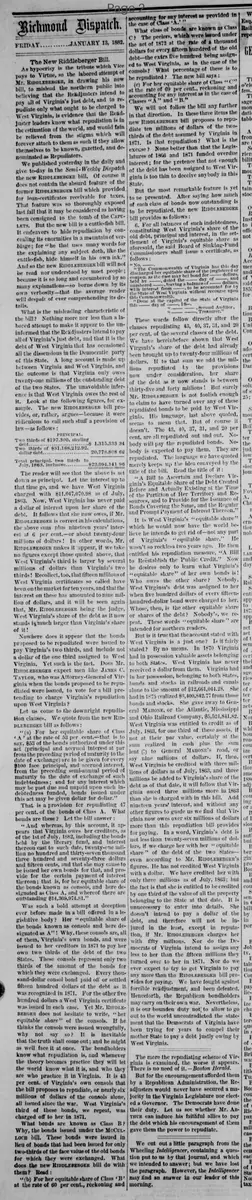
As hypocrisy is the tribute which Vice pays to Virtue, so the labored attempt of Mr. RIDDLEBERGER, in drawing his new bill, to mislead the northern public into believing that the Readjusters intend to pay all of Virginia's just debt, and to repudiate only what ought to be charged to West Virginia, is evidence that the Readjuster leaders know what repudiation is in the estimation of the world, and would fain be relieved from the stigma which will forever attach to them as such if they allow themselves to be known, gazetted, and denominated as Repudiators.
We published yesterday in the daily and the new Riddleberger bill. Of course it does not contain the absurd feature of the former Riddleberger bill which provided for loan-certificates receivable for taxes. That feature was so thoroughly exposed last fall that it may be considered as having been consigned to the tomb of the Capulets. But the new bill is a cuttle-fish bill. It endeavors to hide repudiation by concealing its enormities in a mountain of verbiage; for "he that uses many words for the explaining any subject doth, like the cuttle-fish, hide himself in his own ink," And so the new Riddleberger bill will not be read nor understood by most people; because it is so long and encumbered by so many explanations-so borne down by its own verbosity-that the average reader will despair of ever comprehending its details.
What is the misleading characteristic of the bill? Nothing more nor less than a labored attempt to make it appear to the uninformed that the Readjusters intend to pay all of Virginia's just debt, and that it is the debt of West Virginia that has occasioned all the dissensions in the Democratic party of this State. A long account is made up between Virginia and West Virginia, and the outcome is that Virginia only owes twenty-one millions of the outstanding debt of the two States. The unavoidable inference is that West Virginia owes the rest of it. Look at the following figures, for example. The new RIDDLEBERGER bill provides, or, rather, argues--because it were ridiculous to call such stuff a provision of law--as follows:
PRINCIPAL,
Two thirds of $197,300 sterling debt.. 131,533 34
Two thirds of $31,168,212.92, dollar debt.......... 20,778,808 62
Total principal, two thirds to July, 1863, inclusive............$22,094,141 96
The reader will see that the above is set down as principal. Let the interest up to that time go, and we have West Virginia charged with $11,047,070.98 as of July, 1863. Now, West Virginia has never paid a dollar of interest upon her share of the debt. It follows that she now owes, if Mr. RIDDLEBERGER is correct in his calculations, the above sum plus nineteen years' interest at 6 per cent.-or about twenty-four millions of dollars! In other words, Mr. RIDDLEBERGER makes it appear, if we take no figures except those quoted above, that West Virginia's third is larger by several millions of dollars than Virginia's two thirds! Recollect, too, that fifteen millions of West Virginia certificates so called have been on the market for ten years, and that the interest on these has amounted to nine million of dollars, and it will be seen again that, Mr. RIDDLEBERGER being the judge, West Virginia's share of the debt as it now stands is much larger than Virginia's share of it!
Nowhere does it appear that the bonds proposed to be repudiated were issued to pay Virginia's two thirds, and include not a dollar of the one third assigned to West Virginia. Yet such is the fact. Does Mr. RIDDLEBERGER expect men like JAMES C. TAYLOR, who was Attorney-General of Virginia when the bonds proposed to be repudiated were issued, to vote for a bill pretending to charge Virginia's repudiation upon West Virginia?
Let us come to the downright repudiation clauses. We quote from the new RIDDLEBERGER bill as follows:
"(a) For her equitable share of Class A at the rate of 53 per cent.-that is to say, $53 of the bonds authorized under this act (principal and accrued interest at par from the preceding period of maturity to the date of exchange) are to be given for every $100 face principal, and accrued interest, from the preceding semi-annual period of maturity to the date of exchange of such indebtedness: and for any interest which may be past due and unpaid upon such indebtedness funded, bonds issued under this act may be given dollar for dollar."
That is a provision for repudiating 47 per cent. of the bonds of Class A. What bonds are these? Let the bill answer:
"And whereas, by this account, it appears that Virginia owes her creditors, as of the 1st of July, 1882, including the bonds held by the literary fund, and interest thereon cast to such date, twenty-one million two hundred and thirty-seven thousand three hundred and seventy-three dollars and fifteen cents, and that she may cause to be issued her own bonds for that, and provide for the certain payment of interest thereon; that is, for her equitable share of the bonds known as consols, and here designated as Class A, and whereof there are outstanding $14,369,974.81."
Was such a bold attempt at deception ever before made in a bill offered in a legislative body? Her "equitable share of the bonds known as consols and here designated as A"! Why, these consols are, all of them, Virginia's own bonds, and were issued to her creditors in 1871 to pay her own two thirds of the debt of the two States. These consols represent only two thirds of the amount of the bonds for which they were exchanged. Every thousand-dollar consol bond paid off or settled fifteen hundred dollars of the debt as it was recognized in 1871. For the other five hundred dollars a West Virginia certificate was issued in each case. Yet Mr. RIDDLEBERGER does not hesitate to write, "her equitable share" of the consols. If he thinks the consols were issued wrongfully, why not say so? It is inevitable that the truth shall come out; and he might as well face it at once. The bondholders know what repudiation is, and whenever the theory becomes practice they will let the world know what it is, and who they are who practice it in Virginia. It is 43 per cent. of Virginia's own consols that the bill proposes to repudiate, or nearly six millions of dollars of the consols alone, all issued since the war. West Virginia's third of these bonds, we repeat, was charged off to her in 1871.
What bonds are known as Class B? Why, the bonds issued under the McCULLOCH Loan bill. These bonds were issued in lieu of bonds that had been issued for only two-thirds of the face value of the old bonds for which they were exchanged. What does the new RIDDLEBERGER bill do with them? Read:
"(b) For her equitable share of Class 'B' at the rate of 60 per cent., reckoning and accounting for any interest as provided in the case of Class 'A'."
What class of bonds are known as Class C? The peelers, which were issued under the act of 1872 at the rate of a thousand dollars for every fifteen hundred of the old debt-the extra five hundred being assigned to West Virginia, as in the case of the consols? What percentage of these is to be repudiated? The new bill says:
"(c) For her equitable share of Class "C" at the rate of 69 per cent., reckoning and accounting for any interest as in the case of Classes "A" and "B.""
We will not follow the bill any further in that direction. In these three items the new RIDDLEBERGER bill proposes to repudiate ten millions of dollars of the two-thirds of the debt assumed by Virginia in 1871. Is that repudiation? What is the excuse? None better than that the Legislatures of 1866 and 1871 funded overdue interest; for the pretence that not enough of the debt has been assigned to West Virginia is too thin to deceive anybody in this State.
But the most remarkable feature is yet to be presented. After saying how much of each class of bonds now outstanding is to be repudiated, the new RIDDLEBERGER bill provides as follows:
"6. For all balances of such indebtedness, constituting West Virginia's share of the old debt, principal and interest, in the settlement of Virginia's equitable share as aforesaid, the said Board of Sinking-Fund Commissioners shall issue a certificate, as follows:
"No. .... The Commonwealth of Virginia has this day discharged her equitable share of the (registered or coupon, as the case may be) bond for .... dollars, dated the .... day of .... and numbered ...., leaving a balance of .... dollars, with interest from ...., to be accounted for by the State of West Virginia without recourse upon this Commonwealth.
"Done at the capital of the State of Virginia this .... day of .... 18 ....
Governor.
Auditor,
Treasurer."
These words follow directly after the clauses repudiating 43, 40, 37, 31, and 20 per cent. of the several classes of the debt. We have hereinbefore shown that West Virginia's share of the debt had already been brought up to twenty-four millions of dollars. If to that sum we add the millions repudiated by the provisions now under consideration, her share of the debt as it now stands between the two States is thirty-five and forty millions! But surely Mr. RIDDLEBERGER is not foolish enough to claim to have turned over any of these repudiated bonds to be paid by West Virginia. His language, last above quoted, seems to mean that. But of course it doesn't. The 43, 40, 37, 31, and 20 per cent. are all repudiated out and out. Nobody will pay the repudiated bonds. Nobody is expected to pay them. They are repudiated. The language we have quoted merely keeps up the idea conveyed by the title of the bill. Read the title of it:
"A Bill to Ascertain and Declare Virginia's Equitable Share of the Debt Created Before and Actually Existing at the Time of the Partition of Her Territory and Resources, and to Provide for the Issuance of Bonds Covering the Same, and the Regular and Prompt Payment of Interest Thereon."
It is West Virginia's "equitable share" which he would now have the world believe he intends to get rid of-not any part of Virginia's "equitable share." He wasn't so reckless two years ago. He then entitled his repudiation measure, "A Bill to Re-establish the Public Credit." Now he desires only to learn what Virginia's "equitable share" of her own bonds is! Who owes the other share? Nobody. West Virginia's debt was assigned to her when five hundred dollars of every fifteen-hundred-dollar bond were charged to her. Whose, then, is the other equitable share or shares of the debt? Nobody's, we repeat. These words "equitable share" are intended for northern readers.
But is it true that the account stated with West Virginia is a just one? Is it fairly stated? By no means. In 1870 Virginia had in possession valuable assets belonging to both States. West Virginia has never received a dollar from them. Virginia had in her possession, belonging to both States, bonds and stocks in railroads and canals alone to the amount of $12,661,044.28. She had in 1875 realized $3,400,842.77 from those bonds and stocks. She gave away to General MAHONE, or the Atlantic, Mississippi and Ohio Railroad Company, $5,524,841.82. West Virginia was entitled to credit as of July, 1863, for one third of these assets, if not at their par value, certainly at the sum realized in cash plus the sum lent to General Mahone's road, or say nine millions of dollars. If, then, West Virginia be credited with three millions of dollars as of July, 1863, and three millions be added to Virginia's share of the debt as of that date, it will follow that Virginia owed three millions more in 1863 than she is charged with in this bill. Add nineteen years' interest, and without any other figures to guide us we find that Virginia now owes over six millions of dollars more than this repudiation bill provides for paying. In a word, Virginia's debt is not less than twenty-seven millions of dollars, if we charge her with her "equitable share" of the debt of the two States--even according to Mr. RIDDLEBERGER's figures. He has not credited West Virginia with a dollar. We have credited her with only three millions as of July, 1863; but the fact is that she is entitled to be credited by one third of the value of all the property belonging to the State at that date. It is unnecessary to enter into details. She doesn't intend to pay a dollar of the debt, and therefore will not be injured in the least, except in reputation, if Mr. RIDDLEBERGER charges her with fifty millions. Nor do the Democrats of Virginia intend to assign any less to her than the fifteen millions they turned over to her in 1871. Nor do we ever expect to try to get Virginia to pay any more than the RIDDLEBERGER bill provides for paying. We have fought against forcible readjustment, and been defeated. Henceforth, the Republican bondholders may carry on their own war. Nevertheless, it is our bounden duty not to allow to go out to the world uncontradicted the statement that the Democrats of Virginia have been trying for years to compel their mother State to pay a debt justly owing by West Virginia.
The more the repudiating scheme of Virginia is examined, the worse it appears. There is no need of it. -Boston Herald.
But for the encouragement afforded them by a Republican Administration, the Readjusters would never have secured a majority in the Virginia Legislature nor elected a Governor. The Democrats have done their duty. Let us see whether Mr. ARTHUR can induce his faithful allies to pay the debt which his encouragement of them gave them the power to repudiate.
We cut out a little paragraph from the Wheeling Intelligencer, containing a question put to us by that journal, and which we intended to answer; but we have lost the paragraph. However, the Intelligencer may find an answer in our leader of this morning.
FRIDAY............JANUARY 13, 1882.
As hypocrisy is the tribute which Vice pays to Virtue, so the labored attempt of Mr. RIDDLEBERGER, in drawing his new bill, to mislead the northern public into believing that the Readjusters intend to pay all of Virginia's just debt, and to repudiate only what ought to be charged to West Virginia, is evidence that the Readjuster leaders know what repudiation is in the estimation of the world, and would fain be relieved from the stigma which will forever attach to them as such if they allow themselves to be known, gazetted, and denominated as Repudiators.
We published yesterday in the daily and the new Riddleberger bill. Of course it does not contain the absurd feature of the former Riddleberger bill which provided for loan-certificates receivable for taxes. That feature was so thoroughly exposed last fall that it may be considered as having been consigned to the tomb of the Capulets. But the new bill is a cuttle-fish bill. It endeavors to hide repudiation by concealing its enormities in a mountain of verbiage; for "he that uses many words for the explaining any subject doth, like the cuttle-fish, hide himself in his own ink," And so the new Riddleberger bill will not be read nor understood by most people; because it is so long and encumbered by so many explanations-so borne down by its own verbosity-that the average reader will despair of ever comprehending its details.
What is the misleading characteristic of the bill? Nothing more nor less than a labored attempt to make it appear to the uninformed that the Readjusters intend to pay all of Virginia's just debt, and that it is the debt of West Virginia that has occasioned all the dissensions in the Democratic party of this State. A long account is made up between Virginia and West Virginia, and the outcome is that Virginia only owes twenty-one millions of the outstanding debt of the two States. The unavoidable inference is that West Virginia owes the rest of it. Look at the following figures, for example. The new RIDDLEBERGER bill provides, or, rather, argues--because it were ridiculous to call such stuff a provision of law--as follows:
PRINCIPAL,
Two thirds of $197,300 sterling debt.. 131,533 34
Two thirds of $31,168,212.92, dollar debt.......... 20,778,808 62
Total principal, two thirds to July, 1863, inclusive............$22,094,141 96
The reader will see that the above is set down as principal. Let the interest up to that time go, and we have West Virginia charged with $11,047,070.98 as of July, 1863. Now, West Virginia has never paid a dollar of interest upon her share of the debt. It follows that she now owes, if Mr. RIDDLEBERGER is correct in his calculations, the above sum plus nineteen years' interest at 6 per cent.-or about twenty-four millions of dollars! In other words, Mr. RIDDLEBERGER makes it appear, if we take no figures except those quoted above, that West Virginia's third is larger by several millions of dollars than Virginia's two thirds! Recollect, too, that fifteen millions of West Virginia certificates so called have been on the market for ten years, and that the interest on these has amounted to nine million of dollars, and it will be seen again that, Mr. RIDDLEBERGER being the judge, West Virginia's share of the debt as it now stands is much larger than Virginia's share of it!
Nowhere does it appear that the bonds proposed to be repudiated were issued to pay Virginia's two thirds, and include not a dollar of the one third assigned to West Virginia. Yet such is the fact. Does Mr. RIDDLEBERGER expect men like JAMES C. TAYLOR, who was Attorney-General of Virginia when the bonds proposed to be repudiated were issued, to vote for a bill pretending to charge Virginia's repudiation upon West Virginia?
Let us come to the downright repudiation clauses. We quote from the new RIDDLEBERGER bill as follows:
"(a) For her equitable share of Class A at the rate of 53 per cent.-that is to say, $53 of the bonds authorized under this act (principal and accrued interest at par from the preceding period of maturity to the date of exchange) are to be given for every $100 face principal, and accrued interest, from the preceding semi-annual period of maturity to the date of exchange of such indebtedness: and for any interest which may be past due and unpaid upon such indebtedness funded, bonds issued under this act may be given dollar for dollar."
That is a provision for repudiating 47 per cent. of the bonds of Class A. What bonds are these? Let the bill answer:
"And whereas, by this account, it appears that Virginia owes her creditors, as of the 1st of July, 1882, including the bonds held by the literary fund, and interest thereon cast to such date, twenty-one million two hundred and thirty-seven thousand three hundred and seventy-three dollars and fifteen cents, and that she may cause to be issued her own bonds for that, and provide for the certain payment of interest thereon; that is, for her equitable share of the bonds known as consols, and here designated as Class A, and whereof there are outstanding $14,369,974.81."
Was such a bold attempt at deception ever before made in a bill offered in a legislative body? Her "equitable share of the bonds known as consols and here designated as A"! Why, these consols are, all of them, Virginia's own bonds, and were issued to her creditors in 1871 to pay her own two thirds of the debt of the two States. These consols represent only two thirds of the amount of the bonds for which they were exchanged. Every thousand-dollar consol bond paid off or settled fifteen hundred dollars of the debt as it was recognized in 1871. For the other five hundred dollars a West Virginia certificate was issued in each case. Yet Mr. RIDDLEBERGER does not hesitate to write, "her equitable share" of the consols. If he thinks the consols were issued wrongfully, why not say so? It is inevitable that the truth shall come out; and he might as well face it at once. The bondholders know what repudiation is, and whenever the theory becomes practice they will let the world know what it is, and who they are who practice it in Virginia. It is 43 per cent. of Virginia's own consols that the bill proposes to repudiate, or nearly six millions of dollars of the consols alone, all issued since the war. West Virginia's third of these bonds, we repeat, was charged off to her in 1871.
What bonds are known as Class B? Why, the bonds issued under the McCULLOCH Loan bill. These bonds were issued in lieu of bonds that had been issued for only two-thirds of the face value of the old bonds for which they were exchanged. What does the new RIDDLEBERGER bill do with them? Read:
"(b) For her equitable share of Class 'B' at the rate of 60 per cent., reckoning and accounting for any interest as provided in the case of Class 'A'."
What class of bonds are known as Class C? The peelers, which were issued under the act of 1872 at the rate of a thousand dollars for every fifteen hundred of the old debt-the extra five hundred being assigned to West Virginia, as in the case of the consols? What percentage of these is to be repudiated? The new bill says:
"(c) For her equitable share of Class "C" at the rate of 69 per cent., reckoning and accounting for any interest as in the case of Classes "A" and "B.""
We will not follow the bill any further in that direction. In these three items the new RIDDLEBERGER bill proposes to repudiate ten millions of dollars of the two-thirds of the debt assumed by Virginia in 1871. Is that repudiation? What is the excuse? None better than that the Legislatures of 1866 and 1871 funded overdue interest; for the pretence that not enough of the debt has been assigned to West Virginia is too thin to deceive anybody in this State.
But the most remarkable feature is yet to be presented. After saying how much of each class of bonds now outstanding is to be repudiated, the new RIDDLEBERGER bill provides as follows:
"6. For all balances of such indebtedness, constituting West Virginia's share of the old debt, principal and interest, in the settlement of Virginia's equitable share as aforesaid, the said Board of Sinking-Fund Commissioners shall issue a certificate, as follows:
"No. .... The Commonwealth of Virginia has this day discharged her equitable share of the (registered or coupon, as the case may be) bond for .... dollars, dated the .... day of .... and numbered ...., leaving a balance of .... dollars, with interest from ...., to be accounted for by the State of West Virginia without recourse upon this Commonwealth.
"Done at the capital of the State of Virginia this .... day of .... 18 ....
Governor.
Auditor,
Treasurer."
These words follow directly after the clauses repudiating 43, 40, 37, 31, and 20 per cent. of the several classes of the debt. We have hereinbefore shown that West Virginia's share of the debt had already been brought up to twenty-four millions of dollars. If to that sum we add the millions repudiated by the provisions now under consideration, her share of the debt as it now stands between the two States is thirty-five and forty millions! But surely Mr. RIDDLEBERGER is not foolish enough to claim to have turned over any of these repudiated bonds to be paid by West Virginia. His language, last above quoted, seems to mean that. But of course it doesn't. The 43, 40, 37, 31, and 20 per cent. are all repudiated out and out. Nobody will pay the repudiated bonds. Nobody is expected to pay them. They are repudiated. The language we have quoted merely keeps up the idea conveyed by the title of the bill. Read the title of it:
"A Bill to Ascertain and Declare Virginia's Equitable Share of the Debt Created Before and Actually Existing at the Time of the Partition of Her Territory and Resources, and to Provide for the Issuance of Bonds Covering the Same, and the Regular and Prompt Payment of Interest Thereon."
It is West Virginia's "equitable share" which he would now have the world believe he intends to get rid of-not any part of Virginia's "equitable share." He wasn't so reckless two years ago. He then entitled his repudiation measure, "A Bill to Re-establish the Public Credit." Now he desires only to learn what Virginia's "equitable share" of her own bonds is! Who owes the other share? Nobody. West Virginia's debt was assigned to her when five hundred dollars of every fifteen-hundred-dollar bond were charged to her. Whose, then, is the other equitable share or shares of the debt? Nobody's, we repeat. These words "equitable share" are intended for northern readers.
But is it true that the account stated with West Virginia is a just one? Is it fairly stated? By no means. In 1870 Virginia had in possession valuable assets belonging to both States. West Virginia has never received a dollar from them. Virginia had in her possession, belonging to both States, bonds and stocks in railroads and canals alone to the amount of $12,661,044.28. She had in 1875 realized $3,400,842.77 from those bonds and stocks. She gave away to General MAHONE, or the Atlantic, Mississippi and Ohio Railroad Company, $5,524,841.82. West Virginia was entitled to credit as of July, 1863, for one third of these assets, if not at their par value, certainly at the sum realized in cash plus the sum lent to General Mahone's road, or say nine millions of dollars. If, then, West Virginia be credited with three millions of dollars as of July, 1863, and three millions be added to Virginia's share of the debt as of that date, it will follow that Virginia owed three millions more in 1863 than she is charged with in this bill. Add nineteen years' interest, and without any other figures to guide us we find that Virginia now owes over six millions of dollars more than this repudiation bill provides for paying. In a word, Virginia's debt is not less than twenty-seven millions of dollars, if we charge her with her "equitable share" of the debt of the two States--even according to Mr. RIDDLEBERGER's figures. He has not credited West Virginia with a dollar. We have credited her with only three millions as of July, 1863; but the fact is that she is entitled to be credited by one third of the value of all the property belonging to the State at that date. It is unnecessary to enter into details. She doesn't intend to pay a dollar of the debt, and therefore will not be injured in the least, except in reputation, if Mr. RIDDLEBERGER charges her with fifty millions. Nor do the Democrats of Virginia intend to assign any less to her than the fifteen millions they turned over to her in 1871. Nor do we ever expect to try to get Virginia to pay any more than the RIDDLEBERGER bill provides for paying. We have fought against forcible readjustment, and been defeated. Henceforth, the Republican bondholders may carry on their own war. Nevertheless, it is our bounden duty not to allow to go out to the world uncontradicted the statement that the Democrats of Virginia have been trying for years to compel their mother State to pay a debt justly owing by West Virginia.
The more the repudiating scheme of Virginia is examined, the worse it appears. There is no need of it. -Boston Herald.
But for the encouragement afforded them by a Republican Administration, the Readjusters would never have secured a majority in the Virginia Legislature nor elected a Governor. The Democrats have done their duty. Let us see whether Mr. ARTHUR can induce his faithful allies to pay the debt which his encouragement of them gave them the power to repudiate.
We cut out a little paragraph from the Wheeling Intelligencer, containing a question put to us by that journal, and which we intended to answer; but we have lost the paragraph. However, the Intelligencer may find an answer in our leader of this morning.
What sub-type of article is it?
Historical Event
Deception Fraud
What themes does it cover?
Deception
Justice
Misfortune
What keywords are associated?
Virginia Debt
Riddleberger Bill
Repudiation
West Virginia Share
Readjusters
Debt Funding
Consols
Equitable Share
What entities or persons were involved?
Riddleberger
James C. Taylor
Mahone
Arthur
Where did it happen?
Virginia
Story Details
Key Persons
Riddleberger
James C. Taylor
Mahone
Arthur
Location
Virginia
Event Date
1882
Story Details
Editorial criticizes Mr. Riddleberger's new bill as a deceptive attempt to portray Virginia's debt repudiation as merely assigning West Virginia's share, hiding outright repudiation of Virginia's own bonds through verbose language and misleading calculations.