Thank you for visiting SNEWPapers!
Sign up free
Lynchburg Virginian
Lynchburg, Virginia
What is this article about?
In the U.S. Senate on Tuesday, Vice President Dallas cast the tie-breaking vote (27-27) in favor of the New Tariff bill, explaining his decision based on public will for change from protective tariffs, constitutional duty, and his prior pledges, while expressing regret over some abrupt provisions.
Clipping
OCR Quality
Full Text
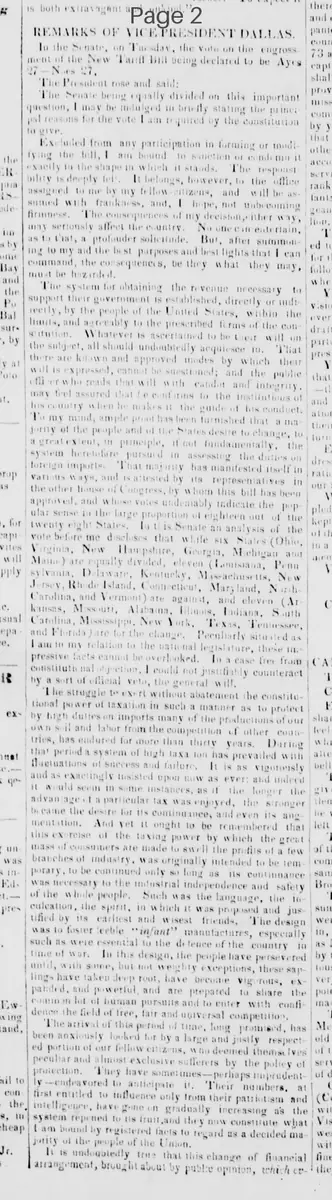
In the Senate, on Tuesday, the vote on the engrossment of the New Tariff bill being declared to be Ayes 27 Nays 27.
The President rose and said:
The Senate being equally divided on this important question, I may be indulged in briefly stating the principal reasons for the vote I am required by the constitution to give.
Excused from any participation in forming or modifying the bill, I am bound to sanction or reject it exactly as the shape in which it stands. The responsibility is deeply felt. It belongs, however, to the office assigned to me by my fellow citizens, and will be assumed with frankness, and, I hope, not unbecoming firmness. The consequences of my decision, either way, may seriously affect the country. No one can estimate as to that, a profounder solicitude. But, after summoning to my aid the best purposes and best lights that I can command, the consequences, be they what they may, must be hazarded.
The system for obtaining the revenue necessary to support their government is established, directly or indirectly, by the people of the United States, within the limits, and agreeably to the prescribed terms of the constitution. Whatever is ascertained to be their will on the subject, all should undoubtedly acquiesce in. That the relative known and approved modes by which their will is expressed, cannot be sustained; and the public faith who reads that will with candor and integrity may feel assured that he errs not in his institutions of his country when he takes it the guide of his conduct.
In my mind, ample proof has been furnished that a majority of the people and of the States desire to change, to a greater or less extent, in principle, if not fundamentally, the system heretofore pursued in assessing the duties on foreign imports. That may has manifested itself in various ways, and is attested by its representatives in the other house of Congress, by whom this bill has been approved, and whose votes undoubtedly indicate the popular sense in the large proportion of eighteen out of the twenty eight States. In this Senate an analysis of the vote before me discloses that while six States (Ohio, Virginia, New Hampshire, Georgia, Michigan and Maine) are equally divided, eleven (Louisiana, Pennsylvania, Delaware, Kentucky, Massachusetts, New Jersey, Rhode Island, Connecticut, Maryland, North Carolina, and Vermont) are against, and eleven (Arkansas, Missouri, Alabama, Illinois, Indiana, South Carolina, Mississippi, New York, Texas, Tennessee and Florida) are for the change. Peculiarly situated as I am in my relation to the national legislature, these impressive facts cannot be overlooked. In a case free from constitutional objection, I could not justly counteract by a sort of ethical veto, the general will.
The struggle to exert without abatement the constitutional power of taxation in such a manner as to protect by high duties on imports many of the productions of our own soil and labor from the competition of other countries, has endured for more than thirty years. During that period a system of high taxation has prevailed with fluctuations of success and failure. It is as vigorously and as exactingly insisted upon now as ever: and indeed it would seem in some instances, as if the longer the advantages of a particular tax was enjoyed, the stronger became the desire for its continuance, and even augmentation. And yet it ought to be remembered that thus exercise of the taxing power by which the great masses of consumers are made to swell the profits of a few branches of industry, was originally intended to be temporary, to be continued only so long as its continuance was necessary to the industrial independence and safety of the whole people. Such was the language, the intention, the spirit, in which it was proposed and justified by its earliest and wisest friends. The design was to foster feeble "infant" manufactures, especially such as were essential to the defence of the country in time of war. In this design, the people have persevered until, with some, but not weighty exceptions, these saplings have taken deep root, have become vigorous, expanded, and powerful and are prepared to share the common lot of human pursuits and to enter with confidence the field of free, fair and universal competition.
The arrival of this period of maturity, long promised, has been anxiously looked for by a large and justly respected portion of our fellow citizens, who deemed themselves peculiar and almost exclusive sufferers by the policy of protection. They have sometimes—perhaps prudently—endeavored to anticipate it. Their numbers, at first entitled to influence only from their patriotic sim and intelligence, have gone on gradually increasing as the system ripened to its fruit, and they now constitute what I am bound by registered facts to regard as a decided majority of the people of the Union.
It is undoubtedly true that this change of financial arrangement, brought about by public opinion, which everywhere ought to guide and influence statesmen, should, nevertheless, be characterized by moderation. By scrupulous tenderness for those interests of our fellow citizens that are to be affected by it. The legislation which encouraged their investments, their educations, training or their habits, should cease, finally and firmly, if required, but still gradually and gently, and hence may be pardoned for expressing a regret that certain provisions which, in their bearing seem to me trenchant and sudden beyond the calls of the occasion, have been allowed to remain as parts of this bill. Were it in my power to except these provisions from the operation of my vote I would do so; but viewed as a whole, as a measure to accomplish moderate a vast and intricate subject to the prevailing sentiment of the American people, to reduce the burdens artificially imposed upon the laboring and productive masses, and to reconcile diminished restriction of trade with increased contributions from it, I cannot resist the impression that the bill is more equal, more tempered, and more just than the act of 1842, which it supersedes. That it deals with some pursuits, and resources of my native Commonwealth less kindly than she might well expect, does not relieve me from my duty, but only makes its performance personally reluctant and painful.
In aid of these considerations, adequate, perhaps in themselves to control my vote, there is another which I am free to confess, nothing but an unforeseen, sheer, and pressing public necessity could ever induce me to forego or forget.—In strict accord with the letter and spirit of the constitution, the Vice President of the United States, now called upon to act, is the direct agent and representative of the whole people—In advance, and dependent upon contingent results, it is perfectly competent to this, his national constituency, to give instruction and to receive pledges for their execution. On this definite subject a tariff of duties on imports, whatever may have been the course of local and casual inconsistency, my own honor can admit of no disclaimer of u-s. Resolutions that were formally announced, and my own good faith stands inviolable to a pledge voluntarily given.
If by thus acting it be my misfortune to offend any portion of those who honored me with their suffrages, I have only to say to them, and to my whole country, that I prefer the deepest obscurity of private life, with an unwounded conscience, to the glare of official eminence, spotted by a stain of moral delinquency.
What sub-type of article is it?
What keywords are associated?
What entities or persons were involved?
Where did it happen?
Domestic News Details
Primary Location
U.S. Senate
Event Date
Tuesday
Key Persons
Outcome
tie vote of 27 ayes to 27 nays; vice president dallas casts deciding vote in favor, allowing engrossment of the new tariff bill.
Event Details
Vice President Dallas delivers remarks justifying his constitutional tie-breaking vote in the Senate for the New Tariff bill, citing majority public and state support for reducing protective tariffs, historical context of the system as temporary aid to industries now mature, need for moderation in changes, and his personal pledges, despite regrets over some provisions affecting his native state.