Thank you for visiting SNEWPapers!
Sign up free
Editorial
November 8, 1836
State Journal
Montpelier, Washington County, Vermont
What is this article about?
An editorial citing the Keeseville Argus lists Martin Van Buren's past votes and actions, such as opposing troop raises, universal suffrage, state canals, and farmer interests, to argue he is an aristocrat unfit for U.S. President.
Clipping
OCR Quality
95%
Excellent
Full Text
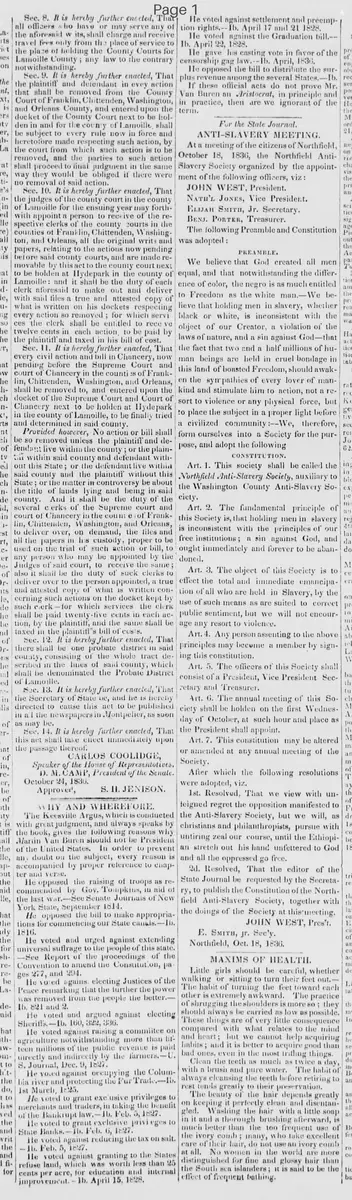
WHY AND WHEREFORE.
The Keeseville Argus, which is conducted with great judgment, and always speaks by the book, gives the following reasons why Martin Van Buren should not be President of the United States. In order to prevent any doubt on the subject, every reason is accompanied by proper reference to chapter and verse.
He opposed the raising of troops as recommended by Gov. Tompkins, in aid of the last war.—See Senate Journals of New York State, September 1814.
He opposed the bill to make appropriations for commencing our State canals.—Ib. 1816.
He voted and urged against extending universal suffrage to the people of this state.—See Report of the proceedings of the Convention to amend the Constitution, pages 277, and 294.
He voted against electing Justices of the Peace remarking that the further the power was removed from the people the better.—Ib. 321 and 2.
He voted and argued against electing Sheriffs.—Ib. 160, 322, 336.
He voted against raising a committee on agriculture notwithstanding more than fifteen millions of the public revenue is paid directly and indirectly by the farmers.—U. S. Journal, Dec. 9, 1827.
He voted against occupying the Columbia river and protecting the Fur Trade.—Ib. 1st March, 1825.
He voted to grant exclusive privileges to merchants and traders, in taking the benefit of the Bankrupt law.—Ib. Feb. 5, 1827.
He voted to grant exclusive privileges to State Banks.—Ib. Feb. 6, 1827.
He voted against reducing the tax on salt. —Ib. Feb. 5, 1827.
He voted against granting to the States refuse land, which was worth less than 25 cents per acre, for education and internal improvement. —Ib. April 15, 1828.
He voted against settlement and preemption rights.—Ib. April 17 and 21 1828.
He voted against the Graduation bill.—Ib. April 22, 1828.
He gave his casting vote in favor of the censorship gag law.—Ib. April, 1836.
He opposed the bill to distribute the surplus revenue among the several States.—Ib.
If these official acts do not prove Mr. Van Buren an Aristocrat, in principle and in practice, then are we ignorant of the term.
The Keeseville Argus, which is conducted with great judgment, and always speaks by the book, gives the following reasons why Martin Van Buren should not be President of the United States. In order to prevent any doubt on the subject, every reason is accompanied by proper reference to chapter and verse.
He opposed the raising of troops as recommended by Gov. Tompkins, in aid of the last war.—See Senate Journals of New York State, September 1814.
He opposed the bill to make appropriations for commencing our State canals.—Ib. 1816.
He voted and urged against extending universal suffrage to the people of this state.—See Report of the proceedings of the Convention to amend the Constitution, pages 277, and 294.
He voted against electing Justices of the Peace remarking that the further the power was removed from the people the better.—Ib. 321 and 2.
He voted and argued against electing Sheriffs.—Ib. 160, 322, 336.
He voted against raising a committee on agriculture notwithstanding more than fifteen millions of the public revenue is paid directly and indirectly by the farmers.—U. S. Journal, Dec. 9, 1827.
He voted against occupying the Columbia river and protecting the Fur Trade.—Ib. 1st March, 1825.
He voted to grant exclusive privileges to merchants and traders, in taking the benefit of the Bankrupt law.—Ib. Feb. 5, 1827.
He voted to grant exclusive privileges to State Banks.—Ib. Feb. 6, 1827.
He voted against reducing the tax on salt. —Ib. Feb. 5, 1827.
He voted against granting to the States refuse land, which was worth less than 25 cents per acre, for education and internal improvement. —Ib. April 15, 1828.
He voted against settlement and preemption rights.—Ib. April 17 and 21 1828.
He voted against the Graduation bill.—Ib. April 22, 1828.
He gave his casting vote in favor of the censorship gag law.—Ib. April, 1836.
He opposed the bill to distribute the surplus revenue among the several States.—Ib.
If these official acts do not prove Mr. Van Buren an Aristocrat, in principle and in practice, then are we ignorant of the term.
What sub-type of article is it?
Partisan Politics
What keywords are associated?
Martin Van Buren
Presidential Opposition
Political Votes
Aristocrat
Universal Suffrage
Agriculture Committee
State Canals
Taxation
What entities or persons were involved?
Martin Van Buren
Keeseville Argus
Gov. Tompkins
Editorial Details
Primary Topic
Opposition To Martin Van Buren As Presidential Candidate
Stance / Tone
Strongly Anti Van Buren, Accusatory Of Aristocracy
Key Figures
Martin Van Buren
Keeseville Argus
Gov. Tompkins
Key Arguments
Opposed Raising Troops For The War Of 1812
Opposed Funding For State Canals
Opposed Universal Suffrage
Opposed Electing Justices Of The Peace
Opposed Electing Sheriffs
Opposed Agriculture Committee
Opposed Columbia River Occupation And Fur Trade Protection
Supported Exclusive Privileges For Merchants In Bankruptcy
Supported Exclusive Privileges For State Banks
Opposed Reducing Salt Tax
Opposed Granting Refuse Land To States For Education
Opposed Settlement And Preemption Rights
Opposed Graduation Bill
Cast Vote For Censorship Gag Law
Opposed Distributing Surplus Revenue To States