Thank you for visiting SNEWPapers!
Sign up free
The Chronicle=News
Trinidad, Las Animas County, Colorado
What is this article about?
Utah archaeological expedition led by Prof. Byron Cummings returned from exploring Snake Valley in western Utah and eastern Nevada, finding glacial reservoirs mistaken for ancient human works, recent indigenous artifacts, natural caverns, and fossil specimens.
Clipping
OCR Quality
Full Text
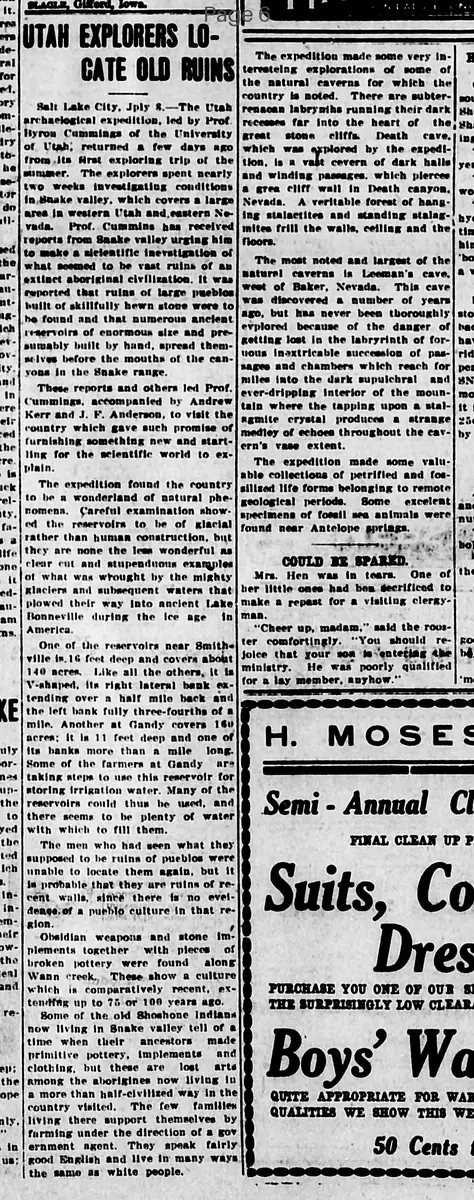
Salt Lake City, July 8.—The Utah archaeological expedition, led by Prof. Byron Cummings of the University of Utah, returned a few days ago from its first exploring trip of the summer.
The explorers spent nearly two weeks investigating conditions in Snake valley, which covers a large area in western Utah and eastern Nevada. Prof. Cummings has received reports from Snake valley urging him to make a scientific investigation of what seemed to be vast ruins of an extinct aboriginal civilization. It was reported ruins large pueblos built of skillfully hewn stone were to be found and that numerous ancient reservoirs of enormous size and presumably built by hand, spread their level floors before the mouths of the canyons in the Snake range.
These reports and others led Prof. Cummings, accompanied by Andrew Kerr and J. F. Anderson, to visit the country which gave such promise of furnishing something new and startling for the scientific world to explain.
The expedition found the country to be a wonderland of natural phenomena. Careful examination showed the reservoirs to be of glacial rather than human construction, but they are none the less wonderful as clear cut and stupendous examples of what was wrought by the mighty glaciers and subsequent waters that plowed their way into ancient Lake Bonneville during the Ice age in America.
One of the reservoirs near Smithville is 16 feet deep and covers about 140 acres. Like all the others, it is V-shaped, its right lateral bank extending over a half mile back and the left bank fully three-fourths of a mile. Another at Gandy covers 160 acres; it is 11 feet deep and one of its banks more than a mile long.
Some of the farmers at Gandy are taking steps to use this reservoir for storing irrigation water. Many of the reservoirs could thus be used, and there seems to be plenty of water with which to fill them.
The men who had seen what they supposed to be ruins of pueblos were unable to locate them again, but it is probable that they are ruins of recent walls, since there is no evidence of a pueblo culture in that region.
Obsidian weapons and stone implements together with pieces of broken pottery were found along Wah creek. These show a culture which is comparatively recent, extending up to 75 or 100 years ago.
Some of the old Shoshone Indians now living in Snake valley tell of a time when their ancestors made primitive pottery, implements and clothing, but these are lost arts among the aborigines now living in a more than half-civilized way in the country visited. The few families living there support themselves by farming under the direction of a government agent. They speak fairly good English and live in many ways the same as white people.
The expedition made some very interesting explorations of some of the natural caverns for which the country is noted. There are subterranean labyrinths running their dark recesses far into the heart of the great stone cliffs. Death cave, which was explored by the expedition, is a vast cavern of dark halls and winding passages, which pierce a great cliff wall in Death canyon, Nevada. A veritable forest of hanging stalactites and upward stalagmites unites to fill the walls, ceilings and the floors.
The most noted and largest of the natural caverns is Looman's cave, west of Baker, Nevada. This cave was discovered a number of years ago, but has never been thoroughly explored because of the danger of getting lost in the labyrinth of tortuous inextricable succession of passages and chambers which reach for miles into the dark, sepulchral and ever-dripping interior of the mountain where the tapping upon a stalactite crystal produces a strange medley of echoes throughout the cavern's vast extent.
The expedition made some valuable collections of petrified and fossilized life forms belonging to remote geological periods. Some excellent specimens of fossil sea animals were found near Antelope Springs.
What sub-type of article is it?
What keywords are associated?
What entities or persons were involved?
Where did it happen?
Domestic News Details
Primary Location
Snake Valley, Western Utah And Eastern Nevada
Event Date
A Few Days Before July 8
Key Persons
Outcome
reservoirs identified as glacial formations; no ancient pueblo ruins found, likely recent walls; obsidian weapons, stone implements, and pottery from 75-100 years ago discovered; natural caverns explored; fossil and petrified specimens collected.
Event Details
The Utah archaeological expedition investigated Snake Valley based on reports of ancient ruins and reservoirs. They determined reservoirs were glacial, explored caverns like Death Cave and Looman's Cave, found recent indigenous artifacts along Wah Creek, and learned from Shoshone Indians about lost traditional arts. Collected fossils near Antelope Springs.