Thank you for visiting SNEWPapers!
Sign up free
Literary
May 31, 1906
The Oakley Eagle
Oakley, Cassia County, Idaho
What is this article about?
In Chapter XVI of 'The Girl at the Halfway House,' Mary Ellen and Aunt Lucy tend to hens at their prairie ranch, chase off prairie dogs, and discuss starting a garden. Amid the monotonous plains, they reflect on Southern contrasts, with Aunt Lucy finding comfort in prayer and guitar-accompanied hymns, highlighting adaptation to frontier life.
Merged-components note: Merging the central image illustration and its caption into the serialized literary story chapter, as they are spatially integrated within the story's layout.
Clipping
OCR Quality
72%
Good
Full Text
THE GIRL AT THE HALFWAY HOUSE
A STORY OF THE PLAINS
BY E. HOUGHTON
AUTHOR OF THE STORY OF THE COWBOY
Copyrighted, 1903, by D. C. NY, New York
CHAPTER XVI.
The Halfway House.
"Miss Mary Ellen," cried Aunt Lucy, thrusting her head in at the door, "oh, Miss Mary Ellen, I wish't you'd come out yer right quick. They's two o' them prairie dogs out yer a-chasin' ouah hens agin—nasty, dirty things!"
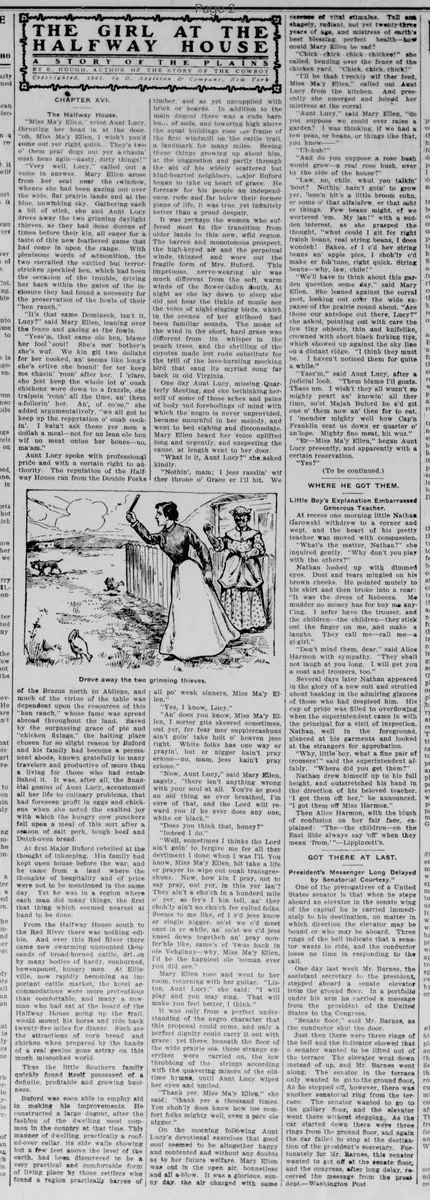
"Very well, Lucy," called out a voice in answer. Mary Ellen arose from her seat near the window, whence she had been gazing out over the wide, flat prairie lands and at the blue, unwinking sky. Gathering each a bit of stick, she and Aunt Lucy drove away the two grinning daylight thieves, as they had done dozens of times before their kin, all eager for a taste of this new feathered game that had come in upon the range. With plenteous words of admonition, the two corralled the excited but terror-stricken speckled hen, which had been the occasion of the trouble, driving her back within the gates of the inclosure they had found a necessity for the preservation of the fowls of their "hen ranch."
"It's that same Dominique, isn't it, Lucy?" said Mary Ellen, leaning over the fence and gazing at the fowls.
"Yess'm, that same ole hen, blame her fool soul! She's mo' bother'n she's wuf. We kin git two dollahs fer her cooked, an' seems like long's she's erlive she bound' fer ter keep me chasin' 'roun' after her. I 'clare, she jest keep the whole lot o' ouah chickens wore down to a frazzle, she traipsin 'roun' all the time, an' them a-follerin' her. An', of co'se," she added argumentatively, "we all got to keep up the reppytation o' ouah cookin'. I kain't ask these yer men a dollah a meal—not fer no lean ole hen wif no meat ontoe her bones—no, ma'am."
Aunt Lucy spoke with professional pride and with a certain right to authority. The reputation of the Halfway House ran from the Double Forks timber, and as yet unsupplied with brick or boards. In addition to the main dugout there was a rude barn built of sods, and towering high above the squat buildings rose the frame of the first windmill on the cattle trail, a landmark for many miles. Seeing these things growing up about him, at the suggestion and partly through the aid of his widely scattered but kind-hearted neighbors, Major Buford began to take on heart of grace. He foresaw for his people an independence, rude and far below their former plane of life, it was true, yet infinitely better than a proud despair.
It was perhaps the women who suffered most in the transition from older lands to this new, wild region. The barren and monotonous prospect, the high-keyed air and the perpetual winds thinned and wore out the fragile form of Mrs. Buford. This impetuous, nerve-wearing air was much different from the soft, warm winds of the flower-laden South. At night as she lay down to sleep she did not hear the tinkle of music nor the voice of night-singing birds, which in the scenes of her girlhood had been familiar sounds. The moan of the wind in the short, hard grass was different from its whisper in the peach trees, and the shrilling of the coyotes made but rude substitute for the trill of the love-bursting mocking bird that sang its myriad song far back in old Virginia.
One day Aunt Lucy, missing Quarterly Meeting, and eke bethinking herself of some of those aches and pains of body and forebodings of mind with which the negro is never unprovided, became mournful in her melody, and went to bed sighing and disconsolate. Mary Ellen heard her voice uplifted long and urgently, and suspecting the cause, at length went to her door.
"What is it, Aunt Lucy?" she asked kindly.
"Nothin', mam; I jess rasslin' wif ther throne o' Grace er l'il bit. We all po' weak sinners, Miss Mary Ellen."
"Yes, I know, Lucy."
"An' does you know, Miss Mary Ellen, I sorter gits skeered sometimes, out yer, fer fear mer supplercashuns ain't goin' take holt o' heaven jess right. White folks has one way er prayin', but er nigger kain't pray erlone—no, mam, jess kain't pray erlone."
"Now, Aunt Lucy," said Mary Ellen, sagely, "there isn't anything wrong with your soul at all. You're as good an old thing as ever breathed, I'm sure of that, and the Lord will reward you if he ever does any one, white or black."
"Does you think that, honey?"
"Indeed I do."
"Well, sometimes I thinks the Lord ain't goin' to fergive me fer all ther devilment I done when I was l'il. You know, Miss Mary Ellen, hit take a life er prayer to wipe out ouah transgreshuns. Now, how kin I pray, not to say pray, out yer, in this yer lan'? They ain't a chu'ch in a hunderd mile o' yer, so fer's I kin tell, an' they shoh'ly ain't no chu'ch fer cullud folks. Seems to me like, ef I c'd jess know er single nigger, so'st we c'd meet onct in er while, an' so'st we c'd jess kneel down togetheh an' pray com-fer'ble llke, same's ef 'twus back in ole Vehginny—why, Miss Mary Ellen, I'd be the happlest ole 'ooman ever you did see."
Mary Ellen rose and went to her room, returning with her guitar. "Listen, Aunt Lucy," she said: "I will play and you may sing. That will make you feel better, I think."
It was only from a perfect understanding of the negro character that this proposal could come, and only a perfect dignity could carry it out with grace; yet there, beneath the floor of the wide prairie sea, these strange exercises were carried on, the low throbbing of the strings according with the quavering minors of the old-time hymns, until Aunt Lucy wiped her eyes and smiled.
"Thank yer, Miss Mary Ellen," she said; "thank yer a thousand times. You shoh'ly does know how toe comfort folks mighty well, even a pore ole nigger."
On the morning following Aunt Lucy's devotional exercises that good soul seemed to be altogether happy and contented and without any doubts as to her future welfare. Mary Ellen was out in the open air, bonnetless and all a-blow. It was a glorious, sunny day, the air charged with some essence of vital stimulus. Tall, shapely, radiant, not yet twenty-three years of age, and mistress of earth's best blessing, perfect health—how could Mary Ellen be sad?
"Chick-chick chick-chickee!" she called, bending over the fence of the chicken yard. "Chick, chick, chick!"
"I'll be thah treckly wif ther feed, Miss Mary Ellen," called out Aunt Lucy from the kitchen.
And presently she emerged and joined her mistress at the corral.
"Aunt Lucy," said Mary Ellen, "do you suppose we could ever raise a garden? I was thinking, if we had a few peas, or beans, or things like that, you know—"
"Uh-huh!"
"And do you suppose a rose bush would grow—a real rose bush, over by the side of the house?"
"Law, no, chile, whut you talkin' 'bout? Nothin' hain't goin' to grow yer, 'less'n hit's a little broom cohn, er some o'that alfalfer, er that soht er things. Few beans might, ef we wortered 'em. My lan!" with a sudden interest, as she grasped the thought, "whut could I git fer right fraish beans, real string beans, I does wondeh! Sakes, ef I c'd hev string beans an' apple pies, I shoh'ly c'd make er foh'tune, right quick. String beans—why, law, chile!"
"We'll have to think about this garden question some day," said Mary Ellen. She leaned against the corral post, looking out over the wide expanse of the prairie round about. "Are those our antelope out there, Lucy?" she asked, pointing out with care the few tiny objects, thin and knifelike, crowned with short black forking tips, which showed up against the sky line on a distant ridge. "I think they must be. I haven't noticed them for quite a while."
"Yass'm," said Aunt Lucy, after a judicial look. "Them blame l'il goats. Thass um. I wish't they all wuzn't so mighty peart an' knowin' all ther time, so'st Majah Buford he c'd git one o'them now an' then fer to eat. I 'member mighty well how Cap'n Franklin sent us down er quarter o' an'lope. Mighty fine meat, hit wuz."
"Er—Miss Mary Ellen," began Aunt Lucy presently, and apparently with a certain reservation.
"Yes?"
(To be continued.)
Drove away the two grinning thieves.
A STORY OF THE PLAINS
BY E. HOUGHTON
AUTHOR OF THE STORY OF THE COWBOY
Copyrighted, 1903, by D. C. NY, New York
CHAPTER XVI.
The Halfway House.
"Miss Mary Ellen," cried Aunt Lucy, thrusting her head in at the door, "oh, Miss Mary Ellen, I wish't you'd come out yer right quick. They's two o' them prairie dogs out yer a-chasin' ouah hens agin—nasty, dirty things!"
"Very well, Lucy," called out a voice in answer. Mary Ellen arose from her seat near the window, whence she had been gazing out over the wide, flat prairie lands and at the blue, unwinking sky. Gathering each a bit of stick, she and Aunt Lucy drove away the two grinning daylight thieves, as they had done dozens of times before their kin, all eager for a taste of this new feathered game that had come in upon the range. With plenteous words of admonition, the two corralled the excited but terror-stricken speckled hen, which had been the occasion of the trouble, driving her back within the gates of the inclosure they had found a necessity for the preservation of the fowls of their "hen ranch."
"It's that same Dominique, isn't it, Lucy?" said Mary Ellen, leaning over the fence and gazing at the fowls.
"Yess'm, that same ole hen, blame her fool soul! She's mo' bother'n she's wuf. We kin git two dollahs fer her cooked, an' seems like long's she's erlive she bound' fer ter keep me chasin' 'roun' after her. I 'clare, she jest keep the whole lot o' ouah chickens wore down to a frazzle, she traipsin 'roun' all the time, an' them a-follerin' her. An', of co'se," she added argumentatively, "we all got to keep up the reppytation o' ouah cookin'. I kain't ask these yer men a dollah a meal—not fer no lean ole hen wif no meat ontoe her bones—no, ma'am."
Aunt Lucy spoke with professional pride and with a certain right to authority. The reputation of the Halfway House ran from the Double Forks timber, and as yet unsupplied with brick or boards. In addition to the main dugout there was a rude barn built of sods, and towering high above the squat buildings rose the frame of the first windmill on the cattle trail, a landmark for many miles. Seeing these things growing up about him, at the suggestion and partly through the aid of his widely scattered but kind-hearted neighbors, Major Buford began to take on heart of grace. He foresaw for his people an independence, rude and far below their former plane of life, it was true, yet infinitely better than a proud despair.
It was perhaps the women who suffered most in the transition from older lands to this new, wild region. The barren and monotonous prospect, the high-keyed air and the perpetual winds thinned and wore out the fragile form of Mrs. Buford. This impetuous, nerve-wearing air was much different from the soft, warm winds of the flower-laden South. At night as she lay down to sleep she did not hear the tinkle of music nor the voice of night-singing birds, which in the scenes of her girlhood had been familiar sounds. The moan of the wind in the short, hard grass was different from its whisper in the peach trees, and the shrilling of the coyotes made but rude substitute for the trill of the love-bursting mocking bird that sang its myriad song far back in old Virginia.
One day Aunt Lucy, missing Quarterly Meeting, and eke bethinking herself of some of those aches and pains of body and forebodings of mind with which the negro is never unprovided, became mournful in her melody, and went to bed sighing and disconsolate. Mary Ellen heard her voice uplifted long and urgently, and suspecting the cause, at length went to her door.
"What is it, Aunt Lucy?" she asked kindly.
"Nothin', mam; I jess rasslin' wif ther throne o' Grace er l'il bit. We all po' weak sinners, Miss Mary Ellen."
"Yes, I know, Lucy."
"An' does you know, Miss Mary Ellen, I sorter gits skeered sometimes, out yer, fer fear mer supplercashuns ain't goin' take holt o' heaven jess right. White folks has one way er prayin', but er nigger kain't pray erlone—no, mam, jess kain't pray erlone."
"Now, Aunt Lucy," said Mary Ellen, sagely, "there isn't anything wrong with your soul at all. You're as good an old thing as ever breathed, I'm sure of that, and the Lord will reward you if he ever does any one, white or black."
"Does you think that, honey?"
"Indeed I do."
"Well, sometimes I thinks the Lord ain't goin' to fergive me fer all ther devilment I done when I was l'il. You know, Miss Mary Ellen, hit take a life er prayer to wipe out ouah transgreshuns. Now, how kin I pray, not to say pray, out yer, in this yer lan'? They ain't a chu'ch in a hunderd mile o' yer, so fer's I kin tell, an' they shoh'ly ain't no chu'ch fer cullud folks. Seems to me like, ef I c'd jess know er single nigger, so'st we c'd meet onct in er while, an' so'st we c'd jess kneel down togetheh an' pray com-fer'ble llke, same's ef 'twus back in ole Vehginny—why, Miss Mary Ellen, I'd be the happlest ole 'ooman ever you did see."
Mary Ellen rose and went to her room, returning with her guitar. "Listen, Aunt Lucy," she said: "I will play and you may sing. That will make you feel better, I think."
It was only from a perfect understanding of the negro character that this proposal could come, and only a perfect dignity could carry it out with grace; yet there, beneath the floor of the wide prairie sea, these strange exercises were carried on, the low throbbing of the strings according with the quavering minors of the old-time hymns, until Aunt Lucy wiped her eyes and smiled.
"Thank yer, Miss Mary Ellen," she said; "thank yer a thousand times. You shoh'ly does know how toe comfort folks mighty well, even a pore ole nigger."
On the morning following Aunt Lucy's devotional exercises that good soul seemed to be altogether happy and contented and without any doubts as to her future welfare. Mary Ellen was out in the open air, bonnetless and all a-blow. It was a glorious, sunny day, the air charged with some essence of vital stimulus. Tall, shapely, radiant, not yet twenty-three years of age, and mistress of earth's best blessing, perfect health—how could Mary Ellen be sad?
"Chick-chick chick-chickee!" she called, bending over the fence of the chicken yard. "Chick, chick, chick!"
"I'll be thah treckly wif ther feed, Miss Mary Ellen," called out Aunt Lucy from the kitchen.
And presently she emerged and joined her mistress at the corral.
"Aunt Lucy," said Mary Ellen, "do you suppose we could ever raise a garden? I was thinking, if we had a few peas, or beans, or things like that, you know—"
"Uh-huh!"
"And do you suppose a rose bush would grow—a real rose bush, over by the side of the house?"
"Law, no, chile, whut you talkin' 'bout? Nothin' hain't goin' to grow yer, 'less'n hit's a little broom cohn, er some o'that alfalfer, er that soht er things. Few beans might, ef we wortered 'em. My lan!" with a sudden interest, as she grasped the thought, "whut could I git fer right fraish beans, real string beans, I does wondeh! Sakes, ef I c'd hev string beans an' apple pies, I shoh'ly c'd make er foh'tune, right quick. String beans—why, law, chile!"
"We'll have to think about this garden question some day," said Mary Ellen. She leaned against the corral post, looking out over the wide expanse of the prairie round about. "Are those our antelope out there, Lucy?" she asked, pointing out with care the few tiny objects, thin and knifelike, crowned with short black forking tips, which showed up against the sky line on a distant ridge. "I think they must be. I haven't noticed them for quite a while."
"Yass'm," said Aunt Lucy, after a judicial look. "Them blame l'il goats. Thass um. I wish't they all wuzn't so mighty peart an' knowin' all ther time, so'st Majah Buford he c'd git one o'them now an' then fer to eat. I 'member mighty well how Cap'n Franklin sent us down er quarter o' an'lope. Mighty fine meat, hit wuz."
"Er—Miss Mary Ellen," began Aunt Lucy presently, and apparently with a certain reservation.
"Yes?"
(To be continued.)
Drove away the two grinning thieves.
What sub-type of article is it?
Prose Fiction
What themes does it cover?
Agriculture Rural
Nature
Religious
What keywords are associated?
Prairie Life
Halfway House
Aunt Lucy
Mary Ellen
Hen Ranch
Frontier Adaptation
Negro Prayer
Southern Contrast
What entities or persons were involved?
By E. Houghton
Literary Details
Title
Chapter Xvi. The Halfway House.
Author
By E. Houghton
Key Lines
"Miss Mary Ellen," Cried Aunt Lucy, Thrusting Her Head In At The Door, "Oh, Miss Mary Ellen, I Wish't You'd Come Out Yer Right Quick. They's Two O' Them Prairie Dogs Out Yer A Chasin' Ouah Hens Agin—Nasty, Dirty Things!"
"An' Does You Know, Miss Mary Ellen, I Sorter Gits Skeered Sometimes, Out Yer, Fer Fear Mer Supplercashuns Ain't Goin' Take Holt O' Heaven Jess Right. White Folks Has One Way Er Prayin', But Er Nigger Kain't Pray Erlone—No, Mam, Jess Kain't Pray Erlone."
Mary Ellen Rose And Went To Her Room, Returning With Her Guitar. "Listen, Aunt Lucy," She Said: "I Will Play And You May Sing. That Will Make You Feel Better, I Think."
"Aunt Lucy," Said Mary Ellen, "Do You Suppose We Could Ever Raise A Garden? I Was Thinking, If We Had A Few Peas, Or Beans, Or Things Like That, You Know—"