Thank you for visiting SNEWPapers!
Sign up free
The New Hampshire Gazette
Portsmouth, Rockingham County, New Hampshire
What is this article about?
Editorial from the National Intelligencer supporting the Embargo Act as a necessary measure to maintain national honor amid crisis, detailing its economic impacts on farmers, merchants, and the public, while arming the government for negotiation. Includes a note on Senate's military augmentation bill.
Merged-components note: These two components form a single continuous article on the Embargo from the National Intelligencer, with sequential reading order and connecting text.
Clipping
OCR Quality
Full Text
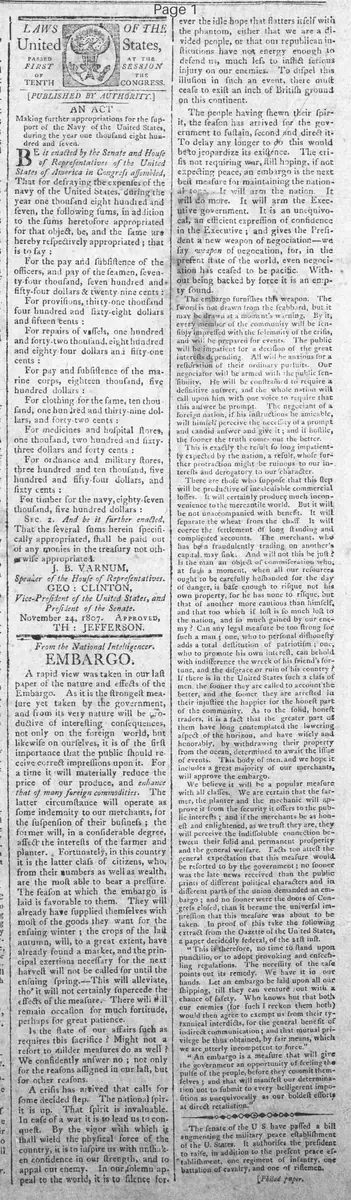
EMBARGO.
A rapid view was taken in our last paper of the nature and effects of the Embargo. As it is the strongest measure yet taken by the government, and from its very nature will be productive of interesting consequences, not only on the foreign world, but likewise on ourselves, it is of the first importance that the public should receive correct impressions upon it. For a time it will materially reduce the price of our produce, and enhance that of many foreign commodities. The latter circumstance will operate as some indemnity to our merchants, for the suspension of their business; the former will, in a considerable degree, affect the interests of the farmer and planter. Fortunately, in this country it is the latter class of citizens, who, from their numbers as well as wealth, are the most able to bear a pressure. The season at which the embargo is laid is favorable to them. They will already have supplied themselves with most of the goods they want for the ensuing winter; the crops of the last autumn, will, to a great extent, have already found a market, and the principal exertions necessary for the next harvest will not be called for until the ensuing spring.—This will alleviate, though it will not certainly supersede the effects of the measure. There will still remain occasion for much fortitude, perhaps for great patience.
Is the state of our affairs such as requires this sacrifice? Might not a resort to milder measures do as well? We confidently answer no; not only for the reasons assigned in our last, but for other reasons.
A crisis has arrived that calls for some decided step. The national spirit is up. That spirit is invaluable. In case of a war it is to lead us to conquest. By the vigor with which it shall wield the physical force of the country, it is to inspire us with unshaken confidence in our strength, and to appal our enemy. In our solemn appeal to the world, it is to silence forever the idle hope that flatters itself with the phantom, either that we are a divided people, or that our republican institutions have not energy enough to defend us, much less to inflict serious injury on our enemies. To dispel this illusion in such an event, there must cease to exist an inch of British ground on this continent.
The people having shewn their spirit, the season has arrived for the government to sustain, second and direct it: To delay any longer to do this would be to jeopardize its existence. The crisis not requiring war, still hoping, if not expecting peace, an embargo is the next best measure for maintaining the national honor. It will arm the nation. It will do more. It will arm the Executive government. It is an unequivocal, an efficient expression of confidence in the Executive; and gives the President a new weapon of negociation—we say weapon of negociation, for, in the present state of the world, even negociation has ceased to be pacific. Without being backed by force it is an empty sound.
The embargo furnishes this weapon. The sword is not drawn from the scabbard, but it may be drawn at a moment's warning. By it; every member of the community will be sensibly impressed with the solemnity of the crisis, and will be prepared for events. The public will be impatient for a decision of the great interests depending All will be anxious for a restoration of their ordinary pursuits. Our negociators will be armed with the public sensibility. He will be constrained to require a definitive answer, and the whole nation will call upon him with one voice to require that this answer be prompt. The negociator of a foreign nation, if his instructions be amicable, will himself perceive the necessity of a prompt and candid answer and give it; and if hostile, the sooner the truth comes out the better.
This is exactly the result so long impatiently expected by the nation, a result, whose further protraction might be ruinous to our interests and derogatory to our character.
There are those who suppose that this step will be productive of incalculable commercial losses. It will certainly produce much inconvenience to the mercantile world. But it will be not unaccompanied with benefit. It will separate the wheat from the chaff. It will coerce the settlement of long standing and complicated accounts. The merchant, who has been fraudulently trading on another's capital, may sink. And will not this be just? Is the man an object of commiseration who; at such a moment, when all our resources ought to be carefully husbanded for the day of danger, is base enough to risk not his own property, for he has none to risk, but that of another more cautious than himself. and that too which if lost is so much lost to the nation, and so much gained by our enemy? Can any legal measure be too strong for such a man; one, who to personal dishonesty adds a total destitution of patriotism; one, who to promote his own interest, can behold with indifference the wreck of his friend's fortune, and the disgrace or ruin of his country?
If there is in the United States such a class of men, the sooner they are called to account the better, and the sooner they are arrested in their injustice the happier for the honest part of the community. As to the solid, honest traders, it is a fact that the greater part of them have long contemplated the lowering aspect of the horizon, and have wisely and honorably, by withdrawing their property from the ocean, determined to await the issue of events. This body of men, and we hope it includes a great majority of our merchants, will approve the embargo.
We believe it will be a popular measure with all classes. We are certain that the farmer, the planter and the mechanic will approve it from the security it offers to the public interests; and if the merchants be as honest and enlightened, as we trust they are, they will perceive the indissoluble connection between their solid and permanent prosperity and the general welfare. Facts too attest the general expectation that this measure would be resorted to by the government; no sooner was the late news received than the public prints of different political characters and in different parts of the union demanded an embargo; and no sooner were the doors of Congress closed, than it became the universal impression that this measure was about to be taken. In proof of this take the following extract from the Gazette of the United States, a paper decidedly federal, of the 21st inst.
"This is therefore, no time to stand upon punctilio, or to adopt provoking and enfeebling regulations. The necessity of the case points out its remedy. We have it in our hands. Let an embargo be laid upon all our shipping, till they can venture out with a chance of safety. Who knows but that both our enemies (for such I reckon them both) would then agree to exempt us from their tyrannical interdicts, for the general benefit of indirect communication; and that mutual privilege be thus obtained, by fair means, which we are utterly incompetent to force."
"An embargo is a measure that will give the government an opportunity of feeling the pulse of the people, before they commit themselves; and that will manifest our determination not to submit to every belligerent imposition as unequivocally as our boldest efforts at direct retaliation."
The Senate of the U S have passed a bill augmenting the military peace establishment of the U. States. It authorizes the president to raise, in addition to the present peace establishment, one regiment of infantry, one battalion of cavalry, and one of riflemen.
What sub-type of article is it?
What themes does it cover?
What keywords are associated?
Where did it happen?
Story Details
Location
United States
Story Details
The editorial argues in favor of the Embargo as a vital step to sustain national spirit, arm the government for negotiation, and prepare for potential war, while addressing economic impacts and weeding out dishonest merchants. It cites public and press support, including from a Federal paper, and notes Senate's passage of a military expansion bill.