Thank you for visiting SNEWPapers!
Sign up free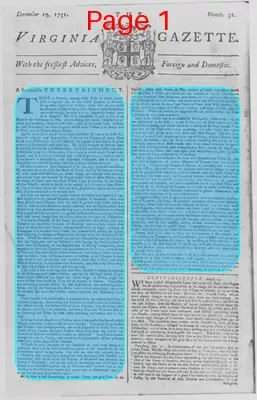
Literary
December 19, 1751
The Virginia Gazette
Richmond, Williamsburg, Richmond County, Virginia
What is this article about?
An essay exploring the universal dread of poverty, contrasting it with other evils, and admonishing the thoughtless and dissolute for their extravagant habits that lead to ruin, emphasizing that true pleasure requires frugality and moderation.
Clipping
OCR Quality
98%
Excellent
Full Text
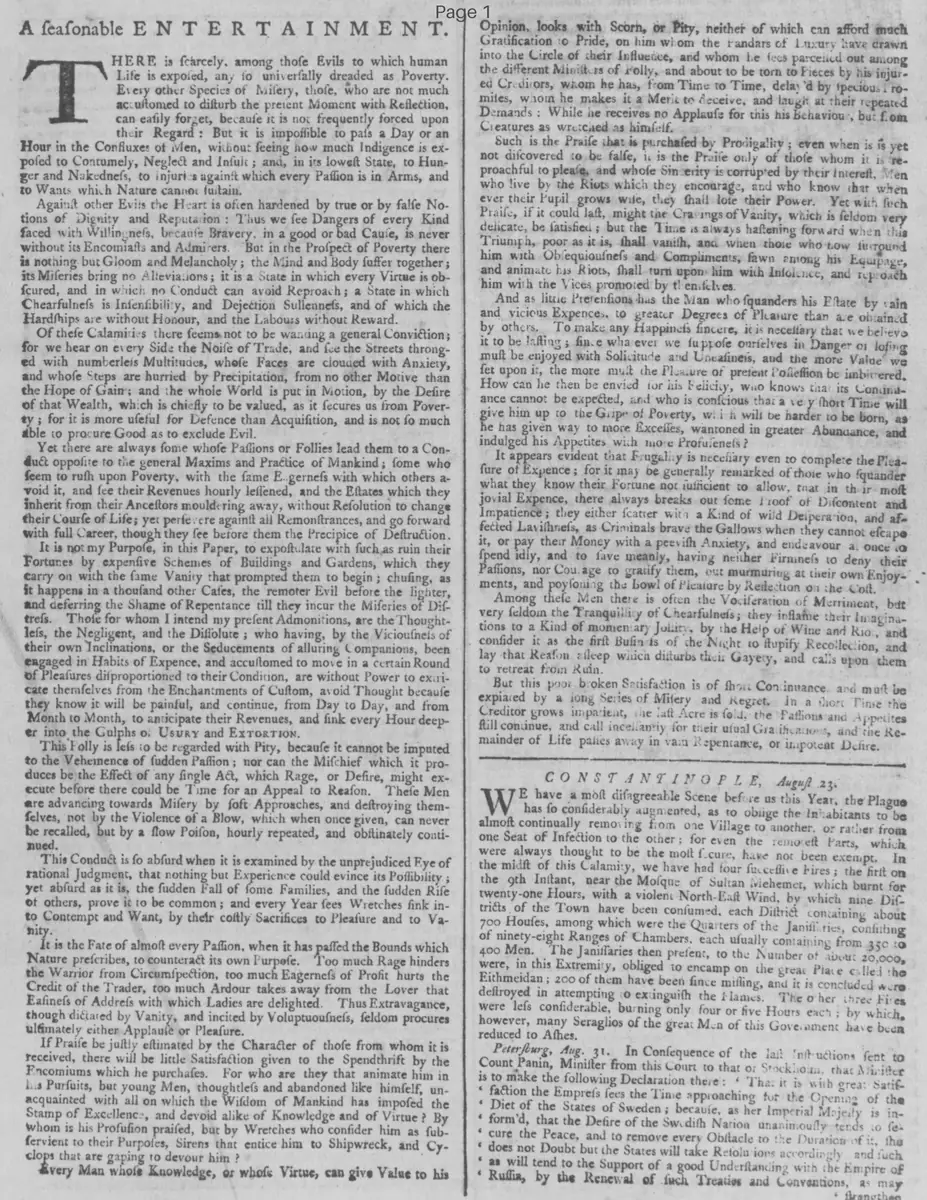
A Seasonable ENTERTAINMENT.
There is scarcely, among those Evils to which human Life is exposed, any so universally dreaded as Poverty. Every other Species of Misery, those, who are not much accustomed to disturb the present Moment with Reflection, can easily forget, because it is not frequently forced upon their Regard: But it is impossible to pass a Day or an Hour in the Confluxes of Men, without seeing how much Indigence is exposed to Contumely, Neglect and Insult; and, in its lowest State, to Hunger and Nakedness, to injuries against which every Passion is in Arms, and to Wants which Nature cannot sustain.
Against other Evils the Heart is often hardened by true or by false Notions of Dignity and Reputation: Thus we see Dangers of every Kind faced with Willingness, because Bravery, in a good or bad Cause, is never without its Encomiasts and Admirers. But in the Prospect of Poverty there is nothing but Gloom and Melancholy; the Mind and Body suffer together; its Miseries bring no Alleviations; it is a State in which every Virtue is obscured, and in which no Conduct can avoid Reproach; a State in which Cheerfulness is Insensibility, and Dejection Sullenness, and of which the Hardships are without Honour, and the Labours without Reward.
Of these Calamities there seems not to be wanting a general Conviction; for we hear on every Side the Noise of Trade, and see the Streets thronged with numberless Multitudes, whose Faces are clouded with Anxiety, and whose Steps are hurried by Precipitation, from no other Motive than the Hope of Gain; and the whole World is put in Motion, by the Desire of that Wealth, which is chiefly to be valued, as it secures us from Poverty; for it is more useful for Defence than Acquisition, and is not so much able to procure Good as to exclude Evil.
Yet there are always some whose Passions or Follies lead them to a Conduct opposite to the general Maxims and Practice of Mankind; some who seem to rush upon Poverty, with the same Eagerness with which others avoid it, and see their Revenues hourly lessened, and the Estates which they inherit from their Ancestors mouldering away, without Resolution to change their Course of Life; yet persevere against all Remonstrances, and go forward with full Career, though they see before them the Precipice of Destruction.
It is not my Purpose, in this Paper, to expostulate with such as ruin their Fortunes by expensive Schemes of Buildings and Gardens, which they carry on with the same Vanity that prompted them to begin; chusing, as it happens in a thousand other Cases, the remoter Evil before the lighter, and deferring the Shame of Repentance till they incur the Miseries of Distress. Those for whom I intend my present Admonitions, are the Thoughtless, the Negligent, and the Dissolute; who having, by the Viciousness of their own Inclinations, or the Seducements of alluring Companions, been engaged in Habits of Expence, and accustomed to move in a certain Round of Pleasures disproportioned to their Condition, are without Power to extricate themselves from the Enchantments of Custom, avoid Thought because they know it will be painful, and continue, from Day to Day, and from Month to Month, to anticipate their Revenues, and sink every Hour deeper into the Gulphs of Usury and Extortion.
This Folly is less to be regarded with Pity, because it cannot be imputed to the Vehemence of sudden Passion; nor can the Mischief which it produces be the Effect of any single Act, which Rage, or Desire, might execute before there could be Time for an Appeal to Reason. These Men are advancing towards Misery by soft Approaches, and destroying themselves, not by the Violence of a Blow, which when once given, can never be recalled, but by a slow Poison, hourly repeated, and obstinately continued.
This Conduct is so absurd when it is examined by the unprejudiced Eye of rational Judgment, that nothing but Experience could evince its Possibility; yet absurd as it is, the sudden Fall of some Families, and the sudden Rise of others, prove it to be common; and every Year sees Wretches sink into Contempt and Want, by their costly Sacrifices to Pleasure and to Vanity.
It is the Fate of almost every Passion, when it has passed the Bounds which Nature prescribes, to counteract its own Purpose. Too much Rage hinders the Warrior from Circumspection, too much Eagerness of Profit hurts the Credit of the Trader, too much Ardour takes away from the Lover that Easiness of Address with which Ladies are delighted. Thus Extravagance, though dictated by Vanity, and incited by Voluptuousness, seldom procures ultimately either Applause or Pleasure.
If Praise be justly estimated by the Character of those from whom it is received, there will be little Satisfaction given to the Spendthrift by the Fracomiuns which he purchases. For who are they that animate him in his Pursuits, but young Men, thoughtless and abandoned like himself, unacquainted with all on which the Wisdom of Mankind has imposed the Stamp of Excellence, and devoid alike of Knowledge and of Virtue? By whom is his Profusion praised, but by Wretches who consider him as subservient to their Purposes, Sirens that entice him to Shipwreck, and Cyclops that are gaping to devour him?
Every Man whose Knowledge, or whose Virtue, can give Value to his Opinion, looks with Scorn, or Pity, neither of which can afford much Gratification to Pride, on him whom the Pandars of Luxury have drawn into the Circle of their Influence, and whom he sees parcelled out among the different Ministers of Folly, and about to be torn to Pieces by his injured Creditors, whom he has, from Time to Time, delayed by specious Promises, whom he makes it a Merit to deceive, and laugh at their repeated Demands: While he receives no Applause for this his Behaviour, but from Creatures as wretched as himself.
Such is the Praise that is purchased by Prodigality; even when it is yet not discovered to be false, it is the Praise only of those whom it is reproachful to please, and whose Sincerity is corrupted by their Interest, Men who live by the Riots which they encourage, and who know that whenever their Pupil grows wise, they shall lose their Power. Yet with such Praise, if it could last, might the Cravings of Vanity, which is seldom very delicate, be satisfied; but the Time is always hastening forward when this Triumph, poor as it is, shall vanish, and when those who now surround him with Obsequiousness and Compliments, fawn among his Equipage, and animate his Riots, shall turn upon him with Insolence, and reproach him with the Vices promoted by themselves.
And as little Pretensions has the Man who squanders his Estate by vain and vicious Expences, to greater Degrees of Pleasure than are obtained by others. To make any Happiness sincere, it is necessary that we believe it to be lasting; in whatever we suppose ourselves in Danger of losing must be enjoyed with Solicitude and Uneasiness, and the more Value we set upon it, the more must the Pleasure of present Possession be imbittered.
How can he then be envied for his Felicity, who knows that its Continuance cannot be expected, and who is conscious that a very short Time will give him up to the Gripes of Poverty, which will be harder to be borne, as he has given way to more Excesses, wantoned in greater Abundance, and indulged his Appetites with more Profuseness?
It appears evident that Frugality is necessary even to complete the Pleasure of Expence; for it may be generally remarked of those who squander what they know their Fortune not sufficient to allow, that in their most jovial Expence, there always breaks out some Proof of Discontent and Impatience; they either scatter with a Kind of wild Desperation, and affected Lavishness, as Criminals brave the Gallows when they cannot escape it, or pay their Money with a peevish Anxiety, and endeavour at once to spend idly, and to save meanly, having neither Firmness to deny their Passions, nor Courage to gratify them, but murmuring at their own Enjoyments, and poisoning the Bowl of Pleasure by Reflection on the Cost.
Among these Men there is often the Vociferation of Merriment, but very seldom the Tranquillity of Cheerfulness; they inflame their Imaginations to a Kind of momentary Jollity, by the Help of Wine and Riot, and consider it as the first Business of the Night to stupify Recollection, and lay that Reason asleep which disturbs their Gayety, and calls upon them to retreat from Ruin.
But this poor broken Satisfaction is of short Continuance and must be expiated by a long Series of Misery and Regret. In a short Time the Creditor grows impatient, the last Acre is sold, the Fashions and Appetites still continue, and call incessantly for their usual Gratifications, and the Remainder of Life passes away in vain Repentance, or impotent Desire.
There is scarcely, among those Evils to which human Life is exposed, any so universally dreaded as Poverty. Every other Species of Misery, those, who are not much accustomed to disturb the present Moment with Reflection, can easily forget, because it is not frequently forced upon their Regard: But it is impossible to pass a Day or an Hour in the Confluxes of Men, without seeing how much Indigence is exposed to Contumely, Neglect and Insult; and, in its lowest State, to Hunger and Nakedness, to injuries against which every Passion is in Arms, and to Wants which Nature cannot sustain.
Against other Evils the Heart is often hardened by true or by false Notions of Dignity and Reputation: Thus we see Dangers of every Kind faced with Willingness, because Bravery, in a good or bad Cause, is never without its Encomiasts and Admirers. But in the Prospect of Poverty there is nothing but Gloom and Melancholy; the Mind and Body suffer together; its Miseries bring no Alleviations; it is a State in which every Virtue is obscured, and in which no Conduct can avoid Reproach; a State in which Cheerfulness is Insensibility, and Dejection Sullenness, and of which the Hardships are without Honour, and the Labours without Reward.
Of these Calamities there seems not to be wanting a general Conviction; for we hear on every Side the Noise of Trade, and see the Streets thronged with numberless Multitudes, whose Faces are clouded with Anxiety, and whose Steps are hurried by Precipitation, from no other Motive than the Hope of Gain; and the whole World is put in Motion, by the Desire of that Wealth, which is chiefly to be valued, as it secures us from Poverty; for it is more useful for Defence than Acquisition, and is not so much able to procure Good as to exclude Evil.
Yet there are always some whose Passions or Follies lead them to a Conduct opposite to the general Maxims and Practice of Mankind; some who seem to rush upon Poverty, with the same Eagerness with which others avoid it, and see their Revenues hourly lessened, and the Estates which they inherit from their Ancestors mouldering away, without Resolution to change their Course of Life; yet persevere against all Remonstrances, and go forward with full Career, though they see before them the Precipice of Destruction.
It is not my Purpose, in this Paper, to expostulate with such as ruin their Fortunes by expensive Schemes of Buildings and Gardens, which they carry on with the same Vanity that prompted them to begin; chusing, as it happens in a thousand other Cases, the remoter Evil before the lighter, and deferring the Shame of Repentance till they incur the Miseries of Distress. Those for whom I intend my present Admonitions, are the Thoughtless, the Negligent, and the Dissolute; who having, by the Viciousness of their own Inclinations, or the Seducements of alluring Companions, been engaged in Habits of Expence, and accustomed to move in a certain Round of Pleasures disproportioned to their Condition, are without Power to extricate themselves from the Enchantments of Custom, avoid Thought because they know it will be painful, and continue, from Day to Day, and from Month to Month, to anticipate their Revenues, and sink every Hour deeper into the Gulphs of Usury and Extortion.
This Folly is less to be regarded with Pity, because it cannot be imputed to the Vehemence of sudden Passion; nor can the Mischief which it produces be the Effect of any single Act, which Rage, or Desire, might execute before there could be Time for an Appeal to Reason. These Men are advancing towards Misery by soft Approaches, and destroying themselves, not by the Violence of a Blow, which when once given, can never be recalled, but by a slow Poison, hourly repeated, and obstinately continued.
This Conduct is so absurd when it is examined by the unprejudiced Eye of rational Judgment, that nothing but Experience could evince its Possibility; yet absurd as it is, the sudden Fall of some Families, and the sudden Rise of others, prove it to be common; and every Year sees Wretches sink into Contempt and Want, by their costly Sacrifices to Pleasure and to Vanity.
It is the Fate of almost every Passion, when it has passed the Bounds which Nature prescribes, to counteract its own Purpose. Too much Rage hinders the Warrior from Circumspection, too much Eagerness of Profit hurts the Credit of the Trader, too much Ardour takes away from the Lover that Easiness of Address with which Ladies are delighted. Thus Extravagance, though dictated by Vanity, and incited by Voluptuousness, seldom procures ultimately either Applause or Pleasure.
If Praise be justly estimated by the Character of those from whom it is received, there will be little Satisfaction given to the Spendthrift by the Fracomiuns which he purchases. For who are they that animate him in his Pursuits, but young Men, thoughtless and abandoned like himself, unacquainted with all on which the Wisdom of Mankind has imposed the Stamp of Excellence, and devoid alike of Knowledge and of Virtue? By whom is his Profusion praised, but by Wretches who consider him as subservient to their Purposes, Sirens that entice him to Shipwreck, and Cyclops that are gaping to devour him?
Every Man whose Knowledge, or whose Virtue, can give Value to his Opinion, looks with Scorn, or Pity, neither of which can afford much Gratification to Pride, on him whom the Pandars of Luxury have drawn into the Circle of their Influence, and whom he sees parcelled out among the different Ministers of Folly, and about to be torn to Pieces by his injured Creditors, whom he has, from Time to Time, delayed by specious Promises, whom he makes it a Merit to deceive, and laugh at their repeated Demands: While he receives no Applause for this his Behaviour, but from Creatures as wretched as himself.
Such is the Praise that is purchased by Prodigality; even when it is yet not discovered to be false, it is the Praise only of those whom it is reproachful to please, and whose Sincerity is corrupted by their Interest, Men who live by the Riots which they encourage, and who know that whenever their Pupil grows wise, they shall lose their Power. Yet with such Praise, if it could last, might the Cravings of Vanity, which is seldom very delicate, be satisfied; but the Time is always hastening forward when this Triumph, poor as it is, shall vanish, and when those who now surround him with Obsequiousness and Compliments, fawn among his Equipage, and animate his Riots, shall turn upon him with Insolence, and reproach him with the Vices promoted by themselves.
And as little Pretensions has the Man who squanders his Estate by vain and vicious Expences, to greater Degrees of Pleasure than are obtained by others. To make any Happiness sincere, it is necessary that we believe it to be lasting; in whatever we suppose ourselves in Danger of losing must be enjoyed with Solicitude and Uneasiness, and the more Value we set upon it, the more must the Pleasure of present Possession be imbittered.
How can he then be envied for his Felicity, who knows that its Continuance cannot be expected, and who is conscious that a very short Time will give him up to the Gripes of Poverty, which will be harder to be borne, as he has given way to more Excesses, wantoned in greater Abundance, and indulged his Appetites with more Profuseness?
It appears evident that Frugality is necessary even to complete the Pleasure of Expence; for it may be generally remarked of those who squander what they know their Fortune not sufficient to allow, that in their most jovial Expence, there always breaks out some Proof of Discontent and Impatience; they either scatter with a Kind of wild Desperation, and affected Lavishness, as Criminals brave the Gallows when they cannot escape it, or pay their Money with a peevish Anxiety, and endeavour at once to spend idly, and to save meanly, having neither Firmness to deny their Passions, nor Courage to gratify them, but murmuring at their own Enjoyments, and poisoning the Bowl of Pleasure by Reflection on the Cost.
Among these Men there is often the Vociferation of Merriment, but very seldom the Tranquillity of Cheerfulness; they inflame their Imaginations to a Kind of momentary Jollity, by the Help of Wine and Riot, and consider it as the first Business of the Night to stupify Recollection, and lay that Reason asleep which disturbs their Gayety, and calls upon them to retreat from Ruin.
But this poor broken Satisfaction is of short Continuance and must be expiated by a long Series of Misery and Regret. In a short Time the Creditor grows impatient, the last Acre is sold, the Fashions and Appetites still continue, and call incessantly for their usual Gratifications, and the Remainder of Life passes away in vain Repentance, or impotent Desire.
What sub-type of article is it?
Essay
Satire
What themes does it cover?
Moral Virtue
Temperance
What keywords are associated?
Poverty
Extravagance
Prodigality
Frugality
Vanity
Misery
Pleasure
Ruin
Literary Details
Title
A Seasonable Entertainment.
Key Lines
There Is Scarcely, Among Those Evils To Which Human Life Is Exposed, Any So Universally Dreaded As Poverty.
But In The Prospect Of Poverty There Is Nothing But Gloom And Melancholy; The Mind And Body Suffer Together; Its Miseries Bring No Alleviations;
Thus Extravagance, Though Dictated By Vanity, And Incited By Voluptuousness, Seldom Procures Ultimately Either Applause Or Pleasure.
It Appears Evident That Frugality Is Necessary Even To Complete The Pleasure Of Expence;
But This Poor Broken Satisfaction Is Of Short Continuance And Must Be Expiated By A Long Series Of Misery And Regret.