Thank you for visiting SNEWPapers!
Sign up free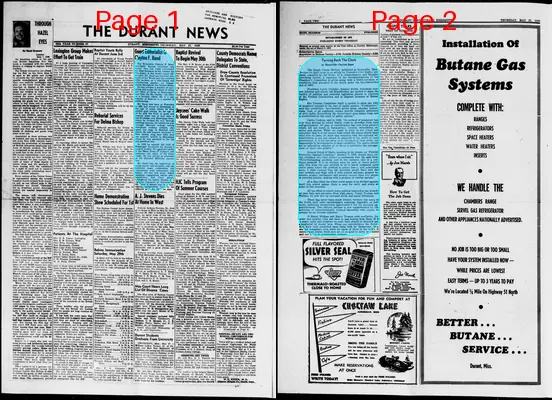
The Durant News
Durant, Holmes County, Mississippi
What is this article about?
Biographical introduction to guest editorialist Clayton F. Rand, followed by his piece 'Turning Back The Clock' critiquing President Truman's civil rights proposals as unconstitutional federal overreach, defending Southern states' rights on race issues, and quoting Republicans like Coolidge and Borah to advocate national unity over sectional strife.
Merged-components note: The introduction to the guest editorialist on page 1 and the actual editorial piece by Clayton F. Rand on page 2 form a single logical editorial component
Clippings
1 of 2
OCR Quality
Full Text
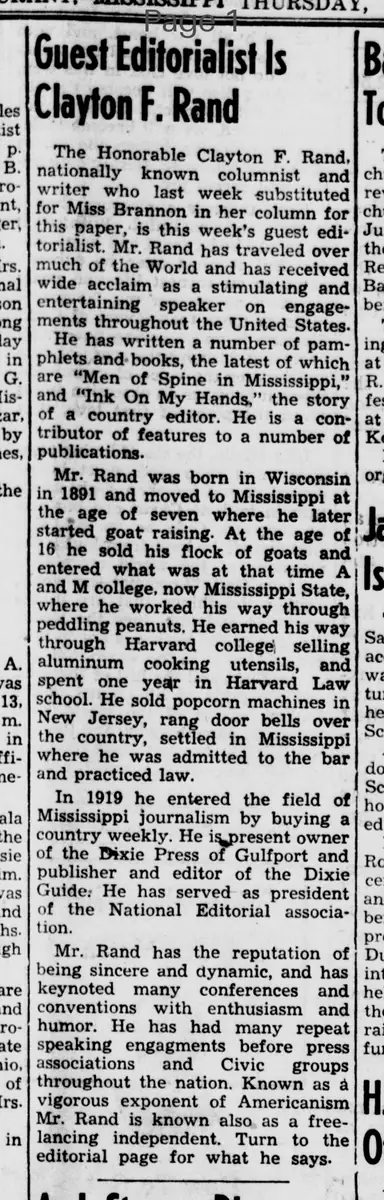
The Honorable Clayton F. Rand, nationally known columnist and writer who last week substituted for Miss Brannon in her column for this paper, is this week's guest editorialist. Mr. Rand has traveled over much of the World and has received wide acclaim as a stimulating and entertaining speaker on engagements throughout the United States. He has written a number of pamphlets and books, the latest of which are "Men of Spine in Mississippi," and "Ink On My Hands," the story of a country editor. He is a contributor of features to a number of publications.
Mr. Rand was born in Wisconsin in 1891 and moved to Mississippi at the age of seven where he later started goat raising. At the age of 16 he sold his flock of goats and entered what was at that time A and M college, now Mississippi State, where he worked his way through peddling peanuts. He earned his way through Harvard college selling aluminum cooking utensils, and spent one year in Harvard Law school. He sold popcorn machines in New Jersey, rang door bells over the country, settled in Mississippi where he was admitted to the bar and practiced law.
In 1919 he entered the field of Mississippi journalism by buying a country weekly. He is present owner of the Dixie Press of Gulfport and publisher and editor of the Dixie Guide: He has served as president of the National Editorial association.
Mr. Rand has the reputation of being sincere and dynamic, and has keynoted many conferences and conventions with enthusiasm and humor. He has had many repeat speaking engagements before press associations and Civic groups throughout the nation. Known as a vigorous exponent of Americanism Mr. Rand is known also as a free-lancing independent. Turn to the editorial page for what he says.
Turning Back The Clock
by Honorable Clayton Rand
The Staple Cotton Review, published in Greenville, Miss., devotes its April issue to an article on Truman's Civil Rights proposal, compiled by Alf Stone. In a comprehensive and thought-provoking review, a summary of the recommendations of the President's Committee is given along with a bird's-eye-view of conditions that prevailed in the South under the Reconstruction Act of 1867.
President Calvin Coolidge, Senator Borah, President Andrew Johnson and others (all Republicans) are quoted to show the futility of political and sectional legislation passed in violation of the Federal Constitution and in flagrant invasion of States' Rights.
The Truman Committee itself is quoted to show the folly of measures imposed in the face of public opinion. "Furthermore," said this committee, "government action alone, whether federal, state, local, or all combined, cannot provide complete protection of civil rights. Everything the Government does stems from and is conditioned by the state of public opinion."
Calvin Coolidge said in 1925. "No method of procedure has ever been devised by which liberty could be divorced from local self-government. No plan of centralization has ever been adopted which did not result in bureaucracy, tyranny, inflexibility, reaction and decline. While we ought to glory in the Union and remember that it is the source from which the states derive their chief title to fame, we must also recognize that the national administration is not and cannot be adjusted to the needs of local government. It is too far away to be informed of local needs, too inaccessible to be responsive to local conditions. The states should not be induced by coercion or by favor to surrender the management of their own affairs."
Senator Borah of Idaho, speaking in the Senate on "Federal Protection Against Lynching," January 7, 1938, should have put this meddling into state affairs to permanent rest. He said then, "Notwithstanding anything said to the contrary, this is a sectional measure. It is an attempt upon the part of states practically free from the race problem to sit in harsh judgment upon sister states where the problem is always heavy, and sometimes acute. I shall contend that the Southern people have met the race problem and dealt with it with greater patience, greater tolerance, greater intelligence and greater success than any people in recorded history, dealing with a problem of similar nature."
At a time when the whole world seems to be divided against itself into armed camps, there is need for unity and peace at home in this Republic.
All too often in recent years political leadership has preached class hate and prejudice from high places. Under Truman and Wallace, we now stir up sectional strife and racial bitterness.
There has never been much friction between the races in the South until some carpetbagger, scalawag, do-gooder, or politically ambitious mountebank aggravated it for his personal aggrandizement. This sinister purpose is now supplemented by the activities of communistically inclined minorities who expect to prosper by an internal upheaval.
If Henry Wallace and Harry Truman seek confusion, disorder and conflict, they can have it, and heaven help them. If it is peace, unity and progress we seek, both should be shunned and shanghaied by decent men. When one contemplates the honors that have been conferred upon them both by Democrats, they are but renegades, even when we speak of them in the terms of extravagant praise. Such men are of no good to party or country and can serve no constructive purpose.
What sub-type of article is it?
What keywords are associated?
What entities or persons were involved?
Editorial Details
Primary Topic
Opposition To Truman's Civil Rights Proposals
Stance / Tone
Strongly Pro States' Rights And Anti Federal Intervention In Racial Matters
Key Figures
Key Arguments